French cut diamonds have a distinctive look that is easy to recognize once you know what to look for. Their square or rectangular outlines, high crowns, and geometric facet patterns give them a vintage character that feels very different from the bright, symmetrical sparkle of a modern round brilliant.
They are especially associated with antique jewelry and Art Deco designs, where their clean geometry works beautifully with structured settings. French cut diamonds are also frequently used as accent stones alongside a larger center diamond.
But what exactly makes a diamond a French cut, and is this unusual cut right for your jewelry?
This French cut diamond guide explains the history, faceting, appearance, sparkle, advantages, drawbacks, and buying considerations you should know before choosing one.
What Is a French Cut Diamond?
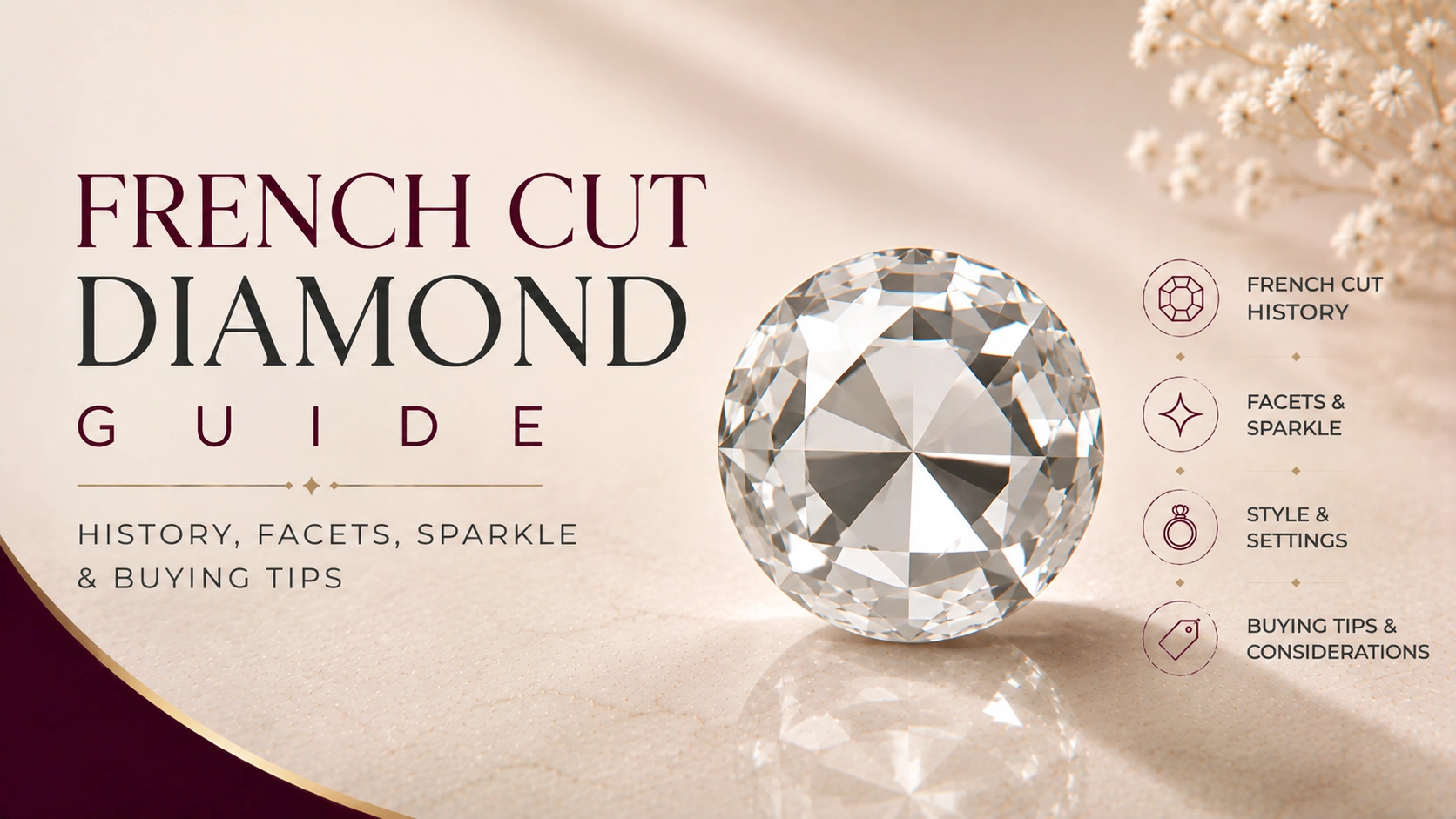
A French cut diamond is an antique-style diamond cut typically characterized by a square or rectangular outline, a relatively high crown, and large angular facets arranged in a distinctive geometric pattern.
One of its most recognizable features is the pattern created across the crown. Depending on the specific stone and cutting style, the facets can create a cross-like or four-pointed-star appearance when viewed from above.
Unlike a modern brilliant cut, which uses many smaller facets to maximize bright, dynamic light return, French cuts rely on fewer and larger facets. This gives them a more structured and understated type of sparkle.
French cuts evolved from early diamond-cutting techniques and became particularly popular among European royalty and aristocracy. They later experienced a major revival during the Art Deco period of the 1920s and 1930s, when their geometric appearance fit the era’s design aesthetic particularly well.
If you want to understand how French cuts fit into the broader world of diamond cutting, a guide to different types of diamond cuts can provide useful context.
What Does a French Cut Diamond Look Like?
From above, a French cut diamond generally has a square or rectangular outline.
The crown is the most visually distinctive part. Rather than displaying the many small facets associated with a modern brilliant cut, French cuts use larger, angular facets that create a bold geometric pattern.
Typical characteristics include:
- Square or rectangular shape
- High crown
- Small table compared with many modern cuts
- Large angular facets
- Distinctive cross or star-like pattern
- Strong geometric appearance
- More subtle light return than a modern brilliant cut
The exact facet arrangement can vary because historical French cut diamonds were not necessarily produced to one standardized modern cutting specification. Some sources describe traditional French cuts as having around 18 to 24 total facets, while other descriptions focus on particular crown and pavilion arrangements.
That variation is part of their appeal. Two vintage French cut diamonds may not look perfectly identical, particularly when they were hand-cut or later modified.
French Cut Diamond Facets Explained
The facets are what give a French cut its personality.
A French cut evolved from earlier table-cut diamonds. As diamond cutters experimented with adding facets to the crown and pavilion, they were able to produce more defined flashes of light while still working with the natural geometry of the rough crystal.
The crown typically contains several large triangular or angular facets arranged around a small table. The pavilion also contains larger facets that help return light through the stone.
Instead of producing the rapid sparkle associated with dozens of smaller facets, these larger surfaces can create broader flashes and a more architectural appearance.
This is why French cut diamonds can look particularly striking in geometric settings. The stone and the mounting often work together as part of the same visual design.
History of French Cut Diamonds
The history of the French cut stretches back several centuries.
Early Development
French cuts developed from early table cuts, an important stage in the history of diamond cutting. Table cuts created a flat surface on the top of a rough diamond, giving cutters more control over the stone’s appearance and interaction with light.
Over time, additional facets were introduced, gradually producing more sophisticated cutting styles.
Sources generally place the early development of the French cut in the 15th or 16th century, although the exact history and naming of the cut are not completely documented.
Popularity Among European Royalty
The cut became associated with European aristocracy and was particularly favored in France.
Importantly, the name does not necessarily mean that the diamonds were invented or exclusively cut in France. The connection appears to be more closely related to the cut’s popularity among French royalty and European jewelry traditions.
The Art Deco Revival
French cut diamonds experienced another surge in popularity during the 1920s and 1930s.
That timing makes sense. Art Deco jewelry favored:
- Geometric shapes
- Symmetry
- Straight lines
- Bold contrasts
- Structured designs
- Platinum and diamond combinations
The angular appearance of French cuts fit naturally into this aesthetic.
Today, French cuts are still strongly associated with antique and Art Deco-inspired jewelry.
How Do French Cut Diamonds Sparkle?
French cut diamonds have a different type of sparkle from modern brilliant cuts.
Their larger, fewer facets tend to create broader and more defined flashes rather than the rapid scintillation associated with a round brilliant.
That doesn’t mean a French cut is necessarily dull. A well-cut stone can show attractive flashes of light, but its optical personality is more restrained and geometric.
Think of the difference as:
Modern brilliant cut: bright, lively, high-scintillation sparkle
French cut: broad, structured, vintage-inspired flashes
This distinction is important when shopping for one. Someone who wants maximum brilliance may prefer a modern brilliant cut, while someone drawn to antique character may appreciate the more unusual light performance of a French cut.
French Cut vs. Brilliant Cut
The biggest difference is the way the two cuts are designed to interact with light.
A modern brilliant cut uses a large number of carefully arranged facets to create intense brightness and scintillation. French cuts use fewer, larger facets and emphasize geometric pattern and broader flashes.
| Feature | French Cut | Modern Brilliant |
|---|---|---|
| Typical outline | Square or rectangular | Often round, but brilliant faceting is used on many shapes |
| Facets | Fewer, larger facets | Many smaller facets |
| Sparkle | Broad, structured flashes | Bright, lively scintillation |
| Style | Vintage, antique, Art Deco | Modern and versatile |
| Common use | Accent stones, vintage jewelry | Center stones and all types of jewelry |
| Appearance | Geometric and distinctive | Bright and highly reflective |
If you’re deciding between different approaches to diamond cutting, you can also compare step-cut and brilliant-cut diamonds for a broader understanding of how faceting changes a stone’s appearance.
French Cut vs. Single Cut
French cuts and single cuts can sometimes be confused because both have historical connections and are commonly seen in smaller accent diamonds.
A single cut is generally much simpler, with fewer facets. French cuts have a more elaborate geometric crown pattern and are typically square or rectangular.
The distinction becomes particularly important when evaluating antique jewelry because terminology can sometimes be used inconsistently, especially for old or modified stones.
For buyers looking specifically for the recognizable French cut appearance, examine the actual facet pattern rather than relying only on the seller’s description.
French Cut vs. Rose Cut
Rose cuts have a fundamentally different construction.
A rose cut generally has a flat or relatively flat base and a domed crown covered with triangular facets. It is known for producing a soft, shimmering glow rather than the sharper flashes associated with French cuts.
French cuts, by contrast, have a more structured crown and pavilion arrangement and are usually square or rectangular.
The two cuts can both create a vintage appearance, but they produce noticeably different visual effects.
If you’re comparing antique-inspired options, you may also want to see how a rose cut compares with a round cut diamond.
French Cut vs. Old Mine Cut
French cuts and old mine cuts are both associated with antique jewelry, but they are quite different.
Old mine cuts are generally squarish or cushion-shaped and are known for their deeper proportions, larger culets, and softer, warmer appearance.
French cuts are more geometric, typically with square or rectangular outlines and angular crown faceting.
The choice often comes down to aesthetic preference:
- Choose French cut for crisp geometry and structured flashes.
- Choose old mine for softer antique proportions and a more rounded, romantic appearance.
Those interested in antique diamond history may also find an old mine vs. old European cut comparison useful when exploring vintage diamond styles.
Are French Cut Diamonds Good for Engagement Rings?
They can be, particularly for someone who values individuality and vintage character over conventional brilliance.
French cut diamonds are less commonly used as large center stones than modern brilliant cuts. Their strongest traditional role has been as accent diamonds, particularly in bands, three-stone designs, and vintage-inspired settings.
That said, a French cut can also serve as a center stone if the design and proportions suit the wearer.
A French cut engagement ring can be a particularly good fit for someone who likes:
- Antique jewelry
- Art Deco design
- Geometric patterns
- Understated sparkle
- Unusual diamond cuts
- Vintage-inspired engagement rings
It may be less suitable for someone who expects the intense brilliance of a modern round brilliant.
French Cut Diamonds as Side Stones
One of the most common uses for French cut diamonds is as accent or side stones.
Their square or rectangular geometry allows them to sit neatly beside a center diamond. They can be arranged in bands, halos, three-stone designs, and other structured settings.
This makes them particularly useful when a designer wants the side stones to look like an intentional part of the overall architecture rather than simply small versions of the center diamond.
French cuts can also work particularly well with emerald cut and other geometric center stones because the shapes complement one another.
Are French Cut Diamonds Rare?
Large, authentic French cut diamonds are relatively uncommon compared with mainstream modern cuts.
Historically, French cuts were often used for smaller stones and accent diamonds. Their connection with antique and Art Deco jewelry also means that many examples found today are vintage stones rather than newly mined diamonds cut specifically as French cuts.
However, rarity should not automatically be interpreted as higher value.
A French cut’s value depends on factors such as:
- Carat weight
- Color
- Clarity
- Cut quality
- Condition
- Provenance
- Whether the stone is antique or newly cut
- Demand for the particular style
For a broader overview of how diamond quality is evaluated, see this guide to the 4Cs of diamond quality.
How to Choose a French Cut Diamond
Buying a French cut requires a slightly different mindset from buying a modern standardized diamond.
1. Look at the Facet Pattern
The facet pattern is a major part of the appeal.
Look for a clear, attractive geometric pattern rather than judging the stone solely by specifications.
2. Check the Symmetry
Symmetry can vary, particularly among antique hand-cut stones.
Some irregularity may be part of the charm of an authentic antique diamond, but excessive asymmetry can affect how attractive the stone looks when mounted.
3. Consider the Light Performance
Don’t expect the same sparkle as a round brilliant.
Instead, look for attractive flashes and a clear, well-defined pattern.
4. Inspect the Clarity
Large facets can make inclusions easier to notice in some stones.
For that reason, clarity deserves attention when buying a French cut, particularly if the diamond will be used as a larger center stone.
You can learn more about how clarity affects diamond appearance in this diamond clarity guide.
5. Consider the Setting
The setting can dramatically change how a French cut looks.
Platinum and white gold can emphasize its crisp, geometric appearance, while yellow gold can create a warmer antique effect.
Channel settings and other structured designs are especially well suited to French cut accent stones.
6. Decide Whether You Want Antique or Newly Cut
An antique French cut can have historical character and handmade variation.
A newly cut French cut may offer greater consistency in shape and proportions.
Neither is automatically better. The right choice depends on whether you prioritize historical authenticity or predictable appearance.
Pros and Cons of French Cut Diamonds
Pros
- Distinctive vintage appearance
- Strong geometric character
- Excellent for Art Deco-inspired jewelry
- Unusual alternative to mainstream diamond cuts
- Works particularly well as an accent stone
- Can complement square and rectangular center diamonds
- Appeals to buyers who prefer subtle sparkle
Cons
- Less brilliant than many modern cuts
- Less common than mainstream diamond cuts
- Large examples can be difficult to find
- Antique examples may have irregular proportions
- Quality can be harder to evaluate using modern cut standards alone
- Not ideal for shoppers seeking maximum scintillation
Are French Cut Diamonds a Good Choice for You?
A French cut diamond is worth considering if you want something that feels different from the typical engagement ring.
Its appeal isn’t based on trying to outperform a modern brilliant cut in brightness. Instead, it offers a combination of history, geometry, craftsmanship, and understated light play.
For a vintage-inspired engagement ring, French cut accent diamonds can be especially compelling. They can add character without overwhelming the center stone.
If you’re still deciding which diamond style suits you best, exploring diamond shapes and diamond cuts can help you compare the visual characteristics of different options.
Explore Our Diamond Cut Guides
Learn about different diamond cuts, their shapes, sparkle, proportions, and unique characteristics before choosing your favorite.
Frequently Asked Questions
What is a French cut diamond?
A French cut diamond is an antique-style cut generally characterized by a square or rectangular outline, a high crown, and large angular facets that create a distinctive geometric pattern.
Are French cut diamonds vintage?
Many French cut diamonds found in antique jewelry are vintage or antique, and the style has strong historical associations with antique and Art Deco jewelry. However, French cut diamonds can also be newly cut today.
Do French cut diamonds sparkle?
Yes. French cut diamonds can show attractive flashes of light, but their sparkle is generally broader and more structured than the rapid scintillation of a modern brilliant cut.
Are French cut diamonds expensive?
There is no fixed price premium simply because a diamond is French cut. Price depends on characteristics such as carat weight, color, clarity, craftsmanship, condition, provenance, and market demand.
Are French cut diamonds good for engagement rings?
Yes, particularly for shoppers who like vintage or Art Deco aesthetics. They are especially common as accent stones, although they can also be used as center stones.
What shape is a French cut diamond?
French cut diamonds are most commonly square or rectangular, although proportions and exact facet arrangements can vary.
Is a French cut the same as a step cut?
Not exactly. French cuts share some geometric characteristics with step-cut styles, but the facet arrangement and overall appearance are distinct. French cuts are particularly recognizable for their angular crown pattern.
Are French cut diamonds rare?
They are less common than mainstream modern cuts, especially in larger sizes. Historically, they were frequently used as smaller accent stones.
Final Takeaway
French cut diamonds offer something that many modern diamond cuts cannot: a strong sense of history and individuality.
Their square or rectangular shape, angular facets, and distinctive geometric pattern make them especially appealing for vintage and Art Deco jewelry. Their sparkle is more restrained than that of a modern brilliant cut, but that is precisely what makes them attractive to people who prefer broader flashes and an understated look.
For an engagement ring, French cuts can work beautifully as accent stones or as a distinctive center stone for someone who wants to move beyond conventional diamond styles.
The best choice ultimately comes down to what you value most. If maximum brilliance is your priority, a modern brilliant cut may be a better fit. If character, history, geometry, and vintage charm matter more, a French cut diamond deserves a closer look.