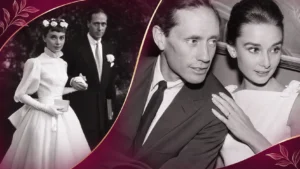
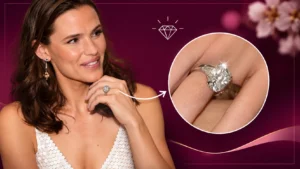
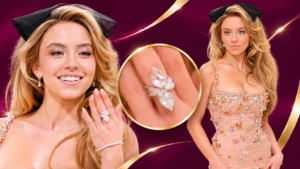
A marquise cut diamond is an elegant choice for anyone who wants an engagement ring with a distinctive silhouette, an elongated appearance, and plenty of visual presence. Its curved sides and pointed ends create a dramatic shape that stands apart from more traditional round diamonds.
But choosing a marquise diamond involves more than finding a carat weight you like. The stone’s proportions, symmetry, sparkle, color, and setting all influence how beautiful it looks and how well it holds up to everyday wear.
This marquise cut diamond guide explains what makes the shape special, its advantages and disadvantages, how to choose the right proportions, and what to look for before buying a marquise engagement ring.
What Is a Marquise Cut Diamond?
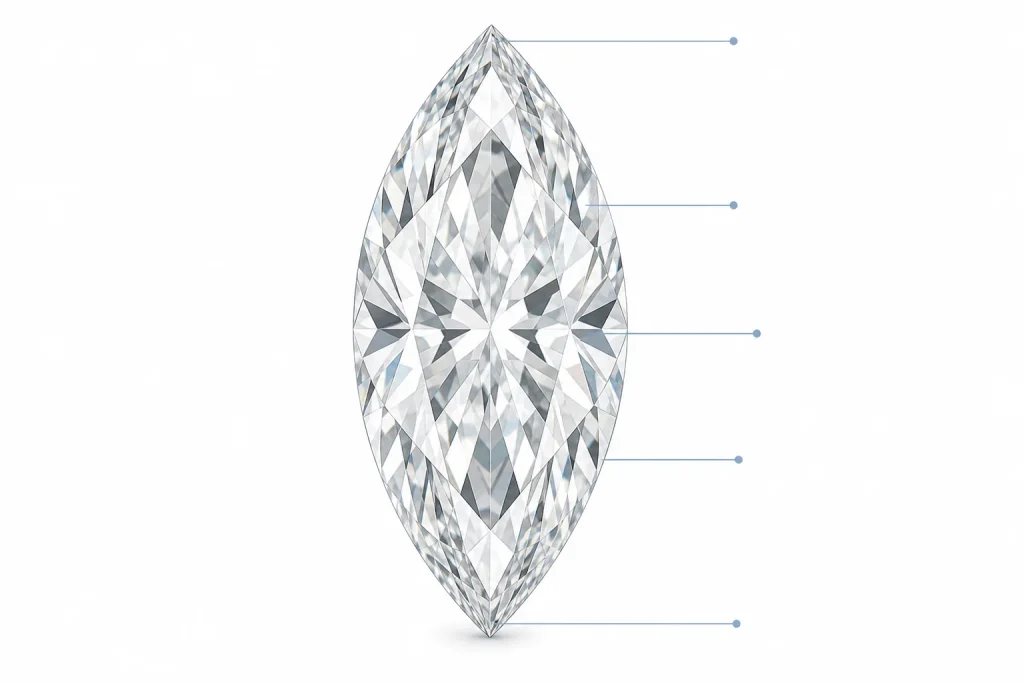
A marquise cut diamond is an elongated, brilliant-style diamond with curved sides and two pointed ends. Its outline resembles a narrow oval or a small boat, creating a distinctive appearance that can make the stone look larger than its carat weight suggests.
The shape is also known as a navette, a French term associated with a small ship. Unlike a round brilliant diamond, which has a circular outline, a marquise diamond stretches lengthwise across the finger.
Marquise diamonds are popular among shoppers who want a combination of vintage-inspired elegance, noticeable finger coverage, and a less conventional engagement ring design.
Key characteristics of a marquise diamond
- Shape: Elongated with two pointed ends.
- Faceting: Typically features a brilliant-style facet pattern designed to return light.
- Appearance: Creates a long, slender silhouette on the finger.
- Visual size: Often appears large for its carat weight because of its elongated spread.
- Durability: The pointed ends require particular attention when selecting a setting.
- Style: Works with classic, modern, minimalist, vintage, and alternative engagement ring designs.
A marquise diamond’s appearance can vary considerably depending on its length-to-width ratio, facet arrangement, and cutting quality. Two diamonds with the same carat weight can look noticeably different when viewed side by side.
A Brief History of the Marquise Cut
The marquise cut is traditionally associated with 18th-century French royalty. According to a popular historical story, King Louis XV commissioned a diamond shape inspired by the smile of his mistress, the Marquise de Pompadour.
Although the story is widely repeated, it is best understood as a historical legend rather than a definitively established account of the cut’s origin.
Over time, the marquise became associated with regal styling, vintage jewelry, and distinctive engagement rings. Its elongated outline continues to appeal to people who want something different from the familiar round or oval shape.
Today, marquise diamonds appear in traditional solitaire rings, diamond halos, three-stone designs, and contemporary east-west settings.
Pros and Cons of Marquise Cut Diamonds
Pros
- Larger Appearance: The elongated shape can make a marquise diamond look larger than other diamond shapes of the same carat weight.
- Elongated Finger Appearance: Its long, slender silhouette creates an elegant, elongated look on the finger.
- Unique Style: The pointed ends and curved sides offer a distinctive alternative to traditional round diamonds.
- Versatile Settings: Marquise diamonds work beautifully with solitaire, halo, three-stone, and east-west engagement ring settings.
- Potential Value: They can offer impressive face-up coverage for their carat weight, depending on the diamond’s proportions and price.
- Elegant Design: Their dramatic silhouette suits classic, vintage-inspired, and modern jewelry styles.
Cons
- Fragile Pointed Ends: The two tips are vulnerable to chipping from hard impacts and benefit from protective settings, such as V-prongs.
- Bow-Tie Effect: Some marquise diamonds display a dark, bow-tie-shaped area across the center that can affect their visual appeal.
- Symmetry Concerns: Uneven sides or misaligned tips can make the diamond look unbalanced.
- Visible Body Color: Color may be more noticeable near the pointed ends in some diamonds.
- Difficult Proportions: Finding the right balance between length, width, symmetry, and sparkle may require comparing several stones.
- Setting Considerations: The shape requires careful setting selection to protect both tips and support everyday wear
Marquise Diamond Size Chart: How Big Does Each Carat Look?

Carat measures a diamond’s weight, not its physical dimensions. A marquise diamond’s length and width determine how much surface area is visible when viewed from above.
The following table provides approximate illustrative dimensions. Individual measurements vary with cutting proportions, so use the actual millimeter measurements when comparing diamonds.
| Carat weight | Approximate length | Approximate width |
|---|---|---|
| 0.50 carat | 7.5 mm | 3.8 mm |
| 0.75 carat | 8.5 mm | 4.3 mm |
| 1.00 carat | 10.0 mm | 5.0 mm |
| 1.50 carats | 11.5 mm | 5.8 mm |
| 2.00 carats | 12.5 mm | 6.3 mm |
| 3.00 carats | 14.5 mm | 7.3 mm |
These measurements are examples, not guaranteed dimensions for every stone of the stated weight.
For a more detailed comparison, use the Marquise Diamond Size Chart to understand how dimensions relate to carat weight.
Does a marquise diamond look bigger than a round diamond?
A marquise diamond often offers more visible length and face-up coverage than a round diamond of the same carat weight. That does not mean every marquise will look larger in every dimension or have better light performance.
For example, a well-proportioned 1-carat marquise may create a longer visual impression than a 1-carat round diamond. However, the round diamond may deliver a more familiar, symmetrical appearance and exceptionally consistent brilliance when well cut.
Compare length, width, face-up appearance, and sparkle together instead of choosing by carat weight alone.
What Is the Ideal Marquise Diamond Length-to-Width Ratio?
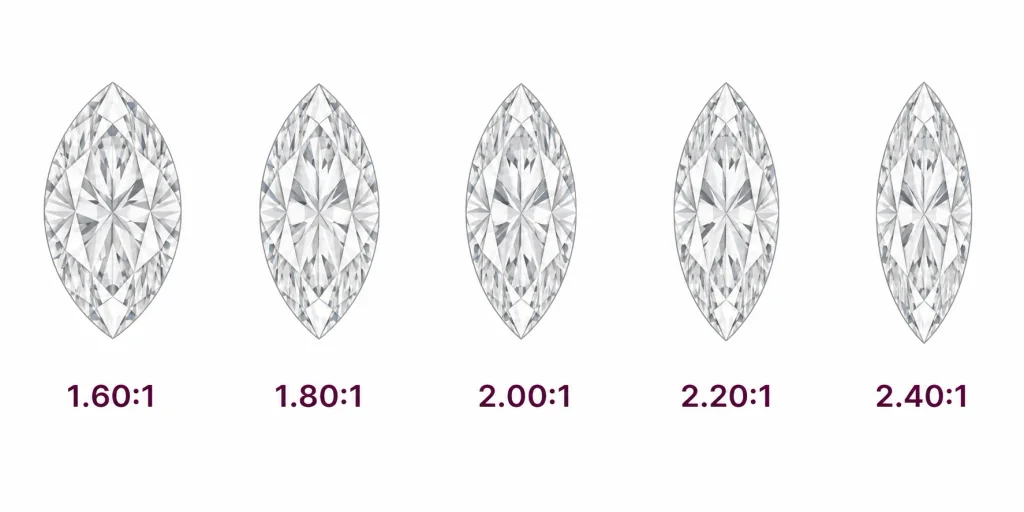
The length-to-width ratio describes how long a diamond is relative to its width. It is calculated by dividing the stone’s length by its width.
For example, a marquise diamond measuring 10 mm long and 5 mm wide has a length-to-width ratio of 2.00:1.
There is no single ratio that suits everyone. The right choice depends on whether you prefer a fuller shape or a long, slender silhouette.
Common marquise diamond ratios
| Length-to-width ratio | General appearance |
|---|---|
| 1.50–1.70:1 | Fuller and broader |
| 1.70–1.90:1 | Moderately elongated |
| 1.90–2.10:1 | Classic, slender marquise appearance |
| 2.10–2.30:1 | Longer and narrower |
| Above 2.30:1 | Particularly elongated |
These are visual style ranges, not universal grading standards. GIA’s guidance identifies approximately 1.75–2.25:1 as a useful range to consider when purchasing fancy-shaped diamonds, but personal preference should guide the final decision.
A lower ratio creates a fuller silhouette, while a higher ratio emphasizes length. Neither is automatically better.
Most importantly, do not judge a diamond by its ratio alone. A beautifully balanced stone with slightly unconventional proportions may be more appealing than one that matches a popular ratio but has poor symmetry or distracting light performance.
How to Evaluate Marquise Diamond Cut Quality and Sparkle
Unlike round brilliant diamonds, marquise diamonds do not receive an overall GIA cut grade. Buyers must therefore evaluate the stone’s proportions, symmetry, polish, and visual performance together.
1. Check the bow-tie effect
The bow-tie effect appears as a darker area resembling a bow tie across the center of an elongated diamond. It results from how light interacts with the stone’s facets and viewing conditions.
A slight bow-tie does not automatically make a diamond poor quality. The important question is whether the dark area is distracting or noticeably reduces the stone’s liveliness.
When reviewing a marquise diamond:
- Look at it face-up under more than one lighting condition.
- Check whether the center remains lively as the diamond moves.
- Watch for a large, persistent dark area.
- Compare multiple stones of similar size and shape.
- Use actual videos or in-person viewing when possible.
Do not rely on a single photograph to assess sparkle. Lighting, camera exposure, and image processing can affect how the diamond appears.
2. Look for balanced symmetry
The two tips should align along the same central axis, and the curved sides should look balanced.
Look for a stone that does not appear twisted, lopsided, or noticeably wider on one side. Symmetry is particularly important for marquise diamonds because even small differences can affect the overall outline.
3. Review the grading report
A grading report from a reputable independent gemological laboratory can help verify a diamond’s reported characteristics.
Review the carat weight, color, clarity, measurements, and available polish and symmetry grades. Confirm that the report corresponds to the diamond being offered.
The report is an important starting point, but it cannot replace an assessment of the actual stone’s visual appearance.
Best Color Grade for a Marquise Diamond
The best color grade depends on your preferred appearance, budget, and ring metal.
The GIA D-to-Z color scale runs from colorless to progressively more noticeable body color. A higher grade generally means less visible color, but the difference between adjacent grades may be difficult to notice without direct comparison.
For marquise diamonds, inspect the pointed ends carefully because color can sometimes be more noticeable there.
Which color grade should you choose?
- D–F: Suitable for shoppers prioritizing a colorless appearance and willing to pay for a higher color grade.
- G–H: Worth comparing for a balance between a bright appearance and budget.
- I–J: May offer additional value for shoppers comfortable with some warmth, depending on the stone and setting.
These are starting points rather than strict requirements. Actual appearance varies by diamond, and the best choice depends on your preferences.
White metals such as platinum and white gold can make warmth easier to notice in some stones. Yellow or rose gold may complement a warmer-looking diamond, but the metal does not change the diamond’s underlying color grade.
For a broader explanation of diamond color and purchasing trade-offs, see the guide to the best diamond color for an engagement ring.
Best Clarity Grade for a Marquise Diamond
Clarity describes the presence of internal inclusions and external blemishes. For marquise diamonds, both the visibility and location of inclusions matter.
The pointed ends deserve particular attention because they are vulnerable to damage, and inclusions in these areas may affect the stone’s durability depending on their type and position.
Is VS2 or SI1 clarity good for a marquise diamond?
VS2 and SI1 diamonds can both be worth considering, but neither guarantees an eye-clean appearance.
An eye-clean diamond has no inclusions readily visible to the unaided eye under ordinary viewing conditions. Whether a stone meets that standard depends on the size, type, location, and contrast of its inclusions, as well as the viewer.
When comparing clarity grades:
- Check the actual stone rather than assuming a grade guarantees eye cleanliness.
- Pay attention to inclusions near either pointed end.
- Ask whether any inclusion affects durability.
- Consider whether the price difference between grades is justified by a visible improvement.
A higher clarity grade is not automatically necessary if a lower-graded diamond looks clean to you and has no concerning durability issues.
Best Settings for Marquise Diamond Engagement Rings
A marquise diamond’s setting affects its appearance, comfort, and protection. Because the tips are exposed areas of concern, the prong arrangement deserves special attention.
1. Solitaire setting
A solitaire places the marquise diamond at the center without a surrounding halo of smaller stones.
It emphasizes the elongated outline and works well for shoppers who prefer a clean, timeless design. Protective prongs should secure both tips.
2. Halo setting
A halo surrounds the center stone with smaller diamonds. It can create a more elaborate appearance and make the center look visually prominent.
Choose a halo that follows the marquise outline closely without making the ring look unbalanced.
3. Three-stone setting
A three-stone ring pairs the marquise center diamond with two side stones. The side stones may be round, pear, half-moon, or other shapes that complement the center.
This setting offers an opportunity to create a distinctive design while maintaining a clear focal point.
4. Bezel setting
A bezel surrounds the diamond’s perimeter with a metal rim. Depending on its construction, a well-designed bezel can offer additional protection for vulnerable areas.
However, the design must fit the marquise outline precisely. Ask the jeweler how both points are secured and whether the setting provides adequate protection without compromising the diamond’s appearance.
5. East-west setting
An east-west setting places the marquise diamond horizontally across the finger rather than vertically along it.
This contemporary orientation creates a wider visual profile and is an appealing alternative to traditional marquise engagement rings.
If you are considering this style, explore the guide to the best diamond shape for an east-west setting.
Why V-prongs matter

V-shaped prongs are designed to cradle the pointed ends of a marquise diamond. They can help reduce the risk of damage by protecting areas that would otherwise be exposed.
The exact design and quality of the setting still matter, and no setting makes a diamond indestructible.
For a closer look at this protective feature, read the guide to V-prongs for marquise diamonds.
Marquise vs. Oval vs. Pear Diamond: Which Should You Choose?
Marquise, oval, and pear diamonds all have elongated outlines, but they create noticeably different looks.
| Feature | Marquise | Oval | Pear |
|---|---|---|---|
| Outline | Two pointed ends | Rounded at both ends | One rounded end and one point |
| Overall style | Dramatic and distinctive | Soft and classic | Elegant and asymmetrical |
| Visual length | Strong elongated effect | Elongated but rounded | Elongated teardrop effect |
| Main durability concern | Both points | No pointed ends | One pointed end |
| Setting considerations | Protect both tips | Secure the stone appropriately | Protect the pointed tip |
| Best for | Bold, elongated styling | A softer, familiar silhouette | A distinctive teardrop look |
A marquise is a strong choice if you want a dramatic outline and prominent finger coverage. An oval may suit you better if you prefer a rounded silhouette without pointed ends. A pear is worth considering if you like an asymmetrical shape with a single point.
There is no universal winner. Compare actual diamonds for symmetry, sparkle, dimensions, and price before deciding.
Read the full comparison of marquise vs. oval vs. pear diamonds for a closer look at these three shapes.
How to Choose the Best Marquise Cut Diamond
Before buying a marquise diamond, use this checklist to narrow your options.
Step 1: Choose your preferred shape ratio
Decide whether you want a broad, fuller marquise or a longer, more slender appearance. Use the ratio as a guide, not a strict quality threshold.
Step 2: Compare actual dimensions
Look at the diamond’s length and width in millimeters. Compare its face-up appearance with other stones of similar carat weight.
Step 3: Evaluate sparkle and bow-tie effect
Review the stone in different lighting conditions, ideally through high-quality video or in person. Avoid stones with a distracting dark center if that bothers you.
Step 4: Inspect symmetry and the tips
Check that the outline looks balanced and both points align. Ask about any inclusions or damage near the tips.
Step 5: Choose color and clarity based on appearance
Set a realistic budget and compare stones directly. A slightly lower color or clarity grade may offer good value when the individual diamond looks attractive and has no concerning durability issues.
Step 6: Prioritize a protective setting
Discuss V-prongs, double-prong designs, or a suitable bezel with your jeweler. Confirm that the setting protects both tips and is appropriate for daily wear.
Step 7: Compare price and documentation
Verify the grading report, measurements, return policy, and any available warranty or maintenance terms. Compare the total price for diamonds with similar dimensions and visual performance rather than relying on carat weight alone.
Step 8: Match the diamond to your lifestyle
If you work frequently with your hands or prefer a low-maintenance ring, consider how the setting’s height, exposed tips, and cleaning requirements fit your routine.
A beautiful marquise diamond should suit both your aesthetic preferences and the way you plan to wear the ring.
Are Marquise Cut Diamonds a Good Choice for Engagement Rings?
Yes, a marquise diamond can be an excellent engagement ring choice for someone who appreciates an elongated silhouette, distinctive styling, and strong visual presence.
It is particularly appealing if you want a center stone that looks different from the traditional round brilliant or offers substantial face-up coverage.
However, it may not be the ideal choice for everyone. Buyers who prefer a shape without pointed ends or want the simplest possible everyday setting may find an oval diamond more suitable.
The best decision comes down to the individual stone. Prioritize balanced proportions, attractive light performance, suitable color and clarity, and a setting that protects the tips.
Frequently Asked Questions
What is the best length-to-width ratio for a marquise diamond?
A length-to-width ratio of around 2:1 is a popular choice for a balanced marquise shape. Ratios between approximately 1.6:1 and 2.2:1 are also common, depending on whether you prefer a shorter, wider outline or a longer, slimmer appearance.
Does a marquise diamond look bigger than a round diamond?
Yes, a marquise diamond can appear larger than a round diamond of the same carat weight because its elongated shape spreads more of its visible surface across the finger. However, the actual face-up dimensions depend on the stone’s proportions, depth, and cutting quality.
What is the bow-tie effect in a marquise diamond?
The bow-tie effect is a dark, bow-shaped shadow that appears across the center of some marquise diamonds. A subtle bow-tie is common, but a prominent, dark pattern can reduce the stone’s visual brightness. Compare diamonds in different lighting conditions before choosing one.
Are marquise cut diamonds more fragile than other diamond shapes?
Marquise diamonds have two pointed tips that are more vulnerable to chipping if struck against a hard surface. A protective setting with V-shaped prongs at both ends can help reduce this risk. Careful handling and regular jewelry inspections also help protect the stone.
How much does a 1-carat marquise diamond measure?
A 1-carat marquise diamond may measure approximately 10 × 5 mm, although dimensions vary with its proportions and depth. When comparing stones of the same carat weight, check the millimeter measurements to understand how much visible surface area each diamond offers.
What should you look for when buying a marquise cut diamond?
When buying a marquise diamond, prioritize balanced symmetry, well-aligned pointed ends, attractive proportions, and a bow-tie effect that is not overly dark. Also review the diamond’s color, clarity, millimeter measurements, and grading report, and ensure the setting protects both tips.
Is a marquise cut diamond a good choice for an engagement ring?
Yes, a marquise cut diamond can be an excellent engagement ring choice if you want a distinctive shape, an elongated look, and strong visual presence. Choose a well-proportioned stone with good symmetry and a secure setting that protects its pointed ends for everyday wear.
Final Words
A marquise cut diamond combines an elongated silhouette, distinctive styling, and the potential for impressive face-up size. It can be an excellent engagement ring choice for shoppers who want something elegant without following the most conventional diamond shape.
The key is to look beyond carat weight. Compare the length-to-width ratio, symmetry, bow-tie effect, color, clarity, and actual dimensions before choosing your stone. Most importantly, select a setting that protects both pointed ends.
When these details work together, a marquise diamond can deliver the appearance, practicality, and personal style you’re looking for in an engagement ring.