Choosing between hidden halo vs solitaire engagement rings can feel surprisingly difficult. From the top, the two styles can look almost identical: one center diamond, a clean band, and a classic engagement-ring silhouette.
The difference appears when you look closer.
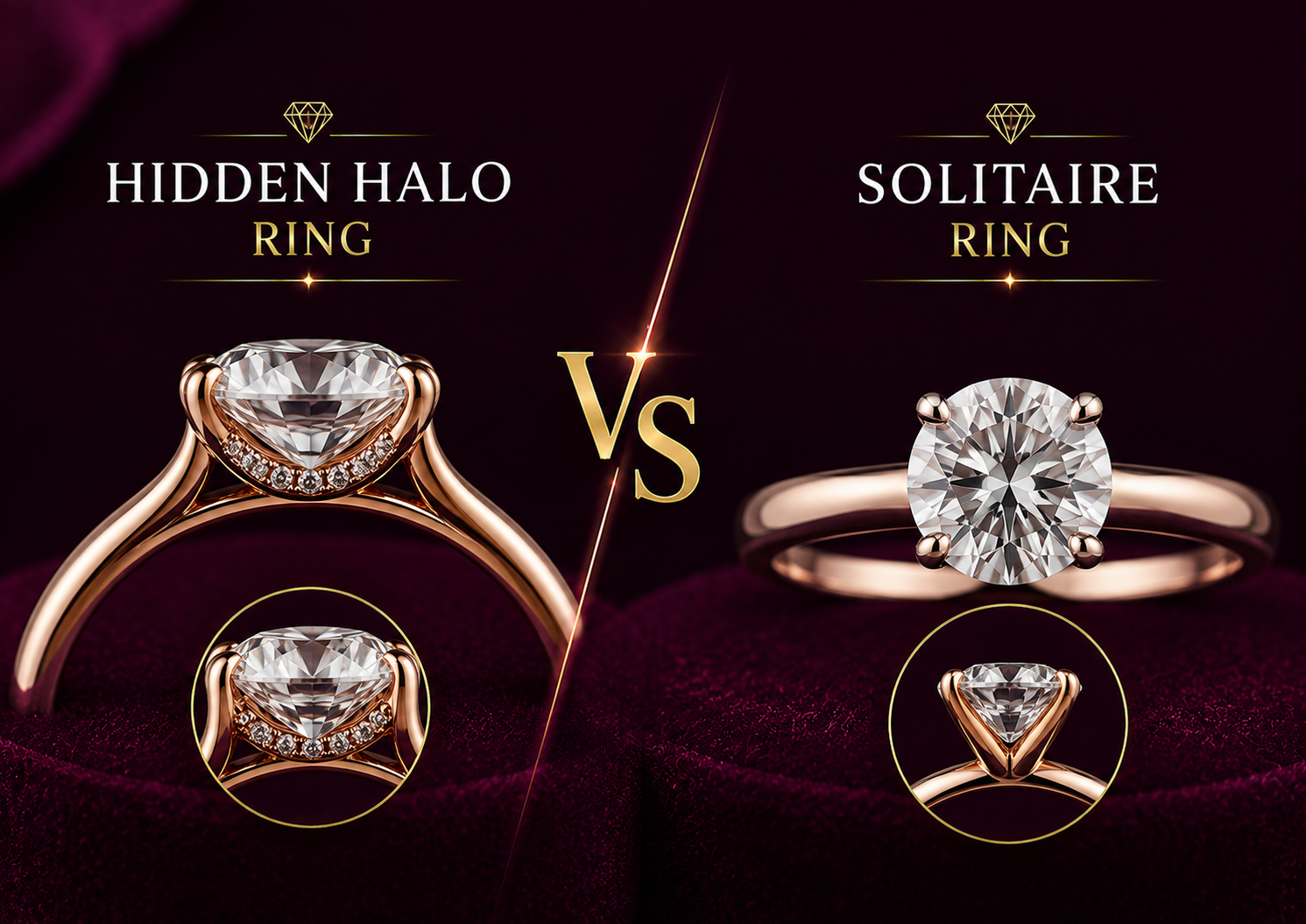
A hidden halo engagement ring places a row of small diamonds beneath the center stone, usually around the gallery or basket. A solitaire engagement ring keeps the center diamond as the only diamond in the setting.
So, hidden halo vs solitaire: which is better?
There is no universal winner. The right choice depends on how much extra sparkle you want, your preferred side profile, your maintenance tolerance, wedding-band plans, budget, and how you expect to wear the ring every day.
Hidden Halo vs Solitaire Engagement Rings: What’s the Difference?
The simplest way to understand the difference is to look at where the diamonds are placed.
A solitaire features one center gemstone as the focal point. GIA defines a solitaire as jewelry with a single diamond, and solitaire engagement rings commonly use prong settings to hold the center stone while keeping much of it visible.
A hidden halo still has one main center stone, but adds a circle of smaller diamonds underneath it. The halo usually remains hidden when you look directly at the ring from above. From the side, however, the extra diamonds become visible.
That gives the hidden halo a little surprise factor.
Think of a solitaire as wearing a beautifully tailored white shirt. A hidden halo is the same shirt with a tiny piece of jewelry hidden under the cuff. Most people will not notice it immediately, but you know it is there.
Hidden Halo vs Solitaire: Quick Comparison
| Feature | Hidden Halo | Solitaire |
|---|---|---|
| Overall look | Classic from the top, detailed from the side | Clean and minimalist |
| Center diamond | Main focal point | Main and only diamond |
| Extra sparkle | Yes, from the hidden diamonds | Primarily from the center stone |
| Side profile | More detailed | Simple |
| Maintenance | Usually requires more attention | Generally simpler |
| Cost | Often higher because of additional diamonds and work | Usually simpler in construction |
| Wedding-band fit | Depends heavily on gallery design | Often easier to pair |
| Style | Modern, romantic, subtly glamorous | Classic, timeless, minimalist |
| Best for | Someone who wants a hidden detail | Someone who wants simplicity |
The important word here is usually. Ring construction varies enormously, so you should compare the actual settings rather than assuming every hidden halo or solitaire behaves the same way.
What Is a Hidden Halo Engagement Ring?
A hidden halo ring features small accent diamonds positioned underneath the center stone rather than surrounding it visibly from the top.
That distinction separates it from a traditional halo.
In a traditional halo, smaller diamonds surround the center stone and form part of the ring’s visible face. GIA notes that halo settings can add sparkle and make the center stone appear larger.
A hidden halo takes a quieter approach.
From the top, you still see the center diamond. Turn your hand slightly, and the hidden diamonds appear around the gallery.
This makes the style particularly appealing if you like the clean appearance of a solitaire but want more detail than a completely plain setting offers.
Hidden Halo Pros and Cons
Pros
- Adds extra diamonds without creating a traditional visible halo.
- Gives the ring more detail from the side.
- Can add sparkle around the gallery.
- Keeps the center diamond as the visual focus.
- Offers a more decorative alternative to a classic solitaire.
Cons
- Additional small diamonds mean additional components to maintain.
- The gallery can become more intricate depending on the design.
- Some designs may affect how a wedding band sits against the engagement ring.
- The extra detail may not be worthwhile if you strongly prefer minimalist jewelry.
The quality of the setting matters just as much as the style name. GIA recommends considering lifestyle when selecting an engagement-ring setting because more intricate or higher-profile designs can be more vulnerable to catching or impact.
What Is a Solitaire Engagement Ring?
A solitaire engagement ring keeps things beautifully simple: one center diamond, supported by the ring’s setting.
That simplicity is exactly why solitaires remain such a popular choice.
GIA describes the solitaire as a classic engagement-ring style that keeps attention on the center diamond. Prong settings can also allow significant light to reach the stone, helping showcase its brilliance.
You can find solitaire rings with four-prong, six-prong, cathedral, bezel and other setting designs.
Because a solitaire can work with many different center stones, your choice of diamond shapes can have a major effect on the final look.
So, a solitaire does not automatically mean one specific ring shape or mounting. It describes the single-center-stone concept.
Solitaire Pros and Cons
Pros
- Clean, timeless appearance.
- Keeps attention firmly on the center diamond.
- Fewer accent stones to maintain.
- Easy to style with different wedding bands.
- Works with many diamond shapes and setting styles.
- A strong choice for minimalist jewelry lovers.
Cons
- Does not provide the extra side sparkle of a hidden halo.
- The visual impact depends heavily on the center diamond and setting.
- Some high-profile solitaire designs can still snag or catch.
GIA specifically recommends considering the wearer’s lifestyle when choosing a setting, particularly for people who are active or regularly work with their hands.
Hidden Halo vs Solitaire: Which Looks Bigger?
This question needs a little clarification.
A hidden halo does not make your center diamond physically larger. When comparing apparent size, it also helps to understand how diamond carat weight relates to a stone’s visible dimensions.
What can change is the overall visual impression.
The additional diamonds beneath the center stone can create more dimension around the gallery. Depending on the design, they may be visible from certain angles and contribute to a fuller appearance.
However, do not confuse this with a traditional halo.
A traditional halo directly surrounds the center stone when viewed from above, which can create a stronger apparent-size effect. GIA confirms that halo settings can make the center stone appear larger.
If your main goal is making the center diamond look larger from the top, focus on the diamond’s shape, proportions, setting and band width rather than assuming a hidden halo will do the job.
Which Has More Sparkle: Hidden Halo or Solitaire?
If we are talking about additional sparkle around the ring, the hidden halo has the advantage because it includes additional diamonds.
But there is an important catch.
Those diamonds sit underneath the center stone. You will not see them as prominently from the top as you would see a traditional halo.
A solitaire can still look incredibly bright because the center diamond’s cut strongly influences how it handles light and produces brilliance. GIA notes that cut and cleanliness play important roles in diamond sparkle, and that prong settings can allow more light into the stone than settings that cover more of it.
So:
Hidden halo: more decorative sparkle from certain angles.
Solitaire: concentrated attention and sparkle from the center diamond.
If you want the center diamond itself to be the star of the show, a solitaire makes a strong case.
Hidden Halo vs Solitaire Price: Which Costs More?
There is no universal price difference.
A hidden halo generally requires additional small diamonds and more setting work, so it can cost more than an otherwise comparable simple solitaire. But the final price depends on the center stone, metal, craftsmanship, accent-diamond quality, setting complexity and brand.
If the center diamond is taking up most of your budget, understanding the 4Cs of diamond quality can help you decide where your money matters most.
That means you should avoid rules such as “a hidden halo always costs X more.”
It does not.
If your budget is limited, compare the complete ring rather than judging the setting alone. A well-chosen solitaire may allow you to put more of your budget into the center diamond.
That can be a very appealing trade-off for someone who cares most about the main stone.
For shoppers comparing different ways to maximize their ring budget, it can also be useful to understand the differences between lab-grown vs natural diamonds.
Hidden Halo vs Solitaire Maintenance: Which Is Easier?
This is one area where simplicity has a genuine advantage.
A solitaire usually has fewer stones and fewer small areas around the setting that need attention. A hidden halo adds additional diamonds and a more detailed gallery, so there are more components to keep clean and inspect.
GIA recommends regular care and notes that diamonds can become loose if their settings are not secure. It also advises avoiding harsh cleaning solutions because they can damage some metals and loosen or weaken settings.
That does not mean a hidden halo is fragile.
It means the design deserves appropriate care.
If you choose a hidden halo, pay attention to the security of the small stones and have the setting checked periodically by a qualified jeweler.
If you want the easiest possible ring to clean and inspect, a simple solitaire has an advantage.
Hidden Halo vs Solitaire Wedding Band: Which Fits Better?
Your wedding band deserves attention before you buy the engagement ring.
A solitaire often gives you more freedom because the area around the center stone can be relatively open. Many solitaire designs allow a wedding band to sit close to the engagement ring.
A hidden halo can also pair beautifully with a wedding band, but the gallery structure matters.
If the hidden halo or basket extends downward, the wedding band may not sit completely flush against the engagement ring.
That is not necessarily a problem.
Some couples prefer a small intentional gap. Others want the two rings to sit tightly together.
If having the two rings sit closely together is important to you, it is worth understanding the difference between a flush-fit engagement ring and a non-flush design before choosing your setting.
If you are planning to wear multiple rings together, your engagement ring’s height, profile and band shape can also affect how comfortable the ring stack feels.
The safest approach is to show your jeweler the wedding-band style you have in mind before finalizing the engagement ring. The height of the center stone, gallery, prongs and band all influence the final fit.
Hidden Halo vs Solitaire for Everyday Wear
Neither style automatically wins for everyday wear.
The specific construction matters more than the label.
GIA recommends choosing a setting based partly on lifestyle. People with active lifestyles may benefit from lower-profile or more secure settings that are less likely to catch on objects.
For a hidden halo, look closely at:
- How securely the small diamonds are set
- Whether the gallery feels sturdy
- The overall height of the center stone
- How the wedding band will fit
- How comfortable the ring feels on your hand
A proper fit matters just as much as the setting itself, so use an engagement ring size guide before finalizing your ring size.
For a solitaire, consider:
- Four or six prongs
- The height of the center stone
- Whether the prongs feel secure
- The shape of the center diamond
- Whether the setting suits your daily routine
Your ring should also feel secure without being uncomfortably tight; this guide explains how an engagement ring should fit.
GIA notes that six-prong settings can provide additional protection compared with four-prong designs, although both can be secure when properly designed and maintained.
Who Should Choose a Hidden Halo?
A hidden halo engagement ring may suit you if you want:
- A classic look with a little extra personality
- More sparkle from the side
- A detailed gallery
- A subtle romantic touch
- Something more decorative than a plain solitaire
- A ring that looks understated from above but interesting from other angles
It is especially attractive if you keep thinking, “I love solitaires, but I want just a little something extra.”
That is basically the hidden halo’s job description.
Who Should Choose a Solitaire?
A solitaire engagement ring may be the better choice if you want:
- A timeless design
- Minimalist styling
- Maximum focus on the center diamond
- Simpler maintenance
- Flexible wedding-band pairing
- A setting that will not compete with the diamond
A solitaire also makes sense if you would rather spend more of your ring budget on the center stone instead of additional accent diamonds and setting details.
If the center diamond is your main priority, it is worth learning how diamond cut and overall quality affect its appearance before allocating more of your budget to the stone.
For many buyers, that simplicity is not boring. It is the entire point.
Hidden Halo vs Solitaire: Which One Is Right for You?
When comparing hidden halo vs solitaire engagement rings, do not ask which style is objectively better.
Ask which features matter most to you.
Choose a hidden halo if you love the clean appearance of a solitaire but want extra detail and sparkle from the side.
Choose a solitaire if you want a classic engagement ring where the center diamond gets all the attention.
And if you are stuck between the two, look at the rings from three angles: straight from the top, from the side, and on your hand with a wedding band beside it.
The right ring often becomes obvious once you stop looking at product photos and start thinking about how you will actually wear it.
Frequently Asked Questions
Is a hidden halo better than a solitaire?
Not necessarily. A hidden halo offers additional detail and side sparkle, while a solitaire provides a simpler design and keeps the focus on the center diamond. The better option depends on your style, budget, maintenance preferences and wedding-band plans.
Does a hidden halo make a diamond look bigger?
A hidden halo can add dimension and visual interest around the center stone, but it does not increase the actual size of the diamond. A traditional visible halo generally creates a stronger apparent-size effect because the smaller diamonds surround the center stone when viewed from above.
Which has more sparkle, hidden halo or solitaire?
A hidden halo adds additional diamonds, so it can create more sparkle around the gallery and from side angles. A solitaire concentrates the visual attention on the center diamond, whose sparkle depends heavily on its cut, setting and cleanliness.
Is a hidden halo more expensive than a solitaire?
It can be, because a hidden halo adds small diamonds and additional setting work. However, there is no fixed price difference. The center diamond, metal, craftsmanship and design complexity all affect the final price.
Is a hidden halo harder to maintain?
Generally, a hidden halo has more small stones and setting details than a simple solitaire, so it can require more attention during cleaning and inspection. GIA recommends checking ring settings and avoiding harsh cleaning products that may damage metals or loosen settings.
Can you wear a wedding band with a hidden halo?
Yes. A hidden halo can pair beautifully with a wedding band. However, the gallery design and center-stone height determine whether the bands sit flush. Check the fit before purchasing if a close-fitting stack is important to you.
Is a solitaire engagement ring timeless?
A solitaire has a long-standing place in engagement-ring design because its simple construction keeps attention on the center stone. GIA describes the solitaire as a classic engagement-ring choice.
Should I choose a hidden halo or solitaire?
Choose a hidden halo if you want understated sparkle and extra detail from the side. Choose a solitaire if you prefer simplicity, easy styling and a strong focus on the center diamond.
Final Verdict
The hidden halo vs solitaire decision really comes down to one question: do you want your ring to whisper or add a little secret sparkle?
A solitaire keeps everything focused on the center diamond. A hidden halo keeps that same clean top view while adding a detail you notice when you look closer.
Neither is the wrong choice.
Choose the design that fits your style, your lifestyle and the way you want your engagement ring to feel every time you look down at your hand.