You found an engagement ring you love. Then someone asks, “What wedding band will you wear with it?”
Suddenly, there is homework.
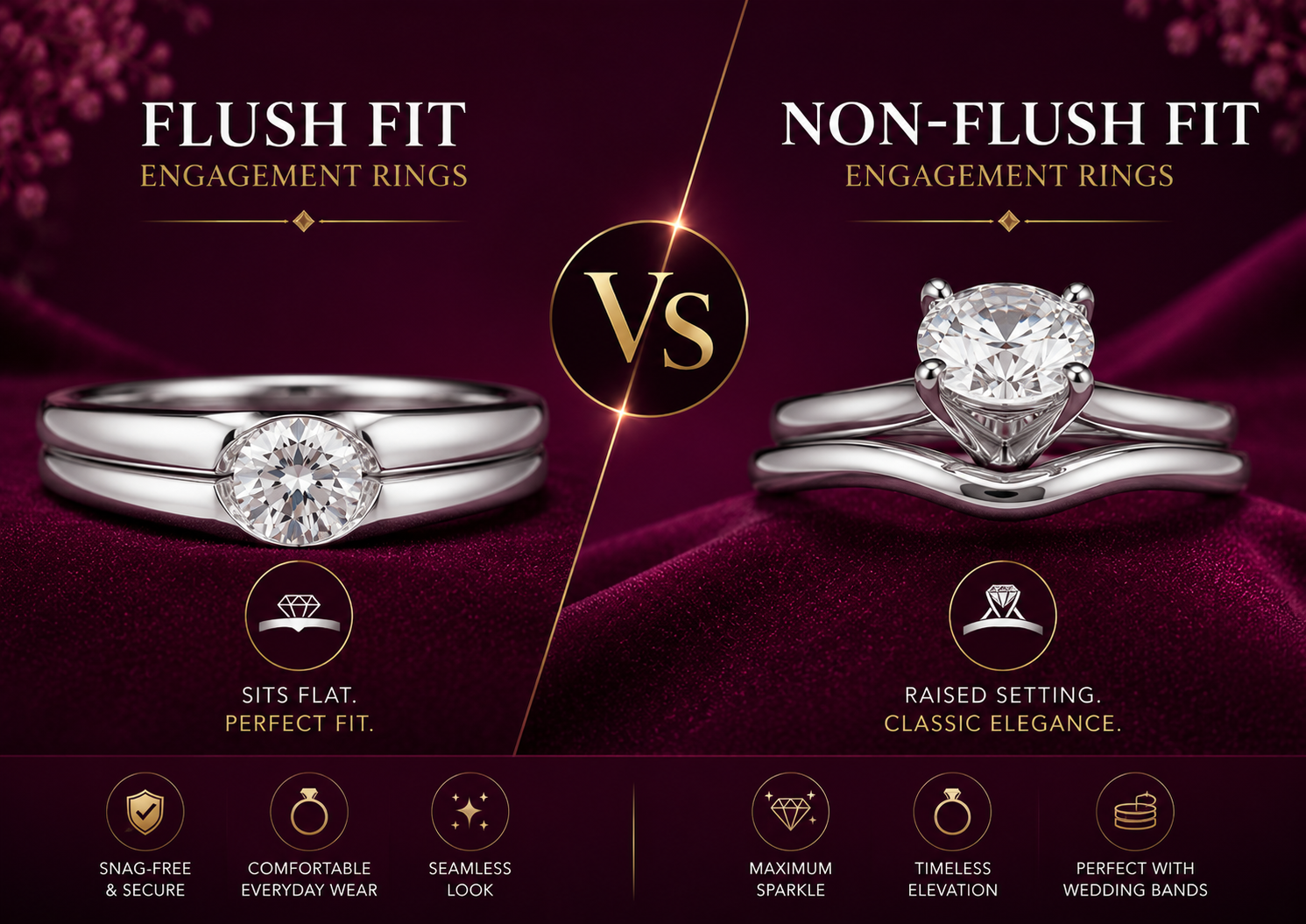
One detail that many buyers overlook is whether the engagement ring will allow a wedding band to sit flush beside it. Some settings leave enough room for a straight wedding band. Others create a visible gap because the center setting extends into the band’s path.
That is the basic difference between flush fit vs. non-flush fit engagement rings.
Neither option is automatically better. The right choice depends on the look you want, your preferred ring profile, the wedding band you plan to wear, and how you want your finished ring stack to feel.
Let’s make the difference easy to understand.
What Is a Flush Fit Engagement Ring?
A flush fit engagement ring is designed with enough clearance for a compatible wedding band, often a straight band, to sit closely beside the engagement ring without an unwanted visible gap.
Think of it like two puzzle pieces with unusually good manners: neither one gets in the other’s way.
The important part is the architecture underneath the center stone.
A ring generally needs sufficient gallery height and bridge clearance so the wedding band can approach the engagement ring without hitting the basket, halo, prongs, or another part of the setting.
Current jewelry guidance similarly describes flush fit as an architectural issue rather than simply the name of a setting.
A typical flush-fit design may have:
- Enough clearance beneath the center setting
- A basket that does not extend too far toward the finger
- A bridge that allows room for the wedding band
- A relatively high-profile engagement ring setting
- A shank and gallery designed with ring stacking in mind
This arrangement can create the clean appearance of an engagement ring with a flush wedding band.
What Is a Non-Flush Fit Engagement Ring?
A non-flush fit engagement ring has part of its setting positioned where a straight wedding band would otherwise sit.
The obstruction might be a low basket, halo, wide base, decorative gallery, side stones, or another structural element.
As a result, placing a straight wedding band next to the engagement ring can leave visible negative space between the two rings. This is usually a consequence of the design rather than a manufacturing defect.
And importantly:
A gap is not automatically a problem.
Some people intentionally prefer the separation because it gives each ring its own visual identity.
If you want a no-gap appearance with a non-flush engagement ring, a curved wedding band, contour wedding band, open band, notched band, or custom-designed band may offer a better match.
Flush Fit vs. Non-Flush Fit Rings at a Glance
| Feature | Flush Fit | Non-Flush Fit |
|---|---|---|
| Straight wedding band compatibility | Often easier | May leave a gap |
| Ring profile | Often higher | Frequently lower |
| Visible gap | Usually minimal with a compatible band | Often present with a straight band |
| Wedding band choices | More straight-band options | May require curved, contour or custom styles |
| Overall appearance | Seamless, continuous stack | Defined separation between rings |
| Low-profile options | More limited | Often easier to achieve |
| Best for | Flexible stacking | Low-set or distinctive designs |
These are general tendencies, not universal rules. The exact dimensions of both rings determine whether they will actually sit flush.
Why Doesn’t My Wedding Band Sit Flush?
If your wedding band leaves a gap, look underneath the center stone before blaming the band.
A straight wedding band needs a clear path beside the engagement ring. If part of the engagement ring occupies that space, the two rings physically cannot sit together.
Common causes include:
1. Low Basket Setting
A basket setting supports the center stone with a framework of metal. When that basket sits close to the finger, its lower section may block a straight wedding band.
This is one of the most common reasons for an engagement ring gap with a wedding band.
2. Wide Setting Base
A wide base or bridge can extend beyond the engagement ring’s shank.
Even a few structural differences can affect compatibility, which is why looking at the ring from the side can tell you more about flush fit than looking at it from the top.
3. Halo or Hidden Halo
A halo or hidden halo can change the dimensions underneath the center stone.
A hidden halo flush fit design is certainly possible, but “hidden halo” does not automatically mean “flush fit.”
The deciding factor remains clearance.
4. Side Stones
Three-stone rings and elaborate side-stone designs can extend toward the wedding band.
In these situations, a contour or custom wedding band may provide a better fit than a straight band.
Flush Fit vs. Low-Profile Engagement Rings
This is where buyers sometimes get confused.
Low profile describes how close the ring’s center setting sits to the finger.
Flush fit describes how well the engagement ring accommodates the wedding band.
They are related, but they are not synonyms.
A low-profile ring may feel less elevated on the finger, but its basket can occupy the exact space a straight wedding band needs.
A higher-profile ring generally provides more room beneath the center setting. GIA, for example, notes that prong solitaire settings can suspend a stone above the band, while cathedral settings use rising shoulders around the center stone.
So when comparing low profile vs. high profile engagement rings, consider both everyday wear and future wedding-band compatibility.
Cathedral vs. Flush Fit Engagement Ring: Are Cathedral Settings Better?
Not automatically.
A cathedral setting has shoulders that rise toward the center stone, creating the architectural arches that give the style its name.
Many cathedral engagement rings can provide enough clearance for a straight wedding band.
But the word cathedral alone doesn’t guarantee anything.
The basket can still sit too low or extend too far outward.
So instead of asking only:
“Is this a cathedral setting?”
Ask your jeweler:
“Will my preferred wedding band clear the basket and bridge and sit flush against this ring?”
Much better question. Much fewer wedding-band surprises.
Basket Setting vs. Cathedral Setting
A basket setting and cathedral setting describe different parts or characteristics of ring construction, so the terms should not always be treated as opposites.
A basket refers to the structure holding the center stone.
A cathedral design refers to the way the shoulders rise toward and visually support the center setting.
You can therefore encounter designs incorporating characteristics of both.
For flush-fit purposes, inspect the entire side profile rather than relying on the product name.
Peg Head vs. Cathedral Setting
A peg-head style setting places the center setting above the shank, which can create useful space underneath it.
A cathedral design uses rising shoulders to integrate the center setting more closely into the ring’s profile.
Either design can potentially create an engagement ring that sits flush with a wedding band.
What matters is whether the finished design leaves enough usable clearance for the actual wedding band you plan to wear.
Can Every Engagement Ring Sit Flush?
No.
At least, not with every straight wedding band.
Low baskets, wide galleries, halos, side stones and decorative elements can prevent a conventional straight band from reaching the engagement ring.
That does not mean you need to replace your engagement ring.
You have alternatives.
Choose a Curved or Contour Wedding Band
A curved wedding band for an engagement ring follows the outline of the center setting instead of trying to pass underneath it.
Contour bands are specifically designed to nest around engagement rings.
This can create a much tighter visual fit.
The trade-off?
A strongly curved band may look more unusual when worn by itself.
Consider an Open or Notched Band
An open or specially notched wedding band can provide space around a low or wide center setting.
This approach can be particularly useful when the engagement ring’s architecture makes a traditional straight band impractical.
Have a Custom Wedding Band Made
If your engagement ring has an unusual gallery, halo, side stones, or distinctive proportions, a jeweler can design a custom flush fit wedding band around its actual measurements.
For custom engagement rings, planning both rings together from the beginning is even better.
Use a Spacer Band When Appropriate
A spacer ring for an engagement ring is a thin band worn between the engagement ring and wedding band.
Depending on the design, it can add separation and help prevent parts of adjacent rings from directly rubbing against each other. Helzberg specifically notes that delicate spacer rings can help keep engagement and wedding rings from rubbing.
However, don’t assume every stack needs one. Ask a jeweler to inspect the contact points between your specific rings.
Is a Gap Between an Engagement Ring and Wedding Band Bad?
No.
There is no rule saying your bridal set must look like one continuous ring.
A small intentional gap can give the engagement ring and wedding band more visual definition. Some non-flush settings are specifically chosen for their lower profile or distinctive architecture.
The more important issue is how the rings contact each other.
If stones, prongs, or exposed setting components constantly rub against the neighboring ring, ask a qualified jeweler whether the contact could create unnecessary wear.
In other words:
A visual gap can be perfectly fine.
Poor physical compatibility deserves more attention.
Flush Fit Engagement Ring Pros and Cons
Pros
- Clean, seamless ring stack
- Easier pairing with many straight wedding bands
- Greater flexibility when changing bands
- Classic no-gap appearance
- Convenient for future ring stacking
Cons
- May require a higher center setting
- Higher profiles may feel more prominent on the finger
- Not every decorative setting can provide the necessary clearance
- Flush compatibility still depends on wedding-band dimensions
Non-Flush Fit Engagement Ring Pros and Cons
Pros
- Allows low-profile setting options
- Can create intentional negative space
- Works well with distinctive baskets and galleries
- Opens the door to curved and contour band combinations
- Each ring can remain visually separate
Cons
- Straight wedding bands may leave a gap
- Finding a matching band can take more planning
- Some designs benefit from a custom or contour band
- Wedding-band choices can become more limited
Does Diamond Shape Determine Flush Fit?
Usually, setting construction matters more than center-stone shape.
A round flush fit engagement ring and an oval flush fit engagement ring can use similar structural principles.
The same applies to:
- Marquise flush fit engagement rings
- Pear flush fit engagement rings
- Cushion-cut rings
- Emerald-cut rings
- Lab-grown diamond engagement rings
- Moissanite engagement rings
A marquise or pear stone may look dramatically different from a round diamond from above, but wedding-band compatibility largely depends on what happens underneath it.
This distinction is especially useful when shopping for a flush fit lab grown diamond ring or flush fit moissanite engagement ring: don’t judge compatibility from the center stone alone.
How to Choose a Flush Fit Engagement Ring
If you already know you want a wedding band without a gap, plan for it before purchasing your engagement ring.
Check the Side Profile
Product photos from above can hide the information you need.
Look at the ring from the side.
Examine:
- Gallery height
- Basket width
- Bridge clearance
- Setting height
- Shank shape
- Decorative elements near the finger
Decide on Your Wedding Band Early
You don’t necessarily have to buy both rings together.
But knowing whether you prefer a straight eternity band, plain gold band, pavé band, contour band, or wider diamond band can influence the engagement-ring design.
Test the Actual Combination
Two bands can have different heights and widths even when both appear “straight.”
Whenever possible, try the engagement ring with the style and dimensions of wedding band you actually plan to wear.
For a custom ring, ask the jeweler to design or model the two rings together.
Think Beyond the Wedding Day
Your rings are not just posing for wedding photos.
Consider whether you want to:
- Wear both rings every day
- Wear the wedding band alone sometimes
- Add anniversary bands later
- Build a larger ring stack
- Keep the engagement ring relatively low
A little planning now can save you from playing bridal-ring Tetris later.
Flush Fit vs. Non-Flush Fit: Which Is Better?
Choose a flush fit engagement ring if you strongly prefer:
- A seamless ring stack
- A straight wedding band
- Minimal visible space
- More flexibility for future stacking
Consider a non-flush fit engagement ring if you prefer:
- A lower profile
- A distinctive basket or gallery
- A curved or contour wedding band
- Intentional negative space
- A setting whose design matters more to you than a no-gap stack
There is no universally correct choice.
The best engagement ring setting is the one that balances the center stone, structural design, wedding-band compatibility, comfort, and the appearance you actually want.
Frequently Asked Questions
Can every engagement ring have a flush wedding band?
Not with a standard straight band. Low baskets, halos, side stones and wide setting bases may block the band. A curved, contour, open, notched or custom wedding band can sometimes create a closer fit.
Why does my wedding band leave a gap?
The engagement ring’s basket, gallery, halo or another part of the setting may extend into the space where the wedding band needs to sit. This is often a design characteristic rather than a defect.
Is a gap between an engagement ring and wedding band bad?
No. A visible gap can be an intentional design choice. However, if the rings rub against exposed stones or delicate setting components, have a jeweler check the contact points.
Are flush fit engagement rings more expensive?
Not necessarily. Flush fit describes ring compatibility and setting architecture rather than a particular material, diamond size or price category. Custom engineering or a specially matched bridal set can affect cost, but flush fit alone does not establish price.
What settings allow a wedding band to sit flush?
Elevated settings with adequate gallery and bridge clearance are generally easier to pair with straight bands. High-set solitaires and some cathedral or peg-head designs can work well, but exact dimensions matter more than the setting’s name.
Do cathedral rings sit flush?
Some do, but not all. A cathedral setting may provide useful height, while its basket or base can still interfere with a wedding band. Always check the complete side profile.
Is a low-profile engagement ring flush fit?
Not necessarily. Many low-profile rings place the basket close to the finger, which can block a straight wedding band. Low profile and flush fit describe different characteristics.
Should I choose a flush fit engagement ring?
Choose one if a straight wedding band, seamless stack and minimal gap are priorities. If you prefer a very low setting or a distinctive gallery and don’t mind a contour band or visible gap, a non-flush design may suit you better.
Final Thoughts
The biggest difference between flush fit vs. non-flush fit engagement rings isn’t the diamond shape or how expensive the ring looks.
It’s architecture.
A flush fit ring setting provides enough clearance for a compatible wedding band to sit closely beside the engagement ring. A non-flush design has a structural element that prevents a straight band from sitting directly against it.
If a no-gap bridal stack matters to you, discuss the wedding band before finalizing your engagement ring.
Look at the gallery height. Check the basket. Check the bridge clearance. Try the rings together.
Your future self will appreciate it.