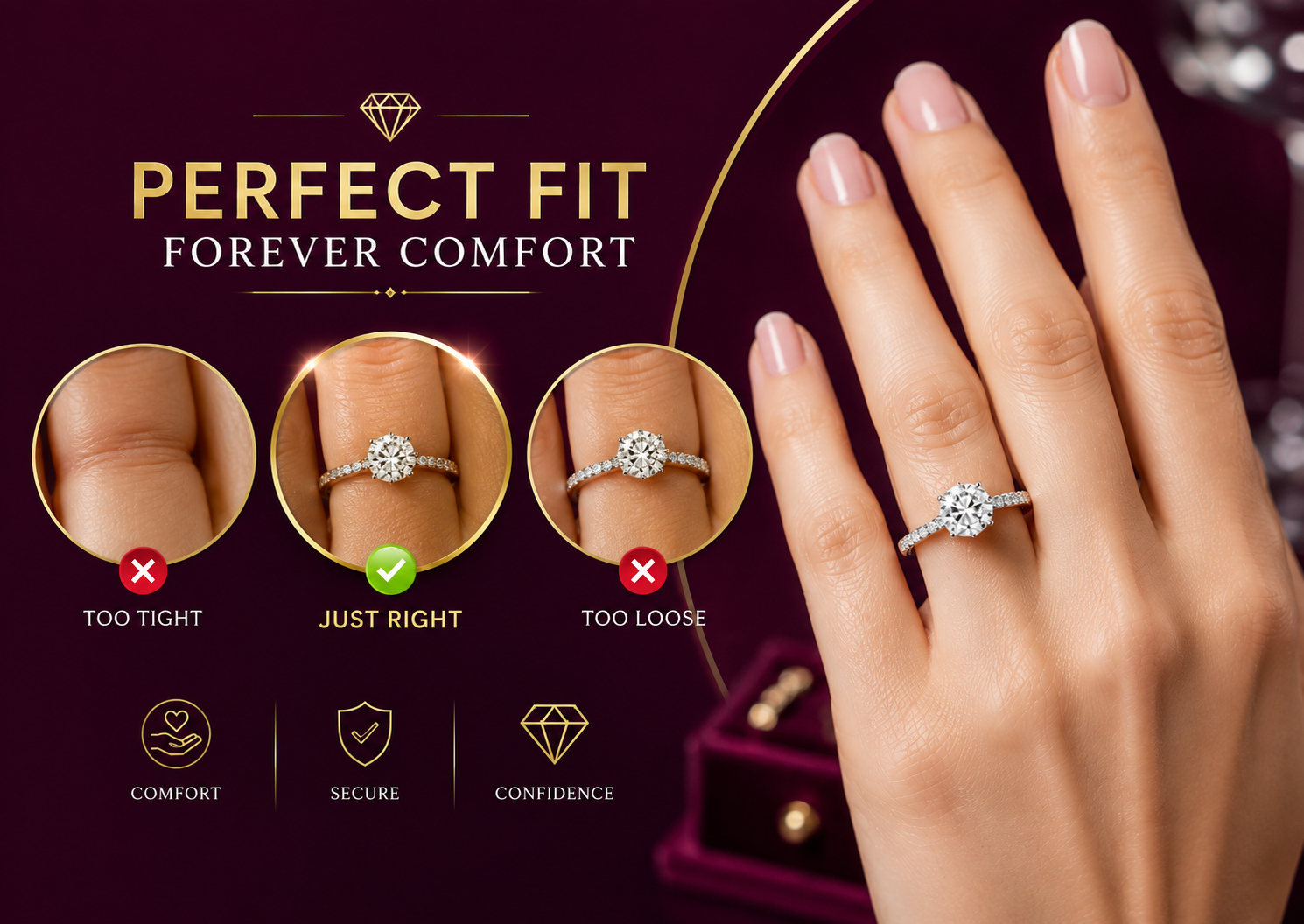
An engagement ring should feel secure without feeling restrictive. Ideally, it should slide over your knuckle with a little resistance, sit comfortably at the base of your finger, and stay in place during normal daily activities.
It shouldn’t fall off easily, but you also shouldn’t have to fight to remove it.
A small amount of movement is normal. Your fingers naturally change size throughout the day, and factors such as temperature, activity, and swelling can affect how your ring feels.
If you’re wondering whether your engagement ring fits correctly, these simple tests can help you tell the difference between a comfortable fit, a ring that’s too tight, and one that’s too loose.
How Tight Should an Engagement Ring Be?
The ideal engagement ring should feel snug, but not tight.
When you put it on, it should slide onto your finger without excessive force. You may feel some resistance as it passes over your knuckle, especially if your knuckle is wider than the base of your finger.
Once the ring is in place, it should:
- Sit comfortably at the base of your finger
- Stay secure when you move your hand
- Require a gentle pull or twist to remove
- Allow you to bend your finger normally
- Avoid causing pain, numbness, or significant swelling
- Not spin continuously during normal activity
The easiest way to think about it is this: your ring should be secure enough that you’re not worried about losing it, but comfortable enough that you don’t constantly notice it.
If you’re still choosing your size, a ring size guide can help with the measurement side of the process.
The 3 Simple Tests for a Proper Ring Fit
You don’t need complicated measurements to get a useful first impression of how your engagement ring fits.
1. The Knuckle Test
Try sliding the ring over your knuckle.
A correctly sized ring should pass over it with some resistance, but you shouldn’t need to force it.
A little friction is useful because your knuckle helps keep the ring from slipping off. However, if you have to push hard, twist aggressively, or struggle every time you remove the ring, it may be too small.
2. The Movement Test
Once the ring is on your finger, move your hand normally.
A properly fitted ring may rotate slightly, particularly if the setting is top-heavy. It shouldn’t constantly slide from one side of your finger to the other.
Try gently shaking your hand.
If the ring stays securely on your finger, that’s a good sign. If it moves dramatically toward your fingertips or feels like it could come off, the fit may be too loose.
3. The Removal Test
Take the ring off normally.
You should feel some resistance at the knuckle, but removing it shouldn’t be painful or require a major struggle.
A little twist can help the ring pass over the knuckle. What you don’t want is a ring that becomes increasingly difficult to remove every time you wear it.
Signs Your Engagement Ring Is Too Tight
A ring doesn’t have to be painfully tight to be too small.
Watch for these signs.
It Feels Uncomfortable Throughout the Day
If you’re constantly aware of pressure around your finger, the ring may be too tight.
A properly fitted engagement ring should be comfortable enough for everyday wear. It shouldn’t feel like it’s squeezing your finger.
It Leaves a Deep Indentation
A faint mark after removing a ring isn’t necessarily a problem.
But deep grooves, significant redness, or skin that appears to bulge around the band can indicate that the ring is too tight.
Your Finger Swells Around the Band
Some minor swelling can occur naturally, particularly in warm weather or after physical activity.
However, if your finger consistently appears swollen around the ring, the fit deserves attention.
It’s Difficult to Remove
Some resistance over the knuckle is normal.
Needing excessive force to remove the ring is not.
If you regularly need soap or another lubricant just to remove your engagement ring, it’s worth having the fit checked by a jeweler.
Your Finger Feels Numb or Tingly
Pain, numbness, tingling, or significant swelling should not be ignored.
If your ring is causing these symptoms, remove it if you can do so safely and have the fit assessed.
If swelling is severe and the ring cannot be removed, seek professional help rather than continuing to force it.
Signs Your Engagement Ring Is Too Loose
A ring that’s too loose can seem comfortable at first, but there’s one major downside: it can be easier to lose.
Here are some signs to watch for.
It Spins Constantly
Some rotation is normal.
A ring with a larger center stone may naturally tilt or rotate because the top of the ring weighs more than the band.
But if you’re constantly pushing the ring back into position throughout the day, it may be too loose.
Diamiv also covers this more specifically in its guide to why a ring spins around your finger.
It Slides Easily Toward Your Fingertip
Pay attention when you wash your hands, apply lotion, or move your fingers.
Water and lotion can reduce friction between the ring and your skin. A ring that’s already loose can become even easier to slip off in these situations.
It Comes Off With Almost No Resistance
Try removing the ring normally.
If it slides straight over your knuckle without any noticeable resistance, the size may be too large.
It Moves Excessively
Your ring doesn’t have to stay completely motionless.
A small amount of movement is expected. The problem is excessive movement that makes the ring feel unstable or puts it at risk of slipping off.
How Much Should an Engagement Ring Move?
Your engagement ring does not need to be completely immobile.
In fact, expecting zero movement can lead to choosing a ring that’s unnecessarily tight.
A correctly fitted ring may:
- Rotate slightly when you deliberately twist it
- Move a little when your hands are cold
- Shift slightly during normal hand movement
- Tilt if the center stone is relatively heavy
The important distinction is between occasional movement and constant movement.
If the ring moves a little but stays securely on your finger, the fit may be perfectly fine.
If it continually rotates, slides toward your fingertips, or feels as though it could fall off, the ring may be too loose.
Why Your Engagement Ring Fits Differently During the Day
Your finger isn’t exactly the same size from morning to night.
Temperature, physical activity, hydration, and other everyday factors can cause temporary changes in finger size.
For example, your fingers may feel larger after exercise or in hot weather. They can also feel smaller in colder conditions.
This means you shouldn’t automatically resize your ring because it feels slightly different at different times of the day.
Instead, pay attention to the overall pattern.
If the ring is comfortable and secure under normal conditions, a little variation is expected.
If it is consistently too tight or consistently too loose, that’s a different matter.
For example, if your ring regularly feels tight when you wake up, you may find why a ring feels tight in the morning useful.
How Knuckle Size Affects Ring Fit
One of the biggest challenges with ring sizing is that your finger isn’t necessarily the same width from the base to the knuckle.
For some people, the knuckle is significantly wider.
That creates a balancing act.
The ring needs to be large enough to pass comfortably over the knuckle, but not so large that it becomes loose once it reaches the base of the finger.
This is one reason simply measuring the circumference of the base of your finger doesn’t always tell the whole story.
If you have prominent knuckles, a jeweler may recommend a particular ring profile or another sizing solution rather than simply moving up to a much larger size.
The goal is still the same: comfortable over the knuckle and secure at the base of the finger.
Does Band Width Affect How Tight a Ring Feels?
Yes.
Two rings with the same numerical size can feel different on the same finger.
A wider band covers more of your finger and generally feels more substantial. A narrow band can feel less restrictive and may move more easily.
This is especially important if you’re comparing the fit of an engagement ring with a wider wedding band.
Don’t assume that because one ring in a particular size feels comfortable, every ring in that size will feel exactly the same.
The ring’s width, shape, setting, and your finger anatomy all influence how it feels.
What If You’re Between Ring Sizes?
Being between sizes doesn’t necessarily mean you should automatically choose the smaller or larger option.
Consider:
- How easily the ring passes over your knuckle
- How securely it sits at the base of your finger
- Whether you expect to wear a wedding band alongside it
- The width of the ring
- How much your fingers change with temperature
- Whether the ring is top-heavy and prone to rotating
If you’re unsure, professional sizing is preferable to guessing.
You can also use an engagement ring size calculator as part of the sizing process.
The calculator can help establish a starting point, but the final fit still depends on the specific ring and your finger.
When Should You Resize an Engagement Ring?
Consider professional resizing when the fit problem is consistent rather than temporary.
A ring may need attention if:
- It repeatedly slips toward your fingertip
- It constantly spins during normal activity
- It comes off too easily
- It consistently causes discomfort
- It leaves deep indentations
- It becomes difficult to remove under normal conditions
- Your finger size has changed permanently
Don’t rush to resize a ring because it feels slightly different on one unusually hot or cold day.
Instead, observe how it fits under normal conditions.
If the problem continues, have a jeweler assess the ring before deciding whether it needs to be made larger or smaller.
Is It Better for an Engagement Ring to Be Tight or Loose?
Neither.
Too tight can make the ring uncomfortable and difficult to remove.
Too loose increases the chance that the ring will move excessively or slip off.
The ideal fit is somewhere in between.
Your engagement ring should feel secure enough for everyday wear while remaining comfortable enough that you can forget you’re wearing it.
That’s the real test.
Frequently Asked Questions
Should an engagement ring leave a mark?
A light indentation after removing your ring can be normal.
A deep groove accompanied by pain, swelling, or significant redness suggests that the ring may be too tight.
Should an engagement ring spin?
A small amount of rotation is normal, particularly with top-heavy settings.
Constant spinning or frequent movement can indicate that the ring is too loose or that the design is naturally top-heavy.
How hard should it be to remove an engagement ring?
It should require a little resistance at the knuckle, but it shouldn’t require excessive force.
A gentle twist or pull is normal. Pain or a prolonged struggle is not.
Should my ring feel tighter in the morning?
It can.
Temporary changes in finger size can make a ring feel different at different times of day. If the difference is significant or persistent, have the fit checked.
Should an engagement ring be loose enough to spin?
It should have enough room for normal movement, but you shouldn’t need to constantly reposition it.
If it spins freely and repeatedly during everyday activity, it may be too loose.
What if my knuckle is much bigger than the base of my finger?
This is a common sizing challenge.
The ring needs to pass over the knuckle without excessive force while remaining secure once it reaches the base of the finger. A jeweler can help determine the most suitable fit for your finger shape.
Can an engagement ring be resized?
Many engagement rings can be resized, but the suitability and amount of resizing depend on the ring’s construction, setting, metal, and design.
If you’re unsure, have the ring evaluated by a professional jeweler before making changes.
Final Takeaway
The perfect engagement ring fit is snug, secure, and comfortable.
You should be able to slide the ring over your knuckle with some resistance, wear it without discomfort, and remove it without a struggle. A little movement is normal, but constant spinning or easy slipping can mean the ring is too loose.
Remember that finger size naturally changes throughout the day and with temperature and activity. Don’t judge your ring’s fit based on one moment alone.
If your ring consistently feels too tight or too loose, a professional jeweler can determine whether you need a different size or another fitting solution.
The goal isn’t to make your engagement ring as tight as possible.
The goal is to find the size that feels secure without making you think about the fit all day.