Choosing a moissanite is usually exciting until you reach the color-grade options: DEF, GH, GHI, colorless, near-colorless. Suddenly, a simple ring purchase starts to feel like a chemistry exam.
The good news? The difference between DEF vs GH moissanite is much easier to understand than the terminology makes it sound.
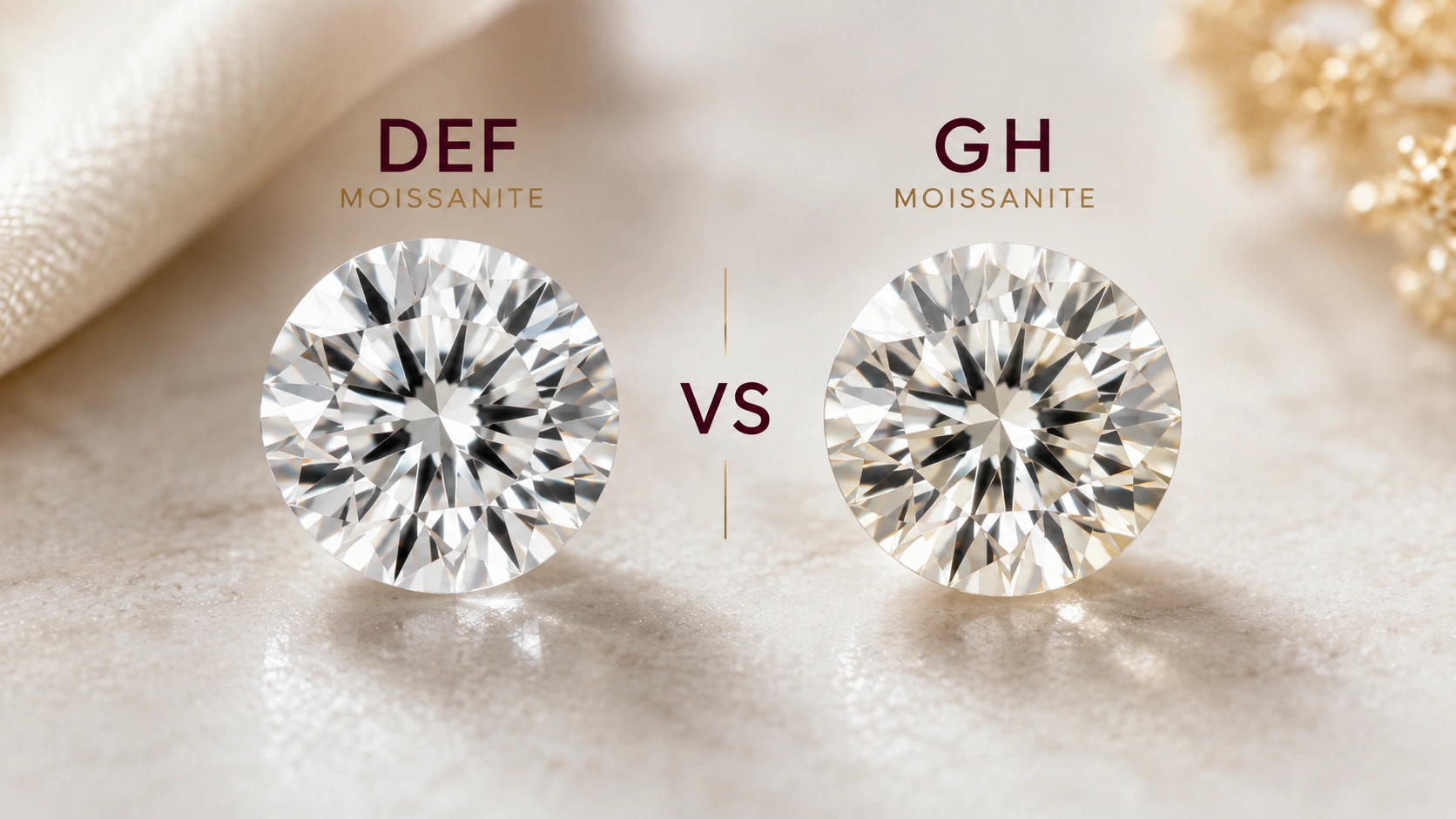
DEF moissanite sits in the colorless range, while GH is generally marketed as near-colorless. Both can look bright and beautiful in jewelry, but they can create slightly different visual effects depending on the stone, cut, size, lighting, and metal setting.
So, is DEF moissanite better than GH? Not necessarily. The better choice depends on the appearance you want.
DEF vs GH Moissanite at a Glance
| Feature | DEF Moissanite | GH Moissanite |
|---|---|---|
| General appearance | Colorless, crisp white | Near-colorless, subtly warmer |
| Common description | Bright or icy white | White with a little warmth |
| Visible color | Very little body color | May show a slight warm tone |
| White gold/platinum | Excellent pairing | Also works well |
| Yellow/rose gold | Can create a stronger contrast | Often creates a softer look |
| Overall look | Crisp and cool | Natural and slightly warm |
| Best for | Buyers wanting a very white appearance | Buyers who prefer warmth and value |
There is one important detail behind this chart. Moissanite sellers often use diamond-style color terminology as a convenient way to describe their stones. Charles & Colvard explains that the GIA diamond color scale itself was not designed specifically for moissanite, although the company uses the familiar D-to-Z terminology to describe its moissanite color ranges.
That means you should treat DEF and GH as useful industry descriptions, not assume that every moissanite brand grades stones in exactly the same way.
What Does DEF Mean in Moissanite?
DEF moissanite refers to moissanite marketed in the colorless range.
The letters D, E and F traditionally represent the colorless portion of the diamond color scale. In moissanite, manufacturers and retailers commonly borrow this terminology to communicate how little body color the gemstone shows.
Charles & Colvard, for example, describes its colorless moissanite as D-E-F.
In practical terms, DEF moissanite aims for a very crisp white appearance.
Some buyers describe this appearance as icy white, particularly when the stone sits beside a white metal such as platinum or white gold.
However, “colorless” does not mean that the stone will look identical in every lighting environment. Moissanite has its own optical properties and can produce strong flashes of light because of its high refractive index and dispersion. GIA identifies synthetic moissanite as silicon carbide and notes its distinctive optical characteristics compared with diamond.
So if you want the whitest-looking moissanite available within a brand’s color range, DEF is usually the natural starting point.
What Does GH Mean in Moissanite?
GH moissanite generally refers to a near-colorless range.
The stone can still appear very white, but it may show a subtle amount of warmth compared with a DEF stone.
Charles & Colvard currently lists GH as its near-colorless option, while its broader educational material describes its near-colorless range as G-H-I. This explains why shoppers sometimes see GH vs GHI moissanite terminology on different websites.
In other words, don’t assume that “GH” and “GHI” always mean precisely the same thing across every seller.
The safest approach is to check the specific manufacturer’s grading description.
DEF vs GHI Moissanite: What’s the Difference?
This is where many buyers get confused.
You may search for DEF vs GHI moissanite and find guides that compare:
- DEF = colorless
- GHI = near-colorless
That comparison is legitimate as an industry convention, but the exact labeling varies between brands.
Charles & Colvard has historically described its Forever One moissanite as D-E-F for colorless and G-H-I for near-colorless. Its current product pages commonly display the near-colorless option as GH.
So when comparing DEF moissanite vs GHI, focus less on the letters alone and more on the seller’s actual color definition.
That is especially important if you compare stones from different manufacturers.
DEF Moissanite vs GH Moissanite: Can You See the Difference?
Sometimes, yes. Sometimes, not easily.
The moissanite color difference between DEF and GH is usually subtle rather than dramatic.
A side-by-side comparison under controlled lighting can make the difference easier to notice. On the finger, however, the distinction may become much less obvious.
Several factors affect what you see:
- Stone size
- Shape and faceting
- Cut quality
- Lighting
- Metal color
- Surrounding gemstones
- Your own visual sensitivity to color
A small GH stone can look extremely white face-up. A larger stone can reveal more of its body color simply because there is more material for you to observe.
This is why saying “GH is yellow” is too simplistic.
Is GH Moissanite Yellow?
Not necessarily.
GH is generally described as near-colorless, not visibly yellow.
A well-cut GH moissanite can still look bright white in normal jewelry settings. Depending on the stone and lighting, you may notice a slight warmth compared with DEF, but that does not mean the gemstone will look obviously yellow.
This distinction matters because many shoppers search “is GH moissanite yellow?” expecting a yes-or-no answer.
The better answer is: GH may show more warmth than DEF, but near-colorless does not automatically mean yellow.
Your best reference should always be the actual stone or the manufacturer’s representative images rather than a generic color chart.
Is DEF Moissanite Colorless?
Yes, DEF is commonly marketed as the colorless range for moissanite.
Charles & Colvard explicitly identifies its DEF stones as colorless.
But remember that “colorless” describes body color. It does not mean the stone will behave optically like a diamond.
Moissanite has different optical properties from diamond. GIA notes that synthetic moissanite is silicon carbide and has a high refractive index and dispersion, contributing to its distinctive brilliance and fire.
That is why two colorless gemstones can still look noticeably different when they sparkle.
Which Is Better: DEF or GH Moissanite?
There is no universal winner.
If you want a crisp, very white appearance, DEF may be the better choice.
If you prefer a slightly warmer, softer appearance, GH may suit you better.
Think of it like choosing between two white shirts. One is bright, almost stark white. The other has a softer off-white character. Neither shirt is “better.” It depends on what looks right to you.
The same idea applies to DEF or GH moissanite.
DEF vs GH Moissanite for Different Metal Colors
Your ring’s metal can change how the center stone looks.
DEF Moissanite With White Gold or Platinum
DEF pairs naturally with white metals when you want a crisp, bright appearance.
The colorless stone and cool-toned metal create a consistent white look.
If your priority is a classic, icy-white engagement ring, DEF moissanite with white gold or platinum is a strong combination.
GH Moissanite With White Gold
GH can also work beautifully with white gold.
Because GH is near-colorless, it can still appear very white, while offering a little more warmth than DEF.
The difference may be subtle, particularly when you view the ring at normal distance.
GH Moissanite With Yellow Gold
This combination can be especially appealing if you like warmth.
Yellow gold already introduces a warm color around the gemstone, so a near-colorless GH stone can create a softer overall appearance.
Some buyers specifically prefer this combination because they don’t want the center stone to look dramatically cooler than the setting.
GH or DEF With Rose Gold
Both can work with rose gold.
DEF creates more contrast between the very white center and the warm pink metal.
GH creates a more blended, harmonious appearance.
The choice comes down to whether you prefer contrast or warmth.
Does DEF Look Better Than GH?
“Better” depends on your definition of better.
DEF can look more obviously white, especially in a white-metal setting. GH can look softer and slightly warmer.
Neither color grade automatically gives you better sparkle.
This is an important buying point.
Color grade is not the same thing as cut quality.
A well-cut GH moissanite can look spectacular, while a poorly cut DEF stone can disappoint. Moissanite’s brilliance depends heavily on its optical properties and cutting, not simply the letters attached to its color description.
So don’t spend your entire budget chasing DEF while ignoring the stone’s cut and overall craftsmanship.
Is DEF Moissanite Worth the Extra Cost?
That depends on how much you value the difference in color.
If you have a strong preference for a very white, icy appearance, paying more for DEF may make sense.
But if you’re comfortable with a near-colorless stone, GH can provide an excellent balance between appearance and budget.
This becomes particularly relevant for larger engagement-ring stones.
As the stone gets larger, its presence on the hand increases. Some buyers therefore prefer the crisp appearance of DEF, while others like the slightly warmer character of GH.
The important thing is not to pay a premium simply because DEF sounds like the “higher” grade.
Higher on a color scale does not automatically mean better for your personal style.
Which Moissanite Color Looks Most Like a Diamond?
This question needs a careful answer.
There is no single moissanite color grade that guarantees a “diamond look.”
Moissanite is a different gemstone from diamond. GIA identifies moissanite as silicon carbide and notes its distinctive optical behavior, including facet doubling caused by its double refraction.
Color is only one part of the appearance.
If your goal is a very white gemstone, DEF may be the closest match to the colorless look many shoppers associate with high-color diamonds.
If you prefer a little warmth, GH can provide a softer appearance.
But moissanite will still have its own characteristic brilliance and fire.
What Color Grade Is Best for Moissanite?
For most shoppers, the answer comes down to three choices:
Choose DEF if:
- You want a very crisp white appearance.
- You prefer cooler-looking stones.
- You’re using platinum or white gold.
- You are particularly sensitive to visible warmth.
Choose GH if:
- You want near-colorless moissanite.
- You like a slightly warmer appearance.
- You’re setting the stone in yellow or rose gold.
- You want to prioritize value without giving up a white appearance.
Compare the actual stone if:
- You’re buying a large center stone.
- You’re comparing different brands.
- You are choosing an unusual cut.
- Color is one of your biggest concerns.
Moissanite Color Chart: A Simple Way to Think About It
There is no single universal moissanite color chart that every manufacturer follows in exactly the same way.
However, a commonly used industry description looks like this:
| Moissanite color terminology | General appearance |
|---|---|
| DEF | Colorless |
| GH / GHI | Near-colorless |
| IJ / JK | More noticeable warmth |
Treat this as a general guide, not a universal laboratory grading standard.
For example, Charles & Colvard explains that it uses the familiar diamond color scale to describe its created gemstones even though the GIA diamond scale was not specifically created for moissanite.
That distinction makes your buying decision much clearer.
Can You Tell the Difference Between DEF and GH Moissanite?
Yes, you can sometimes see a difference in a direct comparison.
But don’t expect DEF and GH to look like two completely different gemstones.
The difference tends to appear as a change in temperature or body color, rather than a dramatic change from white to yellow.
Lighting also matters.
A stone viewed under daylight can look different from the same stone under warm indoor lighting. Reflections from the surrounding metal can influence what your eye sees as well.
That’s why product photos alone should not be the final deciding factor when you’re choosing between close color grades.
Does Moissanite Color Matter?
Yes, but it should not be the only thing you consider.
When buying a moissanite engagement ring, look at:
- Color
- Cut
- Shape
- Size
- Setting
- Metal color
- Overall craftsmanship
Moissanite already offers strong brilliance and durability. GIA reports a Mohs hardness of about 9¼ for synthetic moissanite, making it well suited to jewelry use.
So your goal should not be to find the “highest” letter grade at any cost.
Your goal should be to find the stone whose color and overall appearance match your ring design and personal taste.
DEF or GH Moissanite: Which Should You Choose?
If you want the shortest answer:
DEF is the better choice for a crisp, colorless appearance. GH is the better choice if you prefer near-colorless warmth and potentially want to spend less on color.
Neither is automatically superior.
For a white gold or platinum engagement ring, DEF gives you that clean, icy-white look many shoppers want.
For yellow or rose gold, GH can create a softer transition between the stone and the warm metal.
And if you’re still stuck, compare the two stones side by side. Your eyes are far more useful than a four-letter acronym.
Final Takeaway
The real question isn’t “Is DEF better than GH?”
It’s “Which appearance do I prefer?”
DEF moissanite offers a colorless look, while GH moissanite sits in the near-colorless range. The difference can be subtle face-up, and the surrounding metal, stone size, cut and lighting can all influence how the color appears.
Also remember that DEF vs GHI moissanite is not always a perfect apples-to-apples comparison across brands. Different sellers may label their near-colorless range as GH or GHI, so always check the manufacturer’s own grading terminology.
For a classic icy-white engagement ring, DEF is a natural choice.
For a softer, slightly warmer appearance, GH may be exactly what you’re looking for.
There is no prize for choosing the most expensive color grade. The best moissanite is the one that looks beautiful to you every time you look down at your hand.
Frequently Asked Questions
Is DEF moissanite better than GH?
Not automatically. DEF is generally the colorless option, while GH is near-colorless. DEF may suit buyers who want a crisp white appearance, while GH can suit buyers who prefer subtle warmth.
Is GH moissanite yellow?
GH moissanite is generally described as near-colorless, so it should not automatically look yellow. It may show more warmth than DEF, but the visible difference depends on the stone, cut, lighting and setting.
What does DEF mean in moissanite?
DEF commonly describes a colorless moissanite range corresponding to D, E and F terminology. Charles & Colvard uses DEF to identify its colorless moissanite.
What does GH mean in moissanite?
GH generally describes a near-colorless moissanite range. However, grading terminology varies by seller, so check the specific brand’s definition before comparing stones.
Which moissanite color is best for an engagement ring?
DEF is a strong choice if you want a crisp white appearance, while GH can be ideal if you prefer a slightly warmer look. Your metal color and personal preference should guide the final decision.
Is DEF moissanite colorless?
Yes. DEF is commonly used to describe colorless moissanite. It refers to body color, not to the gemstone having the same optical properties as diamond.
Which moissanite color looks most like a diamond?
There is no single color grade that makes moissanite identical to diamond. DEF can provide a very white appearance, while GH offers near-colorless warmth. Moissanite still has its own optical properties and distinctive fire.
Can you tell the difference between DEF and GH moissanite?
A difference can be visible when the stones are compared side by side, but it may be subtle when a single stone is worn in a ring. Lighting, size, cut and metal color all influence the appearance.
Should I get DEF or GH moissanite?
Choose DEF if you want a very white, crisp appearance. Choose GH if you prefer near-colorless warmth or want to avoid paying extra for a color difference that may be difficult to notice in everyday wear.
Final Takeaway
The real question isn’t “Is DEF better than GH?”
It’s “Which appearance do I prefer?”
DEF moissanite offers a colorless look, while GH moissanite sits in the near-colorless range. The difference can be subtle face-up, and the surrounding metal, stone size, cut and lighting can all influence how the color appears.
Also remember that DEF vs GHI moissanite is not always a perfect apples-to-apples comparison across brands. Different sellers may label their near-colorless range as GH or GHI, so always check the manufacturer’s own grading terminology.
For a classic icy-white engagement ring, DEF is a natural choice.
For a softer, slightly warmer appearance, GH may be exactly what you’re looking for.
There is no prize for choosing the most expensive color grade. The best moissanite is the one that looks beautiful to you every time you look down at your hand.