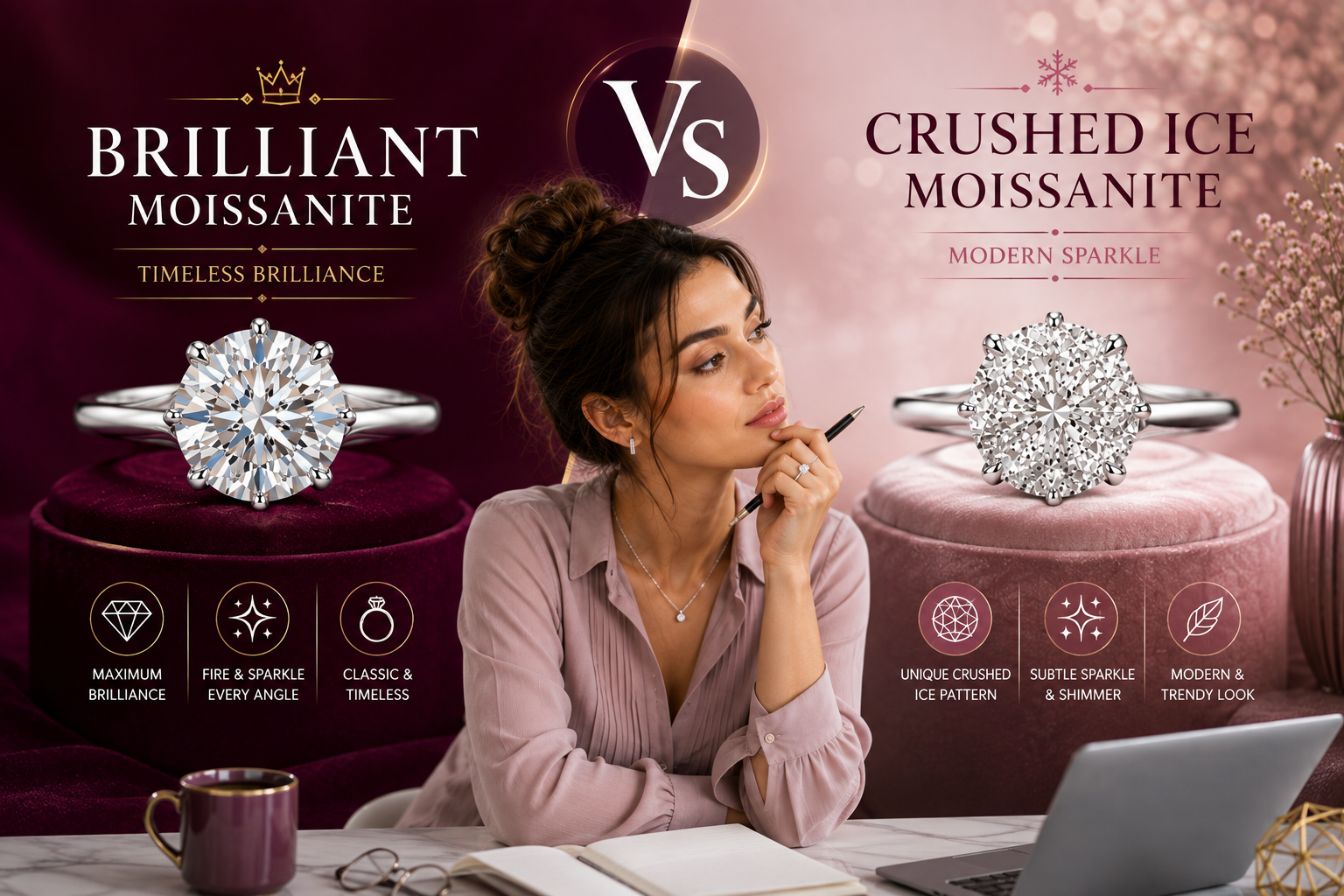
If you’re comparing brilliant vs crushed ice moissanite, you’re really choosing between two very different ways of displaying light.
A brilliant cut moissanite is known for bold, defined flashes, strong brilliance, and noticeable rainbow fire. A crushed ice moissanite creates a finer, more scattered shimmer that many people prefer for a softer, more diamond-inspired appearance.
Neither is automatically better.
The right choice depends on the kind of sparkle you want, the shape of your stone, and how closely you want the appearance to resemble a diamond.
Brilliant vs Crushed Ice Moissanite: Quick Comparison
| Feature | Brilliant Cut | Crushed Ice |
|---|---|---|
| Facet appearance | More organized and defined | Smaller, more fragmented |
| Sparkle | Bold, distinct flashes | Fine, scattered shimmer |
| Fire | More noticeable rainbow fire | Generally softer |
| Overall look | Crisp and lively | Soft and glittery |
| Diamond-like appearance | Depends on shape and size | Often preferred for fancy shapes |
| Common shapes | Round, oval, cushion, pear | Oval, radiant, cushion, pear |
| Best for | Maximum sparkle and fire | Softer, more subtle sparkle |
| Main concern | Fire can be intense | Poor examples can look hazy or busy |
The biggest thing to remember is that cut quality matters more than the label alone. A well-cut stone can look beautiful in either style, while a poorly cut stone can disappoint regardless of whether it is brilliant or crushed ice.
What Is Brilliant Cut Moissanite?
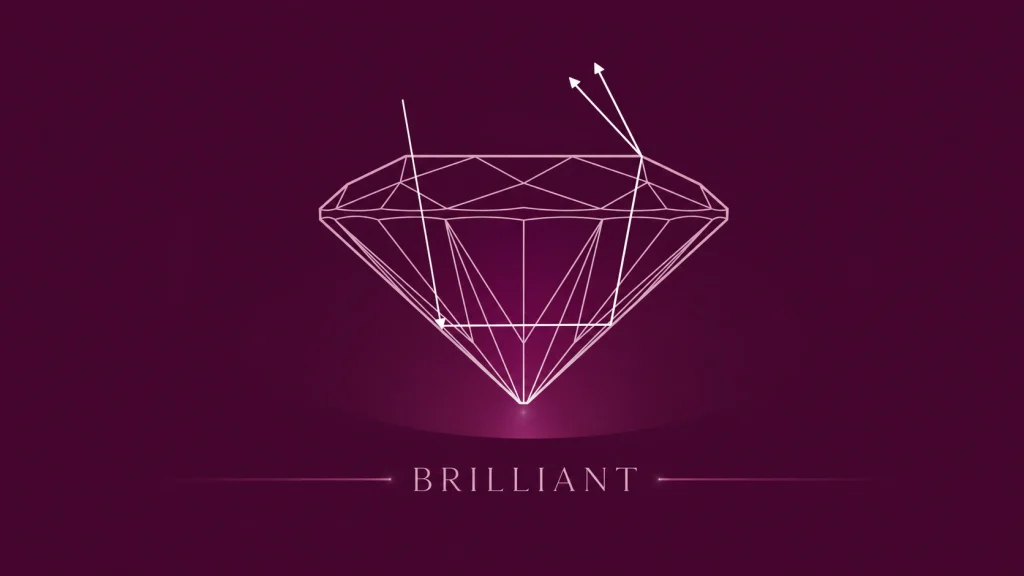
A brilliant cut is a faceting style designed to return a large amount of light through the top of the gemstone.
The facets are arranged in an organized, symmetrical pattern. As the stone moves, those facets create distinct flashes of brightness and color.
Moissanite already has strong optical properties. The Gemological Institute of America notes that moissanite has slightly more brilliance and more than twice the fire of diamond. Moissanite is also doubly refractive, which contributes to some of the visual differences between moissanite and diamond.
A brilliant moissanite can therefore give you:
- Bright white flashes
- Noticeable rainbow fire
- Strong contrast
- A crisp, energetic appearance
- A very lively look as the ring moves
If you love a gemstone that immediately catches the light, brilliant cut moissanite is usually the better starting point.
For a classic round stone, a brilliant cut is especially natural because the round brilliant pattern is designed around strong light return.
What Is Crushed Ice Moissanite?

Crushed ice is not a different type of moissanite. It is a faceting style.
Instead of creating the more organized appearance associated with traditional brilliant faceting, crushed ice uses many smaller facets to create a fragmented pattern of reflections.
The result is less about individual flashes and more about an overall shimmer.
Think of the difference this way:
Brilliant: “Look at that flash.”
Crushed ice: “Look at all that sparkle.”
Crushed ice is particularly common in elongated and fancy shapes such as:
- Oval
- Radiant
- Cushion
- Pear
The style can also appeal to buyers who want to soften the strong rainbow fire that some larger brilliant-cut moissanites display.
However, crushed ice is not automatically better simply because it has more facets.
The exact proportions, facet arrangement, cutting precision, and quality of the individual stone all affect its appearance. A poorly executed crushed ice stone can look hazy, cloudy, or overly busy instead of bright and attractive.
Brilliant vs Crushed Ice: What Is the Difference?
The easiest way to understand the difference is to look at how each style presents light.
Brilliant cut

Brilliant faceting tends to produce:
- Larger-looking flashes
- More defined sparkle
- Stronger contrast
- More noticeable rainbow fire
- A crisp, structured appearance
Crushed ice
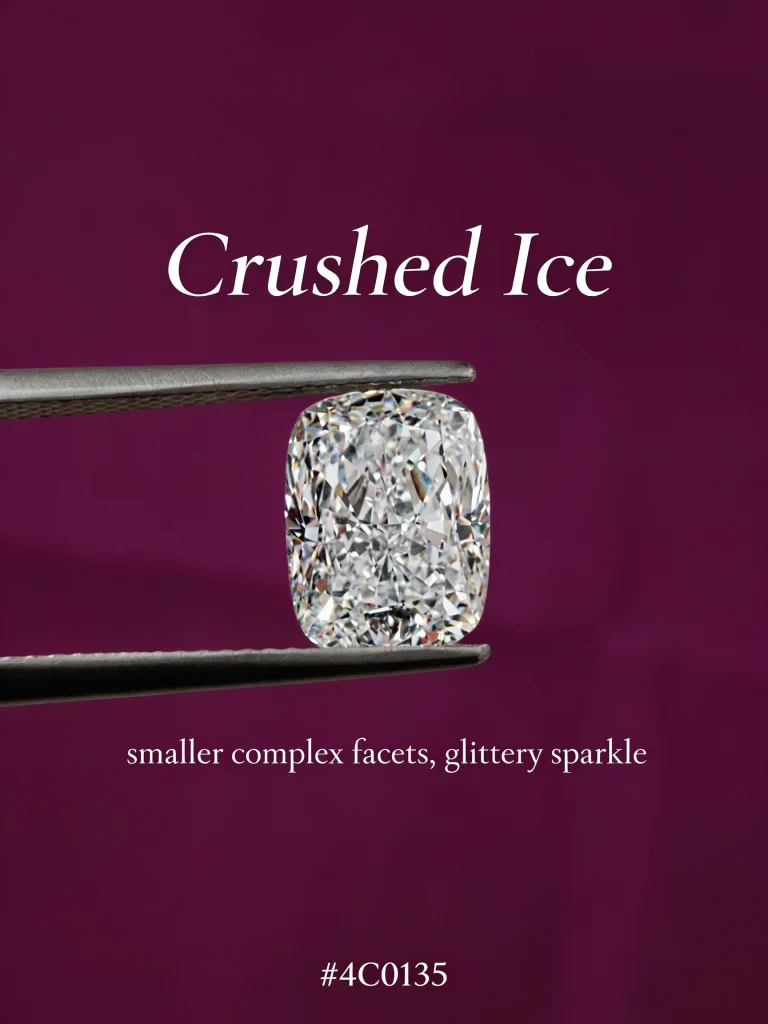
Crushed ice tends to produce:
- Smaller reflections
- More scattered sparkle
- A softer visual pattern
- Less obvious individual flashes
- A dense, glittery appearance
Neither description makes one style objectively superior.
They simply create different visual personalities.
Which Moissanite Cut Sparkles More?
If by “sparkle” you mean bold flashes, brightness, and noticeable fire, brilliant cut generally wins.
Moissanite itself is highly fiery, and brilliant faceting makes that characteristic particularly obvious. You may see colorful flashes as the stone moves under different lighting.
Crushed ice can still look extremely sparkly, but its sparkle is usually more fragmented. Instead of large flashes appearing and disappearing, you may see many smaller reflections blending together.
So:
For maximum visible fire and bold flashes: choose brilliant.
For fine, scattered shimmer: choose crushed ice.
This is also why the answer to “which sparkles more?” can depend on personal preference. One person may consider intense rainbow fire the ultimate sparkle, while another may prefer the softer glitter of crushed ice.
If you’re comparing moissanite with diamond specifically, it’s also worth understanding how their sparkle differs. You can explore the broader comparison in moissanite fire vs diamond sparkle.
Which Looks More Like a Diamond?
This is where crushed ice gets much of its appeal.
A crushed ice moissanite can create a softer, more scattered appearance that many shoppers associate with the sparkle pattern of a diamond, particularly in fancy shapes.
That does not mean crushed ice moissanite becomes indistinguishable from diamond.
Moissanite and diamond have different optical properties. Moissanite has more fire and is doubly refractive, while diamond is singly refractive. Those differences can still be visible, particularly in larger stones.
Instead, the question is about visual impression.
If you want to embrace moissanite’s distinctive fire, brilliant is often the more appealing choice.
If you prefer to tone down the rainbow flashes and create a softer, more diamond-inspired appearance, crushed ice may be a better fit.
Brilliant vs Crushed Ice Oval Moissanite
Oval moissanite is one of the shapes where the choice becomes especially noticeable.
A brilliant oval can produce strong flashes across the elongated shape and give the center stone a very lively appearance.
A crushed ice oval creates a more fragmented shimmer and can give the stone a softer visual character.
However, don’t choose an oval based on faceting style alone.
Watch for the bow-tie effect
Ovals can display a dark area across the center known as a bow tie. It results from the way the elongated shape and facets interact with incoming light.
Choosing crushed ice does not automatically eliminate a bow tie.
The best way to evaluate an oval is to see the actual stone moving under different lighting conditions. A seller’s single studio photograph may not tell you how the stone performs in everyday use.
If you’re shopping for an oval moissanite, prioritize the individual stone’s light performance over the name of the faceting style.
Brilliant vs Crushed Ice Cushion
Cushion shapes offer another interesting comparison because both styles can work well.
Brilliant cushion
A brilliant cushion generally gives you:
- Stronger individual flashes
- More visible fire
- A lively appearance
- More defined facet contrast
Crushed ice cushion
A crushed ice cushion tends to give you:
- Smaller flashes
- More glitter
- A softer appearance
- A more fragmented light pattern
If you want your cushion to be dramatic and highly sparkly, brilliant may be the better choice.
If you want a softer cushion with lots of tiny reflections, crushed ice may suit you better.
Brilliant vs Crushed Ice Radiant
Radiant moissanites are another popular option for comparing these two faceting styles.
A brilliant radiant combines the rectangular or square outline of a radiant with strong brilliant-style light performance. It can look bright, crisp, and energetic.
A crushed ice radiant creates a more fragmented, glittery appearance.
This can make a noticeable difference in how the center of the stone looks.
The important thing is to check transparency.
Some crushed ice stones can appear hazy or cloudy if their proportions and faceting do not produce good light performance. That is why you should evaluate the actual stone instead of assuming every crushed ice radiant will look the same.
What About Pear Moissanite?
Pear shapes can also work with either style.
A brilliant pear tends to emphasize strong flashes and fire, making the stone look lively as it moves.
A crushed ice pear can provide a softer, more scattered appearance that some shoppers find more subtle and diamond-inspired.
Because pear shapes are elongated, you should also examine the stone for uneven light performance and any noticeable dark areas.
Again, the individual stone matters more than the cut label.
What About Round Moissanite?
If you’re considering a round moissanite, brilliant is usually the more obvious choice.
Round brilliant faceting is designed to create strong, symmetrical light performance. The classic round shape also pairs naturally with the brilliant style.
Crushed ice can technically be used in other designs, but the style is much more commonly associated with fancy shapes such as ovals, cushions, radiants, and pears.
If your priority is maximum sparkle in a classic round engagement ring, brilliant is the safer choice.
Pros and Cons of Brilliant Cut Moissanite
Pros
- Strong, noticeable sparkle
- Distinct flashes of light
- More visible rainbow fire
- Crisp and lively appearance
- Excellent for buyers who love dramatic sparkle
- Natural fit for round brilliant stones
Cons
- Rainbow fire can be intense
- Some buyers may find the appearance too flashy
- May look less subtle than crushed ice
- Elongated shapes can still show bow ties
Brilliant is particularly attractive if you love moissanite for what makes moissanite different.
There is no reason to hide its fire if that is the feature you enjoy most.
Pros and Cons of Crushed Ice Moissanite
Pros
- Soft, glittery appearance
- Smaller, more scattered reflections
- Often attractive in fancy shapes
- Can reduce the visual intensity of rainbow fire
- May provide a more diamond-inspired appearance
Cons
- Some stones can appear hazy or cloudy
- Sparkle may look less defined
- Quality can vary significantly between stones
- Does not automatically eliminate bow ties
- May feel too subdued for buyers who love strong fire
Crushed ice can be an excellent choice, but it rewards careful shopping.
Don’t choose it simply because you heard that it “looks more like a diamond.”
Choose it because you actually like the way the stone looks.
Brilliant vs Crushed Ice: Which Is Better?
There is no universal winner.
Choose brilliant cut moissanite if you:
- Want bold sparkle
- Love rainbow fire
- Prefer distinct flashes
- Want a crisp and lively appearance
- Are considering a round moissanite
- Want your moissanite to show off its unique optical character
Choose crushed ice moissanite if you:
- Prefer finer, scattered sparkle
- Want a softer visual effect
- Like oval, cushion, radiant, or pear shapes
- Prefer less obvious rainbow fire
- Want a more diamond-inspired appearance
If you’re still unsure, compare the two stones side by side under the same lighting.
That is more useful than relying on product photographs or the words “brilliant” and “crushed ice.”
How to Choose the Right Moissanite Cut
The easiest way to make the decision is to work through three questions.
1. What shape do you want?
Start with the outline of the stone.
If you want a classic round, brilliant is the natural choice.
If you want an oval, cushion, radiant, or pear, both brilliant and crushed ice deserve consideration.
2. What kind of sparkle do you prefer?
Ask yourself whether you prefer:
Bold flashes and rainbow fire
or
Fine, scattered glitter.
If you want the first, lean brilliant.
If you want the second, lean crushed ice.
3. How does the actual stone perform?
This is the most important step.
Before buying, look for:
- Good transparency
- No obvious haziness
- Balanced light return
- Attractive sparkle while moving
- Minimal distracting dark areas
- Good proportions
- A pleasing appearance in multiple lighting conditions
A video of the actual stone can be much more informative than a single photograph.
If color is also part of your decision, you can compare options in a guide to DEF vs GH moissanite.
Final Words
The choice between brilliant vs crushed ice moissanite comes down to the type of sparkle you want.
Brilliant cut is the better choice for bold flashes, strong brilliance, and noticeable rainbow fire.
Crushed ice is the better choice if you prefer a softer, more scattered shimmer and a potentially more diamond-inspired appearance, especially in fancy shapes.
For oval, cushion, radiant, and pear moissanites, the decision deserves extra attention because the shape and faceting style work together to determine how the stone handles light.
Most importantly, don’t assume one style is universally better.
A beautifully cut brilliant moissanite can be stunning. A beautifully cut crushed ice moissanite can be stunning too.
The best choice is the one whose sparkle you will enjoy seeing every day.
Frequently Asked Questions
Does crushed ice moissanite sparkle less than brilliant cut?
Not necessarily. It produces a different type of sparkle. Brilliant moissanite generally gives stronger, more defined flashes, while crushed ice produces many smaller reflections that blend into a glittery shimmer.
Which moissanite has more fire?
Brilliant cut moissanite generally shows more noticeable rainbow fire than crushed ice because its faceting emphasizes distinct flashes. Moissanite itself is naturally more fiery than diamond.
Does brilliant cut moissanite look like a diamond?
It can look diamond-like, but it still has optical differences from diamond. Moissanite has more fire and is doubly refractive, which can become more noticeable in larger stones.
Does crushed ice moissanite look like a diamond?
Many shoppers prefer crushed ice because its scattered sparkle can create a softer, more diamond-inspired appearance. It is still moissanite, however, and will retain the optical characteristics of moissanite.
Is crushed ice moissanite good?
Yes. It can be an excellent choice if you like its softer, glittery appearance. The key is choosing an individual stone with good transparency and light performance.
Is brilliant cut moissanite good?
Yes. Brilliant cut is an excellent option for anyone who wants strong sparkle, distinct flashes, and noticeable fire.
Is crushed ice or brilliant better for an oval moissanite?
It depends on your preferred appearance. Brilliant usually offers stronger flashes, while crushed ice creates a softer, more scattered effect. With either style, inspect the actual oval for bow ties and uneven light performance.
Which is better for a cushion: brilliant or crushed ice?
Choose brilliant if you want stronger flashes and fire. Choose crushed ice if you prefer finer, more scattered sparkle. The quality of the individual stone still matters more than the label.
Is crushed ice moissanite worth it?
It can be, especially if you genuinely prefer its appearance. Its value depends on the quality of the stone and whether its sparkle matches your preferences, not simply on whether crushed ice is objectively “better.”