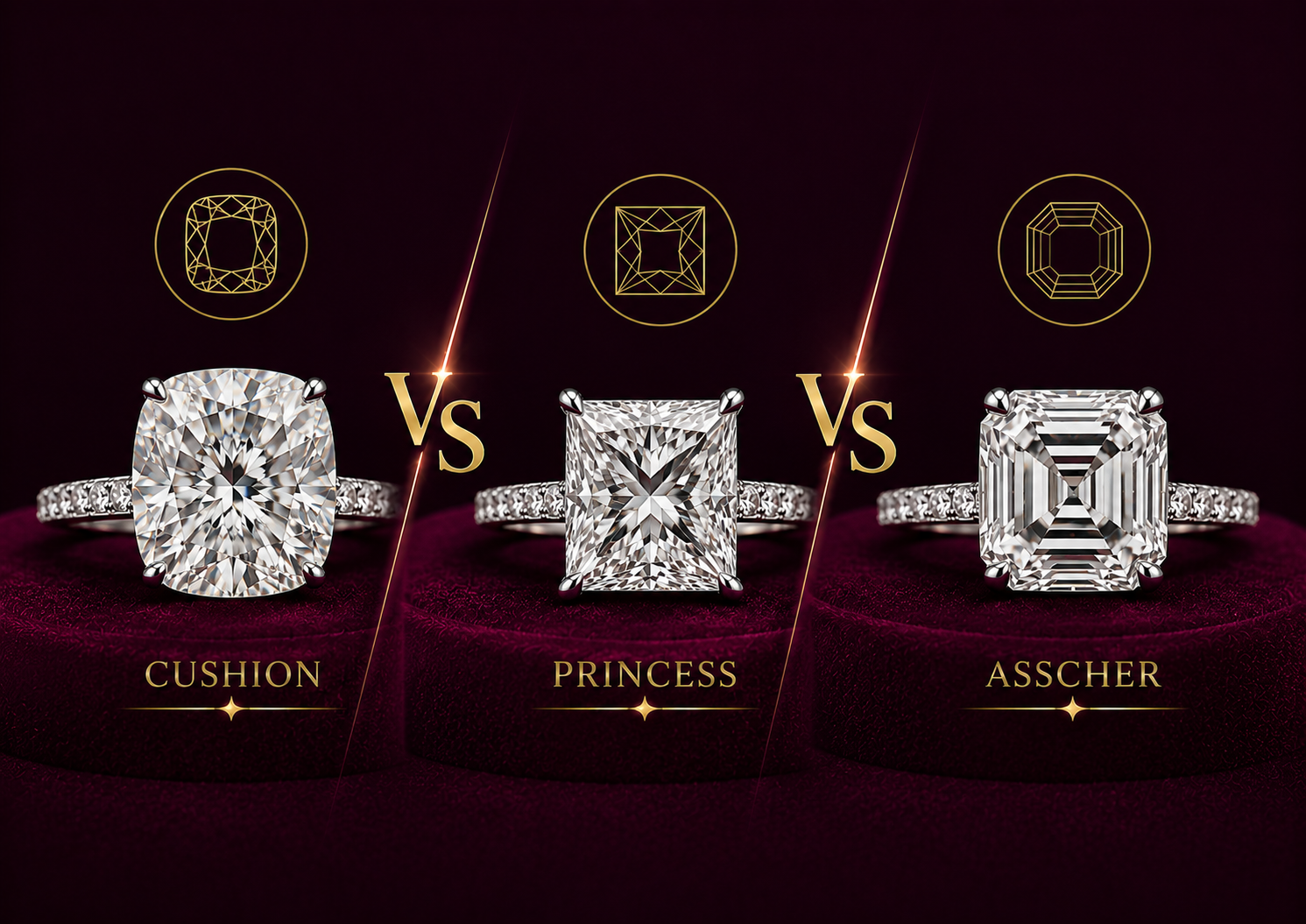
Cushion, princess, and Asscher cuts can all give an engagement ring a square or rectangular appearance, but they create very different looks once you compare their corners, faceting, sparkle, and proportions.
A cushion cut has soft, rounded corners and a romantic appearance. A princess cut has sharp corners and a crisp, modern look. An Asscher cut has cropped corners and step-cut facets that create a distinctive geometric, mirror-like effect.
So which one is best?
There is no universal winner. The right choice depends on whether you prioritize sparkle, vintage style, modern geometry, durability, clarity, or face-up size.
Cushion vs Princess vs Asscher: Quick Comparison
| Feature | Cushion Cut | Princess Cut | Asscher Cut |
|---|---|---|---|
| Overall appearance | Soft and romantic | Sharp and modern | Geometric and vintage-inspired |
| Corners | Rounded | Sharp and pointed | Cropped/beveled |
| Faceting | Brilliant or modified brilliant | Modified brilliant | Step cut |
| Sparkle | Soft to lively, depending on faceting | Bright and energetic | Broad flashes and reflections |
| Clarity visibility | Moderate | Generally forgiving | Inclusions can be easier to see |
| Corner durability | Good | Requires extra protection | Good |
| Shape | Square or rectangular | Usually square | Square with octagonal outline |
| Best style | Romantic, classic, vintage | Modern, contemporary | Art Deco, vintage |
| Main advantage | Soft shape and varied sparkle | Strong brilliance and crisp geometry | Distinctive step-cut appearance |
| Main drawback | Sparkle varies between stones | Vulnerable pointed corners | More revealing of clarity and color |
The biggest difference is the faceting style. Cushion and princess diamonds belong to the brilliant-cut family, while Asscher is a step cut. That distinction has a major effect on how each diamond handles light. GIA describes princess as a square modified brilliant and notes that Asscher uses larger step facets for a very different visual effect.
What Is a Cushion Cut Diamond?
A cushion cut combines a square or rectangular outline with rounded corners. Its soft shape is the reason it is often described as pillow-like.
Cushion diamonds can have different facet arrangements, so not every cushion looks the same. Some have a more structured brilliant appearance, while modified cushions can produce a more fragmented or “crushed ice” pattern.
That variation is one of the biggest things to understand when shopping for a cushion.
If two cushion diamonds have the same carat weight, color, and clarity grades, they can still look noticeably different because of their proportions and faceting.
GIA recommends paying attention to symmetry in the outline and evaluating the individual diamond rather than assuming that every cushion will have the same sparkle pattern.
For shoppers who want a softer alternative to a square diamond with sharp corners, cushion is often the most natural choice.
What Is a Princess Cut Diamond?
The princess cut is a square-shaped modified brilliant cut with four pointed corners.
Its combination of straight edges and brilliant-style faceting gives it a crisp, contemporary appearance. Compared with an Asscher, a princess typically has much more energetic light return and scintillation.
The sharp corners are also the main practical consideration.
GIA specifically identifies princess-cut corners as vulnerable to chipping and recommends protective settings, including V-shaped prongs, to help protect them.
That does not make princess diamonds unsuitable for engagement rings. It simply means that the setting should be selected with the stone’s vulnerable corners in mind.
Princess is particularly appealing if you want a square diamond that feels clean, bold, and modern.
What Is an Asscher Cut Diamond?
An Asscher cut is a square step-cut diamond with cropped corners, giving it an octagonal outline when viewed from above.
Instead of relying on numerous smaller brilliant-style facets, an Asscher uses broad, concentric step facets.
The result is completely different from the sparkle of a princess or brilliant-style cushion.
Rather than looking intensely glittery, an Asscher can produce broad flashes and reflections that create a distinctive geometric or “hall-of-mirrors” appearance.
This is why Asscher diamonds are especially appealing to shoppers who like Art Deco jewelry, symmetry, and vintage-inspired design.
The tradeoff is that the large, open facets can make clarity characteristics easier to notice. An Asscher therefore rewards careful inspection of the actual stone.
Cushion vs Princess vs Asscher: The Biggest Differences
1. Shape and Corners
The easiest way to tell these three shapes apart is to look at their corners.
Cushion: rounded corners.
Princess: four sharp corners.
Asscher: cropped corners.
That difference is more than cosmetic.
The pointed corners of a princess create a strong geometric silhouette, but they also create areas that need protection. Rounded and cropped corners generally avoid the same degree of point exposure.
GIA notes that diamonds with sharp corners or points are more exposed to chipping, while rounded-corner cushions avoid that particular point exposure.
2. Faceting and Sparkle
Cushion and princess cuts are both capable of substantial brilliance, but the character of their sparkle is different.
A princess usually produces a crisp, energetic pattern of light.
A cushion can produce broader or softer flashes, although the exact appearance varies substantially between cushion facet styles.
An Asscher is different again. Its step-cut facets create broader reflections instead of the rapid scintillation associated with brilliant cuts.
If sparkle is your top priority, compare the actual stones rather than choosing solely from the shape name.
3. Face-Up Size
Carat weight tells you how much a diamond weighs. It does not tell you exactly how large the diamond will look from above.
Two one-carat diamonds can have different length and width measurements because their proportions and depth differ.
Princess diamonds can carry considerable weight below the girdle, and cushion and Asscher diamonds can also have deeper proportions.
That means you should compare millimeter measurements, not just carat weights.
A useful way to make the comparison is to check the actual length and width of each stone and then consider how those dimensions relate to the ring size and setting.
For a broader explanation of how diamond dimensions relate to carat weight, see this diamond carat size chart by shape.
4. Durability
All three can be suitable for an engagement ring, but their corner designs are different.
Cushion
The rounded corners of a cushion reduce the exposure of sharp points. The girdle still matters, particularly if there are very thin areas or inclusions close to vulnerable areas.
Princess
The four pointed corners are the main concern.
A protective setting can help reduce the risk of damage. V-shaped prongs are commonly used to shield the corners.
GIA specifically recommends protective settings for princess diamonds because their corners are vulnerable to chipping.
Asscher
The cropped corners of an Asscher avoid the exposed points found on a princess.
However, corner shape is not the only factor affecting durability. Girdle thickness, inclusions, setting design, and how the ring is worn all matter.
So if durability is your primary concern, don’t evaluate the shape in isolation.
5. Clarity
Clarity can be especially important when comparing these three cuts.
Step cuts such as Asscher have larger, more open facets. That can make inclusions easier to notice.
Brilliant-style faceting tends to create more visual activity, which can make some inclusions less obvious.
That does not mean you automatically need a very high clarity grade for every Asscher or a low clarity grade for every princess or cushion.
Instead, inspect the actual diamond.
A diamond’s clarity grade is based on characteristics observed under magnification, but what matters to the buyer is also whether those characteristics are visible in normal viewing conditions.
The location of an inclusion matters as well. GIA notes that inclusions near the girdle or other vulnerable areas can have durability implications.
6. Cut Quality
One important difference when shopping for these shapes is that you should not expect the same standardized cut-grade approach used for round brilliant diamonds.
GIA currently gives an overall cut grade to round brilliant diamonds, while fancy shapes such as cushion, princess, and other non-round shapes do not receive the same overall cut grade on GIA reports.
That makes visual evaluation particularly important.
Look at:
- Symmetry
- Polish
- Proportions
- Facet pattern
- Light performance
- Face-up appearance
- Length-to-width ratio
- Any visible windowing or undesirable dark areas
The grading report is still important, but it should not replace looking carefully at the individual diamond.
For a broader introduction to diamond cutting and faceting, see this guide to [types of diamond cuts].
Which Has the Most Sparkle?
If you want bright, energetic brilliance, the princess cut is usually the strongest match of the three.
Its modified-brilliant faceting is designed to create strong light return and scintillation.
A cushion can also be very lively, but cushion sparkle varies considerably between different facet arrangements. Some have larger, chunkier flashes, while others have a more crushed-ice appearance.
The Asscher is the outlier.
It is not designed to imitate the sparkle pattern of a brilliant cut. Its appeal comes from broad reflections, symmetry, and the distinctive visual depth created by its step facets.
So:
Best for energetic brilliance: Princess
Best for varied, softer sparkle: Cushion
Best for broad reflective flashes: Asscher
There is no guarantee that every princess will outperform every cushion. The individual diamond’s proportions and faceting still matter.
Which Looks Bigger?
There is no automatic winner based on carat weight.
A diamond’s face-up appearance depends on its actual measurements and proportions.
A useful comparison is to look at:
- Length in millimeters
- Width in millimeters
- Length-to-width ratio
- Total depth
- Carat weight
A heavier diamond is not necessarily the diamond that looks largest.
This is particularly important with fancy shapes because different cutting approaches can place more weight below the girdle.
If visual spread matters to you, compare the actual measurements of the stones you are considering rather than choosing the highest carat weight.
You can also use a [diamond size chart in millimeters] to put measurements into perspective.
Which Is Best for an Engagement Ring?
All three can work beautifully, but they suit different aesthetics.
Choose Cushion If You Want a Romantic Look
Cushion is a strong choice if you like:
- Rounded edges
- Romantic styling
- Vintage-inspired jewelry
- Softer geometric shapes
- A choice between square and rectangular proportions
It also works well when you want something square-ish without the sharp corners of a princess.
Choose Princess If You Want Modern Geometry
Princess is a natural fit if you prefer:
- Clean lines
- Sharp corners
- Strong brilliance
- Contemporary settings
- A distinctly square silhouette
Just make sure the ring setting gives the four corners adequate protection.
Choose Asscher If You Want Vintage or Art Deco Style
Asscher is particularly attractive if you like:
- Symmetry
- Geometric designs
- Art Deco jewelry
- Step-cut diamonds
- Broad flashes rather than intense scintillation
It has a very recognizable personality and can look especially striking in a simple setting that lets the stone’s geometry take center stage.
Cushion vs Princess vs Asscher: Pros and Cons
Cushion Cut
Pros
- Soft, rounded appearance
- Romantic and versatile
- Available in square and elongated proportions
- Rounded corners are practical for everyday wear
- Wide variety of sparkle patterns
Cons
- Different cushions can look dramatically different
- Some stones have a pronounced crushed-ice appearance
- Deeper stones may have less face-up spread
- Individual stone evaluation is important
Princess Cut
Pros
- Strong brilliant-style sparkle
- Crisp square outline
- Modern appearance
- Works well with contemporary settings
- Efficient use of rough can make it an attractive value option
Cons
- Four corners are vulnerable to chipping
- Protective prongs or a suitable setting are important
- Some weight can be carried below the girdle
- Faceting and light performance vary between stones
Asscher Cut
Pros
- Distinctive geometric appearance
- Strong symmetry
- Beautiful step-cut reflections
- Cropped corners
- Excellent for vintage and Art Deco-inspired designs
Cons
- Less traditional sparkle than brilliant cuts
- Inclusions can be easier to see
- Color can be more noticeable
- Face-up size should be evaluated using measurements
What About Settings?
The diamond shape should influence the setting you choose.
A princess cut needs particular attention to corner protection. A setting with V-shaped prongs or another protective design can help shield the four corners.
Cushion cuts are more flexible because of their rounded corners and can work with halos, solitaires, bezels, and many vintage-inspired designs.
Asscher cuts often look particularly effective in settings that emphasize their symmetry rather than covering too much of the stone.
If you’re specifically shopping for a setting for a cushion diamond, see these options for the [best setting for a cushion diamond].
Which One Should You Choose?
The simplest way to decide is to start with the visual effect you want.
Choose a Cushion Cut if: you want soft edges, romantic styling, and a more varied sparkle pattern.
Choose a Princess Cut if: you want strong brilliance, a crisp square outline, and modern styling.
Choose an Asscher Cut if: you want a geometric, vintage-inspired look with distinctive step-cut reflections.
If you’re still undecided, compare actual diamonds side by side.
Look at them in different lighting conditions. Pay attention to how the facets move as the stone moves. Check the length and width measurements instead of relying only on carat weight. Inspect the corners and girdle, and make sure the setting provides appropriate protection.
Most importantly, don’t assume that a higher grading number automatically means a more attractive diamond. With fancy shapes, the individual stone matters enormously.
Final Verdict
There is no single winner in the cushion vs princess vs Asscher comparison.
Cushion is the best choice for soft, romantic style.
Princess is the best choice for crisp geometry and lively brilliance.
Asscher is the best choice for step-cut elegance and Art Deco character.
The best diamond is ultimately the one whose shape, sparkle, proportions, and setting match your priorities.
When comparing stones, look beyond the shape name and grading report. Compare the actual diamond, its measurements, faceting, clarity characteristics, and how it looks on the hand.
That is the best way to choose between these three very different square-shaped diamonds.