Choosing a diamond shape can feel surprisingly complicated. You start by looking for a cushion cut, then suddenly you are comparing square cushions, elongated cushions, length-to-width ratios, sparkle patterns, and finger coverage. Before you know it, you have twelve tabs open and still cannot decide.
The good news? The choice between cushion vs elongated cushion is not as complicated as it first appears.
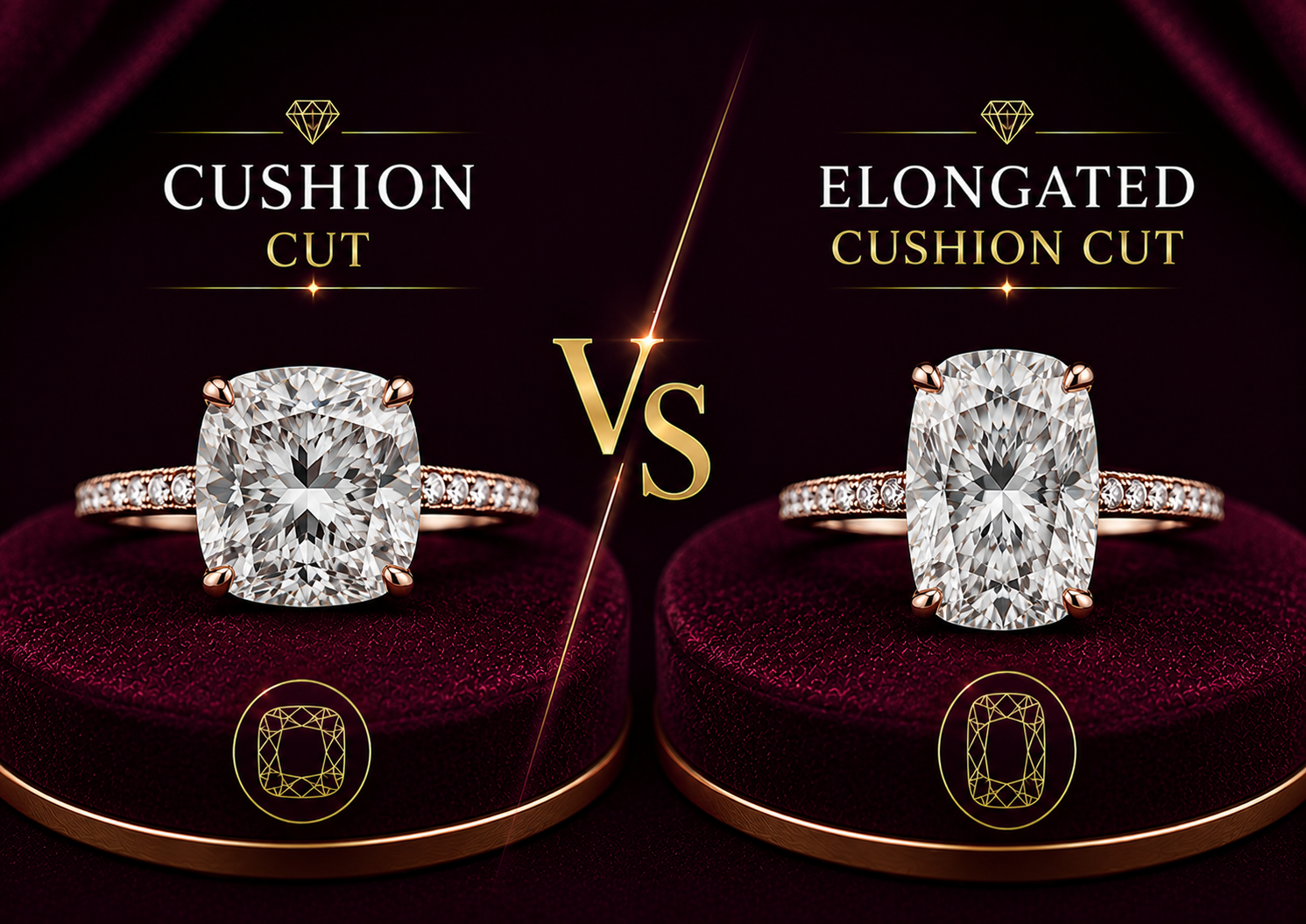
Both are variations of the cushion diamond shape. The main difference comes down to their proportions. A traditional cushion often looks closer to square, while an elongated cushion diamond has a longer outline that creates a more rectangular appearance.
Neither shape is automatically better. The right choice depends on your personal style, the look you want on your hand, and how you want the diamond’s proportions to appear.
Let’s compare cushion cut vs elongated cushion diamonds so you can choose with confidence.
Cushion vs Elongated Cushion: Quick Comparison
| Feature | Cushion Cut | Elongated Cushion |
|---|---|---|
| Overall shape | Square to slightly rectangular | Clearly rectangular |
| Length-to-width ratio | Usually closer to 1.00 | Typically above 1.00 |
| Visual appearance | Soft, balanced, classic | Longer, elegant, more slender |
| Finger coverage | More width-focused | More length-focused |
| Style | Romantic and traditional | Modern, graceful, elongated |
| Best for | Square diamond lovers | Buyers who want a longer outline |
| Main consideration | Can look less elongated on the finger | Requires careful proportion selection |
The most important thing to remember is that these categories can overlap. Cushion diamonds do not follow one universal shape standard, so you should always judge the actual diamond rather than relying only on its label.
What Is a Cushion Cut Diamond?
A cushion cut diamond has a square or rectangular outline with rounded corners. The shape takes its name from its cushion-like appearance.
The modern cushion cut developed from older cushion-shaped diamond styles. Today, cushion diamonds can feature different facet arrangements, including cushion brilliant and cushion modified brilliant styles.
This matters because two diamonds with similar outlines can show light differently.
The Gemological Institute of America (GIA) notes that cushion-cut diamonds can vary considerably in appearance. Their shape may range from square to rectangular, while their facet patterns can also differ. As a result, buyers should look at the individual diamond rather than assume every cushion will have the same visual performance.
A cushion cut engagement ring often appeals to people who want a softer alternative to sharper geometric shapes such as princess or emerald cuts.
The rounded corners give the shape a romantic feel, while the larger outline can create a substantial presence on the finger.
What Is an Elongated Cushion Diamond?
An elongated cushion diamond is a cushion-shaped diamond with a noticeably longer outline.
Instead of appearing almost square, the diamond stretches further from end to end. This creates a more rectangular silhouette while keeping the rounded corners that define the cushion shape.
The term “elongated cushion” describes the diamond’s proportions rather than a completely separate diamond shape.
In simple terms:
Square cushion: Shorter and wider appearance.
Elongated cushion: Longer and narrower appearance.
You may also see the term elongated cushion cut diamond used by retailers and diamond sellers. However, there is no single universal length-to-width ratio that officially defines every elongated cushion.
That is why the actual measurements and visual appearance matter.
What Is the Difference Between Cushion and Elongated Cushion?
The biggest difference between cushion vs elongated cushion is the diamond’s length-to-width ratio.
A diamond’s length-to-width ratio compares its length with its width. You calculate it by dividing the length by the width.
For example, if a diamond measures 8 mm long and 6 mm wide:
8 ÷ 6 = 1.33
That gives the diamond a 1.33 length-to-width ratio.
A cushion with a ratio close to 1.00 will appear more square. As the ratio increases, the outline becomes increasingly elongated.
However, the ratio alone does not tell you everything.
Two diamonds with the same ratio can still look different because of their facet patterns, corner shape, depth, and overall proportions.
So when comparing elongated cushion vs cushion, think of the ratio as a useful starting point, not the entire decision.
Square Cushion vs Elongated Cushion Diamond
The comparison between square cushion vs elongated cushion often comes down to personal preference.
A square cushion diamond has a balanced, compact appearance. Its outline looks closer to a square while maintaining the soft corners associated with the cushion shape.
An elongated cushion has a longer silhouette. This can create a more slender visual effect and give the diamond greater length across the finger.
Here is the simple difference:
Square Cushion Diamond
A square cushion may suit you if you prefer:
- A balanced, symmetrical outline
- A classic cushion appearance
- More width relative to length
- A softer alternative to a princess cut
- A traditional or romantic engagement ring style
Elongated Cushion Diamond
An elongated cushion may suit you if you prefer:
- A longer rectangular outline
- More visual length across the finger
- A graceful and modern appearance
- The rounded corners of a cushion with added length
- A shape that feels less square
Neither is inherently superior. It is really a question of whether you prefer a compact or elongated silhouette.
Cushion vs Elongated Cushion: Length-to-Width Ratio
The cushion diamond length to width ratio is one of the most useful measurements when comparing different cushion shapes.
A ratio around 1.00 creates a square appearance. Higher ratios create a more elongated look.
However, there is no universal “perfect” ratio for every buyer.
Some people prefer a cushion that is only slightly elongated. Others want a clearly rectangular diamond.
When choosing an elongated cushion ratio, consider how the diamond looks to your eye rather than selecting a number blindly.
For example, two diamonds with ratios of 1.20 and 1.30 may both look elongated, but the difference in appearance can be noticeable depending on their actual dimensions.
If you are shopping online, compare the listed measurements and look at the diamond from the top view. A video can also help because it gives you a better sense of the diamond’s outline and visual presence.
What Is the Best Ratio for an Elongated Cushion Diamond?
There is no single best ratio for an elongated cushion diamond.
That is one of the most important points to understand before buying.
A lower ratio gives you a shape that sits closer to square. A higher ratio creates a longer, more rectangular appearance.
The best ratio depends on your preferred look.
If you want a subtle elongation, you may prefer a cushion that sits closer to square. If you want a distinctly rectangular outline, you may prefer a higher ratio.
Instead of asking, “What is the perfect elongated cushion ratio?” ask:
“Which ratio gives me the outline I personally like?”
That approach is much more useful.
Also remember that the ratio should not be the only factor in your decision. Cut quality, facet pattern, brightness, and overall appearance all deserve attention.
Does an Elongated Cushion Look Bigger Than a Cushion?
An elongated cushion can sometimes look larger or more noticeable on the finger because its longer outline creates more visual length.
However, you should not assume that every elongated cushion will look bigger than every square cushion.
The diamond’s actual dimensions, carat weight, depth, and proportions all affect its appearance.
For example, a diamond with a higher carat weight does not automatically provide better finger coverage if much of that weight sits in its depth rather than its visible face-up dimensions.
When comparing cushion vs elongated cushion diamond options, check the millimeter measurements.
This gives you a more useful idea of visible size than carat weight alone.
Is an Elongated Cushion Flattering on the Finger?
For many people, yes.
The longer outline of an elongated cushion can create a visually lengthened appearance across the finger. This is one reason buyers often consider an elongated cushion engagement ring when they want a shape with more vertical length.
That said, “flattering” is subjective.
Your ring size, finger shape, setting design, and personal preference all influence how the diamond looks.
A solitaire setting, for example, puts most of the attention on the diamond’s outline. A halo can make the center stone appear larger, while side stones can change the overall visual balance.
If you are choosing between cushion or elongated cushion engagement ring styles, try to view both shapes on an actual hand whenever possible.
The diamond that looks best in a product listing may not be the diamond that feels best when you wear it.
Cushion Cut vs Elongated Cushion: Which Is Better?
The answer depends on what you want.
A traditional cushion may be better for you if you love a square or softly rounded outline. It can offer a classic cushion appearance without the stronger rectangular look of an elongated stone.
An elongated cushion may be better if you want a longer silhouette and more visual length across the finger.
Here is a simple way to think about it:
Choose a cushion if:
You prefer a square or slightly rectangular shape with a balanced appearance.
Choose an elongated cushion if:
You prefer a longer outline with rounded corners and a more rectangular silhouette.
So, is an elongated cushion better than a cushion cut?
Not necessarily.
It is simply a different proportion of the cushion shape.
Cushion vs Elongated Cushion Engagement Ring
When choosing between a cushion cut engagement ring and an elongated cushion diamond engagement ring, consider how the center stone works with the entire design.
A square cushion can look especially balanced in a classic solitaire or halo setting.
An elongated cushion can work beautifully in a solitaire setting because the longer shape becomes the main visual feature. It can also pair well with certain side-stone designs that follow the center stone’s length.
The setting can change the appearance of the diamond significantly.
For example, a halo surrounding a cushion can emphasize its outline and increase the overall visual footprint of the ring. A simple solitaire keeps the focus on the center stone itself.
Your choice should therefore include both the diamond and the setting.
Do not buy the diamond first and figure out the ring design later if the setting is an important part of your style.
How to Choose an Elongated Cushion Diamond
If you have decided that an elongated cushion is right for you, focus on more than the ratio.
1. Look at the Face-Up Shape
Start with the diamond’s outline.
Does it look elegantly elongated to you? Or does it appear too narrow?
There is no universal answer here. Your eye matters.
2. Compare Length-to-Width Ratios
Use the ratio to narrow your search, but do not treat it as an absolute quality score.
Compare several diamonds side by side and see which proportions you prefer.
3. Pay Attention to Faceting
Cushion diamonds can have different facet arrangements. These can affect the way the stone interacts with light and the visual pattern you see.
If possible, review high-quality images or videos of the actual diamond.
4. Check for a Bow-Tie Effect
Some elongated diamond shapes can show a dark bow-tie area across the center. The effect varies by diamond and depends on its faceting and proportions.
Do not automatically reject a diamond because you notice some contrast. Instead, judge how prominent it looks in real viewing conditions.
5. Consider Finger Coverage
Look at the diamond’s actual millimeter dimensions.
An elongated cushion diamond finger coverage can vary significantly between stones with the same carat weight.
A diamond’s face-up measurements often give you a clearer idea of how much space it will occupy on your finger.
6. View the Actual Diamond
This is especially important for cushion cuts.
A grading report provides important information about a diamond, but it cannot replace seeing the stone itself.
Look at the diamond from multiple angles and under different lighting conditions when possible.
Are Elongated Cushion Diamonds More Expensive?
Not automatically.
The price of an elongated cushion diamond depends on several factors, including carat weight, color, clarity, cut-related characteristics, certification, and overall market demand.
Unlike round brilliant diamonds, cushion cuts generally do not have a single standardized cut-grading system from GIA. This makes visual evaluation especially important when comparing cushion diamonds.
An elongated shape may also have different pricing depending on availability and buyer demand.
Therefore, you should not assume that an elongated cushion is always cheaper or more expensive than a square cushion of the same carat weight.
The best approach is to compare diamonds with similar quality characteristics and then evaluate their actual appearance and price.
Cushion Diamond Proportions Matter More Than Labels
One common mistake when comparing cushion vs elongated cushion is relying too heavily on the name.
“Elongated” tells you something about the outline, but it does not tell you whether the diamond has the best possible light performance for your preferences.
Likewise, “cushion” does not guarantee that a diamond will look perfectly square.
Cushion diamonds come in many proportions and facet patterns.
That is why you should evaluate:
- Length-to-width ratio
- Face-up measurements
- Facet pattern
- Brightness
- Contrast
- Depth and table information
- Symmetry
- Overall visual appearance
A beautiful diamond is more than a number on a grading report.
How to Decide: Cushion or Elongated Cushion?
If you are still unsure whether to choose a cushion or elongated cushion engagement ring, start with your preferred silhouette.
Ask yourself:
Do I want square or rectangular?
If you prefer a square appearance, look at traditional cushion proportions.
If you want a longer shape, explore elongated cushions.
Then compare actual diamonds rather than shopping by keywords alone.
A well-chosen cushion can look beautiful in a classic setting. A well-chosen elongated cushion can create a graceful, longer silhouette. The “better” option is the one that matches your taste, proportions, and budget.
FAQs
Is an elongated cushion better than a cushion cut?
An elongated cushion is not objectively better than a traditional cushion cut. The better choice depends on your preferred shape. Choose a cushion for a more balanced, square appearance or an elongated cushion for a longer, more rectangular outline.
What is the best ratio for an elongated cushion diamond?
There is no single best ratio for every elongated cushion diamond. A lower ratio creates a shape closer to square, while a higher ratio produces a more elongated appearance. The ideal ratio depends on the look you prefer and the proportions of the individual diamond.
Is an elongated cushion flattering on the finger?
An elongated cushion can create a visually longer appearance across the finger because of its rectangular outline. However, how flattering it looks depends on the wearer’s finger shape, ring size, setting style, and personal preference.
How do I choose an elongated cushion diamond?
When choosing an elongated cushion diamond, compare its length-to-width ratio, face-up measurements, facet pattern, symmetry, brightness, and overall appearance. Viewing the actual diamond through high-quality images or video can help you judge its proportions and light performance.
Are elongated cushion diamonds more expensive?
Elongated cushion diamonds are not automatically more expensive than square cushions. Price depends on factors such as carat weight, color, clarity, certification, cut-related characteristics, market demand, and the individual diamond’s overall appearance.
Should I choose a cushion or elongated cushion engagement ring?
Choose a cushion engagement ring if you prefer a softer, more balanced or square outline. Choose an elongated cushion engagement ring if you want a longer, more rectangular silhouette with rounded corners. Both can create a beautiful engagement ring, so the choice mainly comes down to personal style and preferred proportions.
Does an elongated cushion have more finger coverage?
An elongated cushion can provide strong visual length across the finger, but finger coverage depends on the diamond’s actual face-up dimensions rather than its shape name alone. Compare the length and width measurements when evaluating different stones.
What should I look for when comparing cushion vs elongated cushion diamonds?
When comparing cushion vs elongated cushion diamonds, look at the length-to-width ratio, face-up dimensions, facet pattern, symmetry, brightness, contrast, and overall visual appearance. The actual diamond matters more than the label alone.
Final Verdict: Cushion vs Elongated Cushion
The choice between cushion vs elongated cushion ultimately comes down to proportions and personal style.
A traditional cushion offers a softer, more balanced outline that can range from square to slightly rectangular. An elongated cushion stretches that outline, giving the diamond a more rectangular appearance and potentially more visual length across the finger.
If you love a classic, compact silhouette, a square cushion may be the right choice.
If you prefer a longer outline with rounded corners, an elongated cushion may be the better fit.
The smartest approach is to compare the actual diamonds side by side. Check their measurements, examine their proportions, look closely at their facet patterns, and consider how each one looks in the setting you plan to wear.
In the end, cushion cut vs elongated cushion is not really a battle with one winner. It is a choice between two different ways to wear one of the most romantic diamond shapes around.
And thankfully, there is no diamond referee waiting to blow the whistle if you pick the “wrong” one.