Choosing an engagement ring is about more than the diamond shape or metal color. The way the center stone sits on your finger can change the ring’s appearance, comfort, wedding-band fit, and how practical it feels every day.
That is where the cathedral vs low profile engagement ring debate comes in.
A cathedral setting gives the ring a raised, architectural look. A low-profile or low-set ring places the center stone closer to the finger. Neither is automatically better. The right choice depends on how you want your ring to look and how you plan to wear it.
There is also an important detail that often gets missed: cathedral and low profile are not always opposites. A cathedral design can be made lower than a traditional high-profile cathedral setting.
So, before choosing one, let’s look at how each design actually works.
What Is a Cathedral Setting Engagement Ring?
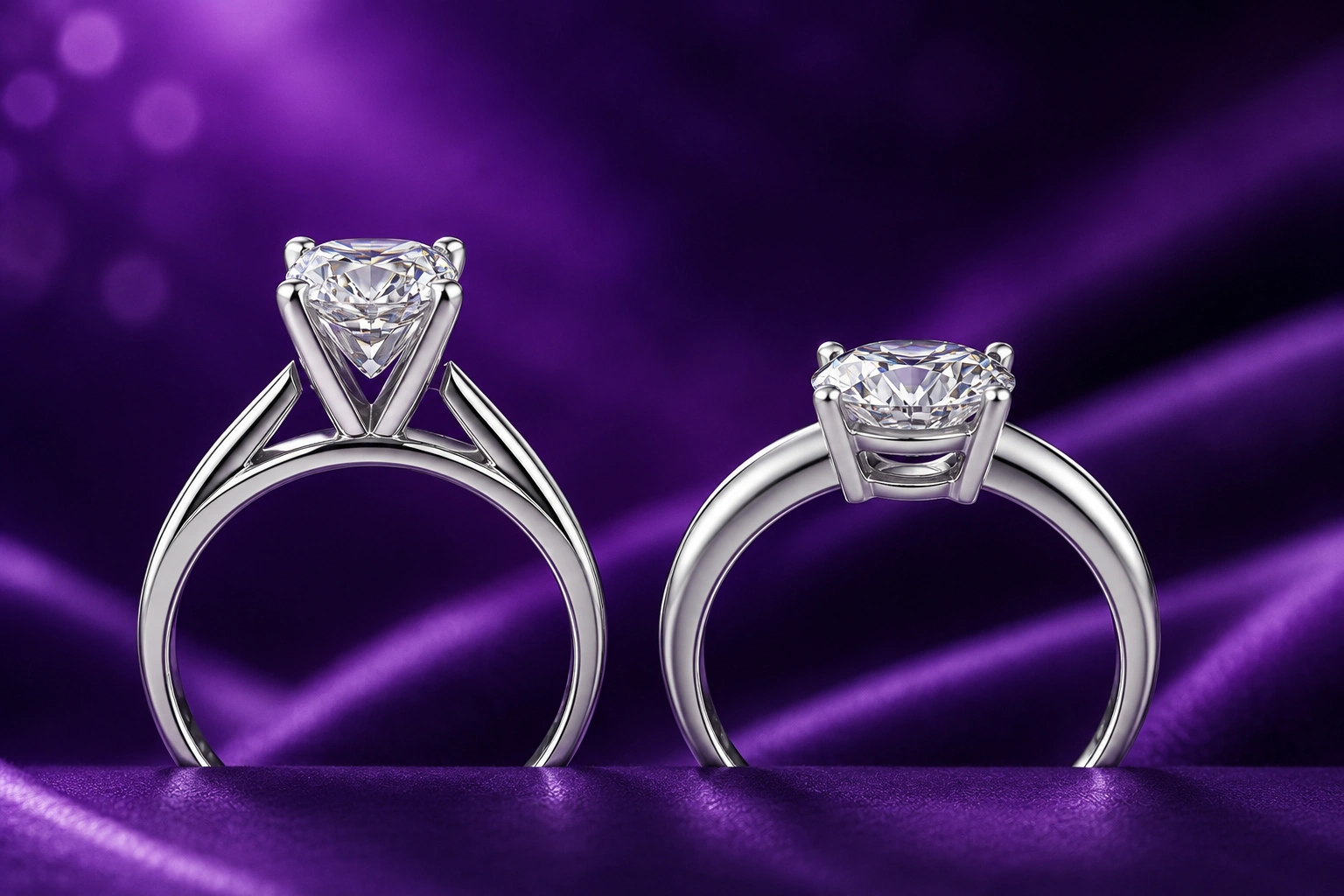
A cathedral setting engagement ring has raised metal shoulders or arches that sweep upward from the shank toward the center stone.
The design gets its name from the architectural arches found in cathedrals. These raised supports create a distinctive side profile and lift the center stone above the band.
GIA describes a cathedral setting as a design with slopes on either side of the diamond that lift the stone and make it more visible. A higher profile can also make the center stone appear more prominent.
The cathedral structure can also provide additional metal support around the center setting. However, the security of the diamond still depends on the complete setting, including the head, prongs, stone fit, and quality of construction.
Are Cathedral Rings High Profile?
Many cathedral rings are high profile, but not every cathedral ring is high set.
That distinction matters.
A traditional cathedral setting often raises the center stone to create more height and space underneath it. However, a jeweler can design the cathedral shoulders lower and create a more subtle profile.
This means you can have a low-profile cathedral engagement ring that keeps the architectural cathedral shoulders without creating an extremely tall center stone.
Think of it as a sliding scale rather than two boxes labeled “high” and “low.”
What Is a Low Profile Engagement Ring?
A low profile engagement ring places the center stone closer to the finger.
Instead of dramatically lifting the diamond above the shank, the setting keeps the stone lower within the ring’s structure.
The exact height varies by design, center stone, setting style, and ring construction. There is no universal height that automatically makes every ring “low profile.”
The easiest way to understand the difference is to look at the ring from the side.
If the center stone sits noticeably above the band, the ring has a higher profile. If the stone sits closer to the finger and the overall setting looks lower, it has a lower profile.
GIA recommends considering lower-profile mountings for people with active lifestyles because they are generally less likely to get knocked against or caught on things.
Cathedral Setting vs Low Profile: The Main Differences
The biggest difference comes down to height, structure, and how the ring interacts with your daily routine.
| Feature | Cathedral Setting | Low-Profile Setting |
|---|---|---|
| Center stone | Usually more elevated | Sits closer to the finger |
| Side profile | Architectural and raised | Lower and more streamlined |
| Visual impact | More dramatic | More understated |
| Snagging | Higher profile may catch more easily | Lower profile generally reduces catching |
| Wedding band | Often allows more clearance | Depends heavily on the design |
| Everyday practicality | Depends on height and construction | Often convenient for active wear |
| Style | Classic, elegant, detailed | Minimal, modern, practical |
The important word here is generally.
A well-designed cathedral ring can be comfortable and practical. A poorly designed low-profile ring can still have fit or maintenance issues.
The setting needs to work as a complete structure, not just match a label.
Cathedral Setting Pros and Cons
Pros of a Cathedral Setting
1. Strong visual presence
The raised shoulders draw attention toward the center stone. This gives the ring a more pronounced side profile and helps create that classic engagement-ring silhouette.
2. More room for design details
The arches can provide space for additional metalwork, pavé details, or other decorative elements. This makes cathedral settings particularly versatile for traditional, vintage-inspired, and detailed designs.
3. Excellent center-stone emphasis
Because the center stone sits higher, it can become the clear focal point of the ring. GIA notes that cathedral settings can make a diamond more visible and may make it appear larger.
4. Wedding-band flexibility
A higher center stone can create clearance for a wedding band to sit closer underneath the engagement ring. That can make a flush or near-flush stack easier to achieve, depending on the exact design.
Cons of a Cathedral Setting
1. More potential for snagging
The higher the center stone sits, the more exposed the setting becomes to everyday bumps and catches. GIA specifically notes that high-profile rings, including cathedral styles, are more likely to scratch or snag on things.
That does not mean a cathedral ring will constantly attack your sweater. It simply means height can increase the chance of interference.
2. Can feel less practical for some lifestyles
If your daily routine involves frequent manual work, sports, gloves, or activities where your hands take a beating, a lower profile may feel more convenient.
3. More areas to clean
Cathedral arches and decorative details can create spaces where dirt and residue collect. A detailed design may therefore need more attention during cleaning.
Low Profile Engagement Ring Pros and Cons
Pros of a Low Profile Engagement Ring
1. Comfortable for everyday wear
A lower center stone stays closer to the finger, which can reduce the feeling of having something tall on your hand.
2. Less likely to catch
A lower setting generally creates less height for clothing, hair, gloves, and other objects to catch on.
That is one reason GIA recommends lower-profile mountings for active or outdoorsy wearers.
3. Clean, understated appearance
If you prefer a sleek engagement ring that does not feel overly elevated, a low-profile design can be a great match.
4. Practical for active lifestyles
A lower profile can make an engagement ring easier to live with during everyday activities. Still, no ring setting is completely immune to damage, and you should remove or protect fine jewelry during activities that could expose it to significant impact.
Cons of a Low Profile Engagement Ring
1. Wedding-band fit can be more complicated
This is one of the biggest considerations.
Depending on how the center stone and setting are constructed, a low-profile engagement ring may not leave enough clearance for a straight wedding band to sit completely flush.
You may need a curved, contoured, notched, or specially designed wedding band.
So, if a perfectly flush wedding-band stack is important to you, discuss both rings with your jeweler before finalizing the engagement-ring setting.
2. Less dramatic side profile
If you love the architectural look of raised cathedral shoulders, a very low setting may feel too subtle.
3. Design limitations
Some larger center stones and certain setting combinations require additional space beneath the stone. A jeweler needs to balance the desired height with the stone’s proportions, setting structure, and wedding-band requirements.
High Profile vs Low Profile Engagement Ring: Which Is More Comfortable?
Comfort depends on more than height.
Ring size, band width, finger shape, setting design, metal edges, and the way the ring fits all affect comfort.
That said, a lower center stone can feel less intrusive because it sits closer to the finger.
A high-profile ring can also be perfectly comfortable for everyday wear. Many people simply prefer the feel and appearance of a raised center stone.
The better question is not “Which ring is comfortable?”
It is:
Which ring feels comfortable for your hands, your routine, and your preferences?
Try both styles on if possible. Move your fingers. Make a fist. Put on a jacket. If you plan to wear gloves regularly, try them with the ring too.
Your hand is the final reviewer.
Do Cathedral Rings Snag?
They can.
A cathedral ring with a higher center stone has more exposed height, which can increase the chance of catching on clothing or other objects. GIA specifically identifies high-profile rings as more likely to scratch or snag.
However, the word cathedral alone does not determine how much a ring will snag.
A low-profile cathedral with smooth edges and carefully finished prongs can behave very differently from a tall cathedral with an exposed center stone.
So when asking “do cathedral rings snag?”, look at the actual side profile rather than relying only on the setting name.
Do Low Profile Rings Snag?
A low-profile ring can still snag, but its lower construction generally reduces the amount of setting that can catch on things.
A bezel setting, for example, can offer an especially smooth and protective profile because metal surrounds the stone. GIA describes bezel settings as low-profile and less likely to catch.
For a prong-set low-profile engagement ring, the prongs still need to be secure and properly finished.
Low profile does not mean snag-proof.
Cathedral Engagement Ring Wedding Band Fit
Wedding-band compatibility deserves serious attention before you choose a setting.
A cathedral setting often raises the center stone enough to leave space underneath it. That can make it easier for a straight wedding band to sit flush against the engagement ring.
This is one reason cathedral settings remain popular with people who want a traditional two-ring stack. Brides also notes that the raised center of a cathedral setting can provide room for a wedding band to sit beneath the center stone.
With a low-profile engagement ring, the situation depends on the exact construction.
If the center stone sits close to the shank, a straight wedding band may meet the engagement ring before reaching the center stone. That can leave a small gap.
Some couples love the gap. Others look at it and think, “Absolutely not.”
Neither reaction is wrong.
If you want a flush wedding-band fit, tell your jeweler before the engagement ring is made. The setting can then be designed around the wedding band rather than trying to make the second ring cooperate later.
Are Cathedral Rings Good for Everyday Wear?
Yes, a cathedral engagement ring can be worn every day.
But the height matters.
A well-made cathedral setting with secure prongs and smooth finishing can be suitable for regular wear. However, a high-profile design can require more awareness because the elevated center stone has a greater chance of catching or taking an impact.
For people who work extensively with their hands or have an especially active routine, a lower profile may be the more practical choice.
The setting should match the wearer, not just the Pinterest board.
Which Is Better: Cathedral or Low Profile Engagement Ring?
There is no universal winner.
Choose a cathedral engagement ring setting if you want:
- A raised and elegant side profile
- More visual emphasis on the center stone
- Architectural shoulders
- More room for decorative metalwork
- Potentially easier clearance for a straight wedding band
Choose a low-profile engagement ring if you want:
- A lower center stone
- A streamlined appearance
- Less exposed height
- A setting that suits an active routine
- A more understated everyday feel
And if you want both?
Consider a low-profile cathedral setting.
It can give you the distinctive cathedral shoulders while keeping the center stone lower than a traditional high cathedral design.
Frequently Asked Questions
Are cathedral rings high profile?
Many traditional cathedral rings have a higher profile because their raised shoulders lift the center stone. However, cathedral rings are not automatically high profile. A jeweler can create a lower-profile cathedral design while retaining the characteristic cathedral shoulders.
Is a cathedral setting high or low?
A traditional cathedral setting is generally higher than a low-profile setting because its arched shoulders raise the center stone. However, the actual height depends on the ring’s design, center stone, basket, and setting construction.
Do cathedral rings snag?
Higher cathedral rings can have a greater chance of catching on clothing, hair, or other objects because the center stone sits higher. The amount of snagging depends on the ring’s height, prongs, edges, and overall construction.
Do low profile engagement rings snag?
Low-profile engagement rings generally have less exposed height, which can reduce the chance of catching on clothing and other objects. However, a low-profile ring is not completely snag-proof because prongs and other setting details can still catch.
Can you wear a wedding band with a low profile engagement ring?
Yes. However, depending on the setting, a straight wedding band may not sit completely flush against a low-profile engagement ring. Curved, contoured, notched, or custom wedding bands can provide a better fit when the center setting leaves limited clearance.
Does a cathedral engagement ring allow a wedding band to sit flush?
A cathedral setting often provides more clearance beneath the center stone because the shoulders raise it above the band. This can make a straight wedding band easier to fit flush, although the exact result depends on the engagement ring’s basket and setting design.
Is a low set engagement ring the same as a low profile ring?
The terms are often used interchangeably because both describe a ring where the center stone sits closer to the finger. However, there is no single universal height measurement that defines every low-profile or low-set ring, so the actual setting should be evaluated from its side profile. Current jewelry guides commonly treat the terms as closely related.
Final Words
The best way to compare cathedral vs low set engagement ring designs is to stop thinking only about labels and look at the actual ring profile.
A cathedral setting is defined by its raised shoulders and architectural structure. A low-profile setting focuses on keeping the center stone closer to the finger. These features can overlap.
If wedding-band compatibility is your top priority, check how the engagement ring and wedding band will sit together before choosing the final setting.
If everyday comfort and a lower profile matter most, compare low-set designs and pay close attention to the side view.
If you love a dramatic center stone and classic cathedral architecture, a cathedral setting may be the better match.
Ultimately, the best engagement ring setting for everyday wear is the one that balances appearance, comfort, security, lifestyle, and wedding-band compatibility.
Your ring should look beautiful from across the room, but it also needs to behave itself when you reach for your coffee.