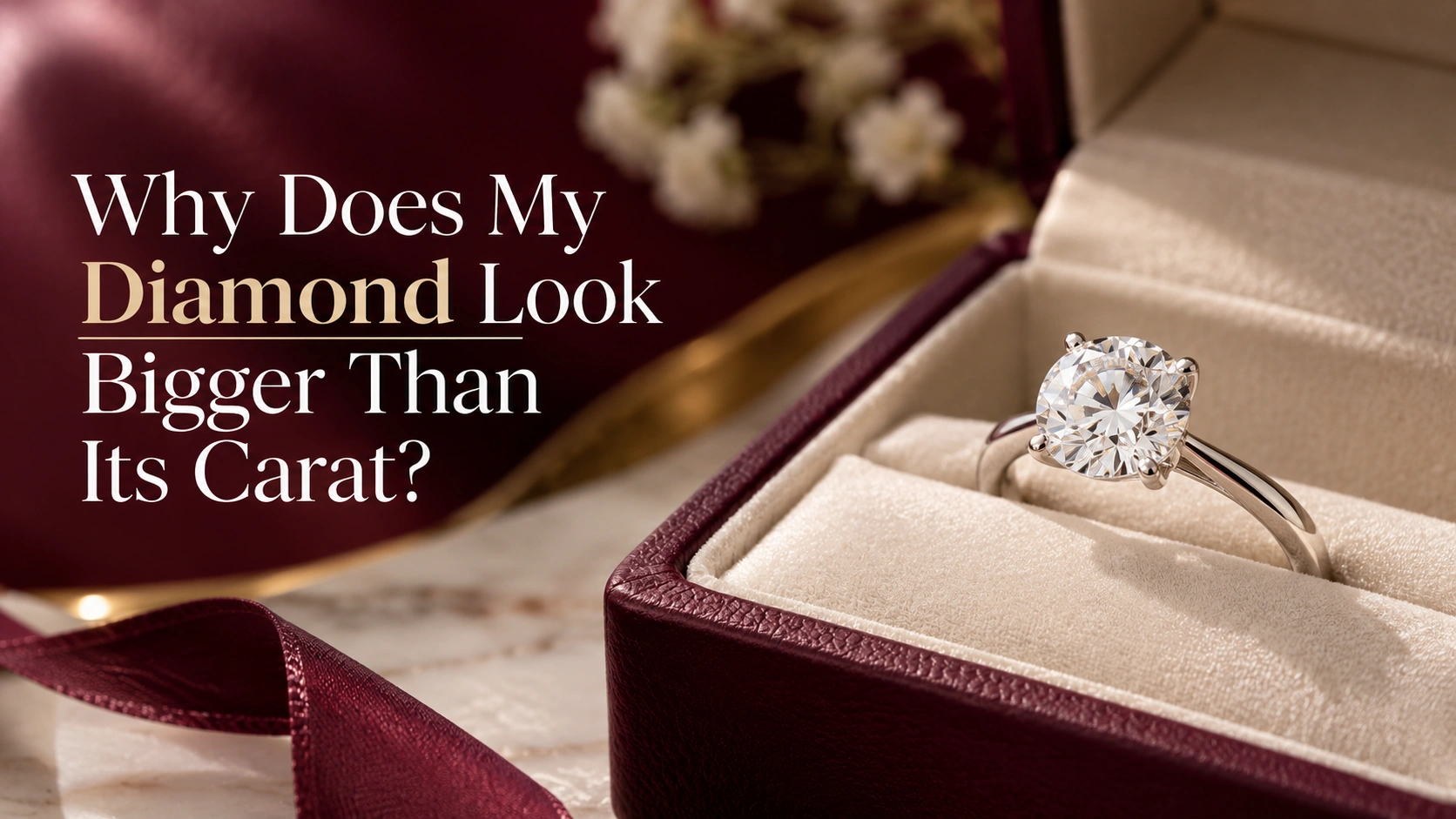
Yes, a diamond can look noticeably bigger than its carat weight suggests. That is because carat measures weight, not the amount of diamond you see from the top.
Two diamonds with the same carat weight can have different length and width measurements, different proportions, and even very different visual presence on the finger. Shape and cutting style also play a major role.
This is especially noticeable with elongated shapes such as oval, pear, and marquise diamonds. Their proportions can spread the diamond’s weight across a larger-looking face-up area, making the stone appear larger than a round diamond of the same weight.
Carat Weight Is Not the Same as Visible Size
The first thing to understand is that carat is a unit of weight.
One carat does not tell you exactly how large a diamond will look from above. A diamond’s visible size depends largely on its face-up dimensions, particularly its length and width.
Think of two objects that weigh the same but have different shapes. One could be tall and narrow while another is wider and flatter. Their weights might be identical, but they would not occupy the same amount of space when viewed from above.
Diamonds work in a similar way.
A diamond can carry relatively little of its weight in its visible surface and more in its depth. Another diamond can distribute more of that weight across its length and width. The second diamond may look larger even though both have the same carat weight.
That is why looking at carat alone is not enough if your goal is to find a diamond with strong visual spread.
What Does “Face-Up Size” Mean?
Face-up size refers to how large the diamond appears when you look at it from the top, as you normally would when it is set in a ring.
The most useful measurements are:
- Length
- Width
- Length-to-width ratio
- Overall proportions
- Depth
For a round diamond, length and width are usually very similar. For an oval, marquise, or pear, the diamond may have considerably more length relative to its width.
That elongated outline can make the stone occupy more visual space across the finger.
This is one reason GIA notes that oval diamonds can have a larger surface area than round diamonds of equal carat weight.
1. Diamond Shape Can Make It Look Bigger
Shape is one of the biggest reasons a diamond can look larger than its carat weight.
Elongated fancy shapes are particularly well known for creating this effect.
Oval Diamonds
An oval diamond has an elongated outline that can give it a larger face-up appearance than a round diamond of the same weight.
Its length also creates a visual effect that can make the finger appear longer and slimmer.
If you’re shopping specifically for this look, you can compare options in the oval cut diamond collections.
Marquise Diamonds
The marquise is even more elongated, with pointed ends and curved sides.
Because of this long outline, a marquise diamond can look substantially larger face-up than a round diamond with the same carat weight.
You can also explore marquise cut diamonds by carat weight when comparing how different weights translate into visible size.
Pear Diamonds
Pear-shaped diamonds combine a rounded end with a pointed end. Their elongated outline can also create an impression of greater size and length on the finger.
GIA describes pear diamonds as having a visual effect similar to other elongated shapes, although their exact appearance varies considerably with proportions and outline.
For shoppers comparing sizes, looking at pear cut diamonds by carat can be more informative than comparing carat weights alone.
2. The Diamond May Be Cut to Have More Visible Spread
The way a diamond is cut determines how its weight is distributed throughout the stone.
Some of the diamond’s material contributes to the visible face-up area. Other material contributes to depth underneath the girdle.
If more weight is concentrated in the depth, the diamond may not look particularly large from above.
If the proportions distribute more material across the length and width, the diamond can have greater visual spread.
This is why two diamonds with identical carat weights can have different measurements.
GIA’s research on round diamonds specifically recognizes the problem of “hidden” weight, where proportions can cause a diamond to look smaller from above than its weight would suggest.
The reverse situation can also happen: a diamond may have proportions that give it a larger face-up appearance for its weight.
3. Depth Has a Major Effect on Appearance
Depth is the distance from the table area down through the diamond to the bottom.
A diamond that is excessively deep can carry extra weight underneath the visible surface. That weight increases the carat total but does not necessarily make the diamond look larger from above.
This is one reason a heavier diamond is not automatically a larger-looking diamond.
However, there is an important catch: shallower does not automatically mean better.
A diamond can be physically wide and long but still have poor light performance if its proportions are too shallow. GIA notes that a shallow diamond can allow light to escape through the pavilion, producing a dull or flat appearance.
So the goal is not simply to find the shallowest diamond possible. The goal is to find a diamond with a good balance between visible spread and attractive light performance.
4. The Table and Other Proportions Affect What You See
The table is the large facet on the top of a diamond.
Along with the crown, pavilion, angles, depth, and other proportions, it influences how light moves through the stone and how the diamond looks face-up.
For round brilliant diamonds, these proportions are standardized enough that GIA provides an overall cut grade. Fancy shapes such as oval, pear, and marquise are more complicated because their outlines and facet arrangements vary considerably.
That means you should not judge a fancy-shaped diamond simply by applying a single set of “ideal” numbers.
Two ovals with identical carat weights and similar measurements can still look different because their outlines, facet patterns, symmetry, and light behavior differ.
5. Elongated Diamonds Often Look Bigger Per Carat
If your priority is maximum visual size, elongated shapes deserve particular attention.
A round diamond uses a relatively compact outline. An oval, pear, or marquise stretches the visible outline across the finger.
That creates more apparent length and can make the stone look larger without increasing the carat weight.
GIA specifically identifies oval, marquise, and pear shapes as examples where perceived size can exceed what a buyer might expect from the carat weight.
This does not mean every oval or marquise will look larger than every round diamond. Proportions still matter.
It simply means that shape changes how efficiently carat weight translates into visible size.
6. A Bigger-Looking Diamond Isn’t Always a Better Diamond
This is an important distinction.
If two diamonds are the same carat weight and one looks larger, it can be tempting to assume that the larger-looking stone is automatically the better choice.
Not necessarily.
A diamond’s appearance depends on more than spread. You also want to consider:
- Brightness
- Fire
- Scintillation
- Symmetry
- Polish
- Shape
- Proportions
- Color
- Clarity
- Overall visual appeal
GIA’s research emphasizes that diamond appearance is affected by the distribution of bright and dark areas, light return, and other aspects of the cut rather than a single measurement.
A diamond that looks enormous but has poor light performance may be less attractive than a slightly smaller diamond that looks bright and lively.
The best choice is usually a balance between face-up size and visual beauty.
How to Tell If a Diamond Has Good Visual Spread
If you’re comparing diamonds online, don’t stop at carat weight.
Look for the diamond’s actual dimensions, such as:
Length × Width × Depth
For example, two diamonds may both weigh 1 carat but have different measurements. The one with greater length and width may appear larger when viewed from the top.
For elongated shapes, also pay attention to the length-to-width ratio.
The ratio affects whether the diamond looks:
- Short and broad
- Balanced
- Long and narrow
There isn’t one perfect ratio for every shopper. Your preferred appearance matters, particularly with shapes such as oval and marquise.
Does a 1-Carat Oval Look Bigger Than a 1-Carat Round?
It often can.
An oval’s elongated outline and larger face-up surface area can make it appear larger than a round diamond of the same carat weight.
That’s one reason oval diamonds are popular with shoppers who want substantial visual coverage without simply increasing carat weight.
If you’re comparing actual options, a 1-carat oval diamond collection gives you a useful starting point.
Can a Diamond Look Bigger Because of Its Setting?
Yes, the ring setting can also influence perceived size.
A halo can make the overall center-stone area appear larger. A thin band can make the center diamond look more prominent by comparison. Certain settings also emphasize the length of elongated shapes.
However, this article is primarily about the diamond itself. If the stone already looks unusually large for its carat weight, its shape and proportions are likely the first things to examine.
What Should You Look For When Buying a Diamond That Looks Big?
If visual size is a major priority, use this checklist:
1. Compare measurements, not just carat weight
Check the length and width on the diamond’s grading report or listing.
2. Compare diamonds of the same shape
A 1-carat oval should be compared with other 1-carat ovals before drawing conclusions about its proportions.
3. Look at the depth
Excessive depth can hide weight below the girdle and reduce face-up spread.
4. Don’t chase extreme shallow proportions
A diamond that is unusually shallow may look wide but can suffer from poor light performance.
5. Check the actual diamond visually
Numbers are useful, but they cannot completely describe how an individual diamond looks.
6. Pay attention to shape
Oval, pear, and marquise diamonds are particularly worth considering if you want an elongated, larger-looking appearance.
7. Don’t sacrifice cut quality just for size
The largest-looking diamond is not necessarily the most attractive one.
Why Does My Diamond Look Bigger Than Its Carat?
Your diamond probably looks bigger than its carat because carat measures weight rather than visible dimensions.
Its shape may spread that weight across a larger face-up area, especially if it is an oval, pear, or marquise. Its cutting proportions may also give it greater visible spread than another diamond with the same weight.
The important thing is to judge the diamond by both how much it weighs and how much of that weight you can actually see.
If you’re shopping for maximum visual impact, compare the diamond’s dimensions, proportions, shape, and light performance together rather than choosing based on carat weight alone.
Frequently Asked Questions
Is a bigger-looking diamond better?
Not necessarily. A larger face-up appearance can be desirable, but a diamond also needs good light performance, symmetry, and overall visual appeal.
Which diamond shapes look biggest for their carat weight?
Elongated shapes such as oval, marquise, and pear often create a larger face-up appearance than a round diamond of the same weight.
Does a higher carat always mean a bigger-looking diamond?
No. Carat is weight. A deeper diamond can carry more weight below the girdle without looking proportionally larger from the top.
Can a shallow diamond look bigger?
Yes, greater face-up dimensions can make a diamond look larger. But an excessively shallow cut can negatively affect light performance, so shallow is not automatically better.
Should I choose carat weight or visible size?
If visual impact is your priority, pay attention to face-up measurements as well as carat weight. Ideally, choose a diamond that combines good spread with attractive light performance.
Final Words
A diamond’s carat weight tells you how much it weighs, not exactly how large it will look.
Shape, length, width, depth, proportions, and cut quality all affect its visual presence. Elongated shapes such as oval, pear, and marquise can make particularly efficient use of carat weight, while excessive depth can hide weight where you cannot see it.
So if your diamond looks bigger than its carat, that’s not unusual. It may simply have a shape and proportions that give it excellent face-up spread.
When comparing diamonds, think beyond the number on the scale: look at the measurements, evaluate the proportions, and judge the diamond’s actual appearance.