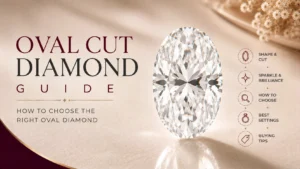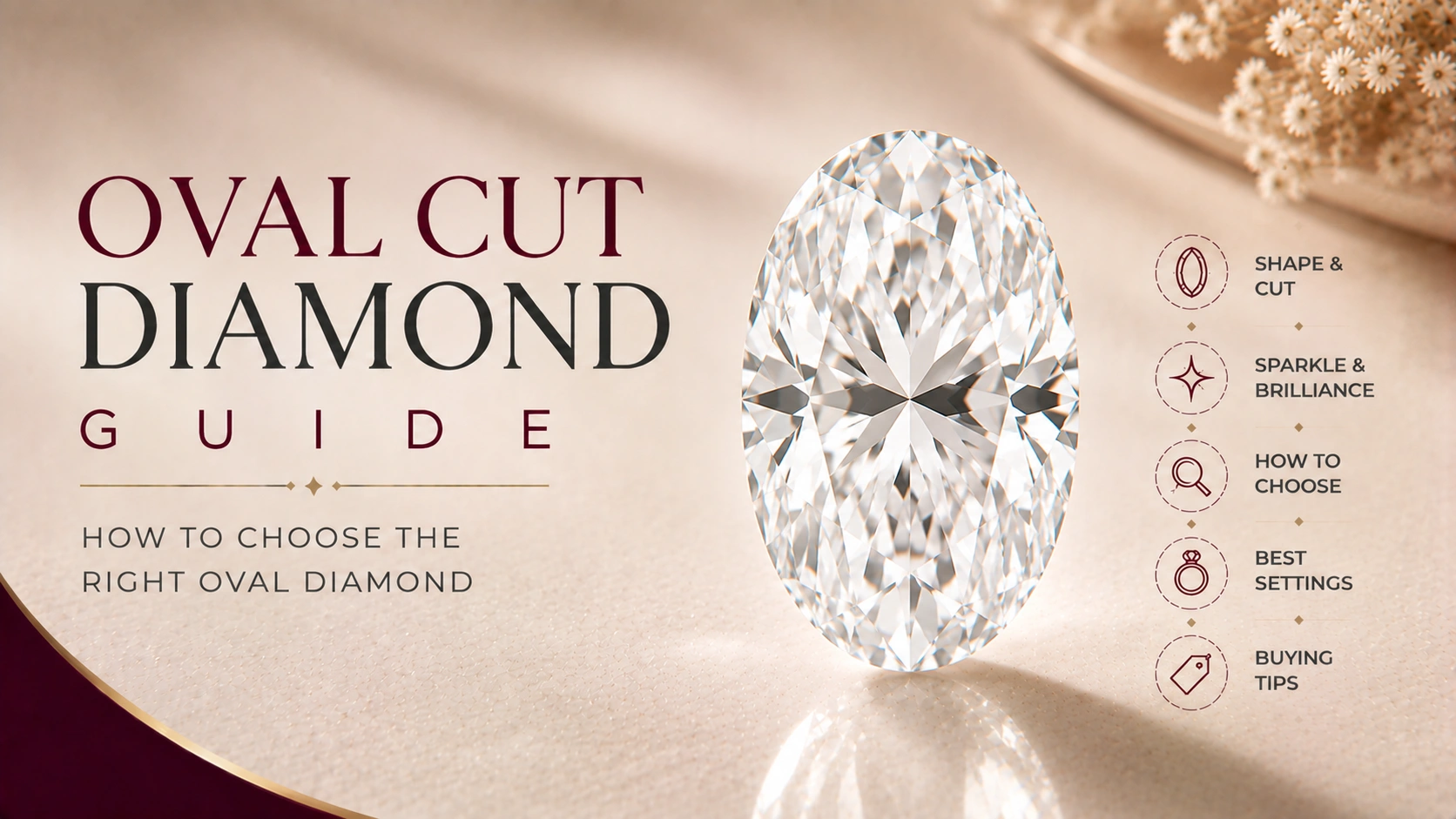
An oval cut diamond combines the brilliance of a round brilliant diamond with a longer, more distinctive shape. Its elongated outline can make the diamond appear larger from above while creating a finger-lengthening effect, which is one reason oval diamonds have become a popular choice for engagement rings.
But choosing an oval diamond is a little different from choosing a round brilliant.
There is no overall GIA cut grade for oval diamonds, so you need to pay closer attention to the diamond’s proportions, symmetry, shape, and light performance. The bow-tie effect is another important consideration because it can range from subtle and attractive to dark and distracting.
This oval diamond guide explains what to look for, including the best length-to-width ratio, how to evaluate the bow-tie effect, which color and clarity grades make sense, and which settings work particularly well.
What Is an Oval Cut Diamond?
An oval cut diamond is an elongated brilliant-cut diamond with a rounded outline rather than the circular outline of a round brilliant.
The modern oval brilliant is generally based on the brilliant facet arrangement used to create strong brightness and fire, but the facets are adapted to an elongated shape. This gives the diamond a combination of classic sparkle and a more distinctive silhouette.
Because the shape is longer than it is wide, an oval diamond can also have a larger-looking face-up appearance than a round diamond of the same carat weight.
Oval diamonds are classified as fancy-shaped diamonds. Unlike round brilliant diamonds, they do not receive an overall cut grade from GIA. GIA does, however, grade characteristics such as polish and symmetry.
That makes visual inspection especially important when choosing an oval.
Why Are Oval Diamonds So Popular?
Oval diamonds appeal to buyers who want brilliance without choosing the traditional round shape.
Some of their biggest advantages include:
- Elongated appearance
- Strong brilliance
- Large-looking face-up size
- Finger-lengthening effect
- Versatility with different ring settings
- Classic appearance with a slightly more distinctive silhouette
- Generally good compatibility with both modern and vintage-inspired designs
The elongated outline is particularly attractive to people who like the look of a larger diamond without moving to a significantly higher carat weight.
However, not every oval looks equally attractive. Two diamonds with the same carat weight can have noticeably different proportions and light performance.
That’s why the shape itself should be only the beginning of your evaluation.
Oval vs. Round Diamond
The biggest difference between an oval and a round diamond is the outline.
A round brilliant is symmetrical around a circular shape, while an oval is elongated along one axis.
| Feature | Oval Diamond | Round Diamond |
|---|---|---|
| Shape | Elongated and rounded | Circular |
| Sparkle | High | Very high |
| Face-up appearance | Often looks large for its weight | More compact |
| Finger appearance | Can create a lengthening effect | More neutral |
| Cut grading | No overall GIA cut grade | GIA provides cut grade |
| Bow-tie | Can be present | Not characteristic of round brilliants |
| Style | Elegant, elongated, distinctive | Classic and traditional |
Round diamonds are generally easier to evaluate because standardized cut grading provides an additional reference point.
With an oval, the buyer has to pay more attention to the individual stone.
For a broader comparison of diamond shapes, you can explore this diamond shape guide.
Oval Diamond Length-to-Width Ratio
The length-to-width ratio is one of the most important measurements to understand when shopping for an oval diamond.
It compares the diamond’s length with its width.
For example, if an oval measures 9.0 mm long and 6.0 mm wide:
9 ÷ 6 = 1.50
The diamond therefore has a length-to-width ratio of 1.50:1.
A lower ratio produces a shorter, wider oval, while a higher ratio creates a longer, narrower appearance.
Common Oval Diamond Ratios
| Length-to-Width Ratio | General Appearance |
|---|---|
| 1.20–1.29 | Short and rounded |
| 1.30–1.40 | Moderately elongated |
| 1.41–1.50 | Classic elongated oval |
| 1.51+ | Longer and narrower |
There isn’t one universally perfect ratio.
GIA notes that many oval diamonds fall around the 1.30:1 to 1.50:1 range, with personal preference playing a major role in the ideal appearance.
What Is the Best Oval Diamond Ratio?
For many buyers, a ratio between approximately 1.30 and 1.50 offers a pleasing balance between width and length.
A ratio around 1.30 to 1.40 tends to create a fuller, more rounded oval.
A ratio around 1.40 to 1.50 generally produces a more elongated appearance.
Above 1.50, the diamond becomes progressively longer and narrower.
The right choice ultimately depends on the look you prefer.
Don’t reject a beautiful diamond simply because its ratio falls outside a commonly recommended range. Ratio describes the outline, not the complete quality of the diamond.
A well-proportioned 1.52 oval can look better than a poorly balanced 1.40 oval.
What Is the Bow-Tie Effect in an Oval Diamond?
The bow-tie effect is one of the most important things to understand before buying an oval diamond.
It appears as a darker area extending across the center of the diamond, creating a shape that resembles a bow tie.
Some degree of contrast is common in oval diamonds. The problem is when the center becomes excessively dark and remains distracting when the diamond is viewed from different angles and in different lighting conditions.
The bow-tie effect is related to how the diamond’s facets interact with light.
Is a Bow-Tie Effect Bad?
Not necessarily.
A subtle bow-tie can provide contrast and visual depth. A strong, persistent bow-tie can make the center of the diamond appear noticeably darker and reduce its overall visual appeal.
The goal is therefore not necessarily to find an oval with absolutely no bow-tie.
Instead, look for one where the effect is light, balanced, and not distracting.
GIA recommends viewing an oval diamond in person or requesting video because bow-tie visibility can vary significantly between individual stones.
How to Check for Bow-Tie
When reviewing an oval diamond:
- Look at it face-up.
- Examine the center of the stone.
- Check whether the dark area dominates the diamond.
- Watch the diamond move through different lighting conditions.
- Review a high-quality video when buying online.
- Compare several ovals rather than judging one stone in isolation.
Don’t rely on the length-to-width ratio alone to predict bow-tie severity.
Two diamonds with nearly identical ratios can display very different light patterns.
How to Choose a Well-Cut Oval Diamond
Because oval diamonds don’t receive an overall GIA cut grade, evaluating the individual stone matters.
Here are the most important things to check.
1. Look at the Overall Shape
A good oval should have a smooth, balanced outline.
Avoid stones with:
- Noticeably flat shoulders
- Uneven curves
- Bulging areas
- Asymmetrical ends
- A shape that looks too narrow or too wide for your preference
The two sides should look balanced when viewed face-up.
2. Check Symmetry
Symmetry is especially important for an oval because the shape has two major axes.
Imagine drawing a line through the center of the diamond from end to end. The two halves should look reasonably similar.
Then imagine another line across the center. Again, the shape should appear balanced.
GIA grades symmetry from Excellent to Poor, so the grading report can provide useful information here.
3. Examine the Bow-Tie
A good oval should have lively light return across the stone rather than a large, distracting dark band.
4. Review the Measurements
Don’t focus only on carat weight.
Look at the diamond’s millimeter dimensions as well.
Two diamonds with the same carat weight can have different face-up dimensions because weight can be distributed differently through the stone.
5. Check the Girdle
The girdle is the outer edge of the diamond.
Extremely thin areas can increase the risk of damage, particularly around vulnerable parts of the stone.
GIA reports girdle thickness as part of the diamond’s proportion information.
6. Review Polish and Symmetry
Since fancy shapes don’t receive an overall GIA cut grade, polish and symmetry become particularly useful indicators on the grading report.
Excellent or Very Good grades are generally preferable when other factors are comparable.
What Color Is Best for an Oval Diamond?
Oval diamonds can show body color somewhat differently from round brilliant diamonds.
There isn’t one color grade that is automatically right for every buyer.
Your choice depends on:
- Diamond size
- Setting metal
- Personal color sensitivity
- Budget
- Whether you want a very white appearance
For a colorless-looking diamond, buyers often consider the G through D range.
If you’re comfortable with a little warmth, moving lower on the color scale can potentially reduce cost.
The metal can also affect the appearance of color. Yellow or rose gold settings can make a warmer diamond look intentional and harmonious, while white metals may make color easier to notice.
Rather than paying automatically for the highest color grade, compare diamonds visually.
For more information, see the guide to diamond color.
What Clarity Is Best for an Oval Diamond?
Clarity refers to the presence of internal and external characteristics in a diamond.
Oval diamonds are brilliant-style diamonds, which means their faceting can help disguise some inclusions better than step-cut shapes such as emerald cuts.
That doesn’t mean clarity should be ignored.
The right approach is to look for an eye-clean diamond rather than automatically buying the highest clarity grade available.
A diamond can have a high clarity grade and still cost substantially more without producing a noticeable visual improvement.
On the other hand, some inclusions can be visible depending on their location, size, color, and the diamond’s overall appearance.
When comparing stones, consider clarity together with price and visual performance.
You can learn more about the grading scale in the diamond clarity guide.
How Much Does an Oval Diamond Cost?
The price of an oval diamond depends on much more than carat weight.
Important factors include:
- Carat weight
- Color
- Clarity
- Proportions
- Symmetry
- Polish
- Natural vs. lab-grown origin
- Certification
- Overall visual quality
- Bow-tie severity
Oval diamonds can offer attractive face-up size for their weight, which can make them appealing to buyers focused on appearance per dollar.
However, avoid assuming that every oval is automatically a bargain.
A poorly proportioned stone with a strong bow-tie may be less attractive than a smaller, better-performing diamond.
For budgeting, compare the actual diamond rather than buying based solely on carat weight.
You can also use a diamond carat guide when deciding how much weight makes sense for your budget.
Do Oval Diamonds Look Bigger?
One of the biggest attractions of an oval diamond is its elongated face-up appearance.
Because more of the diamond’s outline extends lengthwise, an oval can look larger than a round diamond with the same carat weight.
However, carat weight is a measurement of mass, not visible size.
Two one-carat oval diamonds can have different millimeter measurements and therefore appear different in size.
That’s why you should compare:
Carat weight + millimeter dimensions + proportions
rather than carat weight alone.
This is particularly important when you’re trying to maximize visible size within a fixed budget.
Best Settings for Oval Diamond Engagement Rings
Oval diamonds are versatile and work with many engagement-ring settings.
Solitaire
A solitaire puts almost all of the attention on the center stone.
It is a strong choice if you want the oval’s elongated silhouette to be the main feature.
Halo
A halo surrounds the oval with smaller diamonds and can make the center stone look larger.
However, the halo should be proportionate to the oval. A very large halo can change the visual balance of the ring.
Hidden Halo
A hidden halo adds diamonds beneath the center stone rather than creating a visible halo around the perimeter.
This can give the ring additional sparkle while preserving the clean outline of the oval.
A hidden halo ring guide can help if you’re considering this style.
Three-Stone Setting
An oval center can be paired with side stones for a more substantial look.
The elongated center stone can work particularly well with tapered or complementary side shapes.
Bezel Setting
A bezel surrounds the diamond with metal and provides substantial protection around the stone.
It creates a more modern, streamlined appearance compared with traditional prongs.
Cathedral Setting
A cathedral setting raises the center stone above the shoulders of the ring, creating a dramatic profile.
If you’re deciding between different setting profiles, comparing cathedral vs. low-profile engagement rings can help.
What Prongs Are Best for an Oval Diamond?
Prongs help secure the diamond in the setting.
Oval diamonds are commonly set with four or six prongs, although the exact design varies by ring.
Because an oval has rounded ends rather than sharp points, it doesn’t have the same pointed-tip vulnerability as a pear or marquise diamond.
Still, the ends should be properly secured.
A common approach is to position prongs near the curved ends while using additional prongs along the sides as needed.
The best design depends on the setting, diamond dimensions, and jeweler’s construction.
You can learn more about their role in why engagement rings have prongs.
Are Oval Diamonds Durable?
Diamond is an extremely hard material, but hardness does not make a diamond impossible to damage.
Oval diamonds have rounded ends, which removes the sharp points found on shapes such as pear and marquise diamonds.
That can make the outline relatively practical for everyday engagement rings.
The setting still matters.
A secure setting can protect the diamond from impacts, while an exposed stone may be more vulnerable during activities that put stress on the ring.
Regular inspection is a good idea, especially if you wear your engagement ring every day.
Oval Diamond Pros and Cons
Pros
- Elegant elongated shape
- Strong brilliance
- Can appear larger for its carat weight
- Creates a finger-lengthening effect
- Works with many ring settings
- Distinctive without being overly unusual
- Available in a wide variety of proportions
Cons
- No overall GIA cut grade
- Bow-tie effect can be significant in some stones
- Proportions vary considerably
- Symmetry needs careful inspection
- Color may be more noticeable in some stones
- Ratio alone cannot tell you whether the diamond is beautiful
For buyers who prioritize visual size and an elongated silhouette, the advantages can outweigh these considerations. The key is to evaluate the actual diamond rather than relying on a single specification.
Oval vs. Other Popular Diamond Shapes
Oval isn’t the only elongated diamond shape worth considering.
Oval vs. Pear
Pear diamonds combine a rounded end with a pointed tip, creating a teardrop appearance.
Oval diamonds have two rounded ends, making them a softer alternative.
For a direct comparison, see the guide to marquise vs. oval vs. pear.
Oval vs. Marquise
Marquise diamonds are considerably more pointed and dramatic.
Oval diamonds offer a softer silhouette while retaining some of the finger-lengthening effect associated with elongated shapes.
Oval vs. Cushion
Cushion diamonds generally have broader, softer corners and can range from square to elongated.
If you prefer a softer outline but aren’t sure whether an oval is right for you, comparing cushion vs. elongated cushion can help.
Oval vs. Emerald
Emerald cuts have step facets rather than the brilliant-style faceting typically associated with oval diamonds.
Emerald cuts emphasize clarity, broad flashes, and a hall-of-mirrors appearance, while ovals generally offer more scintillation.
How to Buy an Oval Diamond
Before buying, work through this checklist.
Step 1: Decide on the Overall Shape
Do you prefer:
- Short and rounded?
- Classic oval?
- Long and slender?
Use the length-to-width ratio as a starting point.
Step 2: Compare Several Diamonds
Don’t evaluate only one stone.
Compare multiple ovals with similar carat weights and ratios.
This makes differences in shape, bow-tie, symmetry, and brightness much easier to recognize.
Step 3: Check the Bow-Tie
Look at the stone in motion.
If you’re shopping online, request or watch a high-quality video.
A still image may not show how the diamond performs in different lighting conditions.
Step 4: Review the Grading Report
Check:
- Carat weight
- Color
- Clarity
- Polish
- Symmetry
- Measurements
- Girdle information
Remember that an oval won’t have the same overall GIA cut-grade framework as a round brilliant.
Step 5: Compare Millimeter Size
Don’t compare carat weight alone.
Check the actual length and width to understand how large the diamond will appear from above.
Step 6: Choose Color and Clarity Based on Appearance
Don’t automatically pay for the highest grades.
Look for the point where additional grading quality stops producing a meaningful visual improvement for your eyes and budget.
Step 7: Choose the Setting
Consider whether you want:
- Solitaire
- Halo
- Hidden halo
- Three-stone
- Bezel
- Cathedral
- Vintage-inspired setting
The setting can dramatically change how the same oval diamond looks.
Step 8: Consider the Ring Size and Finger Proportions
An oval’s elongated shape can be particularly flattering on many fingers, but the ideal ratio is ultimately personal.
If you’re still determining the ring size, an engagement ring size guide can help.
Oval Diamond Buying Checklist
Before purchasing, make sure you can answer yes to these questions:
- Do I like the oval’s overall shape?
- Is the length-to-width ratio right for my taste?
- Is the diamond symmetrical?
- Does it have good polish and symmetry grades?
- Is the bow-tie subtle rather than distracting?
- Does the diamond look lively across the entire stone?
- Have I checked the actual millimeter dimensions?
- Is the color appropriate for my setting?
- Is the clarity eye-clean?
- Does the price make sense compared with similar diamonds?
- Is the setting secure?
- Have I reviewed the diamond’s grading report?
- If buying online, have I watched a video of the actual stone?
If the answer to all of these is yes, you’re in a much stronger position to choose an oval diamond you’ll love.
Frequently Asked Questions About Oval Diamonds
Is an oval diamond a good choice for an engagement ring?
Yes. Oval diamonds combine strong brilliance with an elongated shape that can look large and create a lengthening effect on the finger. They also work well with a wide variety of engagement-ring settings.
What is the ideal oval diamond ratio?
There is no single ideal ratio. Many buyers prefer approximately 1.30:1 to 1.50:1, with lower ratios producing a fuller oval and higher ratios creating a more elongated shape. Personal preference should ultimately determine the ratio you choose.
Is a bow-tie normal in an oval diamond?
Yes. Some degree of bow-tie is common in oval diamonds. The important question is how strong and distracting it is. A subtle bow-tie can add contrast, while a heavy dark band can negatively affect the diamond’s appearance.
Do oval diamonds have a cut grade?
GIA does not assign an overall cut grade to oval diamonds. Instead, its grading report includes factors such as polish and symmetry. This makes visual evaluation particularly important when selecting an oval.
Do oval diamonds look bigger than round diamonds?
An oval can have a larger-looking face-up appearance than a round diamond of the same carat weight because of its elongated shape. Actual appearance depends on the diamond’s measurements and proportions.
What color is best for an oval diamond?
The best color depends on your desired appearance, setting metal, diamond size, and budget. There is no single color grade that is best for every oval diamond buyer.
What clarity should I choose for an oval diamond?
Look for an eye-clean diamond rather than automatically choosing the highest clarity grade. Brilliant-style faceting can help disguise some inclusions, but the actual stone should always be evaluated.
Is an oval diamond good for short fingers?
Oval diamonds can create a visually lengthening effect because of their elongated outline. However, the best ratio depends on your personal preference and the proportions of your hand.
Is an oval diamond better than a round diamond?
Neither is universally better. Round diamonds offer a classic shape and standardized cut grading, while oval diamonds provide an elongated appearance and can offer strong visual size. The right choice depends on your priorities.
Final Takeaway
An oval diamond can be an excellent choice if you want the brilliance of a brilliant-cut diamond with a more elongated and distinctive silhouette.
But choosing a beautiful oval requires more than picking a carat weight and color grade.
Pay particular attention to:
Length-to-width ratio + shape symmetry + bow-tie + face-up size + color + clarity + setting
Most importantly, evaluate the actual diamond.
A ratio that looks perfect on paper does not guarantee a beautiful stone, and a subtle bow-tie is not necessarily a problem. Compare several diamonds, review the grading report, inspect the stone in motion, and choose the one that looks brightest and most balanced to your eyes.
That’s the best way to turn an oval diamond from a specification on a report into a stone you’ll be happy to wear every day.