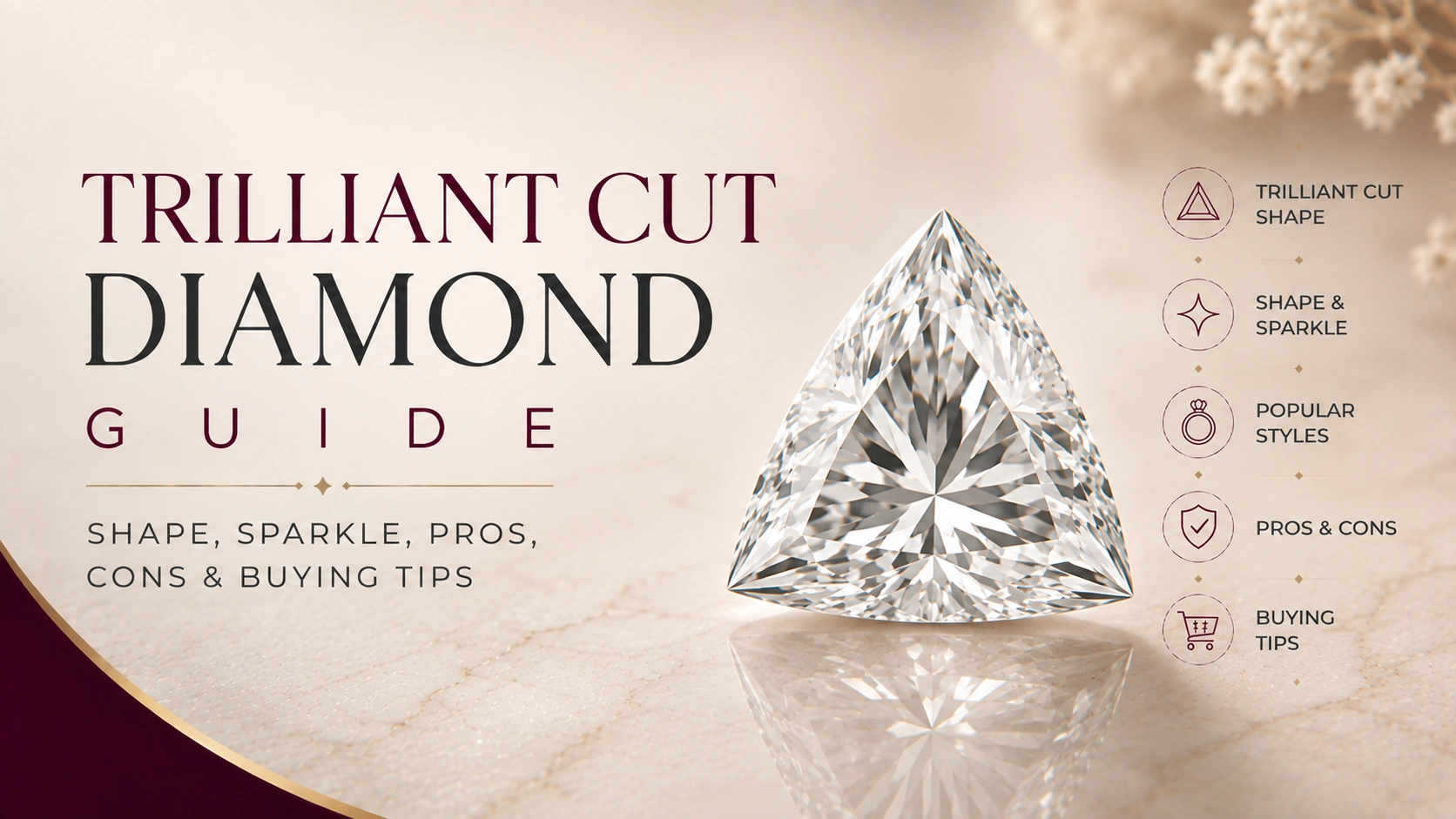
A trilliant cut diamond is a distinctive triangular diamond known for its geometric outline and lively brilliance. It can make a dramatic center stone, but it is especially popular as a side stone because its triangular profile frames a larger center diamond beautifully.
One thing that makes trilliant diamonds confusing is the terminology. “Trilliant” and “trillion” are often used interchangeably in the jewelry industry, even though some diamond professionals use the terms to distinguish between different triangular facet arrangements or proportions.
If you’re considering one for an engagement ring, this guide explains what makes the shape different, what to look for when buying one, and how to protect its pointed corners.
What Is a Trilliant Cut Diamond?
A trilliant cut diamond is a triangular-shaped brilliant-cut diamond. Its three-sided outline gives it a modern, architectural appearance, while its brilliant-style faceting creates flashes of white light and color.
The shape can have straight or slightly curved sides, depending on the particular cutting style. This means two diamonds both described as “trilliant” can look noticeably different from one another.
Trilliant diamonds are also commonly called trillion, trillian, or triangular brilliant cuts. Because the terminology isn’t consistently standardized, shoppers should pay attention to the actual diamond’s measurements, faceting, symmetry, and appearance rather than relying on the name alone.
If you’re still learning the difference between diamond shape and cut, a broader diamond shape guide can help put the trilliant into context.
Trilliant vs. Trillion: What’s the Difference?
This is one of the most confusing parts of shopping for a triangular diamond.
In everyday jewelry retail, trilliant and trillion can refer to the same general family of triangular brilliant-cut diamonds. Some sources, however, use the names to distinguish between variations in side shape, faceting, or depth.
Some descriptions characterize trilliants as having more curved sides and trillons as having straighter sides. Other sources use the terminology differently.
The safest approach is not to assume that the name tells you everything about the diamond.
When comparing two stones, look at:
- Shape and outline
- Length-to-width ratio
- Depth percentage
- Table percentage
- Facet arrangement
- Symmetry
- Actual photographs or video
- How the corners are finished and protected
In other words, judge the diamond, not just the label.
What Does a Trilliant Diamond Look Like?
From the top, a trilliant diamond has a triangular outline with three sides and three corners. Many examples are close to an equilateral triangle, although proportions can vary.
Its visual personality is quite different from a round diamond. A round brilliant has a symmetrical circular outline, while a trilliant immediately draws attention with its angular silhouette.
The shape can look:
- Modern and geometric
- Bold without being oversized
- Bright and lively
- Architectural
- Distinctive compared with traditional diamond shapes
The triangular outline also makes trilliant diamonds particularly useful in three-stone and side-stone designs.
Small trilliant diamonds placed on either side of a larger center stone can create a strong visual transition from the center of the ring toward the band.
How Many Facets Does a Trilliant Diamond Have?
There isn’t one universal facet count for every stone sold under the trilliant name.
Common descriptions place many trilliant-style diamonds in the 31-to-50-facet range, although modern examples and different cutting conventions can vary.
The important point is that facet count alone does not determine whether a diamond looks beautiful.
Two stones with similar facet counts can have very different light performance because of differences in proportions, symmetry, facet angles, polish, and overall craftsmanship.
How Does a Trilliant Diamond Sparkle?
Trilliant diamonds use brilliant-style faceting to produce brightness, fire, and scintillation.
When light enters the diamond and is reflected back toward the viewer, you can see:
- Brightness: white light reflected from the diamond
- Fire: flashes of spectral color
- Scintillation: flashes of light and dark that appear as the diamond or light source moves
These are the visual components that people generally describe as “sparkle.” GIA explains these same concepts when discussing diamond appearance and cut quality, although its standardized cut-grade system applies specifically to round brilliant diamonds.
Because trilliant diamonds are fancy shapes, their appearance depends heavily on the individual stone. A shallow stone may show impressive face-up spread but sacrifice some light performance, while a very deep stone can lose some of its visual size.
That’s why photographs, video, and careful evaluation matter when buying one.
Trilliant Diamond Pros and Cons
Pros
Distinctive appearance:
The triangular shape is immediately recognizable and less conventional than a round or oval diamond.
Strong brilliance:
Well-made examples can show attractive brightness and lively flashes.
Excellent for side stones:
The shape naturally works alongside many center-diamond shapes.
Can look substantial for its weight:
Some triangular diamonds have relatively shallow profiles, giving them generous face-up spread.
Works with modern and geometric designs:
The angular silhouette fits particularly well with contemporary and Art Deco-inspired jewelry.
Cons
The corners need protection:
The three corners are more vulnerable than the curved edge of a round diamond.
Terminology can be confusing:
“Trilliant” and “trillion” aren’t consistently used across the trade.
No universal fancy-shape cut grade:
Unlike round brilliants, trilliant diamonds don’t have the same standardized GIA cut-grade system.
Quality varies considerably:
Two stones with similar carat weights can have very different appearances because of their proportions and faceting.
Finding the right setting matters:
The pointed corners need appropriate protection from accidental impact.
How to Choose a Trilliant Diamond
1. Look at the Overall Shape
Start with the outline.
A good trilliant should have an intentional, balanced appearance. Look for:
- Consistent triangular proportions
- Good symmetry
- Even sides
- No obviously awkward or distorted corners
- A pleasing relationship between the table and the surrounding facets
Don’t choose a stone based only on its certificate specifications. Look at the actual diamond.
2. Pay Attention to Depth
Depth is particularly important with triangular diamonds because cutting too shallow or too deep can affect both appearance and light performance.
Some trilliant-style diamonds are cut relatively shallow to maximize their face-up size. But excessive shallowness can compromise brilliance.
Rather than searching for one magic depth percentage, compare stones visually and consider the complete proportion set.
3. Check Symmetry Carefully
Symmetry is especially noticeable in a triangular shape.
If one side looks different from another, or one corner appears out of alignment, the imbalance can be obvious when the diamond is mounted.
A well-balanced outline can make the entire ring look more polished.
4. Don’t Ignore the Corners
The corners are one of the most important considerations when buying a trilliant.
A diamond is extremely hard, but hardness does not mean it is impossible to chip. Pointed corners are more exposed to impact than the rounded perimeter of a round brilliant.
Look for a setting that provides appropriate protection around the corners. Prongs are commonly used to cover vulnerable points, and some triangular diamonds have slightly softened or bruted corners for additional durability.
5. Consider Clarity
Clarity is the degree to which a diamond has internal inclusions and external blemishes.
For a trilliant center stone, examine the actual diamond rather than automatically paying for the highest clarity grade.
The goal is generally to find a diamond that appears clean to the naked eye while allocating your budget to characteristics that have a stronger visual effect.
For smaller trilliant side stones, inclusions may be much harder to notice because of their size and the way the stones are mounted.
You can learn more about the grading system in this diamond clarity guide.
6. Consider Color
Color can be more noticeable in some fancy-shaped diamonds than in a round brilliant because of differences in faceting and how light travels through the stone.
Your choice should depend on the setting, metal color, personal preference, and how the actual diamond looks.
For a broader explanation of diamond color grades, see the diamond color guide.
7. Evaluate Carat Weight and Face-Up Size
Carat measures weight, not the visible dimensions of a diamond.
A trilliant can have a generous face-up appearance because triangular diamonds may be cut with relatively shallow profiles.
That can make the shape attractive for shoppers who want a noticeable-looking diamond without simply increasing carat weight.
Compare the actual measurements rather than assuming two one-carat diamonds will look the same size.
For more context, explore this diamond carat guide.
Are Trilliant Diamonds Durable?
A trilliant diamond can be suitable for everyday jewelry, but its pointed corners deserve special attention.
The three corners create potential points of vulnerability. A hard impact can cause damage even though diamond is the hardest natural material.
This doesn’t mean you should avoid the shape. It means the setting should be chosen with the diamond’s geometry in mind.
Protective prongs or other appropriate setting designs can help shield the corners.
This is also why a trilliant used as a side stone is often positioned so that its exposed points are carefully incorporated into the surrounding design.
Best Settings for Trilliant Diamonds
The right setting can make a trilliant look dramatically different.
Three-Stone Rings
This is one of the most natural applications for trilliant diamonds.
A larger center diamond can be paired with two smaller trilliants, creating a tapered visual effect toward the band.
The design works especially well with center shapes such as:
- Round
- Oval
- Cushion
- Emerald
- Radiant
- Princess
Solitaire Rings
A trilliant can also serve as the center stone in a solitaire ring.
This creates a much more unusual look than a traditional round or oval solitaire.
Because the stone itself becomes the focal point, symmetry and corner protection become especially important.
Halo Settings
A halo can emphasize the triangular outline, although the design needs to be carefully proportioned so the surrounding stones don’t overwhelm the center.
Side-Stone Engagement Rings
Trilliant diamonds are particularly effective as accent stones.
Their triangular shape can add contrast to a center diamond without competing with it for attention.
If you’re comparing different diamond cuts for a ring, the diamond cut guide provides broader background on cut quality and diamond appearance.
Trilliant Center Stone vs. Side Stones
The same shape can create two very different effects depending on how it is used.
As a Center Stone
A trilliant center diamond is:
- Unusual
- Bold
- Geometric
- Less traditional
- More likely to become the main visual feature of the ring
This is a good choice for someone who wants their engagement ring to feel distinctive.
As Side Stones
Trilliant side stones are more subtle.
They can frame a center diamond and create a clean transition between the central stone and the band.
This is one reason the shape has become a popular choice for three-stone and accent-stone designs.
Trilliant vs. Other Diamond Shapes
Choosing a diamond shape is largely a matter of visual preference, but comparing silhouettes can make the decision easier.
Trilliant vs. Round
A round diamond offers the classic circular outline and has the most established cut-grading framework.
A trilliant is more angular and unconventional.
Choose a trilliant if you want geometry and individuality. Choose a round if you prefer a traditional look and a highly standardized cut evaluation.
Trilliant vs. Princess
Both can have a strong geometric appearance, but a princess diamond is typically square or rectangular with pointed corners, while a trilliant is triangular.
A trilliant creates a much more directional silhouette.
Trilliant vs. Pear
A pear combines a rounded end with a pointed tip, creating a teardrop shape.
A trilliant has three corners and a much more symmetrical triangular appearance.
Trilliant vs. Baguette
A baguette is generally a narrow step-cut shape with long straight edges.
A trilliant is triangular and uses brilliant-style faceting, creating a very different light pattern.
You can also compare it with other unusual shapes in the types of diamond cuts guide.
Are Trilliant Diamonds Good for Engagement Rings?
Yes. A trilliant can make an excellent engagement-ring diamond for someone who wants something outside the most traditional shapes.
It is particularly appealing if you want:
- A distinctive silhouette
- A modern or geometric appearance
- Strong visual presence
- A unique alternative to round or oval
- A center stone that stands out
- Interesting side stones for a three-stone design
The main consideration is that not every trilliant is equally attractive.
Because fancy-shaped diamonds don’t have the same standardized cut-grade system as round brilliants, it is especially important to inspect the actual stone for symmetry, light performance, proportions, and corner protection.
Trilliant Diamond Buying Checklist
Before purchasing, check the following:
- Shape: Does the triangle look balanced and attractive?
- Symmetry: Are the three sides and corners visually consistent?
- Proportions: Does the stone have a pleasing balance of depth, table, and spread?
- Light performance: Does it look bright and lively in photographs and video?
- Color: Does the color work with your setting and preferences?
- Clarity: Is it sufficiently clean for its intended use?
- Measurements: How large does it actually appear face-up?
- Corners: Are the vulnerable points adequately protected?
- Certification: Does the stone come with a reputable grading report?
- Setting: Is the ring designed appropriately for the triangular shape?
The broader 4Cs of diamond quality guide can also help if you’re evaluating the diamond beyond its shape.
Frequently Asked Questions
Is a trilliant diamond the same as a trillion diamond?
Not necessarily. The terms are frequently used interchangeably for triangular brilliant-cut diamonds, but different sources and sellers may use them to describe different variations.
When comparing stones, focus on the actual shape, proportions, faceting, and measurements rather than the name alone.
Are trilliant diamonds rare?
They are less common in engagement rings than popular shapes such as round, oval, cushion, and princess. They are also frequently used as side stones rather than center stones.
That relative lack of mainstream use can make them appealing to shoppers looking for something different.
Do trilliant diamonds sparkle?
Yes. Trilliant diamonds use brilliant-style faceting and can display attractive brightness, fire, and scintillation. Their exact appearance depends on the individual stone’s proportions and faceting.
Are trilliant diamonds good for side stones?
Yes. Their triangular shape works particularly well on either side of a larger center diamond, especially in three-stone designs.
Can a trilliant diamond be a center stone?
Absolutely. A trilliant center stone creates a much less conventional engagement ring and can be especially striking in a solitaire or minimalist setting.
Are trilliant diamonds more likely to chip?
Their three corners are more exposed than the curved edge of a round diamond, so corner protection is important. A suitable setting can help reduce the risk of damage.
Does a trilliant diamond look bigger than a round diamond?
It can appear large for its carat weight because some triangular diamonds are cut relatively shallow and have generous face-up dimensions. However, apparent size depends on the individual stone’s measurements and proportions.
Does GIA give trilliant diamonds a cut grade?
The standardized GIA cut-grade system is designed for round brilliant diamonds, not all fancy shapes. Therefore, shoppers should evaluate a trilliant using its proportions, symmetry, polish, and actual visual appearance rather than expecting the same cut-grade scale used for rounds.
Final Thoughts
A trilliant cut diamond is a strong choice for anyone who wants a diamond with a distinctive geometric personality.
Its triangular shape makes it especially versatile: it can become an unconventional center stone or provide crisp, architectural contrast as a side stone.
The most important thing to remember when shopping is that “trilliant” doesn’t tell you everything about the diamond. Terminology varies, so pay close attention to the actual stone’s proportions, symmetry, brilliance, clarity, color, measurements, and corner protection.
If you find a trilliant that looks balanced, lively, and well protected, it can be a memorable alternative to the more familiar diamond shapes.