An eight cut diamond is a small, simple diamond cut with a long history in jewelry. Also called a single cut, it uses a much simpler facet arrangement than a modern full-cut round brilliant diamond.
Eight cut diamonds are especially associated with small accent stones, antique and vintage jewelry, and settings where many tiny diamonds are placed closely together. Their larger, simpler facets can produce a distinctive flash rather than the complex scintillation associated with a modern brilliant cut.
If you have encountered the term “eight cut diamond” while shopping for vintage jewelry, an engagement ring, a watch, or pavé jewelry, this guide explains what the cut means and what makes it different.
What Is an Eight Cut Diamond?
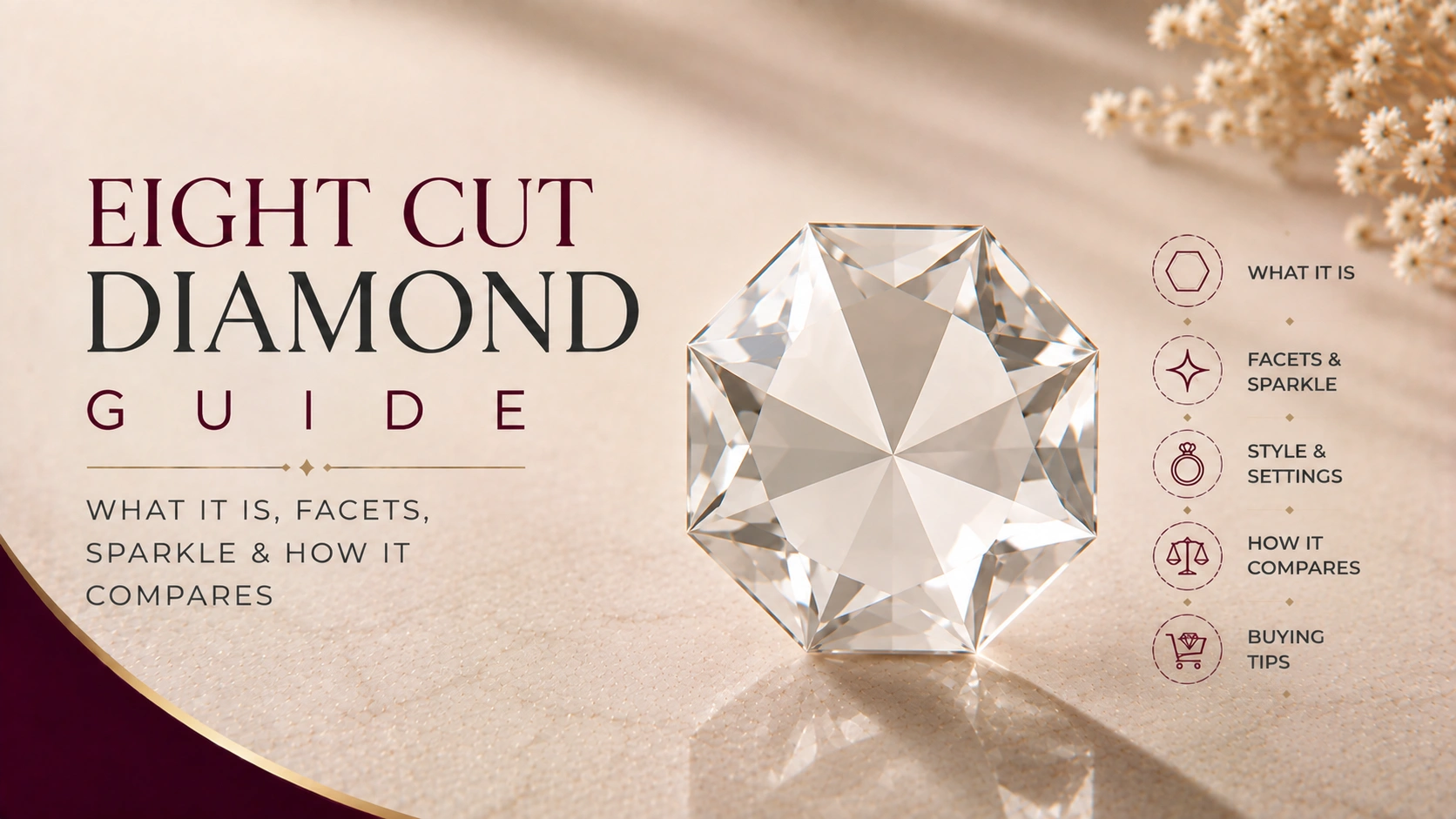
An eight cut diamond, also known as a single cut diamond, is a simplified faceted diamond cut characterized by eight main facets on the crown and eight on the pavilion, along with a table and sometimes a culet.
That gives the stone 17 facets when there is no culet facet, or 18 when a culet is included. The terminology can therefore vary slightly between sources.
Viewed from above, the stone generally has an octagonal outline or an appearance derived from an octagonal arrangement. Its simple facet structure is one of its most recognizable features.
The eight cut is sometimes described as an early or simplified form in the development of more complex diamond cutting styles. It was particularly useful for smaller diamonds where adding many more facets was not necessarily beneficial.
For a broader explanation of how diamond cuts differ, you can explore this guide to types of diamond cuts.
Why Is It Called an Eight Cut?
The name comes from the eight main facets on the crown and eight on the pavilion.
The crown is the upper portion of the diamond above the girdle, while the pavilion is the lower portion. A flat table sits at the top, and a culet may appear at the bottom.
This relatively simple arrangement distinguishes an eight cut from a modern round brilliant, which uses a much more elaborate facet pattern.
The terms eight cut and single cut are generally used interchangeably in diamond terminology. The GIA’s historical glossary, for example, directs “Eight Cut” to “Single Cut,” while standard jewelry references define single cut as having eight facets above and eight below the girdle, plus the table and usually a culet.
How Many Facets Does an Eight Cut Diamond Have?
An eight cut diamond typically has:
- 8 crown facets
- 8 pavilion facets
- 1 table
- A culet that may or may not be present
So the total is generally 17 or 18 facets, depending on whether the culet is counted as an additional facet.
This is considerably fewer than a standard modern round brilliant diamond, which has 57 or 58 facets depending on whether the culet is counted.
The lower facet count gives eight cut diamonds a noticeably simpler optical pattern.
What Does an Eight Cut Diamond Look Like?
An eight cut diamond generally has a simple, geometric appearance.
Instead of the many small facets found in a modern brilliant cut, the stone has fewer and relatively larger facets. When viewed from above, its geometry can create an octagonal appearance.
Its visual character can be described as:
- Simple
- Geometric
- Understated
- Vintage-inspired
- Less intricate than a modern brilliant
- Capable of producing distinct flashes of light
Because the facets are relatively large compared with the overall size of the stone, the sparkle can look more defined and less densely patterned than the sparkle of a full-cut diamond.
Why Are Eight Cut Diamonds Used for Small Stones?
The eight cut became particularly useful for very small diamonds.
When a diamond is extremely small, there is a practical limit to how much benefit can be gained from adding increasingly complicated facets. The individual facets become so tiny that the difference may be difficult for the unaided eye to appreciate.
Eight cuts therefore became common for small accent stones and melee diamonds. Some references describe them as being particularly common below approximately 0.05 carats, while other sources give smaller size ranges depending on the application.
Historically, the simpler cutting arrangement also made sense when working with smaller, lower-value stones because fewer facets required less cutting and polishing work.
Today, eight cut diamonds can still be encountered in small accent stones, although modern cutting technology makes it practical to produce more complex cuts at very small sizes as well.
How Much Sparkle Does an Eight Cut Diamond Have?
Eight cut diamonds can sparkle, but their appearance is different from that of a modern brilliant cut.
A full-cut brilliant has a much more complex facet arrangement designed to create strong brilliance and scintillation. An eight cut has fewer, larger facets, so its flashes can appear broader and simpler.
That does not necessarily mean an eight cut diamond looks dull.
In very small stones, the larger facets can be quite effective because the stone itself is so small. The result can be an attractive, crisp flash that works particularly well when many accent diamonds are placed together.
If maximum modern-style brilliance is your priority, however, a full-cut brilliant will generally be the more appropriate comparison.
Eight Cut vs. Full Cut Diamond
The biggest difference is the number and arrangement of facets.
| Feature | Eight Cut | Full-Cut Brilliant |
|---|---|---|
| Other name | Single cut | Full cut |
| Facet structure | Simple | Complex |
| Main facets | 8 crown + 8 pavilion | Much more extensive facet arrangement |
| Typical use | Small accent stones | Main diamonds and accent stones |
| Appearance | Broad, simple flashes | More complex sparkle |
| Historical character | Strong vintage/antique association | Modern standard |
The eight cut was particularly practical for small stones, while the full-cut brilliant became the dominant style for maximizing the visual performance of larger round diamonds.
For a broader discussion of how different faceting styles affect appearance, see the guide to step-cut vs. brilliant-cut diamonds.
Eight Cut vs. Single Cut Diamond
In most jewelry contexts, eight cut and single cut refer to the same basic diamond cut.
The terms are often used interchangeably:
Eight cut = Single cut
The “eight” refers to the eight crown facets and eight pavilion facets, while “single cut” is the traditional name for the simpler faceting style.
So if a jeweler describes a small diamond as a single cut, you will generally want to think of the eight cut as the same style rather than a completely different diamond cut.
You can also compare it with the dedicated single cut diamond guide for a closer look at the terminology and characteristics.
Eight Cut vs. Other Antique Diamond Cuts
Eight cut diamonds are often found alongside other historically important cuts, but they should not be confused with them.
Eight Cut vs. Rose Cut
A rose cut typically has a flat bottom and a domed top covered with triangular facets. Its visual effect is soft and relatively subtle.
An eight cut, by contrast, has facets on both the crown and pavilion and is structurally closer to later faceted diamond cuts.
See the rose cut diamond guide to learn more about its distinctive construction.
Eight Cut vs. Old Mine Cut
Old mine cuts are much more substantial antique diamond cuts and generally have a larger, more prominent appearance than the tiny accent stones for which eight cuts are commonly used.
Old mine diamonds are also known for their distinctive proportions and chunky facet arrangement.
You can learn more in the old mine cut diamond guide.
Eight Cut vs. Old European Cut
The old European cut represents another important stage in the evolution toward the modern round brilliant.
It generally has considerably more facets than an eight cut and was designed for a more developed form of brilliance.
Read the old European cut diamond guide for a closer comparison.
Eight Cut vs. French Cut
French cuts are especially associated with geometric, square or rectangular stones and antique jewelry.
Their faceting arrangement is different from the simple eight-cut structure, making them easy to distinguish when viewed closely.
See the French cut diamond guide for more information.
Where Are Eight Cut Diamonds Used?
Eight cut diamonds are commonly associated with small accent stones rather than large center stones.
You may find them in:
- Antique engagement rings
- Vintage jewelry
- Pavé settings
- Milgrain jewelry
- Ring shoulders
- Eternity bands
- Watch dials
- Cufflinks
- Small decorative jewelry details
Their relatively simple appearance makes them useful when many small diamonds need to complement a larger center stone rather than compete with it.
In antique and vintage jewelry, eight-cut accents can also contribute to the overall historical character of a piece.
Are Eight Cut Diamonds Good for Engagement Rings?
An eight cut diamond can be a good choice for an engagement ring when it fits the design you want.
It is generally not the first choice for someone looking for a large, highly brilliant center diamond. Instead, it is particularly interesting when used as an accent or when the goal is to recreate a vintage or antique aesthetic.
An eight-cut diamond may appeal to you if you want:
- A vintage-inspired appearance
- Small geometric accent stones
- A less conventional diamond style
- Historical character
- Subtle flashes rather than modern brilliant-style sparkle
- An antique or estate-jewelry look
If your priority is maximum brilliance from the center stone, you will probably want to consider a modern brilliant cut instead.
For more general guidance on choosing a diamond cut for an engagement ring, see the best diamond cut for an engagement ring guide.
How to Identify an Eight Cut Diamond
Identifying a small eight cut diamond by eye can be difficult, especially when it is set in a ring.
Look for these characteristics:
- Very small size: Eight cuts are frequently used for tiny accent diamonds.
- Simple faceting: The stone has a much less complicated facet arrangement than a full-cut brilliant.
- Eight crown facets: The crown is organized around eight main facets.
- Eight pavilion facets: The pavilion mirrors the simplified structure.
- Geometric outline: An octagonal appearance may be visible when the stone is viewed from above.
- Vintage or antique setting: Eight cuts are frequently encountered in older jewelry.
However, the setting, stone size, wear, lighting, and cutting style can make visual identification difficult. If the exact cut matters for valuation or authentication, a qualified gemologist or jeweler should examine the stone.
Pros and Cons of Eight Cut Diamonds
Pros
Distinctive appearance:
The simpler faceting gives eight cuts a visual character that differs from modern brilliant diamonds.
Well suited to tiny stones:
Their simple structure has historically made them practical for very small diamonds.
Vintage appeal:
They are commonly encountered in antique and vintage jewelry.
Works well as an accent:
Their sparkle can complement a larger center stone without overwhelming it.
Historical significance:
The single/eight cut is an important part of the development of diamond cutting.
Cons
Less complex sparkle:
If you prefer the intense scintillation of a modern brilliant cut, an eight cut may appear understated.
Not usually ideal as a large center stone:
The cut is primarily associated with small diamonds.
Harder to identify visually:
Tiny accent stones can be difficult to distinguish from other simple cuts without magnification.
Less common in modern jewelry:
Although still used, the cut is much more strongly associated with small accent stones and vintage or antique designs.
Are Eight Cut Diamonds Considered Antique?
An eight cut diamond can certainly be found in antique jewelry, and the cut has a long history. Sources differ on its exact origins and dating, with historical references placing its development or use in different periods. The Cape Town Diamond Museum notes that the single or eight cut is thought to have originated in India and was introduced into Europe around the mid-1600s, while other gemological references trace forms of the single cut much earlier.
The important distinction is that an eight cut does not automatically mean a diamond or piece of jewelry is antique.
Modern jewelry can also use eight-cut diamonds. The cut itself is a historical style, but the age of an individual stone or piece depends on when it was actually manufactured and set.
Do Eight Cut Diamonds Have More or Less Sparkle Than Brilliant Cuts?
Generally, eight cuts produce a simpler style of sparkle than modern brilliant cuts.
The difference comes primarily from the facet design. An eight cut has fewer facets, while a full-cut brilliant uses a much more elaborate arrangement intended to maximize light return and scintillation.
However, the size of the diamond matters. In extremely small accent stones, the practical visual difference can be much less noticeable to the unaided eye.
Are Eight Cut Diamonds Valuable?
The cut itself does not determine the complete value of a diamond.
Value depends on factors such as:
- Carat weight
- Color
- Clarity
- Cut quality
- Proportions
- Condition
- Provenance
- Age and historical significance of the jewelry
- Whether the piece is antique, vintage, or modern
An eight cut diamond should therefore not automatically be considered inexpensive simply because it has fewer facets. The value of an antique or estate piece can depend heavily on the entire piece of jewelry rather than the individual accent stones.
For the fundamentals of diamond quality, see the guide to the 4Cs of diamond quality.
Frequently Asked Questions
Is an eight cut diamond the same as a single cut diamond?
Yes. Eight cut and single cut are commonly used names for the same basic diamond-cutting style.
How many facets does an eight cut diamond have?
It generally has 17 or 18 facets, depending on whether a culet is present and counted. The basic structure consists of eight crown facets, eight pavilion facets, and a table.
Are eight cut diamonds rare?
They are less common in mainstream modern jewelry than full-cut brilliant diamonds, but they are still used for small accent stones and can be found in antique and vintage jewelry.
Are eight cut diamonds good for pavé rings?
They can work very well as small accent stones because the cut was historically used for tiny diamonds and can provide a consistent, understated sparkle across a setting.
Can an eight cut diamond be a center stone?
It can, but this is unusual compared with modern center-stone cuts. Eight cuts are primarily associated with small diamonds and accent stones.
Is an eight cut diamond the same as a round brilliant?
No. Although both can have a rounded or broadly circular outline, their facet structures are very different. An eight cut is much simpler, while a round brilliant uses a substantially more complex faceting arrangement.
Are eight cut diamonds old?
The eight or single cut has a long history, but an individual eight-cut diamond is not necessarily old. Modern jewelry can also use this cut.
Final Takeaway
An eight cut diamond is a simple, historically important diamond cut also known as a single cut. Its defining feature is the use of eight main crown facets and eight pavilion facets, with a table and sometimes a culet, producing a total of 17 or 18 facets depending on how the stone is constructed and counted.
Rather than competing with a modern brilliant cut for maximum sparkle, the eight cut has traditionally been valued for its simplicity and usefulness in very small diamonds. That makes it especially relevant to antique jewelry, vintage-inspired designs, pavé settings, and other pieces where small accent stones are meant to complement a larger design.
If you are researching unusual or historical diamond cuts, understanding the eight cut also makes it easier to distinguish it from related styles such as the rose cut, old mine cut, old European cut, and French cut.