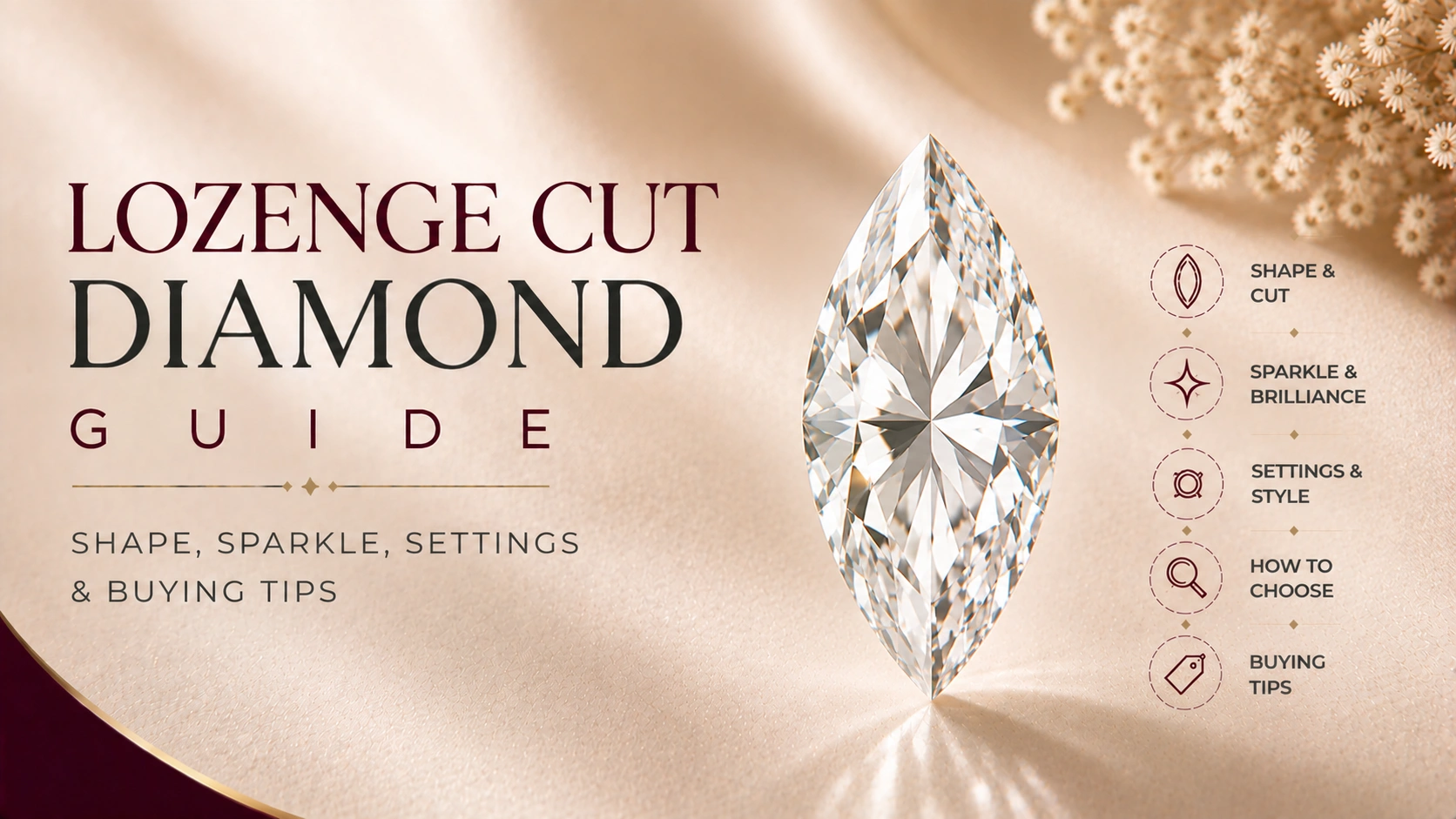
A lozenge cut diamond is one of the more unusual diamond shapes you can choose for an engagement ring. Its elongated, geometric outline resembles a rhombus or the diamond symbol on a deck of playing cards, giving it a distinctive look that stands apart from more familiar shapes such as round, oval, and emerald.
The lozenge is especially interesting because its appearance is influenced by both its unusual outline and its step-cut faceting. Instead of producing the busy sparkle associated with a round brilliant, step-cut facets create broader flashes of light and a clean, mirror-like appearance.
That combination makes the lozenge appealing to shoppers who want something architectural, vintage-inspired, and uncommon.
This guide explains what a lozenge cut diamond is, how it looks, how to evaluate one, which settings work well, and what to consider before buying.
What Is a Lozenge Cut Diamond?
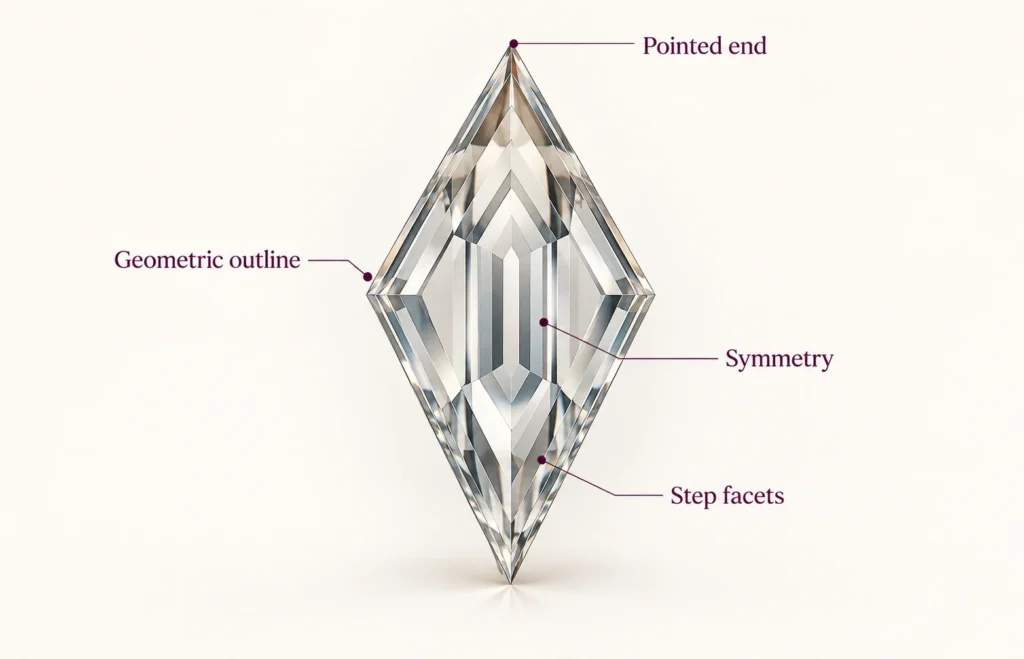
A lozenge cut diamond has a four-sided rhombus-shaped outline, with two pointed corners and two wider corners. When viewed from above, its silhouette looks similar to the traditional diamond symbol found on playing cards.
The word lozenge has historically been used to describe a diamond or rhombus-shaped figure. The geometric form has long appeared in decorative art and jewelry and became particularly well suited to the strong lines and symmetry associated with Art Deco design.
Modern lozenge diamonds are relatively uncommon compared with mainstream shapes such as round, oval, cushion, and emerald.
The shape can also be made with different faceting arrangements, but the classic lozenge is commonly associated with step-cut facets. Step cuts use larger, elongated facets arranged in parallel or concentric rows. GIA explains that step cuts are characterized by long, sleek facet lines and generally produce a more elegant gleam than the intense scintillation of brilliant cuts.
If you’re still learning the terminology, it helps to understand the difference between a diamond’s outline and its cutting style. A useful overview of diamond shapes can help put the lozenge into context.
What Does a Lozenge Diamond Look Like?
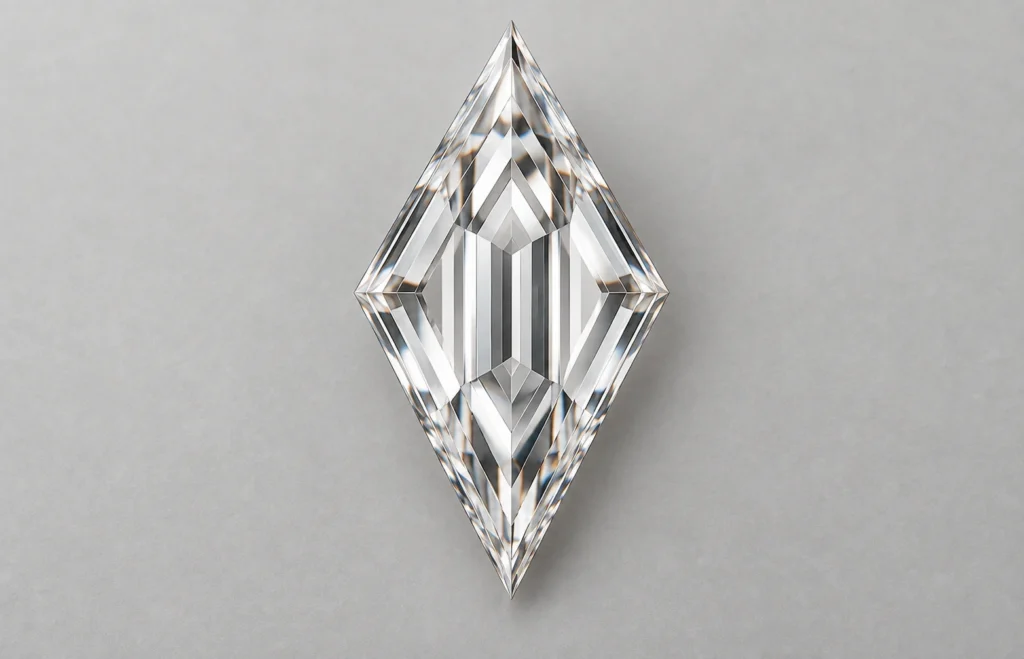
The easiest way to picture a lozenge diamond is to imagine a rhombus that has been elongated.
Its defining characteristics include:
- Four sides forming a diamond-like outline
- Two pointed ends
- Strong geometric symmetry
- An elongated appearance
- Long step-cut facets in many examples
- Broad flashes rather than rapid-fire sparkle
- A distinctly vintage or Art Deco-inspired appearance
The proportions can vary considerably. A relatively compact lozenge can look bold and geometric, while a more elongated stone can create a slimmer, more dramatic silhouette.
Because the outline is so distinctive, symmetry matters enormously. If the two halves do not balance properly, the stone can look noticeably uneven when viewed face-up.
This is one reason a lozenge should not be selected solely by carat weight or the numbers on a grading report. The actual appearance of the stone deserves close attention.
Is a Lozenge Diamond a Step Cut?
Most traditional lozenge diamonds are associated with the step-cut style, although the lozenge outline can also be combined with other faceting arrangements.
Step-cut diamonds use broad, four-sided facets arranged in a stair-step pattern. GIA notes that step cuts can be created in different shapes and that precise facet alignment is important to the appearance of the finished stone.
This creates a visual effect that is very different from a brilliant-cut diamond.
Step cut vs. brilliant cut
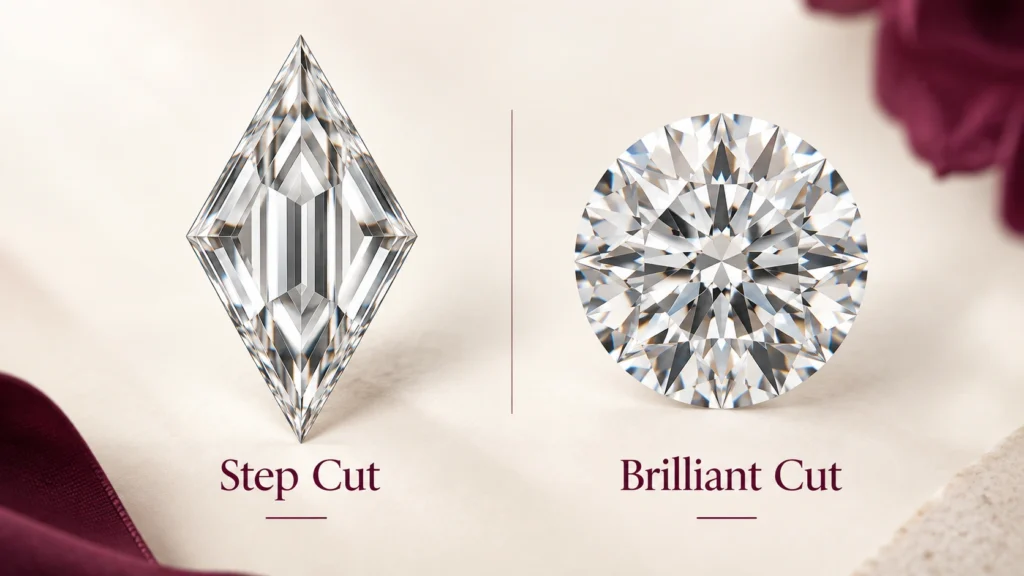
A brilliant cut uses numerous smaller facets designed to create intense light return, scintillation, and fire.
A step cut generally has:
- Larger facets
- Longer facet lines
- A calmer visual pattern
- Broader flashes of light
- Greater transparency into the diamond
The result is often described as a hall-of-mirrors effect.
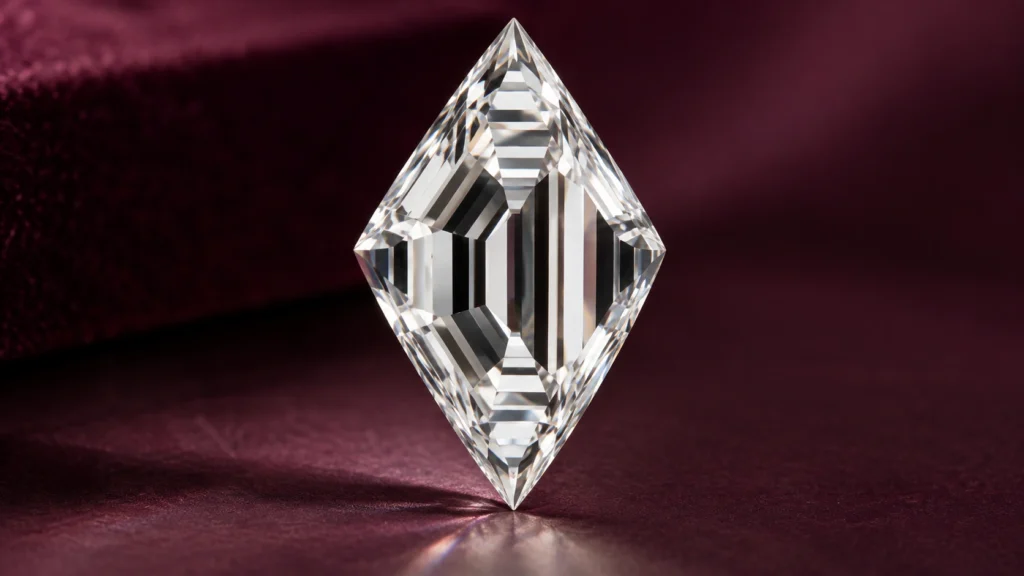
If you prefer explosive sparkle, a lozenge step cut may feel relatively understated. If you prefer clean reflections, symmetry, and architectural lines, its appearance can be much more appealing.
You can also compare this philosophy with step-cut vs. brilliant-cut diamonds before deciding which look suits you.
How Much Does a Lozenge Cut Diamond Sparkle?
A lozenge diamond can sparkle beautifully, but it does not generally produce the same type of sparkle as a round brilliant.
Its larger step facets reflect light in broader flashes. Instead of seeing many tiny flashes across the stone, you may see larger areas light up and darken as the diamond moves.
This is part of the appeal.
A lozenge is better suited to someone who values:
- Clean reflections
- Subtle brilliance
- Geometric beauty
- Contrast between light and dark facets
- A sophisticated rather than flashy appearance
Step cuts also reveal more of the diamond’s interior. GIA explains that larger and fewer facets can make color and inclusions more noticeable than they would be in a heavily faceted brilliant-cut diamond.
How to Choose a Lozenge Cut Diamond
Because lozenge diamonds are uncommon and can vary significantly in appearance, shopping requires more visual judgment than simply selecting the highest grades available.
1. Look for strong symmetry
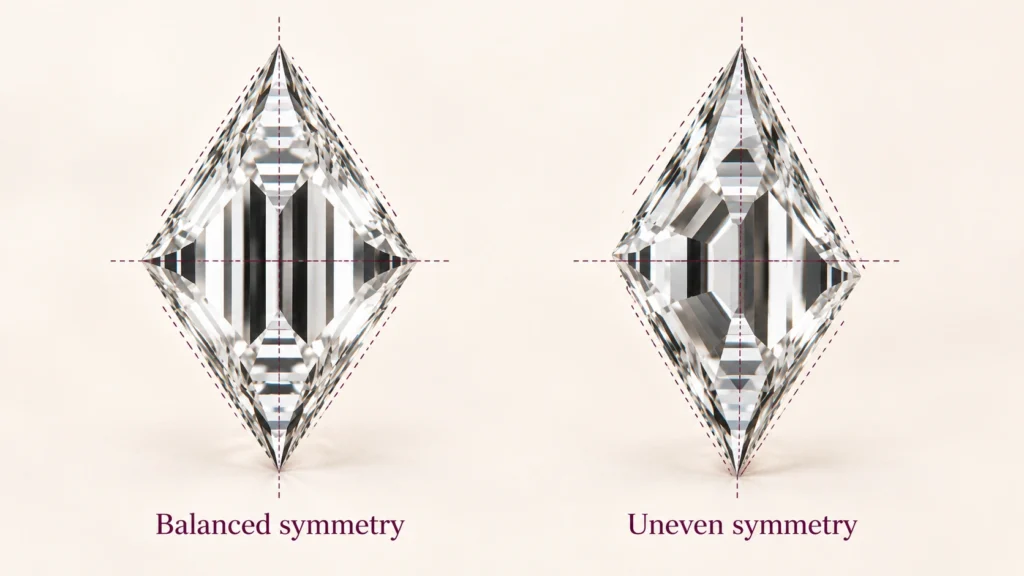
Symmetry should be one of your first priorities.
Viewed face-up, the two sides of the diamond should look balanced. The pointed ends should align naturally, and the step facets should appear organized rather than distorted.
Poor symmetry can make an unusual shape look unintentionally irregular.
GIA describes symmetry as an assessment of the exactness of a diamond’s outline and the placement and alignment of its facets.
For a geometric shape such as a lozenge, that precision is particularly important.
2. Examine the facet pattern
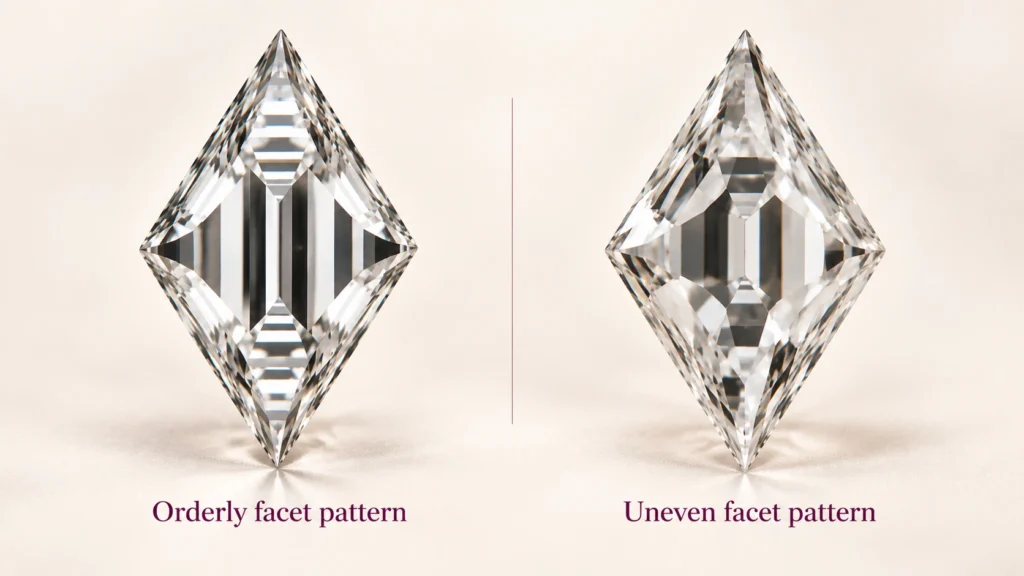
Look closely at the stone in high-resolution photographs and video.
The step facets should appear orderly and consistent. Rotate the diamond and watch how the light moves through the stone.
Be cautious if you notice:
- Large areas that remain dark
- Uneven facet patterns
- Distorted reflections
- A visibly crooked outline
- Significant light leakage
- Facets that appear poorly aligned
A video is often more informative than a single photograph because it shows how the diamond behaves as it moves.
3. Pay attention to clarity
Clarity deserves extra consideration with step-cut diamonds.
Large, open facets can make inclusions easier to see because there are fewer small facets to break up the viewer’s view into the stone. GIA specifically notes that inclusions tend to be more noticeable in step-cut diamonds for this reason.
That does not automatically mean you need a flawless or VVS diamond.
Instead, prioritize an eye-clean appearance.
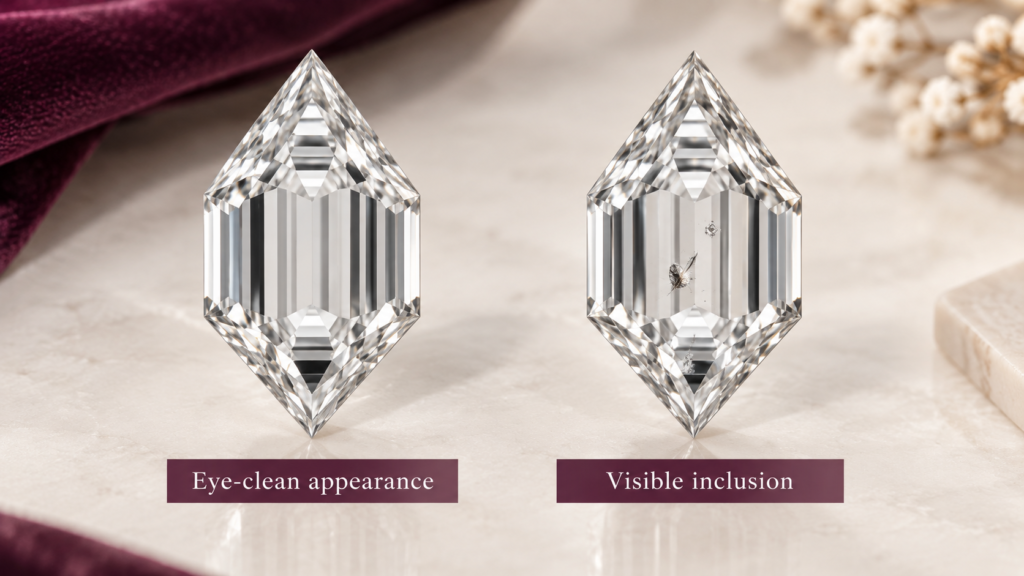
A VS diamond can sometimes offer an excellent balance between appearance and price, depending on the location and type of inclusions. If you’re comparing clarity grades, the best diamond clarity for an engagement ring guide can help explain where your money is most effectively spent.
4. Consider diamond color carefully
Step-cut faceting can also make body color more apparent.
If you want a crisp, icy appearance, you may prefer a higher color grade. If you like a warmer or antique-inspired aesthetic, a slightly lower color grade may work beautifully.
The right choice depends on:
- Your preferred appearance
- The metal color
- Your budget
- Whether the stone is natural or lab grown
- How noticeable the color appears in the actual diamond
Rather than automatically paying for the highest possible grade, compare diamonds side by side whenever possible.
5. Pay attention to the length-to-width ratio
The length-to-width ratio strongly influences the personality of a lozenge.
A shorter, wider stone can look more substantial and geometric. A longer, narrower stone creates a more dramatic silhouette.
There isn’t one universally correct ratio for every buyer.
Instead, consider what you want the stone to communicate:
| Proportion | General appearance |
|---|---|
| Shorter/wider | Bold, compact, geometric |
| Moderate elongation | Balanced and versatile |
| Long/narrow | Dramatic, sleek, elongated |
Because lozenge diamonds are relatively uncommon, it is better to judge the actual outline than to chase a specific ratio simply because a chart recommends it.
Does a Lozenge Diamond Make Fingers Look Longer?
An elongated lozenge can create a lengthening visual effect because the stone’s longest dimension generally follows the finger when positioned north-south.
This is similar to why elongated diamond shapes such as oval and marquise are often considered flattering for shoppers who want additional visual length.
However, the effect depends on the stone’s proportions and the ring’s overall design.
If finger proportion is an important consideration, you can also explore this guide to the best diamond shapes for long fingers.
Lozenge vs. Emerald Cut
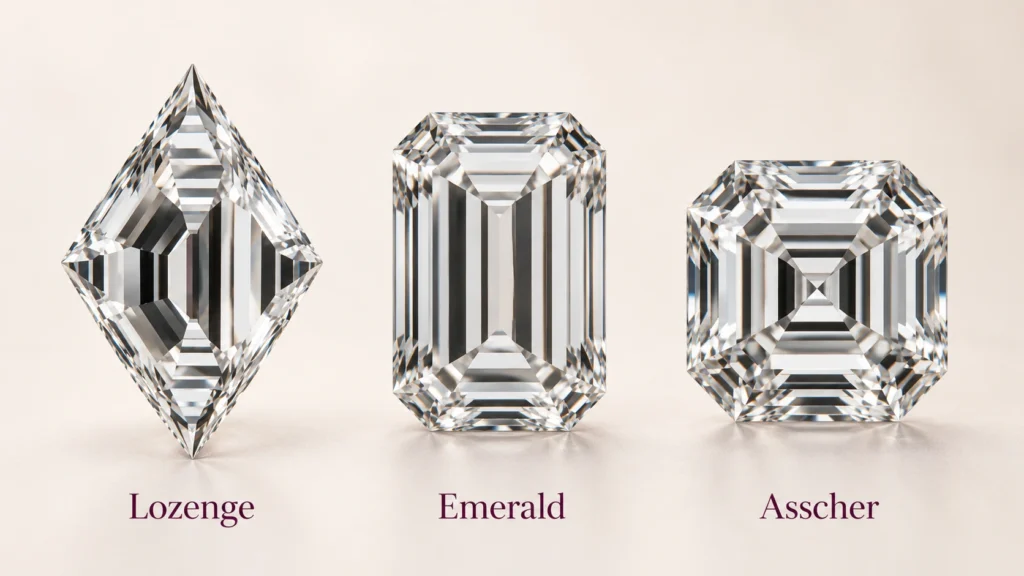
Lozenge and emerald diamonds can both use step-cut faceting, but their silhouettes are very different.
An emerald cut typically has a rectangular outline with cropped corners. A lozenge has a rhombus-like outline with pointed ends.
| Feature | Lozenge | Emerald |
|---|---|---|
| Outline | Rhombus/diamond | Rectangular with cut corners |
| Typical faceting | Step cut | Step cut |
| Overall look | Geometric and unusual | Classic and refined |
| Corners | Pointed | Beveled |
| Availability | Relatively rare | Widely available |
| Style | Art Deco, unconventional | Timeless, sophisticated |
The two can have a similar broad-flash appearance because of their step-cut faceting, but the lozenge has a much more distinctive silhouette.
Lozenge vs. Asscher Cut
An Asscher cut is generally square with cropped corners, while a lozenge has a rhombus-shaped outline.
Both can have a strong Art Deco character and step-cut appearance.
The biggest difference is the silhouette.
Choose an Asscher if you want:
- A square geometric appearance
- Strong Art Deco styling
- Symmetrical cropped corners
Choose a lozenge if you want:
- A more unusual silhouette
- Pointed ends
- A longer visual profile
- Something less commonly seen in engagement rings
For more context, you can explore other unusual step-cut and antique-inspired shapes in the site’s collection of diamond-cut guides, including the Asscher cut diamond guide.
Best Settings for a Lozenge Diamond
The unusual outline gives you considerable flexibility when choosing a setting.
Solitaire
A solitaire can be a strong choice if you want the lozenge to remain the centerpiece.
With minimal surrounding detail, the geometric outline becomes the main visual feature.
Bezel setting
A bezel can provide additional protection around the stone’s perimeter.
This may be especially useful because pointed corners can be more exposed than the protected corners of a cut-corner shape.
Halo
A halo can emphasize the outline and make the center stone appear larger.
However, the halo needs to be designed carefully so it complements rather than overwhelms the unusual geometry.
East-west setting
An east-west orientation places the elongated stone horizontally across the finger.
This is one of the more fashion-forward ways to wear an elongated geometric diamond and can make the ring feel particularly modern.
Three-stone or geometric setting
Lozenge diamonds can also work with complementary side stones, especially when the surrounding stones repeat or contrast with the central geometric lines.
The setting ultimately depends on whether you want the ring to look vintage, minimalist, contemporary, or deliberately unconventional.
Are Lozenge Diamonds Durable?
Diamond is an extremely hard material, but hardness does not mean immunity from damage.
The pointed areas of a lozenge can be more exposed to accidental knocks than a shape with heavily cropped corners.
When evaluating a stone, inspect the tips and girdle carefully for:
- Chips
- Surface-reaching fractures
- Abrasions
- Damage from previous wear
A protective setting can help reduce exposure.
GIA also recommends paying attention to durability-related inclusions and checking for chips or fractures, particularly around vulnerable areas of a diamond.
For an engagement ring that will be worn every day, the combination of the stone’s condition and the setting’s protection matters more than simply choosing a particular shape.
Pros and Cons of Lozenge Cut Diamonds
Pros
- Extremely distinctive appearance
- Uncommon choice for an engagement ring
- Strong geometric character
- Often works beautifully with Art Deco-inspired designs
- Elongated silhouette can provide good finger coverage
- Step-cut faceting creates broad, elegant flashes
- Can work in both minimalist and elaborate settings
Cons
- Much harder to find than mainstream shapes
- Not ideal if you want maximum brilliant-style sparkle
- Large facets can reveal inclusions more easily
- Color may be more noticeable
- Symmetry and facet alignment require careful inspection
- Pointed areas may need additional protection
- There is no standardized GIA overall cut grade for fancy shapes such as the lozenge
That last point is worth emphasizing. GIA currently provides an official overall cut grade only for round brilliant diamonds. Fancy-shaped diamonds are instead evaluated using factors such as polish and symmetry, while the overall appearance needs to be assessed more individually.
Is a Lozenge Diamond Good for an Engagement Ring?
Yes, if you value individuality over conventional popularity.
A lozenge diamond can make an excellent engagement ring center stone for someone who wants a ring that feels different from the typical round, oval, or cushion design.
It is particularly appealing if you like:
- Art Deco jewelry
- Geometric designs
- Vintage-inspired rings
- Minimalist settings
- Unusual diamond shapes
- Elongated stones
- Subtle step-cut sparkle
It may not be the best choice if your priority is maximum brilliance, easy availability, or a standardized cut-quality grading system.
The best lozenge is one whose shape, symmetry, facet pattern, clarity, color, and overall appearance work together.
Frequently Asked Questions
Is a lozenge diamond rare?
Lozenge diamonds are relatively uncommon compared with mainstream diamond shapes such as round, oval, cushion, and emerald. They are therefore a good option for shoppers who want an unusual center stone.
Is a lozenge diamond the same as an emerald cut?
No. They can both use step-cut faceting, but their outlines are different. A lozenge has a rhombus-like shape with pointed ends, while an emerald cut is generally rectangular with cropped corners.
Does a lozenge diamond sparkle?
Yes, but its sparkle tends to look different from a brilliant-cut diamond. Step-cut lozenges generally produce broader flashes and reflective patterns rather than the rapid scintillation associated with round brilliant diamonds.
What clarity is best for a lozenge diamond?
There is no single best clarity grade. Because step-cut facets can make inclusions easier to see, prioritize an eye-clean diamond. A VS stone may offer a strong balance of appearance and price, but the individual diamond should always be evaluated rather than relying on the grade alone.
Does GIA give lozenge diamonds a cut grade?
GIA does not currently give fancy-shaped diamonds an overall cut grade in the same way it grades round brilliant diamonds. Instead, shoppers should pay close attention to the diamond’s proportions, symmetry, polish, facet pattern, and actual light performance.
Is a lozenge diamond good for an Art Deco engagement ring?
Yes. Its strong geometric outline and step-cut appearance naturally complement Art Deco-inspired jewelry, particularly designs using clean lines, platinum or white metal, geometric halos, and contrasting diamond shapes.
What is the biggest mistake when buying a lozenge diamond?
Focusing too heavily on carat weight or grading numbers while ignoring the stone’s actual appearance.
Because lozenge diamonds are less standardized than common shapes, inspect the outline, symmetry, facet alignment, light performance, clarity, and color together.
Final Takeaway
A lozenge cut diamond is a compelling choice for an engagement ring when you want something rare, geometric, and visually distinctive.
Its rhombus-like silhouette immediately separates it from traditional diamond shapes, while step-cut faceting can give it a sophisticated hall-of-mirrors appearance. The trade-off is that its broad facets make clarity, color, symmetry, and overall cut precision more important to evaluate.
If you’re shopping for one, don’t choose based on carat weight alone. Watch the diamond move, inspect its symmetry, look for an eye-clean appearance, compare its color in different lighting, and make sure the pointed ends are adequately protected by the setting.
For shoppers still comparing unusual diamond shapes, the broader diamond cut guide and types of diamond cuts resources are useful next steps.