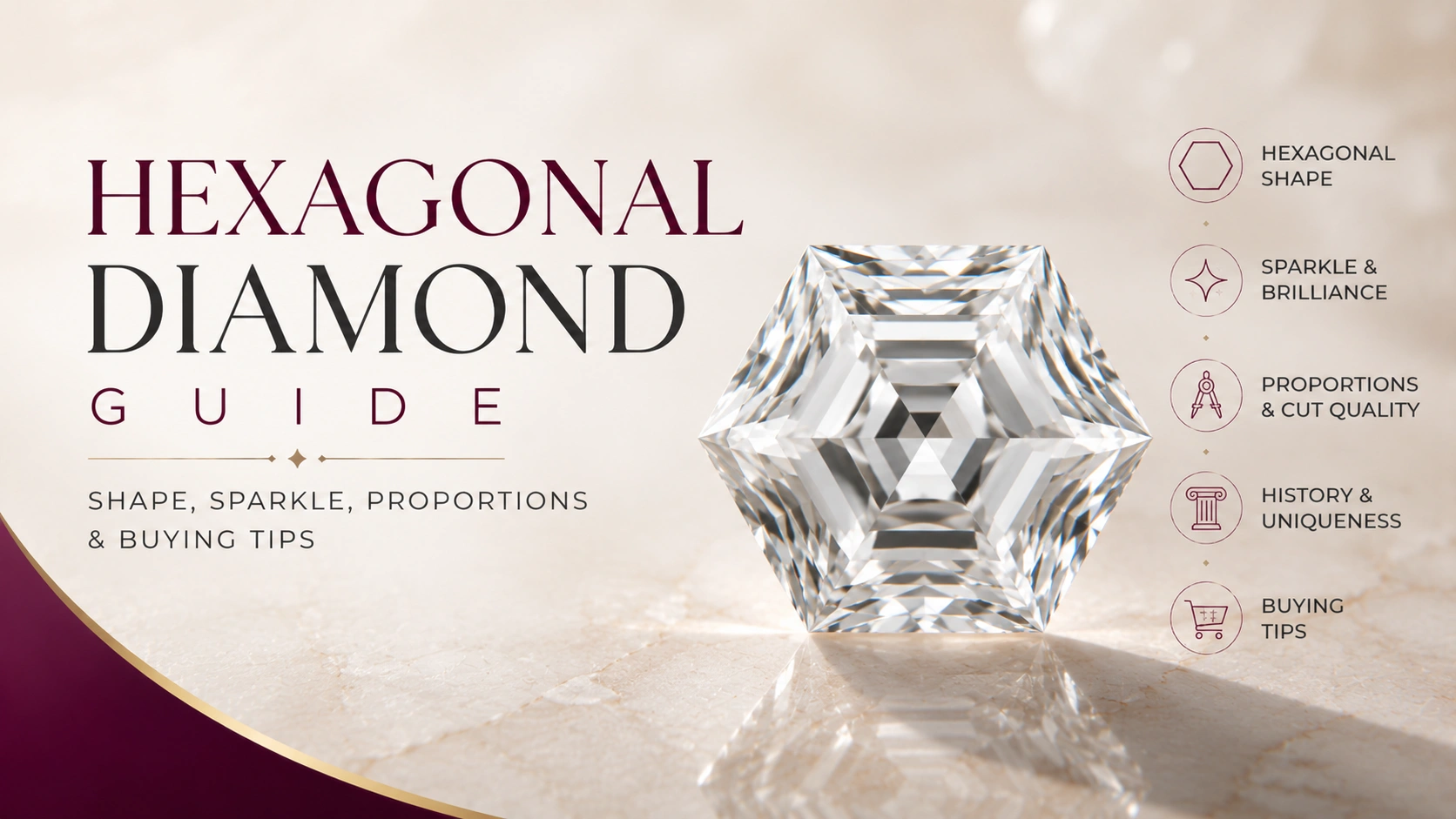
A hexagonal diamond is a six-sided diamond with a distinctive geometric outline. Its straight edges and symmetrical shape give it an architectural appearance that stands apart from more familiar options such as round, oval, and cushion diamonds.
Hexagonal diamonds can be especially appealing if you want an engagement ring that feels modern, unconventional, and highly structured. Many are cut with step facets, creating broad flashes of light rather than the rapid sparkle associated with brilliant cuts. However, the hexagonal outline itself does not determine the faceting style.
That distinction matters when shopping. Two diamonds can both be described as hexagonal while having noticeably different appearances, proportions, and light performance.
This guide explains what to look for in a hexagonal diamond, including its shape, faceting, proportions, clarity, color, durability, and ring-setting options.
What Is a Hexagonal Diamond?
A hexagonal diamond is a diamond shaped with six sides. The outline may be close to a regular hexagon or stretched into a more elongated form.
The defining feature is the outline, not necessarily the internal facet arrangement. Hexagonal diamonds are commonly associated with step-cut faceting, where broad, linear facets create a clean and architectural appearance. Some can also be produced with brilliant-style faceting for a livelier sparkle.
This makes hexagonal diamonds different from shapes where the name more strongly implies a particular cutting style.
For a broader explanation of how diamond outlines and cutting styles differ, see this guide to diamond shape and cut.
What Does a Hexagonal Diamond Look Like?
The easiest way to recognize a hexagonal diamond is by its six straight sides.
A traditional or regular hexagon has a relatively balanced, symmetrical outline. An elongated hexagon stretches the shape lengthwise, producing a slimmer appearance that can look longer across the finger.
The overall appearance can also change considerably depending on the faceting.
Step-cut hexagons typically have:
- Broad, straight facets
- Large flashes of light
- A clean, mirror-like appearance
- A more understated sparkle
- A strong architectural aesthetic
Brilliant-cut hexagons can have:
- More numerous facets
- Smaller flashes of light
- More visible scintillation
- A livelier appearance
Current diamond guides consistently point out that the six-sided outline and the faceting should be considered separately.
Hexagonal vs. Hexagon Cut Diamond
The terms hexagonal diamond and hexagon cut diamond are often used interchangeably when shopping.
In practical terms, both describe a diamond with a six-sided outline. However, the word “hexagon” by itself does not necessarily tell you the diamond’s exact proportions or facet pattern.
This is important because there is no single universal appearance for every hexagonal diamond. One may be broad and symmetrical, while another may be noticeably elongated. One may have step facets, while another uses a more brilliant-style pattern.
When comparing stones, look beyond the product title and examine the actual measurements, photographs, videos, and grading report.
Regular vs. Elongated Hexagonal Diamonds
Hexagonal diamonds generally fall into two broad visual categories: regular and elongated.
Regular Hexagonal Diamonds
A regular hexagon has a compact, balanced appearance. Its proportions emphasize the geometric nature of the shape and can create a bold look in a solitaire or statement ring.
This style works particularly well if you want the diamond itself to be the main design element.
Elongated Hexagonal Diamonds
An elongated hexagon has a longer length relative to its width. This creates a more directional appearance and can make the diamond look longer across the finger.
The right length-to-width ratio is largely a matter of personal preference because hexagonal diamonds do not have one universally accepted ideal proportion. A lower ratio produces a broader appearance, while a higher ratio creates a slimmer, more elongated outline.
If you are deciding between different diamond shapes for finger coverage, you can also compare it with other elongated options in the diamond shape guide.
Step-Cut vs. Brilliant-Cut Hexagonal Diamonds
One of the most important decisions is the faceting style.
Step-Cut Hexagonal Diamonds
Step cuts use broad, parallel facets arranged in tiers. The result is generally a slower, broader pattern of light reflection rather than the busy sparkle of a round brilliant.
This style emphasizes:
- Geometry
- Transparency
- Clean lines
- Broad flashes
- A sophisticated appearance
The large, open facets can also make inclusions and body color easier to notice, so diamond quality deserves particular attention.
Brilliant-Cut Hexagonal Diamonds
A brilliant-style hexagon uses a different facet arrangement intended to create more frequent flashes of light.
If maximum sparkle is a priority, a brilliant-faceted hexagonal diamond may be worth considering.
Neither style is automatically better. They simply create different visual effects. The most important thing is to choose the appearance you prefer and then evaluate the individual diamond carefully.
For additional context on the distinction between diamond outline and cutting style, see types of diamond cuts.
How Much Does a Hexagonal Diamond Sparkle?
Hexagonal diamonds can sparkle beautifully, but their appearance is usually different from a round brilliant.
A step-cut hexagon tends to produce larger, broader flashes because of its relatively large facets. A brilliant-faceted version can produce more active scintillation.
If you are comparing a step-cut hexagon with a round brilliant, do not expect them to look alike. Round brilliants are specifically optimized around their brilliant faceting, while a hexagonal diamond often places more emphasis on geometric appearance.
When shopping, prioritize videos or photographs taken under different lighting conditions. A still product photograph may not reveal how the stone performs when it moves.
Hexagonal Diamond Proportions
There is no single universally accepted set of ideal proportions for hexagonal diamonds.
That means shoppers should pay attention to the actual measurements rather than relying on a generic “ideal” number.
Length-to-Width Ratio
Length-to-width ratio is especially important because it changes the overall character of the stone.
A lower ratio produces a wider, fuller hexagon.
A higher ratio produces a longer, slimmer hexagon.
Neither is inherently better. The best ratio depends on whether you prefer a bold geometric appearance or a more elongated look.
Symmetry
Symmetry is particularly important for a geometric shape.
Look at whether:
- Opposing sides appear balanced
- The corners are evenly positioned
- The outline looks centered
- The facets appear properly aligned
- One side appears noticeably different from the other
Small differences can become more noticeable in a six-sided design because the shape relies so heavily on geometry.
Depth and Table
Depth and table measurements can influence the diamond’s appearance and light performance, but there is no universal hexagonal formula that guarantees a beautiful stone.
Instead of selecting a diamond based on one number, consider the entire stone together: proportions, symmetry, facet arrangement, transparency, and actual visual performance.
Hexagonal Diamond Color
Color can be particularly noticeable in diamonds with large, open step facets.
If you prefer a crisp, icy appearance, you may want to consider a higher color grade.
However, you do not necessarily need the highest possible color grade. The setting’s metal color, the diamond’s size, and your personal tolerance for warmth can all influence the choice.
For a broader explanation of diamond color grades, see the diamond color guide.
A useful approach is to compare diamonds side by side rather than choosing a grade based solely on its letter.
Hexagonal Diamond Clarity
Clarity deserves careful consideration, especially for step-cut hexagonal diamonds.
Their larger, more open facets can make inclusions easier to see than they might be in a heavily faceted brilliant-cut diamond.
That does not mean you automatically need an extremely high clarity grade.
Instead, look for a diamond that appears clean to the naked eye at the size and viewing distance you would normally use.
For more help choosing an appropriate clarity grade, see this guide to diamond clarity.
The goal is not necessarily the highest clarity on the grading report. The goal is a diamond that looks clean while giving you good value for your budget.
Are Hexagonal Diamonds Durable?
A hexagonal diamond has six corners, but its corners are generally less sharp than the four corners of a princess cut.
That can make the shape reasonably practical for everyday wear, although the specific geometry and setting still matter.
No diamond shape is completely immune to damage. The corners and edges can be vulnerable to impact, so the setting should provide appropriate protection for the stone.
If you are choosing an engagement ring that you plan to wear every day, consider both the diamond and the setting rather than evaluating the shape in isolation.
You can also learn more about the role of the setting in protecting a diamond in why engagement rings have prongs.
Best Settings for Hexagonal Diamond Rings
The geometric outline of a hexagonal diamond gives designers plenty of options.
Solitaire Settings
A solitaire keeps the focus on the six-sided center stone.
This is a good choice if you want the unusual outline to remain the main feature of the ring.
Halo Settings
A halo can emphasize the geometric outline and make the center diamond appear larger.
A carefully designed halo can follow the six-sided shape rather than simply surrounding it with a circular arrangement.
Three-Stone Settings
A hexagonal center diamond can be paired with side stones to create a more elaborate look.
Contrasting shapes such as tapered baguettes, trapezoids, or other geometric side stones can reinforce the architectural character.
Pavé Settings
Small diamonds along the band can add additional sparkle without competing too heavily with the center stone.
This can be particularly effective when the center diamond has a restrained step-cut appearance.
Hexagonal Diamond Engagement Ring Styles
Hexagonal diamonds can work with several different design aesthetics.
Modern Minimalist
A simple solitaire with a thin band lets the unusual outline speak for itself.
Art Deco Inspired
The strong geometry of a hexagon naturally works with Art Deco-inspired designs, especially when combined with straight lines and step-cut side stones.
Vintage Inspired
A detailed setting with milgrain, engraving, or decorative metalwork can give the unusual shape a more antique character.
Contemporary Statement
A larger hexagonal center stone with a substantial setting can create a bold, fashion-forward engagement ring.
Because the shape is less conventional than round or oval, the setting can significantly influence whether the final ring feels minimalist, vintage, architectural, or dramatic.
Hexagonal Diamonds vs. Other Diamond Shapes
Hexagonal diamonds are worth considering if you want something outside the most common engagement ring shapes.
Hexagonal vs. Emerald Cut
Both can have step-cut faceting and broad flashes of light. The major difference is the outline: emerald cuts are rectangular with clipped corners, while hexagonal diamonds use six sides.
Hexagonal vs. Asscher Cut
Both can deliver a geometric, step-cut appearance. An Asscher is square with cropped corners, while a hexagon has six distinct sides.
See the Asscher cut diamond guide for more information.
Hexagonal vs. Round
Round brilliant diamonds are designed around a classic brilliant-cut appearance and are known for strong sparkle.
Hexagonal diamonds prioritize geometric individuality and can offer a more architectural appearance.
See the round cut diamond guide if you are comparing the two.
Hexagonal vs. Oval
Oval diamonds offer a softer, curved outline and an elongated appearance. Hexagonal diamonds create the opposite visual effect with straight lines and pronounced geometry.
If finger coverage is important, compare the actual millimeter measurements rather than relying only on carat weight.
Pros and Cons of Hexagonal Diamonds
Pros
- Distinctive six-sided outline
- Unusual alternative to traditional diamond shapes
- Strong geometric and architectural appearance
- Works well in modern and vintage-inspired settings
- Available in regular and elongated proportions
- Can be paired with different faceting styles
- Works particularly well with geometric side stones
- Can create striking cluster and multi-stone designs
Cons
- Less common than traditional diamond shapes
- No universal set of ideal proportions
- Different faceting styles can produce very different appearances
- Large open facets can make inclusions more noticeable
- Step-cut versions may appear less sparkly than brilliant cuts
- Finding the exact combination of shape, proportions, and quality can take more searching
How to Choose a Hexagonal Diamond
If you are shopping for a hexagonal diamond engagement ring, use the following checklist.
1. Decide on the outline
Determine whether you prefer a compact regular hexagon or a longer elongated version.
2. Choose the faceting style
Decide whether you prefer broad step-cut flashes or a more active brilliant-style sparkle.
3. Examine symmetry
Look closely at the six-sided outline and make sure it appears balanced.
4. Compare measurements
Check the length, width, depth, and length-to-width ratio instead of relying only on the carat weight.
5. Pay attention to clarity
Look at the actual stone rather than automatically selecting the highest clarity grade.
6. Check color
Compare the stone face-up and consider how its color interacts with the metal of the setting.
7. Watch a video
Movement can reveal sparkle, windowing, darkness, or other visual characteristics that a still photograph may hide.
8. Consider the setting
Make sure the setting protects the stone appropriately while complementing its six-sided outline.
9. Compare the overall value
Use the 4Cs of diamond quality as part of your evaluation, but remember that beauty and visual performance cannot be reduced to a single number.
Are Hexagonal Diamonds Good for Engagement Rings?
Yes. A hexagonal diamond can be an excellent engagement ring choice if you value individuality and geometric design over traditional popularity.
It is particularly appealing to someone who wants a center stone that looks noticeably different from a round, oval, or cushion diamond.
The main consideration is that hexagonal diamonds require a little more attention during shopping. Because the shape does not have one universal proportion or faceting formula, the individual diamond matters considerably.
Look at the actual stone, compare its measurements, inspect its symmetry, and evaluate its appearance in motion before making a decision.
Final Thoughts
A hexagonal diamond offers a distinctive combination of geometry and individuality. Its six-sided outline can look bold and architectural, while different proportions and faceting styles allow the same basic shape to take on very different personalities.
For a clean, sophisticated appearance, a step-cut hexagon can be especially appealing. If you want more active sparkle, a brilliant-faceted version may be a better fit.
Most importantly, do not shop by the word “hexagon” alone. Compare the diamond’s proportions, symmetry, clarity, color, faceting, and actual light performance. Once those factors match your preferences, the unusual six-sided outline can make for a memorable and highly personal engagement ring.
Frequently Asked Questions
What is a hexagonal diamond?
A hexagonal diamond is a diamond with a six-sided outline. It can be regular or elongated and may use different faceting styles, although step-cut versions are commonly associated with the shape.
Are hexagonal diamonds rare?
Hexagonal diamonds are less commonly encountered than traditional shapes such as round, oval, and cushion diamonds. Their unusual geometry makes them a more distinctive choice for engagement rings.
Do hexagonal diamonds sparkle?
Yes, but the amount and character of sparkle depend heavily on the faceting style. Step-cut hexagons generally produce broad flashes, while brilliant-style faceting can create more frequent scintillation.
Is a hexagonal diamond the same as a hexagon cut diamond?
The terms are commonly used to describe the same six-sided outline. However, “hexagon” does not by itself specify the diamond’s exact proportions or faceting style.
What is the ideal length-to-width ratio for a hexagonal diamond?
There is no single universally accepted ideal ratio. A lower ratio creates a broader appearance, while a higher ratio creates a more elongated look. Choose based on the outline you prefer and how it looks on your hand.
Are hexagonal diamonds good for engagement rings?
They can be an excellent choice for someone who wants a distinctive, geometric center stone. They work particularly well in solitaire, halo, three-stone, and other custom engagement ring designs.
What setting is best for a hexagonal diamond?
There is no single best setting. Solitaire settings emphasize the outline, halos can amplify the geometric shape, and three-stone or pavé designs can create a more elaborate appearance. The setting should also provide suitable protection for the diamond’s edges and corners.
Should I choose high clarity for a hexagonal diamond?
Not necessarily, but clarity deserves close attention, particularly for step-cut stones with larger open facets. Focus on whether the diamond looks clean to the naked eye rather than automatically choosing the highest clarity grade.