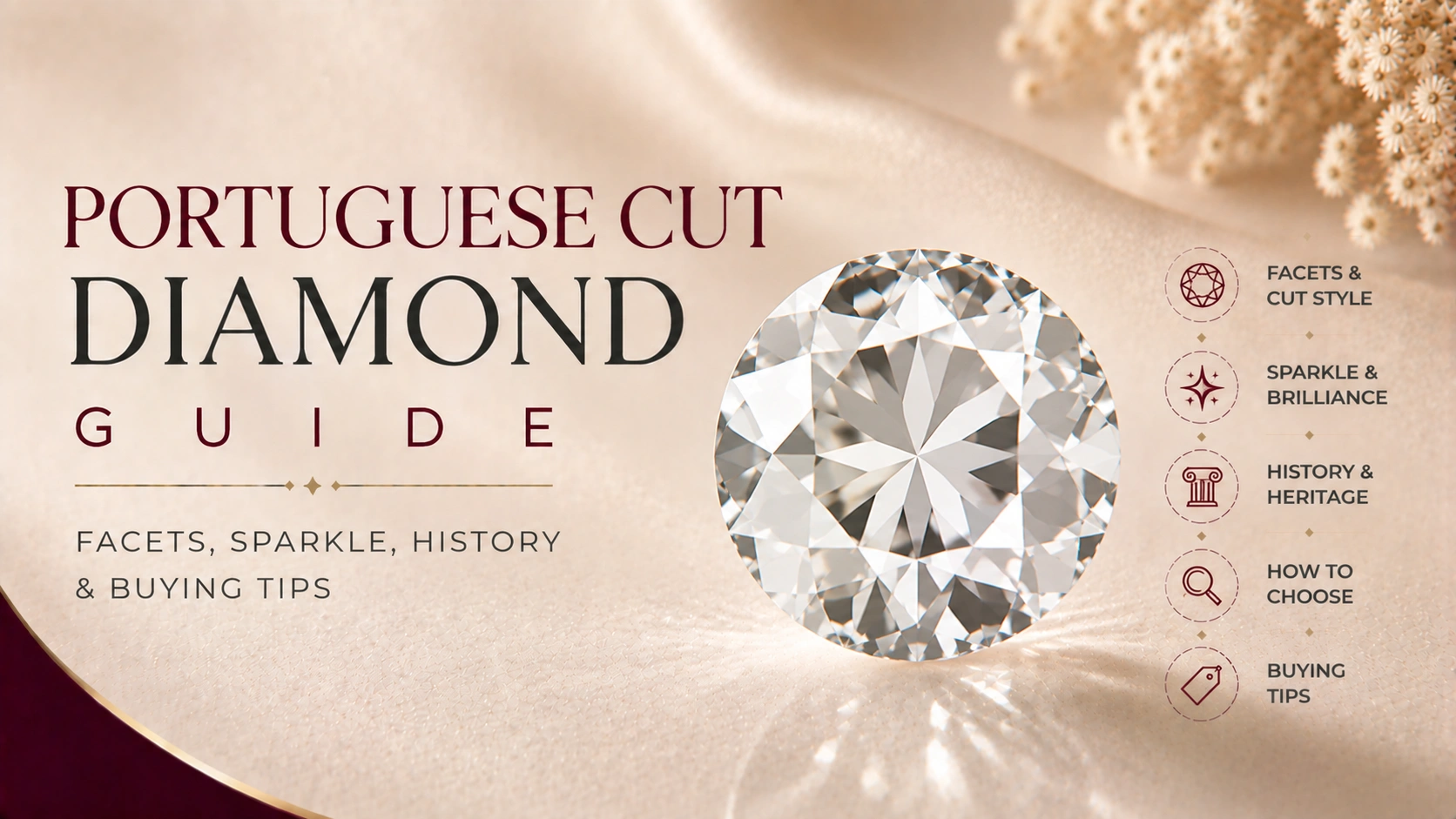
A Portuguese cut diamond is one of the most unusual faceting styles you can encounter when shopping for a diamond. Instead of relying on the familiar facet arrangement of a modern round brilliant, this style uses multiple rows of smaller facets to create a distinctive, intricate pattern of light.
The result is a diamond with a busy, detailed sparkle that can look very different from the broad flashes produced by a conventional brilliant cut.
If you’re considering one for an engagement ring, however, there is more to understand than its impressive facet count. The Portuguese cut is relatively uncommon, its proportions can vary, and the way it performs depends on the quality of the individual stone.
Here’s what you should know before buying one.
What Is a Portuguese Cut Diamond?
A Portuguese cut diamond is a faceting style rather than a diamond shape.
That’s an important distinction. Terms such as round, oval, pear, and marquise describe the outline of a diamond, while Portuguese describes how the stone’s facets are arranged.
The style is generally associated with a round or near-round outline and a dense arrangement of facets across the crown and pavilion. Unlike a standard round brilliant, which uses a standardized 57 or 58-facet design, Portuguese-style stones can contain substantially more facets.
Some modern descriptions place the traditional design at around 161 facets, while other cutting diagrams and conventions use different counts. There isn’t a single universally applied commercial standard for Portuguese-cut diamonds.
What matters visually is the additional layering of facets.
These smaller surfaces create a more intricate pattern of reflections, giving the diamond a distinctive, almost kaleidoscopic appearance.
For a broader explanation of how diamond cutting differs from diamond shape, see this guide to diamond cuts.
What Makes a Portuguese Cut Diamond Different?
Three characteristics immediately distinguish a Portuguese cut:
1. A High Number of Facets
The most obvious difference is the number of facets.
A modern round brilliant typically has 57 or 58 facets. Portuguese designs use many more, with commonly cited versions featuring around 161 facets or other variations depending on the cutting pattern.
More facets create more surfaces for light to interact with, but facet count alone doesn’t determine how attractive a diamond will look.
The size, angle, symmetry, and arrangement of those facets matter just as much.
2. Multiple Rows of Facets
Portuguese-style faceting uses additional rows of facets on the crown and pavilion.
This gives the stone a denser visual pattern than a typical brilliant cut. From above, you may notice a layered or star-like pattern rather than the larger, simpler reflections associated with a round brilliant.
3. A Distinctive Sparkle Pattern
Portuguese-cut diamonds tend to produce numerous smaller flashes rather than relying primarily on large, broad flashes.
That difference is important when deciding whether you actually like the style.
Some people prefer the crisp, dramatic flashes of a modern brilliant. Others love the intricate movement and detailed sparkle of a highly faceted stone.
Neither is inherently better. They simply create different visual experiences.
How Many Facets Does a Portuguese Cut Diamond Have?
There is no single facet count that applies to every stone described as Portuguese cut.
Around 161 facets is commonly cited for the traditional style, while some sources and cutting variations describe different totals.
For comparison:
| Cut | Typical Facet Count |
|---|---|
| Round brilliant | 57–58 |
| Old European | About 58 |
| Rose cut | Varies considerably |
| Portuguese cut | Often around 161+ |
The important takeaway is that Portuguese cutting involves substantially more facets than a conventional round brilliant.
However, don’t use facet count as a shortcut for judging diamond quality.
A poorly proportioned stone with hundreds of facets can still perform worse visually than a well-cut stone with fewer facets.
Why Does a Portuguese Cut Diamond Sparkle Differently?
To understand the Portuguese cut, it helps to separate three aspects of diamond light performance: brilliance, fire, and scintillation.
Brilliance
Brilliance refers primarily to the white light returned from the diamond to the viewer.
A well-designed Portuguese cut can produce strong brightness, but the exact result depends on its proportions and facet arrangement.
Fire
Fire is the colored flashes created when white light is dispersed into spectral colors.
The additional facets and complex internal geometry can create plenty of opportunities for colorful flashes, particularly when the diamond is viewed under suitable lighting.
Scintillation
Scintillation is the pattern of flashes you see as either the diamond or the light source moves.
This is where Portuguese faceting can look particularly distinctive.
Instead of producing only a few broad reflections, the numerous smaller facets can create a dense sequence of flashes that shifts across the stone as it moves.
That’s why two diamonds with similar carat weights can look surprisingly different when viewed in motion.
Portuguese Cut Diamond History and Origins
The history of the Portuguese cut is less straightforward than its name might suggest.
There is no universally accepted historical record identifying a single inventor, exact date, or definitive place where the faceting style originated. Modern sources connect the style with European lapidary traditions and Portuguese associations, but the details remain debated.
It is therefore better to describe the Portuguese cut as a specialized faceting tradition rather than claim that it was definitively invented by a particular Portuguese cutter at a particular time.
The style is also frequently associated with colored gemstones, where elaborate faceting can emphasize both brilliance and color.
Over time, similar highly detailed faceting principles have been applied to diamonds and other gemstones.
The complexity of the cutting process is one reason the style remains much less common than standardized modern diamond cuts.
Portuguese Cut vs. Round Brilliant
The round brilliant remains the benchmark for modern diamond cutting, so it is the most useful comparison.
| Feature | Portuguese Cut | Round Brilliant |
|---|---|---|
| Facet count | Usually much higher | 57–58 |
| Appearance | Intricate, layered | Bright, balanced, classic |
| Sparkle | Many smaller flashes | Broader, more defined flashes |
| Standardization | Less standardized | Highly standardized |
| Availability | Relatively uncommon | Extremely common |
| Style | Distinctive and unusual | Timeless and familiar |
A round brilliant may be the safer choice if you want predictable availability, standardized grading information, and a familiar appearance.
A Portuguese cut makes more sense if you specifically want something unusual and enjoy its intricate facet pattern.
You can also compare the two approaches through this guide to step-cut vs. brilliant-cut diamonds.
Portuguese Cut vs. Old European Cut
The Portuguese cut can sometimes be grouped with vintage-inspired or antique-looking diamonds, but it shouldn’t automatically be treated as the same thing as an Old European cut.
An Old European cut generally has the classic rounded outline, larger facets, a smaller table, and a distinctive antique appearance.
Portuguese faceting takes a different approach by using many more facets and a more complex layered pattern.
If you’re specifically interested in antique diamond styles, see the Old European cut diamond guide.
Portuguese Cut vs. Rose Cut
A Portuguese cut and a rose cut sit toward opposite ends of the faceting spectrum.
Rose cuts typically have a flat or relatively shallow base and a domed crown covered with triangular facets. They are known for a softer, more subtle glow rather than the intense sparkle associated with heavily faceted designs.
Portuguese cuts use many more facets and generally create much more intricate light movement.
If you’re deciding between the two, this rose cut diamond guide provides a useful comparison point.
Are Portuguese Cut Diamonds Rare?
Yes, Portuguese-cut diamonds are relatively uncommon compared with mainstream cuts such as round, oval, cushion, and princess.
There are several reasons.
First, the cutting style is specialized. Creating and aligning a large number of facets requires considerable precision.
Second, the style isn’t produced at anything close to the scale of standardized commercial cuts.
Third, most consumers are familiar with conventional diamond shapes and cuts, so demand is naturally smaller.
That rarity can make a Portuguese cut appealing if you’re looking for an engagement ring that doesn’t resemble the typical designs found in jewelry stores.
However, rarity shouldn’t automatically be interpreted as higher quality.
A rare diamond can still have problems with symmetry, proportions, clarity, or light performance.
Pros and Cons of a Portuguese Cut Diamond
Pros
Distinctive appearance:
The intricate faceting gives the diamond a look that is immediately different from mainstream cuts.
Complex sparkle:
The numerous facets can produce many small flashes as the stone moves.
Unusual choice:
It can be an excellent option for someone who doesn’t want a conventional round brilliant.
Artisan appeal:
The complexity of the faceting makes the style attractive to buyers interested in specialized cutting.
Potential vintage character:
Its intricate appearance can work particularly well with vintage-inspired jewelry.
Cons
Limited availability:
Finding a Portuguese-cut diamond can take more effort than finding a round brilliant.
Less standardization:
Buyers may encounter greater variation between individual stones.
Facet count can be misleading:
More facets do not automatically guarantee superior light performance.
Potentially higher cutting complexity:
Specialized cutting requires more skill and precision.
Fewer direct comparisons:
Because relatively few Portuguese-cut diamonds are available, it can be harder to compare several stones side by side.
How to Choose a Portuguese Cut Diamond
If you’ve decided that the style appeals to you, evaluate the actual stone rather than buying based on the name alone.
1. Look at the Diamond in Motion
A Portuguese cut is all about its intricate light behavior.
Don’t judge one only from a single still photograph.
If possible, watch a video or inspect the diamond under several lighting conditions.
Look for lively flashes across the entire stone rather than a center that looks bright while the edges appear dull.
2. Check Symmetry
With a highly faceted diamond, symmetry becomes especially important.
Poorly aligned facets can disrupt the visual pattern and make the stone look uneven.
From the top, the facet arrangement should appear deliberate and balanced.
3. Consider the Depth and Proportions
Portuguese-style stones can have deeper designs than some modern brilliant cuts.
That can affect how much of the rough diamond’s weight is retained below the girdle and how large the diamond appears from above.
Don’t judge value from carat weight alone.
Two diamonds weighing the same amount can have noticeably different face-up sizes.
4. Inspect Clarity Carefully
The intricate facet pattern can influence how inclusions appear.
A lower clarity grade isn’t necessarily a problem if the diamond looks clean to the naked eye, but inclusions should still be evaluated in the actual stone.
For more background, see this diamond clarity guide.
5. Pay Attention to Color
The effect of color depends partly on the individual stone and the metal used for the setting.
If you’re choosing a near-colorless diamond, compare stones side by side whenever possible rather than assuming that one grade will look identical in every Portuguese cut.
This diamond color guide can help explain how color grades work.
6. Don’t Ignore the Overall Cut Quality
The word “Portuguese” doesn’t eliminate the need to evaluate craftsmanship.
Look for:
- Good symmetry
- Consistent facet alignment
- Attractive light return
- No obvious dead areas
- A balanced outline
- Appropriate proportions
- A polished, well-finished surface
The goal isn’t to find the diamond with the highest facet count. It’s to find the stone whose entire optical pattern looks attractive to you.
Are Portuguese Cut Diamonds Good for Engagement Rings?
They can be, particularly for someone who wants a distinctive engagement ring.
A Portuguese cut is a strong choice for buyers who value individuality and unusual faceting over conventional styling.
It can work especially well in a solitaire or another setting that leaves enough of the diamond visible to appreciate its detailed pattern.
The right setting depends on the stone’s actual proportions and outline. A highly intricate diamond deserves a setting that doesn’t visually compete with it.
If you’re still deciding which overall cut is best for your ring, this guide to the best diamond cut for an engagement ring is a useful starting point.
Is a Portuguese Cut Diamond More Sparkly Than a Round Brilliant?
Not necessarily.
This is one of the biggest misconceptions surrounding highly faceted diamonds.
A Portuguese cut has many more facets, but facet count alone doesn’t determine sparkle.
A diamond’s appearance depends on the interaction between its proportions, facet angles, symmetry, polish, transparency, lighting, and overall optical design.
Portuguese faceting can produce a more intricate and densely patterned sparkle, while a well-cut round brilliant can produce exceptionally strong brightness and broad flashes.
The better choice ultimately comes down to the visual effect you prefer.
Is a Portuguese Cut Diamond a Shape?
No.
Portuguese cut describes the faceting style, not the outline of the diamond.
This distinction is important because a diamond can potentially combine a Portuguese-style facet arrangement with different outlines or customized designs.
When shopping, make sure you understand both the stone’s shape and its faceting style.
For a broader overview of diamond outlines, see the diamond shape guide.
Should You Buy a Portuguese Cut Diamond?
A Portuguese cut diamond is worth considering if you want something rare, intricate, and visually different from a standard engagement-ring diamond.
Its biggest appeal is its complex faceting and distinctive light pattern.
But don’t let the impressive facet count make the decision for you.
The best Portuguese cut diamond is the one that looks lively, balanced, and attractive when you actually view it. Check symmetry, proportions, clarity, color, and light performance, and compare the stone against other options before committing.
If you love the detailed sparkle and want an engagement ring that feels less conventional, a Portuguese cut could be an excellent fit.
If you prefer the predictable brilliance, availability, and standardized proportions of a mainstream diamond, a round brilliant may still be the better choice.
Ultimately, the right diamond is the one whose appearance matches your taste and whose quality makes sense for your budget.
Portuguese Cut Diamond FAQs
How many facets does a Portuguese cut diamond have?
A commonly cited traditional Portuguese design has around 161 facets, although facet counts can vary according to the specific faceting pattern and how facets are counted.
Is Portuguese cut the same as round brilliant?
No. A Portuguese cut is a specialized faceting style, while the round brilliant is a standardized modern diamond cut with 57 or 58 facets.
Are Portuguese cut diamonds rare?
Yes. They are considerably less common than mainstream cuts such as round brilliant, oval, cushion, and princess.
Do Portuguese cut diamonds have more sparkle?
They can produce an exceptionally intricate sparkle pattern, but a higher facet count doesn’t automatically mean more overall brilliance. The quality of the individual cut and its proportions still matter.
Is a Portuguese cut good for an engagement ring?
It can be an excellent choice for someone who wants a distinctive and uncommon diamond. The stone should be evaluated individually for symmetry, proportions, light performance, and durability.
Is Portuguese cut a diamond shape?
No. Portuguese refers to the faceting style. The diamond’s outline or shape is a separate characteristic.
Are Portuguese cut diamonds expensive?
There isn’t a universal price premium simply because a diamond is Portuguese cut. Price depends on factors including carat weight, color, clarity, craftsmanship, availability, and whether the stone is natural or lab-grown.
Where can I compare Portuguese cut diamonds with other styles?
Start by comparing the visual characteristics of Portuguese faceting with established cuts such as round brilliant, Old European, and rose cut. Seeing the differences in facet structure and light behavior can make the choice much easier.