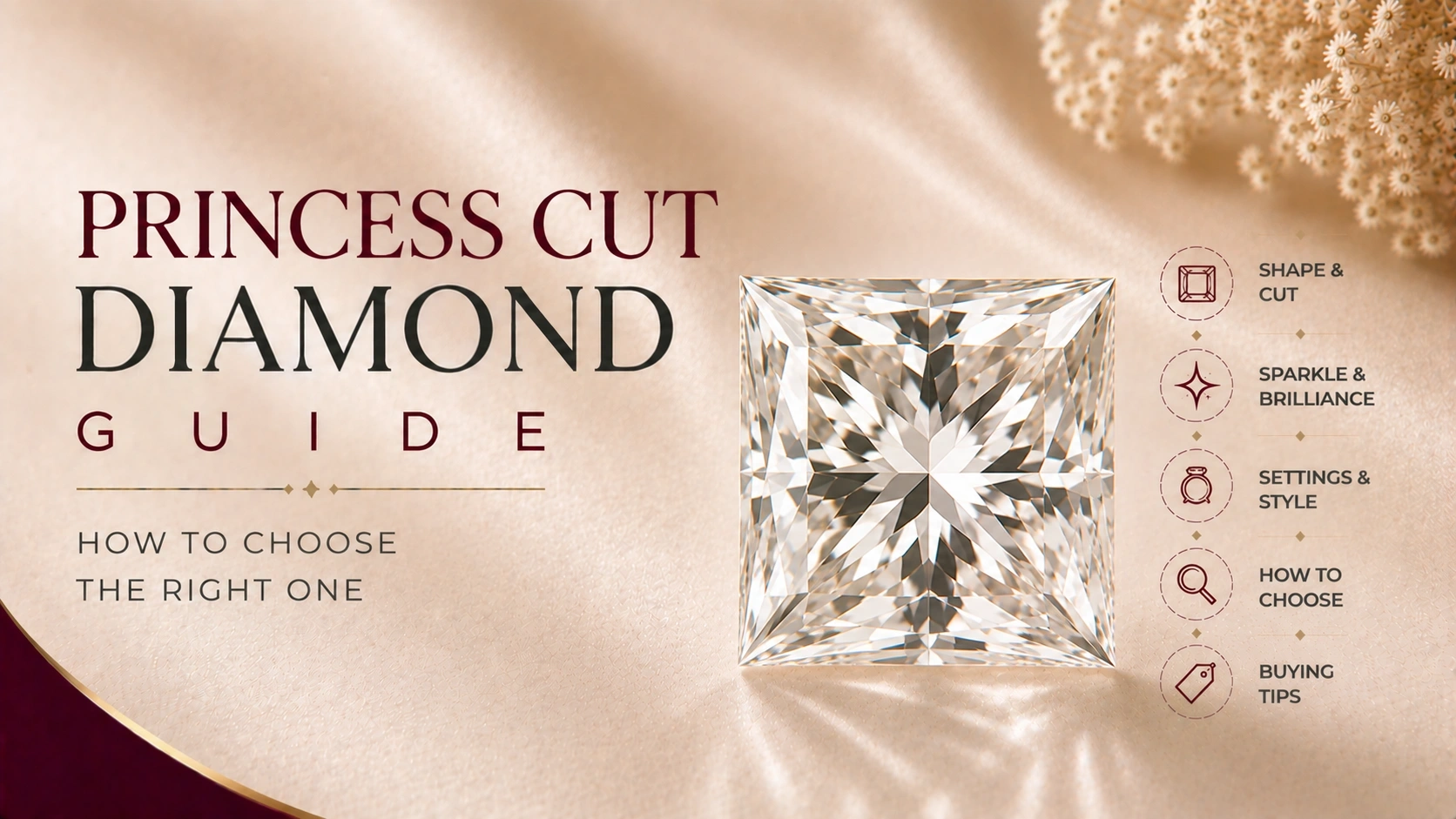
A princess cut diamond combines a bold square shape with the intense sparkle of brilliant-style faceting. It is a popular choice for engagement rings because it looks modern and geometric while still delivering plenty of brilliance.
But not every princess cut diamond will look equally beautiful. Because this shape can vary considerably in proportions, faceting, symmetry, and light performance, knowing what to look for can make a major difference.
This princess cut diamond guide explains the shape, proportions, 4Cs, setting options, corner protection, and the key things to check before buying.
What Is a Princess Cut Diamond?
A princess cut is a square or rectangular diamond with brilliant-style faceting. GIA describes it as a square modified brilliant, distinguishing it from square shapes such as the Asscher cut, which uses step-cut faceting.
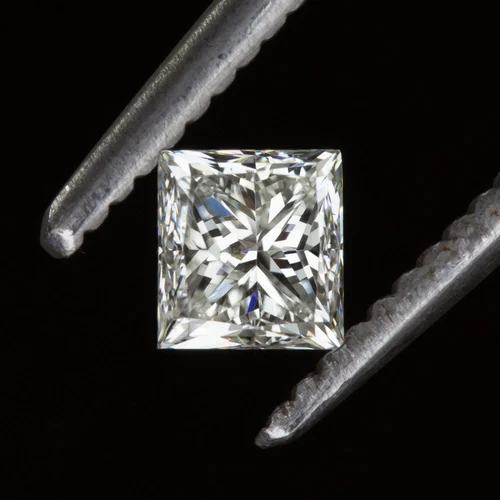
The shape is known for its:
- Square or slightly rectangular outline
- Four pointed corners
- Strong brilliance and scintillation
- Modern, clean appearance
- Brilliant-style faceting
- Versatility in engagement ring settings
Unlike a round brilliant, a princess cut has four sharp corners rather than a continuous rounded outline. Those corners are one of its defining visual features, but they also require special attention when choosing a setting.
Princess cuts can also be somewhat rectangular rather than perfectly square. The length-to-width ratio determines how square or elongated the diamond appears.
Why Are Princess Cut Diamonds Popular?
Princess cut diamonds offer an appealing combination of shape, sparkle, and modern style.
A round brilliant is often chosen for its classic appearance, while a princess cut provides a more architectural look without giving up the brilliance associated with brilliant faceting.
The shape can work particularly well for someone who wants an engagement ring that feels:
- Modern
- Minimalist
- Geometric
- Elegant
- Less traditional than a round diamond
Another attraction is value. Princess cuts can retain more of the original rough diamond during cutting than round brilliants, which can contribute to a lower price per carat.
However, price should not be the only consideration. A poorly proportioned princess cut can have weaker light performance, so evaluating the actual diamond matters more than simply choosing the shape because it costs less.
What Does a Princess Cut Diamond Look Like?
From above, a traditional princess cut looks square with four pointed corners.
Its brilliant-style faceting creates a pattern of bright flashes and darker contrast as the diamond moves relative to the light. The exact appearance can vary substantially from one princess cut to another because fancy shapes do not follow one single faceting design.
The pavilion is also relatively deep, meaning some of the diamond’s weight sits below the girdle. As a result, a princess cut can sometimes look smaller face-up than another diamond of the same carat weight.
For this reason, compare millimeter measurements and face-up appearance, not just carat weight.
Princess Cut vs. Other Diamond Shapes
Princess cuts are easiest to understand when compared with other popular shapes.
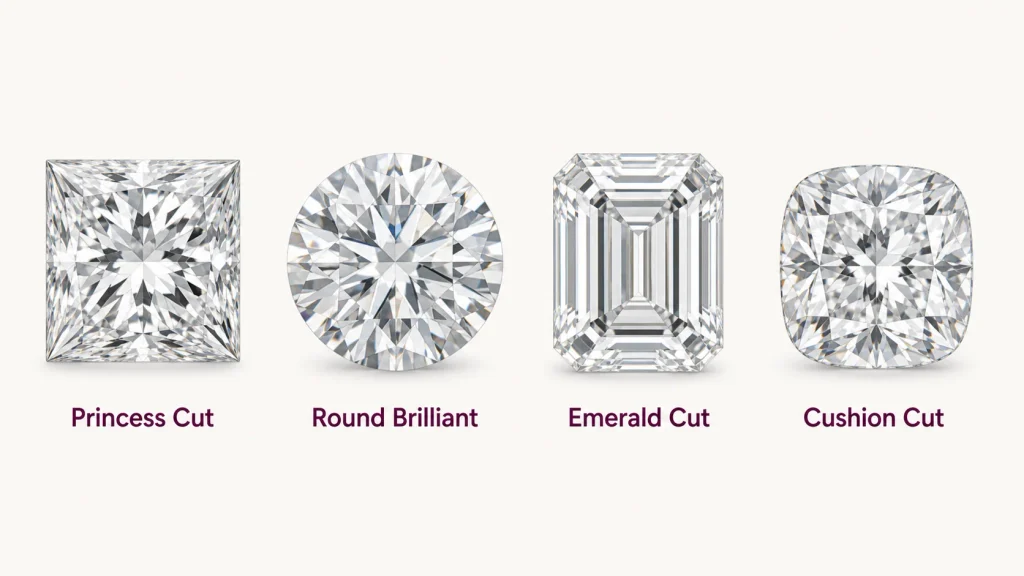
Princess Cut vs. Round Cut
A round diamond has a classic, timeless appearance and is designed around the round brilliant facet arrangement. A princess cut has a square outline and a more angular, contemporary appearance.
If you want traditional brilliance and a rounded silhouette, a round may be the better fit.
If you want strong sparkle with a square outline, a princess cut is worth considering.
Diamiv also has a dedicated comparison of these two shapes: Princess Cut vs. Round Cut Diamonds
Princess Cut vs. Emerald Cut
An emerald cut has long step-cut facets that create broad flashes and a hall-of-mirrors effect. A princess cut uses brilliant-style faceting and generally produces more scintillation.
The two shapes also have very different personalities: emerald cuts emphasize clarity and clean reflections, while princess cuts emphasize sparkle and contrast.
For a detailed comparison, see Emerald Cut vs. Princess Cut.
Princess Cut vs. Cushion Cut
Cushion cuts typically have rounded corners and a softer outline, while princess cuts have crisp, pointed corners.
A cushion may feel more romantic or vintage-inspired. A princess tends to feel sharper and more contemporary.
How to Choose a Princess Cut Diamond
The 4Cs still matter when buying a princess cut, but they need to be considered in the context of this particular shape.
1. Start With Cut Quality and Light Performance
For princess cuts, you should not rely on a single overall cut grade in the same way you might with a round brilliant. Instead, evaluate the diamond’s proportions, symmetry, polish, faceting, and visual performance.
GIA recommends paying close attention to symmetry and the balance of light and dark areas across the diamond.
When reviewing a princess cut, look for:
- Brightness across the stone
- Balanced contrast
- Good symmetry
- No obvious dark center
- No large areas that appear lifeless
- Consistent faceting
- Very Good or Excellent polish and symmetry when available
Two princess cuts with similar carat weights and measurements can still look noticeably different.
If you are shopping online, high-quality photographs and 360-degree videos can be especially useful because they let you examine how the diamond interacts with light.
2. Check the Length-to-Width Ratio
The length-to-width ratio tells you how square or rectangular the diamond appears.
For a classic square princess cut, a ratio close to 1.00 gives the most symmetrical appearance. GIA notes that a square princess cut should have a length-to-width ratio no greater than about 1.05:1.
As the ratio increases, the diamond becomes more rectangular.
A simple guide:
| Length-to-width ratio | General appearance |
|---|---|
| 1.00 | Very square |
| 1.01–1.05 | Square to the eye |
| Around 1.06–1.10 | Slightly rectangular |
| Above 1.10 | Increasingly elongated |
There is no requirement that a princess cut must be perfectly square. If you prefer a rectangular appearance, a higher ratio can be a deliberate stylistic choice.
3. Look at Table and Depth
Table and depth percentages can help you narrow down potential stones, but they should not be treated as an automatic guarantee of beauty.
Common buying guides often suggest looking around the 65%–75% depth range and roughly 68%–75% table range, but princess cuts have considerable variation in faceting and proportions.
The visual result matters more than forcing every diamond into a particular numerical range.
A diamond with promising measurements can still show poor light performance. Whenever possible, judge the actual stone through photographs, video, or in-person viewing.
4. Pay Attention to Symmetry
Symmetry is particularly important for a square diamond.
Look at the stone from above and check whether the faceting appears balanced from left to right and top to bottom.
GIA recommends examining whether corresponding facets mirror one another and whether the overall structure is symmetrical.
Poor symmetry can make a princess cut look uneven or less refined.
5. Choose Color Carefully
Princess cuts can show some body color, particularly toward the corners.
The right color grade depends partly on your setting and your personal tolerance for warmth.
For a white gold or platinum engagement ring, a near-colorless grade can provide a bright appearance. For yellow or rose gold, a slightly warmer diamond can blend naturally with the metal.
Rather than automatically paying for the highest color grade, compare diamonds visually and decide how important an icy-white appearance is to you.
GIA’s general diamond color scale runs from D, representing the highest degree of colorlessness, through Z, with increasing amounts of yellow or brown coloration.
6. Choose Clarity Based on What You Can Actually See
Princess cuts use brilliant-style faceting, which can help disguise small inclusions.
That means you may not need an extremely high clarity grade to find an attractive, eye-clean stone.
For many buyers, VS2 is a useful starting point, while some SI1 diamonds can also offer excellent value if they are eye-clean. The individual diamond matters more than the grade alone.
Pay special attention to inclusions around the corners. A significant fracture or feather near one of the pointed corners deserves extra scrutiny because those areas are already more vulnerable to damage.
7. Don’t Choose Carat Weight in Isolation
Carat is a measure of weight, not visible size.
Two princess cut diamonds can have the same carat weight but different dimensions and face-up appearances.
Before comparing prices, check:
- Length
- Width
- Depth
- Length-to-width ratio
- Face-up appearance
If your priority is getting the largest-looking diamond for your budget, millimeter measurements can be more useful than carat weight alone.
For more guidance, see Best Carat Size for an Engagement Ring.
Why Princess Cut Diamond Corners Matter
The four pointed corners are the main durability concern with a princess cut.
Because the corners extend outward from the body of the diamond, they can be more susceptible to impact and chipping than the rounded edges of a round brilliant.
GIA specifically warns that the absence of a traditional culet leaves the pavilion point and corners vulnerable, and recommends protective settings to reduce the risk.
This does not mean princess cuts are unsuitable for everyday engagement rings. It means the setting should be chosen with the diamond’s geometry in mind.
Best Settings for Princess Cut Diamonds
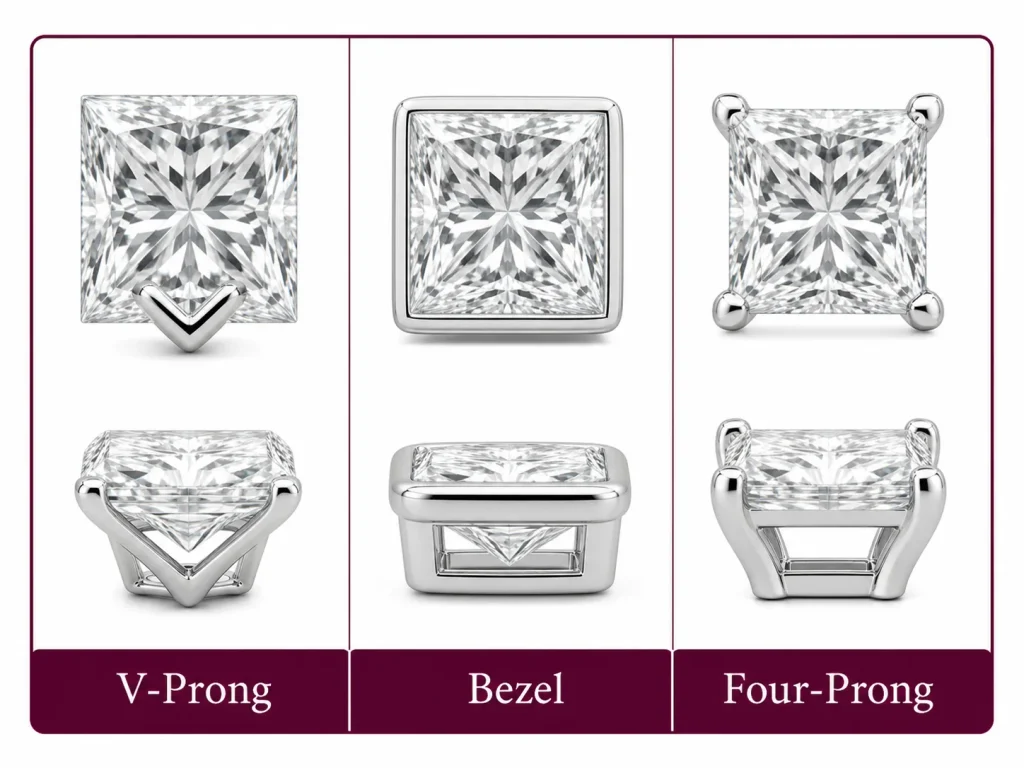
V-Prong Setting
V-shaped prongs are one of the most practical choices for protecting the four corners.
Instead of placing a conventional round prong directly over a corner, a V-prong wraps around the point and helps shield it from impact.
Bezel Setting
A bezel surrounds the diamond with metal, providing substantial protection.
It can also give a princess cut a sleek, modern appearance.
A bezel is particularly appealing if durability and low-profile styling are high priorities.
Four-Prong Setting
Four-prong settings are common for princess cut solitaires, but the design needs to provide adequate corner protection.
The exact prong configuration matters more than simply counting the number of prongs.
Halo Setting
A halo surrounds the princess cut with smaller diamonds.
This can soften the sharp geometry of the center stone while making the overall ring appear larger and more decorative.
Channel Setting
Princess cuts can work especially well as side stones in channel settings because their straight edges fit closely together.
This creates a clean, continuous line of sparkle.
For more setting-related research, you can also explore Why Do Engagement Rings Have Prongs?.
Princess Cut Diamond Pros and Cons
Pros
- Strong brilliance and sparkle
- Distinctive square shape
- Modern and geometric appearance
- Works well in minimalist and contemporary settings
- Can offer good value compared with round diamonds
- Brilliant faceting can help hide some inclusions
- Works well as a center stone or as side stones
Cons
- Pointed corners are vulnerable to chipping
- Requires thoughtful corner protection
- Face-up size can be smaller than expected for its carat weight
- Proportions and faceting can vary considerably
- Color may be more noticeable around the corners
- Not every princess cut has the same level of light performance
Are Princess Cut Diamonds a Good Value?
They can be.
One reason princess cuts can offer attractive value is that their cutting process can retain more of the original rough crystal than a round brilliant. GIA notes that this can contribute to princess cuts costing less per carat than comparable rounds.
But lower price per carat does not automatically mean better value.
A better-value princess cut is one that combines:
- Attractive light performance
- Good symmetry
- Suitable proportions
- An eye-clean appearance
- Appropriate color for the setting
- Secure corner protection
- A price that fits your budget
The goal is not to find the cheapest princess cut. It is to find the best-looking diamond for the money you are willing to spend.
Princess Cut Engagement Ring Styles
Princess cut diamonds are versatile enough to work with many engagement ring designs.
Princess Cut Solitaire
A solitaire keeps the focus on the square center stone.
This is a strong choice if you prefer a clean, understated ring.
Princess Cut Halo
A halo adds surrounding sparkle and can make the center diamond appear larger.
It also creates a softer transition between the angular princess cut and the rest of the ring.
Princess Cut Three-Stone Ring
A princess center can be paired with angular side stones such as baguettes or tapered baguettes.
GIA notes that triangles, trilliants, baguettes, and tapered baguettes can complement the shape particularly well.
Princess Cut Pavé Ring
Small diamonds set along the band add additional sparkle without taking attention away from the center stone.
Princess Cut Bezel Ring
A bezel provides a streamlined appearance while surrounding the center diamond with protective metal.
What Is the Best Princess Cut Diamond?
There is no single set of measurements that guarantees that a princess cut will be the best choice.
The ideal diamond is one that looks bright, balanced, symmetrical, and attractive to you while also meeting your requirements for durability, color, clarity, size, and budget.
As a practical starting point, look for:
- A square ratio around 1.00–1.05 if you want a traditional square shape
- Strong symmetry
- Balanced brightness and contrast
- Attractive proportions
- No obvious dark or dull areas
- Eye-clean clarity
- A color grade appropriate for your setting
- No concerning inclusions near vulnerable corners
- A setting that protects all four corners
Princess Cut Diamond Buying Checklist
Before buying, use this checklist:
Shape
- Does the diamond look square or rectangular as intended?
- Is the length-to-width ratio right for your preference?
Light performance
- Does the stone look bright?
- Are there noticeable dark or lifeless areas?
- Does the sparkle look balanced?
Symmetry
- Do the facets appear evenly matched?
- Does the diamond look straight and well proportioned?
Color
- Does the diamond look sufficiently white for your setting?
- Are you comfortable with any visible warmth?
Clarity
- Is the diamond eye-clean?
- Are there inclusions near the corners?
- Are there any significant feathers or fractures?
Carat and size
- What are the actual millimeter measurements?
- Does the diamond have the face-up size you want?
Setting
- Are all four corners adequately protected?
- Would V-prongs, a bezel, or another protective design be appropriate?
Value
- Are you paying for visible beauty rather than simply a higher grading number?
Frequently Asked Questions
Is a princess cut diamond a good choice for an engagement ring?
Yes. Princess cuts offer strong brilliance, a distinctive square shape, and a modern appearance. Their main consideration is corner protection, so the setting should adequately protect the four pointed corners.
Are princess cut diamonds more affordable than round diamonds?
They can be less expensive per carat than comparable round brilliant diamonds because princess cuts can retain more of the original rough crystal during cutting.
What is the ideal length-to-width ratio for a princess cut?
If you want a traditional square appearance, a ratio between about 1.00 and 1.05 is a useful target. Ratios above that can create a more rectangular appearance.
What color should a princess cut diamond be?
For a white-looking appearance, near-colorless grades are a practical starting point, particularly in white gold or platinum. The best choice depends on the setting, diamond size, and how sensitive you are to visible warmth.
What clarity is best for a princess cut diamond?
There is no single required clarity grade. Many buyers can find an attractive eye-clean princess cut around VS2, while carefully selected SI1 stones can sometimes provide additional value. Inspect the individual diamond, especially around its corners.
Are princess cut diamonds durable?
They can be suitable for everyday wear, but their pointed corners are more vulnerable to chipping than rounded diamond shapes. A protective setting such as V-prongs or a bezel can reduce the risk.
Does a princess cut sparkle more than an emerald cut?
Generally, a princess cut is designed for stronger brilliant-style sparkle, while an emerald cut produces broader flashes from its step-cut facets. They create very different visual effects.
Should a princess cut diamond be perfectly square?
Not necessarily. A ratio close to 1.00 creates a classic square appearance, while a slightly higher ratio can create a subtle rectangular shape. The best choice depends on the look you prefer.
Final Takeaway
A princess cut diamond is a strong choice if you want the sparkle of a brilliant-style diamond with a clean, square silhouette.
The most important thing is not simply choosing a princess cut. It is choosing a well-performing individual diamond.
Pay close attention to symmetry, light performance, length-to-width ratio, color, clarity, and actual face-up measurements. Most importantly, make sure the ring setting protects the four pointed corners.
With those factors in mind, a princess cut can offer a distinctive combination of modern style, strong sparkle, and attractive value for an engagement ring.