A coffin cut diamond is one of the more unusual diamond shapes available today. With its angular outline and distinctive coffin-like silhouette, it appeals to people who want an engagement ring that feels personal rather than traditional.
Unlike round, oval, or princess diamonds, coffin cuts are specialty shapes and can vary in their exact proportions and faceting. That flexibility is part of their appeal, but it also means you need to look more closely at the individual stone rather than relying only on a standard cut grade.
In this coffin cut diamond guide, you’ll learn what the shape is, what it means, how it compares with other geometric diamonds, which settings work well, and what to look for when buying one.
What Is a Coffin Cut Diamond?
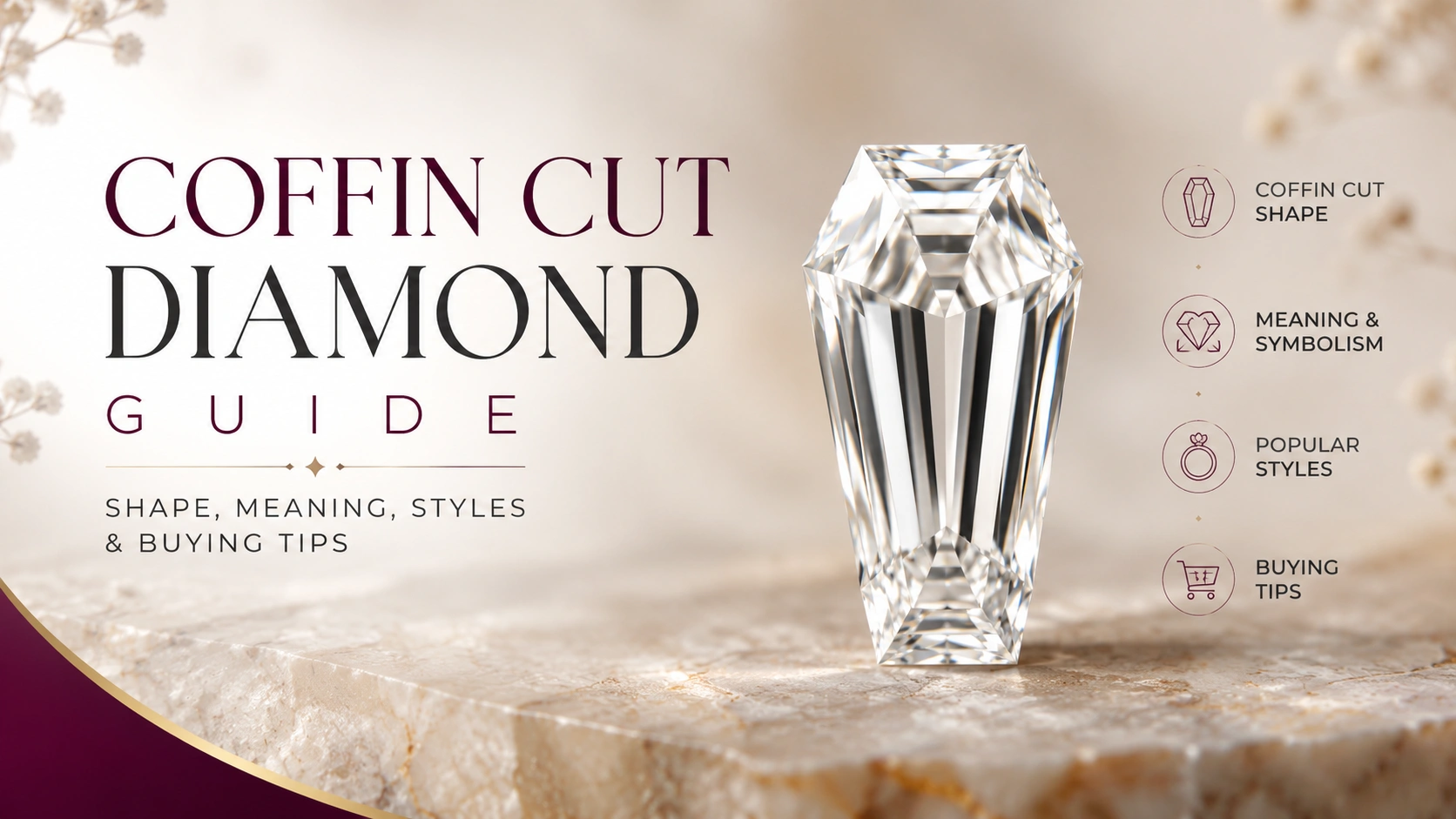
A coffin cut diamond is a specialty diamond shape with an elongated, angular outline that resembles the silhouette of a traditional coffin.
The exact design can vary from one stone to another, but coffin-shaped diamonds generally feature:
- A long, geometric outline
- Angled or tapered sides
- Squared or flattened ends rather than a traditional pointed tip
- A strong architectural appearance
- A shape that can be paired with different faceting styles
The name describes the outline of the diamond, not necessarily the way it is faceted.
Because coffin cut diamonds are not produced according to one universally standardized shape specification, two stones can look noticeably different. This makes the individual diamond’s proportions, symmetry, faceting, and overall appearance particularly important when shopping.
For broader background on how diamond shapes and cuts differ, see the diamond shape guide and types of diamond cuts.
What Does a Coffin Cut Diamond Look Like?
The easiest way to recognize a coffin cut diamond is by its distinctive geometric silhouette.
Instead of the smooth curves of an oval or round diamond, the coffin shape relies on straight lines and angled edges. The outline typically creates a wider central area that tapers toward the ends, giving the stone its recognizable appearance.
Depending on the cutter and design, a coffin diamond may look:
- Long and narrow
- Broad and architectural
- More vintage-inspired
- More modern and minimalist
- Dramatic and gothic
- Subtle and sophisticated
This variation is important. There isn’t necessarily one perfect coffin shape. Personal preference plays a major role in deciding which proportions look best.
Why Is It Called a Coffin Cut?
The name comes from the diamond’s resemblance to the outline of a coffin.
That distinctive silhouette is what separates it from many conventional diamond shapes. The name can initially make the shape sound dark or dramatic, but the finished jewelry does not have to follow a gothic aesthetic.
A coffin diamond can be placed in a minimalist solitaire, a vintage-inspired ring, or a contemporary setting just as easily as it can be used in a darker alternative design.
Coffin Cut Diamond Meaning and Symbolism
The meaning of a coffin cut diamond depends largely on the person wearing it.
Because the shape resembles a coffin, it can naturally evoke ideas associated with mortality, mystery, transformation, and the gothic aesthetic. For some buyers, that symbolism is precisely what makes the shape attractive.
For others, the coffin shape represents something much simpler: individuality.
A coffin cut diamond can symbolize:
- Individuality
- Nonconformity
- Personal expression
- Mystery
- Transformation
- Appreciation for unconventional beauty
It is worth remembering that there is no universal romantic meaning assigned to the coffin cut. Its symbolism is more personal and design-driven than traditional diamond symbolism.
Someone may choose the shape because they love gothic jewelry, while another buyer may simply appreciate its clean geometry.
Coffin Cut vs. Other Diamond Shapes
Coffin cut diamonds can be confused with several other unusual geometric shapes.
Coffin Cut vs. Kite Cut
Kite-shaped diamonds generally have a pointed, four-sided outline resembling a kite.
A coffin cut has a more elongated silhouette with a coffin-like geometric outline and typically flatter or squared-off ends.
The two can look somewhat similar at first glance, especially when used in unconventional engagement rings, but their outlines are different.
Coffin Cut vs. Hexagon Cut
Both shapes have strong geometric characteristics, but a conventional hexagon has six relatively defined sides that create a more symmetrical hexagonal outline.
A coffin cut generally emphasizes an elongated coffin-like silhouette rather than a regular hexagon.
If you’re deciding between them, compare the actual outline of the stones rather than relying only on their names.
Coffin Cut vs. Baguette Cut
Baguette diamonds are typically long, narrow rectangular step-cut stones with straight parallel sides.
A coffin cut is more visually distinctive because its sides taper and its outline creates the coffin-like shape.
Baguettes are also commonly used as accent stones, while a coffin diamond can serve as the center stone of an engagement ring.
For another unusual geometric option, see the tapered baguette diamond guide.
Step-Cut vs. Brilliant-Cut Coffin Diamonds
The coffin shape describes the outline, while the faceting determines how the diamond interacts with light.
This means you should not assume every coffin diamond will have the same visual effect.
Step-Cut Coffin Diamonds
Step cuts use long, linear facets arranged in a way that creates broad flashes of reflected light.
They tend to have a quieter, more architectural appearance than brilliant cuts. This can work particularly well with the coffin shape because the linear facets reinforce its geometric character.
However, step cuts can make inclusions and color more noticeable, so careful visual inspection is important.
Brilliant-Cut Coffin Diamonds
A brilliant-style faceting pattern uses more facets designed to create stronger sparkle and light return.
A brilliant-faceted coffin diamond can therefore feel more energetic and sparkly than a step-cut version of the same outline.
If you love the coffin silhouette but still want substantial sparkle, this can be an option worth exploring.
The key is to evaluate the actual stone rather than assuming that the shape alone determines its brilliance.
Are Coffin Cut Diamonds Rare?
Coffin cut diamonds are considerably less common than mainstream shapes such as round, oval, cushion, or princess.
One reason is demand. Traditional diamond shapes have large established markets, while specialty shapes appeal to a smaller group of buyers.
Another factor is cutting. A specialty outline may require a cutter to work around the characteristics of the rough diamond rather than following one highly standardized mass-market shape.
As a result, you may encounter fewer ready-to-buy coffin diamonds and more custom or specialty options.
This rarity can be a positive if you want an engagement ring that feels genuinely different. It can also make comparison shopping more difficult.
Coffin Cut Diamond Engagement Rings
A coffin cut diamond can make a particularly striking center stone for an engagement ring.
Its unusual outline naturally becomes the focal point, so you don’t necessarily need an elaborate setting to make the ring noticeable.
Some popular approaches include:
Solitaire Coffin Cut Rings
A solitaire keeps attention on the center stone.
This is a strong choice if you want the coffin outline to remain clearly visible without surrounding diamonds competing for attention.
Halo Coffin Cut Rings
A halo places smaller diamonds around the center stone.
This can make the center appear larger and add additional sparkle while emphasizing the unusual outline.
Because the center stone is already distinctive, the halo can be kept relatively simple for a balanced look.
Vintage-Inspired Coffin Rings
The geometric shape works naturally with vintage-inspired details such as milgrain, engraving, filigree, or antique-style metalwork.
This can create an Art Deco-inspired appearance without requiring the entire ring to look gothic.
Modern Minimalist Settings
A clean band and simple setting can make the coffin shape feel architectural and contemporary.
This is a good option for someone who likes unusual jewelry but doesn’t necessarily want a heavily decorated ring.
East-West Settings
Instead of placing the stone vertically along the finger, an east-west setting rotates it horizontally.
This makes the shape even more noticeable and gives the ring a distinctly modern appearance.
What Settings Work Best for Coffin Cut Diamonds?
The best setting depends on the exact shape of the stone and how much of its outline you want to show.
Good options can include:
- Solitaire settings
- Bezel settings
- Halo settings
- Prong settings
- Vintage-inspired settings
- East-west settings
The edges and corners deserve particular attention when selecting a setting.
A qualified jeweler should make sure the stone is securely supported and that vulnerable areas are adequately protected.
If you’re considering the practical side of ring construction, you may also find the guide to [why engagement rings have prongs] useful.
How to Choose a Coffin Cut Diamond
Buying a specialty shape requires a slightly different approach from buying a standard round diamond.
1. Look Closely at Symmetry
Symmetry is especially important because the coffin outline depends on clean geometric lines.
Look for:
- Balanced sides
- Consistent angles
- A centered outline
- Even-looking ends
- No obvious distortion
If one side appears noticeably different from the other, the imbalance may be distracting once the stone is set.
2. Evaluate the Actual Cut
Don’t rely only on a generic cut label.
Because coffin diamonds are specialty shapes, inspect the stone’s actual light performance and faceting pattern.
Look for:
- Good light return
- Attractive reflections
- Minimal dull areas
- Clean, defined facets
- A pleasing appearance from different viewing angles
A photograph or video can help, but seeing the stone in person is even better when possible.
For a broader explanation of diamond cut quality, see the [diamond cut guide] and [4Cs of diamond quality guide].
3. Consider Length and Proportions
There is no single length-to-width ratio that makes every coffin diamond attractive.
A longer, narrower stone can create a sleek appearance, while a wider stone may look bolder and more substantial.
Instead of chasing one numerical ratio, compare several stones and decide which outline looks best to you.
4. Pay Attention to Clarity
Clarity matters because certain faceting patterns can make inclusions easier to see.
Rather than automatically paying for the highest clarity grade, inspect the actual diamond and determine whether it looks clean at normal viewing distance.
This is particularly important when comparing step-cut stones.
You can learn more about this factor in the [diamond clarity guide].
5. Consider Diamond Color
Color can become more noticeable depending on the stone’s faceting and the metal used for the setting.
A colorless-looking appearance may be easier to achieve with higher color grades, while warmer colors can work beautifully with yellow or rose gold.
The right choice depends on your preferred appearance and budget.
See the [diamond color guide] for a broader explanation of diamond color.
6. Think About the Setting Before Buying
A coffin diamond shouldn’t always be purchased independently of the ring design.
Consider how the stone will be set, how much of its outline will remain visible, and whether the setting protects its edges.
A custom jeweler can help design the setting around the exact dimensions of the stone.
Pros and Cons of Coffin Cut Diamonds
Pros
Distinctive appearance: The shape is immediately different from conventional diamond silhouettes.
Strong geometric character: The angular outline works well with modern, Art Deco, vintage, and alternative designs.
Excellent for personal expression: It can be a strong choice for someone who doesn’t want a traditional engagement ring.
Custom-design potential: Specialty shapes provide plenty of room for creative ring designs.
Works with different aesthetics: The same shape can look gothic, minimalist, vintage, or contemporary depending on the setting.
Cons
Limited availability: Coffin diamonds are not as widely stocked as mainstream shapes.
Harder to compare: There may be greater variation between individual stones.
Specialty-cut considerations: You need to evaluate the actual stone carefully rather than relying entirely on standardized shape expectations.
Potentially more difficult to replace: If the diamond is custom cut, finding an identical replacement later may be challenging.
Not ideal for everyone: Buyers who prefer classic, universally recognizable shapes may find the coffin silhouette too unconventional.
Who Is a Coffin Cut Diamond Best For?
A coffin cut diamond may be a good choice if you want an engagement ring that feels different from traditional designs.
It can be particularly appealing if you:
- Prefer unconventional jewelry
- Like geometric designs
- Enjoy gothic or alternative aesthetics
- Want a conversation-starting engagement ring
- Prefer individuality over mainstream trends
- Are interested in custom jewelry
On the other hand, a traditional round or oval diamond may be a better fit if you want maximum familiarity, broad availability, and easy comparison between stones.
If you’re still deciding between diamond shapes, exploring the [diamond shape guide] can help you compare the broader range of options.
Is a Coffin Cut Diamond Good for an Engagement Ring?
Yes. A coffin cut diamond can work very well as an engagement-ring center stone if its unusual appearance matches your personal style.
The biggest advantage is individuality. The shape gives the ring a recognizable identity without requiring an exceptionally large diamond or complicated setting.
The main consideration is that specialty shapes require more attention during selection. Make sure the outline is symmetrical, the stone has attractive light performance, and the setting provides appropriate protection.
Can Coffin Cut Diamonds Be Lab-Grown?
Yes, a coffin shape can be produced from lab-grown diamond rough as well as natural diamond material.
The choice between natural and lab-grown comes down to factors such as budget, origin preferences, availability, and the characteristics of the individual stone.
If you’re comparing diamond origins, see the guide to [lab-grown vs. natural diamonds].
Can Coffin Cut Diamonds Be Black?
Yes. Black diamonds can be fashioned into specialty coffin shapes.
A black coffin diamond creates a particularly dramatic look because the dark body color emphasizes the geometric silhouette.
However, black diamonds interact with light differently from traditional colorless diamonds, so don’t choose one expecting the same type of brilliance.
Black coffin diamonds can be especially effective in gothic, alternative, or contemporary engagement-ring designs.
How Much Does a Coffin Cut Diamond Cost?
There is no single price for a coffin cut diamond.
The cost depends on factors such as:
- Carat weight
- Diamond origin
- Color
- Clarity
- Cut quality
- Faceting style
- Craftsmanship
- Availability
- Whether the stone is custom cut
Because coffin diamonds are specialty shapes, comparing prices solely by carat weight can be misleading.
Two stones with similar carat weights can have very different appearances and prices.
When comparing options, consider the entire diamond rather than focusing on one specification.
Frequently Asked Questions
What is a coffin cut diamond?
A coffin cut diamond is a specialty diamond shape with an elongated, angular outline that resembles a coffin. Exact proportions can vary between stones because it is not a mainstream standardized shape.
Are coffin cut diamonds real diamonds?
Yes. A coffin cut describes the shape of a diamond. The stone can be made from natural diamond or lab-grown diamond material.
Is a coffin cut the same as a hexagon?
No. Both are geometric shapes, but a coffin cut has a distinctive elongated coffin-like outline, while a conventional hexagon has a more regular six-sided shape.
Is a coffin cut diamond gothic?
It can be, but it doesn’t have to be. The shape is often associated with gothic and alternative jewelry, but a simple setting can make it look modern, architectural, or minimalist.
Does a coffin cut diamond sparkle?
It can. Sparkle depends heavily on the stone’s faceting and overall cut quality. Brilliant-faceted versions can produce more obvious sparkle, while step-cut versions generally create broader, quieter flashes.
Are coffin cut diamonds rare?
They are much less common than mainstream shapes such as round, oval, and princess. Their specialty nature means availability can vary significantly between jewelers.
What is the best setting for a coffin cut diamond?
There isn’t one universal best setting. Solitaire, halo, bezel, prong, vintage-inspired, and east-west settings can all work depending on the stone and the desired style.
Should I choose a high-clarity coffin cut diamond?
Not necessarily. The goal should be an attractive, eye-clean stone rather than automatically choosing the highest clarity grade. Inspect the individual diamond carefully, especially if it uses step faceting.
Can a coffin cut diamond be used as an engagement ring?
Yes. Its distinctive outline makes it a strong center-stone choice for someone who wants a non-traditional engagement ring.
Can coffin cut diamonds be lab-grown?
Yes. Lab-grown diamonds can be cut into specialty shapes, including coffin shapes.
Final Thoughts
A coffin cut diamond is an excellent option for someone who wants an engagement ring with a strong sense of individuality.
Its unusual silhouette can feel gothic and dramatic, but it can also look refined, minimalist, vintage, or contemporary depending on the setting. The most important thing is not to choose the shape simply because it is unusual. Look closely at the individual stone.
Pay particular attention to symmetry, proportions, faceting, clarity, color, light performance, and how the diamond will be protected once it is mounted.
If traditional round and oval diamonds don’t feel like you, a coffin cut may offer the distinctive combination of geometry, personality, and originality you’re looking for.
Internal Linking Plan
I would keep the internal linking focused rather than adding every remotely related diamond article. The strongest relevant pages available in the database are:
| Suggested anchor | Destination |
|---|---|
| diamond shape guide | Diamiv diamond shape guide |
| types of diamond cuts | Diamiv types of diamond cuts guide |
| tapered baguette diamond guide | Diamiv tapered baguette diamond guide |
| why engagement rings have prongs | Diamiv prong guide |
| diamond cut guide | Diamiv diamond cut guide |
| 4Cs of diamond quality guide | Diamiv 4Cs guide |
| diamond clarity guide | Diamiv diamond clarity guide |
| diamond color guide | Diamiv diamond color guide |
| lab-grown vs. natural diamonds | Diamiv lab-grown vs. natural diamonds guide |
| French cut diamond guide | Diamiv French cut diamond guide |
| shield cut diamond guide | Diamiv shield cut diamond guide |
| kite cut diamond guide | Diamiv kite cut diamond guide |
These URLs are present in the supplied internal-link database, including the broader diamond-shape/cut cluster and specialty-shape guides.
I also deliberately kept the brand name out of most anchor copy and used descriptive contextual anchors instead, so the article doesn’t repeatedly say “Diamiv,” as requested.