A single cut diamond is a small, simply faceted diamond best known for its subtle sparkle and traditional appearance. Unlike a modern round brilliant, which typically has 57 or 58 facets, a traditional single cut uses a much simpler faceting pattern with about 17 or 18 facets.
You may also see single cut diamonds called 8/8 cuts or huit huit, referring to the eight crown facets and eight pavilion facets used in the classic design. They are especially common in small accent stones, pavé jewelry, vintage-inspired rings, antique jewelry, and watch settings.
If you’re researching unusual diamond cuts, a single cut is worth understanding because it looks and performs differently from the brilliant-cut diamonds commonly used as center stones.
What Is a Single Cut Diamond?
A single cut diamond is a diamond with a relatively simple faceting pattern, traditionally consisting of eight facets on the crown, eight facets on the pavilion, and a table facet.
That gives the classic version 17 facets in total. Some versions are described as having 18 facets when a culet or additional facet is included. Because terminology can vary slightly between jewelry sources, you may encounter both 17-facet and 18-facet descriptions. GIA describes single-cut melee as having 17 or 18 facets depending on whether a culet is present.
The name can be confusing. “Single cut” does not mean the diamond has only one facet. Instead, it refers to a simpler stage or style of faceting compared with a full-cut brilliant.
Single cuts are usually associated with very small round diamonds rather than large center stones.
Why Is It Called an 8/8 Cut?
One of the most common names for a single cut diamond is 8/8 cut.
The first “8” refers to the eight facets on the crown, or upper portion, of the diamond. The second “8” refers to the eight facets on the pavilion, or lower portion.
A table facet sits at the top, bringing the traditional design to 17 facets.
The jewelry trade may also use the French term huit huit, which means “eight eight.”
This simple arrangement is one of the easiest ways to distinguish a traditional single cut from a modern full-cut brilliant.
How Many Facets Does a Single Cut Diamond Have?
A traditional single cut generally has 17 facets, although 18-facet versions are also found depending on the presence of a culet or how the cut is classified.
For comparison:
| Diamond cutting style | Typical facets |
|---|---|
| Single cut | 17–18 |
| Full-cut round brilliant | 57–58 |
| Rose cut | Varies |
| Old European cut | Typically 58 |
A full-cut round brilliant has dramatically more facets than a single cut. The additional facets are designed to create more complex reflections, brilliance, fire, and scintillation.
The number of facets alone, however, does not mean that one diamond is automatically “better” than another. Single cuts are designed for a different purpose and are particularly practical for very small stones.
For a broader explanation of how diamond cutting differs from diamond shape, see this guide to types of diamond cuts.
What Does a Single Cut Diamond Look Like?
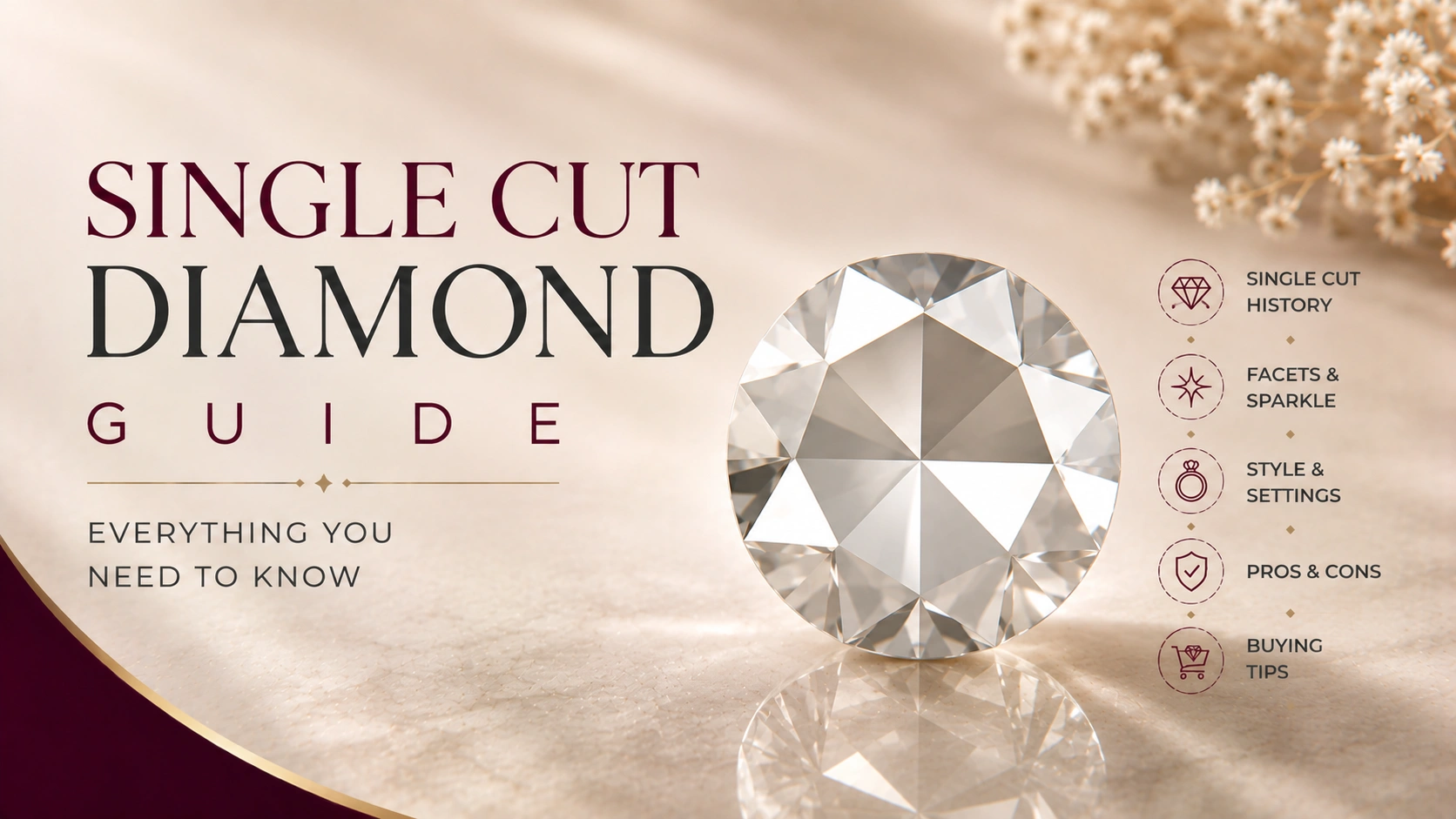
A single cut diamond generally has a round outline with relatively large, simple facets compared with a full-cut brilliant.
When viewed individually, it tends to produce broader and simpler flashes of light rather than the busy, highly scintillating sparkle associated with a modern round brilliant.
This difference becomes especially noticeable when comparing larger stones. However, single cuts are usually used at very small sizes, where the visual distinction between faceting patterns can become much less obvious to the naked eye.
That is an important reason single cuts remain useful in jewelry. Their job is often to contribute a soft layer of sparkle around a larger center stone rather than compete with it.
How Does a Single Cut Diamond Sparkle?
Single cut diamonds generally have a more restrained sparkle than full-cut brilliant diamonds.
The smaller number of facets creates fewer opportunities for the light to break into the numerous small flashes associated with a round brilliant. Instead, single cuts can produce simple flashes of brightness that complement the surrounding jewelry.
This does not make a single cut diamond poorly cut or defective. It is simply a different faceting approach.
In very small accent stones, the difference can be difficult to appreciate without magnification. At those sizes, adding dozens of additional facets may provide little visible benefit to the person looking at the finished jewelry.
Where Are Single Cut Diamonds Used?
Single cut diamonds are most commonly encountered as small accent diamonds.
You may find them in:
- Pavé settings
- Channel settings
- Cluster rings
- Vintage engagement rings
- Antique jewelry
- Art Deco-inspired designs
- Watch cases and bezels
- Small diamond accents around a center stone
They are particularly useful when the designer wants the surrounding diamonds to provide delicate sparkle without overwhelming the main stone.
They can also be important when restoring antique jewelry. If a historic ring originally used single-cut accent diamonds, replacing missing stones with modern full-cut melee can change the overall appearance because the new stones may have a noticeably different sparkle pattern.
Single Cut vs. Full Cut Diamonds
The biggest difference between single cut and full cut diamonds is their faceting pattern.
A traditional single cut has roughly 17 or 18 facets, while a full-cut round brilliant has 57 or 58.
Single Cut
- Simple faceting
- Usually very small
- Subtle sparkle
- Common as an accent stone
- Strong association with antique and vintage jewelry
- Useful for matching older jewelry
Full Cut
- 57 or 58 facets
- More complex faceting
- Greater brilliance and scintillation
- Common in modern jewelry
- Suitable for both center stones and small accent diamonds
A full cut is generally the better choice when you want maximum sparkle from a diamond. A single cut makes more sense when the goal is a delicate accent or a historically appropriate appearance.
Are Single Cut Diamonds Vintage?
Not necessarily.
Single cut diamonds have a long history and are strongly associated with older jewelry, particularly antique and vintage pieces. They were widely used before modern cutting technology made it practical to produce highly faceted diamonds at very small sizes.
However, a single cut does not automatically prove that a piece of jewelry is antique.
Modern jewelers still produce and use single-cut diamonds, particularly when working with tiny accent stones or recreating the appearance of older jewelry.
If you’re trying to determine whether a ring is genuinely antique, the diamond cut should be considered alongside the setting, construction, metalwork, proportions, wear, and overall design.
For more context, compare vintage vs. antique engagement rings.
Single Cut vs. Other Vintage Diamond Cuts
Single cut diamonds are sometimes grouped together with other historic diamond cuts, but they are not interchangeable.
Single Cut vs. Rose Cut
A rose cut typically has a flat base and a domed, faceted crown that rises toward a point. It has a very different appearance and light performance from a single cut.
You can see the differences in rose cut diamonds and this rose cut vs. round cut comparison.
Single Cut vs. Old European Cut
An Old European cut is a much more complex antique round brilliant style and is generally associated with larger stones than the tiny accent diamonds for which single cuts are commonly used.
Learn more in the Old European Cut Diamond Guide.
Single Cut vs. Old Mine Cut
Old Mine cuts are another historic diamond style, typically characterized by a cushion-like outline and distinctive antique proportions.
They should not be confused with the much simpler single cut.
See the Old Mine Cut Diamond Guide for a closer look.
Single Cut vs. French Cut
French cuts are another historic faceting style often found in vintage and antique jewelry. Their geometric appearance makes them particularly recognizable in period-inspired designs.
For a closer comparison, see the French Cut Diamond Guide.
Are Single Cut Diamonds Good for Engagement Rings?
They can be, but their suitability depends on how the diamond is being used.
A single cut is generally not the first choice for a modern engagement-ring center stone when maximum brilliance is the priority. A full-cut brilliant or another well-designed center-stone cut will usually provide a more dramatic light performance.
Single cuts can be excellent, however, as:
- Side stones
- Pavé accents
- Halo accents
- Vintage-style details
- Small stones surrounding an antique center stone
Their quieter sparkle can actually improve the balance of a vintage-inspired engagement ring by allowing the center stone to remain the focal point.
If you’re deciding between different diamond cuts for an engagement ring, this guide to the best diamond cut for an engagement ring provides useful broader context.
Are Single Cut Diamonds Cheaper?
Single cut diamonds can be less expensive than comparable full-cut diamonds because they require fewer facets and a simpler cutting process.
However, you should not assume that every single cut diamond will have a specific price advantage.
When single cuts are used as melee or accent stones, they are often purchased as part of a group rather than as individually graded center stones. The final jewelry price also depends on the number of stones, their size, color, clarity, setting, metal, craftsmanship, and the piece’s overall design.
In other words, the simpler cut can reduce cutting complexity, but the finished jewelry still has many other factors affecting its price.
Advantages of Single Cut Diamonds
Single cut diamonds have several advantages when used in the right context.
1. They suit vintage jewelry
Their historical connection and restrained sparkle work naturally with antique and vintage-inspired designs.
2. They work well as accent stones
Their purpose is usually to complement rather than overpower the center stone.
3. They are practical for very small diamonds
A complex brilliant faceting pattern is not always necessary on a tiny stone.
4. They can help preserve an antique appearance
When restoring older jewelry, using single cuts can create a more consistent visual result than replacing them with modern full-cut melee.
5. They offer a distinctive sparkle
Their broader, simpler flashes can create a softer look than the intense scintillation of full-cut diamonds.
Disadvantages of Single Cut Diamonds
There are also limitations to consider.
1. Less brilliance than full cuts
If maximum sparkle is your priority, a full-cut brilliant generally has the advantage because of its more complex faceting.
2. Not ideal as a modern center stone
The subtle appearance that works well for accent diamonds may feel underwhelming when the diamond is intended to be the main focal point.
3. Less common in modern jewelry
Most contemporary small round diamonds are full cut, so finding single-cut stones may require more specialized sourcing.
4. Individual grading is uncommon
Because single cuts are generally very small, they are not normally treated like large center stones with individual grading reports. Jewelry containing melee is more commonly evaluated as a group.
How to Choose a Single Cut Diamond
If you’re buying jewelry that contains single cut diamonds, start by considering the overall design rather than judging each tiny stone in isolation.
Look at:
The center stone:
The accent diamonds should complement its shape, color, and sparkle.
The jewelry’s age and style:
Single cuts can be especially appropriate for antique, vintage, and vintage-inspired designs.
Consistency:
If multiple single-cut diamonds are used, consistent appearance across the group helps create a more cohesive look.
Setting quality:
Because these stones are usually very small, the quality of the setting is an important part of the finished appearance.
Desired sparkle:
If you want intense, lively scintillation throughout the ring, full-cut melee may be more appropriate. If you prefer a quieter vintage shimmer, single cuts can be a better fit.
For a broader overview of the factors that affect diamond quality, see the 4Cs of diamond quality.
Frequently Asked Questions
Are single cut diamonds real diamonds?
Yes. A single cut describes the diamond’s faceting style, not whether the stone is a real diamond. Single-cut diamonds can be natural diamonds, and the term itself does not indicate the diamond’s origin.
Is a single cut the same as an 8-cut diamond?
In traditional jewelry terminology, yes. “Single cut” and “8/8 cut” are commonly used for the same basic faceting style.
How many facets does an 8/8 diamond have?
A traditional 8/8 single cut has eight crown facets and eight pavilion facets, plus a table, giving 17 facets. Some descriptions count an additional culet facet and refer to 18 facets.
Do single cut diamonds sparkle?
Yes, but their sparkle is generally more subtle than that of full-cut brilliant diamonds. Their simpler facets create broader, less complex flashes of light.
Are single cut diamonds only used in antique jewelry?
No. Although they are strongly associated with antique and vintage jewelry, modern jewelers still use single cuts for small accent stones and other applications.
Are single cut diamonds good quality?
A single cut is not a quality grade. It describes how the diamond is faceted. A single cut can be an intentional and appropriate choice for a small accent stone even though it has fewer facets than a full-cut diamond.
Can a single cut diamond be used as a center stone?
It can, but it is unusual in modern engagement rings. If you want a center diamond with strong brilliance and scintillation, a full-cut brilliant is generally a more natural choice.
Final Takeaway
A single cut diamond is a simple, traditionally faceted diamond with around 17 or 18 facets, commonly arranged as an 8/8 pattern. Its defining characteristic is not maximum brilliance but a softer, simpler sparkle that works particularly well for small accent stones.
Single cuts have an important place in antique and vintage jewelry, but they are not limited to old pieces. Modern jewelers continue to use them when their size, appearance, or subtle sparkle suits the design.
For an engagement ring, single cuts are usually most useful as accent diamonds rather than the center stone. If you want maximum sparkle, a full-cut brilliant is generally the stronger choice. If you want a refined vintage character or need to complement an antique-style center stone, single cuts can be an excellent fit.