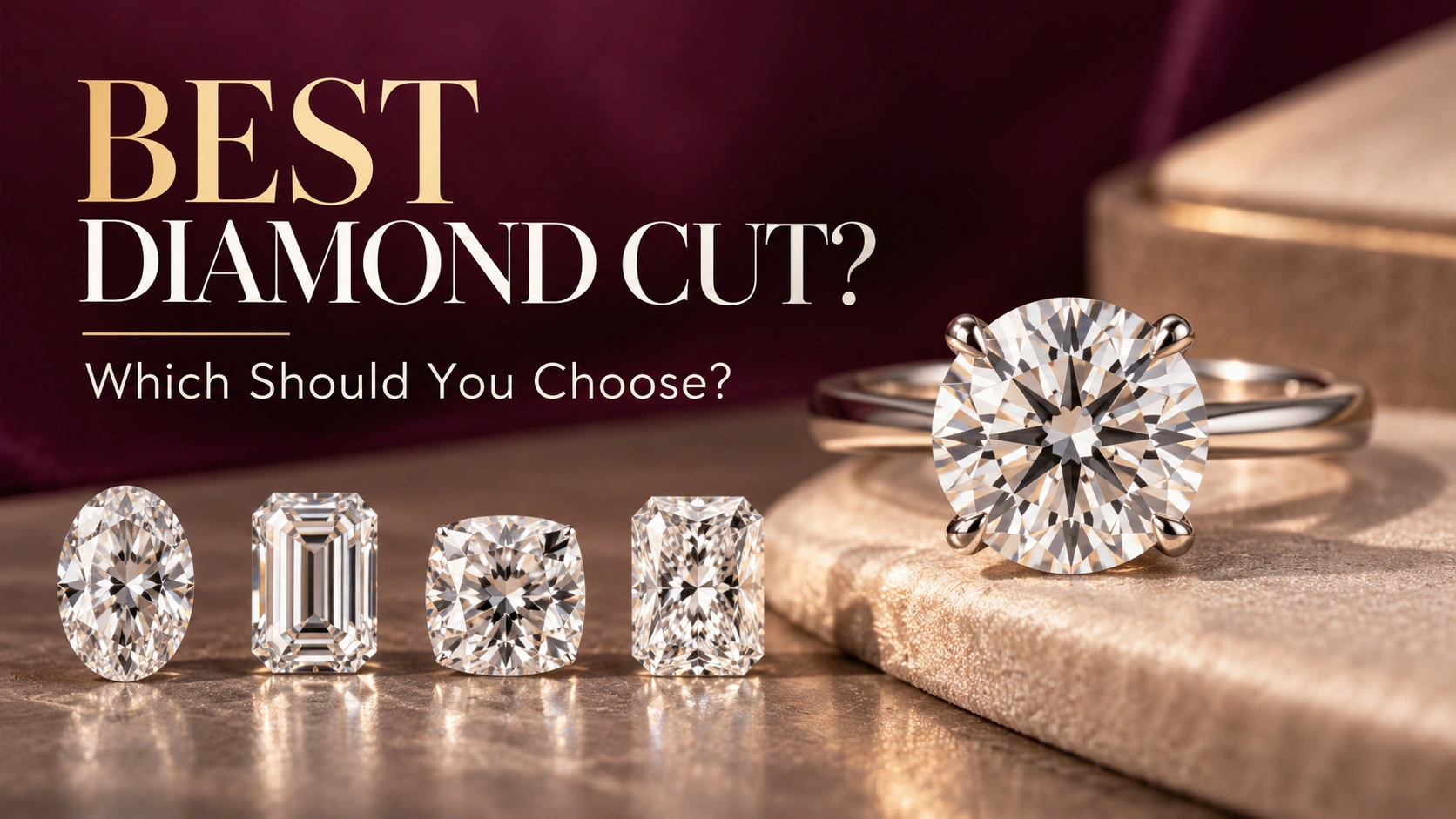
Choosing the best diamond cut for an engagement ring is one of the most important decisions you can make when shopping for a diamond.
But there’s an important distinction that often gets overlooked:
Diamond cut and diamond shape are not the same thing.
A diamond’s shape is its outline, such as round, oval, emerald, pear, or cushion.
Its cut refers to how well the diamond’s proportions, symmetry, facets, and finish interact with light.
That’s why two diamonds with the same shape, color, clarity, and carat weight can look completely different.
For many engagement-ring shoppers, Round Brilliant is the safest starting point if maximum sparkle is the priority. But it isn’t automatically the best choice for everyone.
An oval can create an elongated look. An emerald cut can offer elegant flashes and a sleek appearance. A cushion can feel romantic and softer. A radiant can combine strong brilliance with a distinctive outline.
So, what is the best diamond cut for an engagement ring?
The best cut is the one that gives you the light performance, appearance, durability, and style you want while fitting your budget.
Let’s break it down.
Best Diamond Cut for an Engagement Ring at a Glance
| Diamond Cut/Shape | Sparkle | Appearance | Best For |
|---|---|---|---|
| Round Brilliant | Excellent | Classic and highly brilliant | Maximum sparkle |
| Oval | Excellent | Elongated and elegant | Larger-looking appearance |
| Radiant | Excellent | Brilliant with modern style | Strong sparkle + distinctive shape |
| Cushion | Very Good–Excellent | Soft and romantic | Vintage-inspired styles |
| Princess | Very Good–Excellent | Sharp and geometric | Modern, angular designs |
| Pear | Excellent | Elongated and distinctive | Unique, elegant rings |
| Marquise | Excellent | Long and dramatic | Finger-lengthening effect |
| Emerald | Moderate | Clean and sophisticated | Step-cut elegance |
| Asscher | Moderate | Symmetrical and vintage | Art Deco-inspired designs |
These descriptions are broad because individual diamonds can perform differently even within the same shape.
What Does Diamond Cut Mean?
Diamond cut describes how effectively a diamond has been fashioned to interact with light.
It involves characteristics such as:
- Proportions
- Facet arrangement
- Symmetry
- Polish
- Depth
- Table
- Light return
- Overall craftsmanship
A well-cut diamond can return light efficiently, creating brightness, fire, and scintillation.
A poorly cut diamond may appear dull even if it has excellent color and clarity.
This is why cut is often one of the first characteristics you should protect when building an engagement-ring budget.
For a deeper explanation, see this diamond cut guide.
Cut vs Shape: What’s the Difference?
This is one of the most important things to understand.
Diamond shape
The shape is what you see from above.
Examples include:
- Round
- Oval
- Emerald
- Cushion
- Princess
- Pear
- Marquise
- Radiant
- Asscher
Diamond cut
Cut describes how well the diamond has been proportioned and finished to interact with light.
For example, you can have:
Round shape + excellent cut
or
Round shape + poor cut
They’re both round diamonds, but their visual performance can be dramatically different.
When shoppers ask for the “best diamond cut,” they often really mean the best diamond shape.
So this guide covers both.
What Is the Best Diamond Cut for an Engagement Ring?
If you want the shortest answer:
Best for maximum sparkle: Round Brilliant
Round Brilliant is the classic choice for buyers who want strong brilliance and scintillation.
Best for an elongated appearance: Oval
Oval diamonds can make the finger appear longer while offering plenty of sparkle.
Best for sparkle with a modern shape: Radiant
Radiant cuts combine brilliant-style faceting with a rectangular or square outline.
Best for vintage romance: Cushion
Cushion diamonds offer softer corners and a romantic appearance.
Best for understated elegance: Emerald
Emerald cuts emphasize clarity, symmetry, and broad flashes rather than maximum sparkle.
Best for a dramatic look: Marquise
Marquise diamonds create a long, distinctive silhouette.
Best for a unique silhouette: Pear
Pear-shaped diamonds combine a rounded end with a pointed tip.
Best for Art Deco style: Asscher
Asscher cuts are highly symmetrical and known for their distinctive step-cut appearance.
Best Diamond Cut for Short Fingers
If you want an engagement ring that creates an elongated visual effect, consider:
- Oval
- Marquise
- Pear
- Elongated radiant
Their length-to-width proportions can visually extend the finger.
You can explore more options in this guide to the best diamond shape for long fingers.
Best Diamond Cut for Long Fingers
Long fingers provide considerable flexibility.
Almost any shape can work beautifully.
You can choose based more heavily on your personal style.
Popular options include:
- Round
- Oval
- Emerald
- Cushion
- Radiant
- Pear
- Marquise
If you want to balance very long fingers, wider shapes such as cushion or emerald can create a different visual proportion than very narrow elongated shapes.
Best Diamond Cut for Small Hands
For smaller hands, an elongated shape can create a beautiful sense of proportion without necessarily requiring an enormous carat weight.
Consider:
Oval
Pear
Marquise
Elongated radiant
But don’t choose based solely on hand size.
Personal style matters more.
Best Diamond Cut for a Classic Engagement Ring
If you want a timeless appearance, these are strong choices:
Round Brilliant
The most traditional option.
Oval
Classic but slightly more distinctive.
Cushion
Romantic and traditional.
Emerald
Elegant and understated.
Round Brilliant is the safest choice if you want a style that is unlikely to feel dated.
Best Diamond Cut for a Modern Engagement Ring
For a contemporary appearance, consider:
- Radiant
- Princess
- Oval
- Emerald
- Asscher
A clean solitaire setting paired with an emerald or radiant diamond can create a particularly modern look.
Best Diamond Cut for a Vintage Engagement Ring
If you’re drawn to vintage aesthetics, consider:
Cushion
Soft and romantic.
Asscher
Strong Art Deco influence.
Emerald
Elegant step-cut appearance.
Old-style cuts
Antique and vintage diamonds can have distinctive faceting patterns and proportions.
You can learn more about historical ring styles in this guide to vintage vs antique engagement rings.
Best Diamond Cut for an Art Deco Engagement Ring
If you love Art Deco jewelry, Asscher is an obvious option.
Its geometric step-cut pattern and strong symmetry fit naturally with Art Deco-inspired designs.
Emerald cuts can also work beautifully.
For a broader comparison of design eras, see Art Deco vs Art Nouveau rings.
Does Diamond Cut Affect Sparkle?
Yes.
This is one of the most important factors influencing a diamond’s visual performance.
When a diamond is cut with appropriate proportions and symmetry, light can enter the stone, reflect internally, and return toward the observer.
If the proportions are poorly balanced, light can escape through areas such as the pavilion.
The result can be a diamond that looks:
- Dark
- Dull
- Glassy
- Lifeless
That’s why cut deserves serious attention.
Cut vs Color: Which Should You Prioritize?
If you’re choosing between:
Higher color + poor cut
and
Slightly lower color + excellent cut
the excellent-cut diamond may look considerably more attractive.
For many shoppers, protecting cut quality is a better use of the budget.
Color still matters, especially for certain shapes.
If you’re unsure about color, you can review this guide to the best diamond color for engagement rings.
Cut vs Clarity: Which Should You Prioritize?
The same principle applies.
Don’t automatically buy the highest clarity grade.
An eye-clean VS2 can look beautiful.
An eye-clean SI1 can provide exceptional value.
Meanwhile, a higher-clarity diamond with mediocre cut quality may not have the same brilliance.
You can explore this topic further in the best diamond clarity for engagement rings.
Best Diamond Cut by Metal
The metal doesn’t determine which cut is best, but different combinations create different aesthetics.
| Ring Metal | Shapes to Consider |
|---|---|
| Platinum | Round, Emerald, Oval |
| White Gold | Round, Oval, Radiant |
| Yellow Gold | Cushion, Oval, Emerald |
| Rose Gold | Oval, Cushion, Pear |
| Mixed Metal | Round, Oval, Radiant |
These aren’t rules.
They’re simply useful style combinations to consider.
Best Diamond Cut for a Solitaire Ring
Solitaire settings put almost all of the visual attention on the center diamond.
That makes them ideal for shapes with distinctive personalities.
Classic solitaire
Round Brilliant
Modern solitaire
Oval or radiant
Elegant solitaire
Emerald
Romantic solitaire
Cushion
Unique solitaire
Pear or marquise
The simpler the setting, the more important the center diamond becomes.
Best Diamond Cut for a Halo Ring
Halo settings add surrounding sparkle.
Because the setting already provides significant visual interest, you can choose a center shape based more heavily on personality.
Popular choices include:
- Round
- Oval
- Cushion
- Radiant
- Pear
If you’re considering a halo, you can also explore this guide to hidden halo diamond sparkle.
Best Diamond Cut for a Hidden Halo
A hidden halo adds sparkle beneath the center stone without dramatically changing the top-down silhouette.
It can work particularly well with:
- Oval
- Cushion
- Radiant
- Round
If you’re comparing hidden-halo designs, this hidden halo ring guide can help.
Best Diamond Cut for a Three-Stone Ring
Three-stone rings provide more flexibility.
You can use:
- Same-shape stones
- Contrasting shapes
- One center stone with complementary side stones
Popular combinations include:
Oval + pear side stones
Emerald + trapezoid side stones
Round + round side stones
Cushion + round side stones
The center diamond should usually remain the visual focal point.
Best Diamond Cut for a Wedding Band Pairing
Your engagement ring should work with the wedding band you eventually choose.
Some shapes and settings sit naturally against a straight band, while others may require a curved or contoured band.
For example, high-profile solitaires can make pairing easier.
Low-profile settings may require more consideration.
You can also explore this guide to flush-fit vs non-flush-fit engagement rings.
Best Diamond Cut for Everyday Wear
If you’re wearing your engagement ring every day, consider both beauty and practicality.
Round diamonds are popular because of their classic shape and versatile settings.
Oval, cushion, radiant, and emerald can also work well.
But pointed shapes such as pear and marquise require special attention to their tips.
A protective setting can help reduce exposure to accidental impact.
For a related guide, see why engagement rings have prongs.
Which Diamond Cut Is Most Durable?
Diamond is extremely hard, but hardness isn’t the same as toughness.
Certain shapes have vulnerable areas.
Round
No sharp points, making it relatively straightforward to protect.
Oval
No sharp points.
Cushion
Rounded corners provide good protection.
Emerald
Cut corners help reduce vulnerability.
Princess
Sharp corners can be more vulnerable.
Pear
The pointed tip requires protection.
Marquise
Both ends require careful protection.
If you choose a pointed shape, a setting with protective prongs can be particularly useful.
Best Diamond Cut for a Low-Maintenance Engagement Ring
If your lifestyle involves frequent hand use, sports, manual work, or activities where the ring may experience impact, consider shapes with fewer vulnerable points.
Good starting options include:
- Round
- Oval
- Cushion
However, the setting is just as important as the shape.
For additional guidance, see these low-maintenance engagement rings.
What Is the Best Cut for a 1-Carat Engagement Ring?
At 1 carat, almost any popular shape can work beautifully.
If you want maximum sparkle:
Round Brilliant
If you want an elongated look:
Oval
If you want modern brilliance:
Radiant
If you want sophistication:
Emerald
If you want romance:
Cushion
What Is the Best Cut for a 2-Carat Engagement Ring?
At 2 carats, shape becomes particularly important because the diamond has enough visual presence to define the entire ring.
Popular choices include:
- Oval
- Round
- Emerald
- Radiant
- Cushion
If you’re trying to maximize face-up size, oval and elongated radiant can be especially interesting.
What Is the Best Cut for a 3-Carat Engagement Ring?
At 3 carats, your personal style can become the primary deciding factor.
A large:
- Oval creates a dramatic elongated look
- Round creates classic luxury
- Emerald creates understated sophistication
- Radiant creates bold brilliance
- Cushion creates romantic presence
At this size, cut quality is especially important.
Best Diamond Cut for Value
Round Brilliant diamonds can command a premium compared with some fancy shapes.
If you’re trying to maximize apparent size or value, consider shapes such as:
- Oval
- Cushion
- Radiant
- Pear
- Emerald
The pricing relationship between shapes can change depending on the market and the specific diamond.
Don’t assume a particular shape is always cheaper.
Compare diamonds based on their complete specifications.
Best Diamond Cut for Maximum Face-Up Size
If apparent size is important, consider elongated shapes.
Strong options:
Oval
Marquise
Pear
Elongated radiant
Emerald
These shapes can have a large visible surface area relative to their carat weight.
However, be careful about excessively shallow diamonds.
A diamond can appear large from above but sacrifice light performance if its proportions aren’t well balanced.
Best Diamond Cut for Finger-Lengthening Effect
The strongest candidates are generally:
- Oval
- Marquise
- Pear
- Elongated radiant
Their vertical orientation can create a lengthening visual effect.
This is particularly popular for shoppers who want their fingers to appear longer and more slender.
How to Choose the Best Diamond Cut for Your Engagement Ring
Here’s a simple process.
Step 1: Decide What “Sparkle” Means to You
Do you want:
- Bright white brilliance?
- Rainbow fire?
- Large flashes?
- Broad reflections?
- Subtle elegance?
Your answer can guide the shape.
Step 2: Choose Your Overall Style
Classic?
Modern?
Vintage?
Minimalist?
Romantic?
Architectural?
Step 3: Decide Whether You Want an Elongated Shape
If yes, consider oval, pear, marquise, or elongated radiant.
Step 4: Set Your Budget
Your budget affects the combination of:
- Shape
- Cut quality
- Color
- Clarity
- Carat
Step 5: Protect Cut Quality
Don’t sacrifice light performance just to obtain a higher carat weight.
Step 6: Compare Actual Diamonds
Don’t judge solely from the certificate.
Look at:
- Light performance
- Symmetry
- Proportions
- Bow-tie effect
- Windowing
- Contrast
- Overall appearance
Step 7: Consider the Setting
Some shapes work better with certain settings.
Step 8: Think About Everyday Wear
Consider durability, protection, and how the ring fits your lifestyle.
Step 9: Compare Similar Diamonds
Compare several stones within your chosen shape.
Step 10: Trust Your Eyes
If you keep coming back to one shape, that’s valuable information.
Common Diamond Cut Buying Mistakes
1. Confusing Cut With Shape
They’re related but not identical.
2. Choosing Carat Over Cut
A larger poorly cut diamond may look worse than a smaller well-cut stone.
3. Assuming Every Round Is Excellent
Round diamonds vary in cut quality.
4. Ignoring the Bow-Tie Effect
Some oval, pear, and marquise diamonds can show a dark bow-tie region.
5. Ignoring Proportions
The shape alone doesn’t determine light performance.
6. Buying Only From the Certificate
A grading report is important, but visual inspection matters.
7. Choosing a Shape Because It’s Trending
Trends change.
Your engagement ring should suit your personal style.
8. Forgetting the Setting
The same diamond shape can look completely different in different settings.
9. Ignoring Finger Proportions
A shape should complement the wearer rather than simply follow a trend.
Best Diamond Cut by Priority
| Your Priority | Recommended Shape |
|---|---|
| Maximum sparkle | Round Brilliant |
| Elongated appearance | Oval |
| Large-looking diamond | Oval / Marquise |
| Modern sparkle | Radiant |
| Vintage romance | Cushion |
| Elegant sophistication | Emerald |
| Art Deco style | Asscher |
| Dramatic silhouette | Marquise |
| Unique shape | Pear |
| Sharp modern look | Princess |
Final Words
So, what is the best diamond cut for an engagement ring?
The answer depends on what you want the ring to do.
Best for maximum sparkle: Round Brilliant
If brilliance is your top priority, Round Brilliant is an excellent choice.
Best alternative for sparkle: Oval
Oval offers strong brilliance with an elongated, elegant appearance.
Best modern brilliant shape: Radiant
Radiant combines strong sparkle with a distinctive rectangular or square outline.
Best romantic option: Cushion
Cushion cuts offer softer corners and a timeless, romantic feel.
Best sophisticated option: Emerald
Emerald cuts prioritize clean step-cut reflections over intense scintillation.
Best geometric option: Princess
Princess cuts offer a sharp, contemporary appearance.
Best unique elongated shape: Pear
Pear combines a rounded end with a pointed tip for a distinctive silhouette.
Best dramatic shape: Marquise
Marquise provides a long, striking appearance and can make the finger look longer.
Best Art Deco-inspired option: Asscher
Asscher cuts are highly symmetrical and visually architectural.
But here’s the most important takeaway:
Don’t choose a diamond solely because someone says it’s the “best cut.”
Choose the shape that you love, then find the best-cut version of that shape within your budget.
A beautifully cut oval can be better for you than a round.
A radiant can be better than an emerald if sparkle is your priority.
An emerald can be better than a brilliant cut if you prefer sophistication over maximum scintillation.
And a cushion can be the perfect choice if you want something romantic and timeless.
The best engagement-ring diamond is ultimately the one that combines excellent light performance, the right shape, appropriate color and clarity, and a style you’ll still love years from now.
Frequently Asked Questions
What diamond cut sparkles the most?
Round Brilliant is widely regarded as one of the strongest options for maximizing brilliance and scintillation when properly cut.
What is the best diamond cut for a larger-looking stone?
Oval, marquise, pear, elongated radiant, and emerald shapes can create a large face-up appearance relative to their carat weight.
What diamond cut makes fingers look longer?
Oval, marquise, pear, and elongated radiant diamonds can create an elongated visual effect.
What is the most timeless diamond cut?
Round Brilliant is arguably the safest classic choice, but oval, cushion, and emerald shapes can also have enduring appeal.
What diamond cut is best for everyday wear?
Round, oval, and cushion shapes are practical options, although the setting and protection around the stone are equally important.
Does diamond cut affect sparkle?
Yes. Cut quality strongly influences how efficiently a diamond interacts with light, which affects brilliance, fire, and scintillation.
What is the best cut for a solitaire engagement ring?
Round Brilliant is a classic choice, while oval, radiant, emerald, and cushion can create distinctive solitaire styles.
Should I choose diamond shape or cut first?
Choose the shape you love first, then focus on finding a well-cut diamond within that shape. This prevents you from sacrificing your preferred style while still protecting light performance.
What is the most important thing when choosing a diamond cut?
Look for strong light performance, appropriate proportions, good symmetry, and a shape that suits your personal style. The individual diamond matters more than simply choosing a shape from a list.