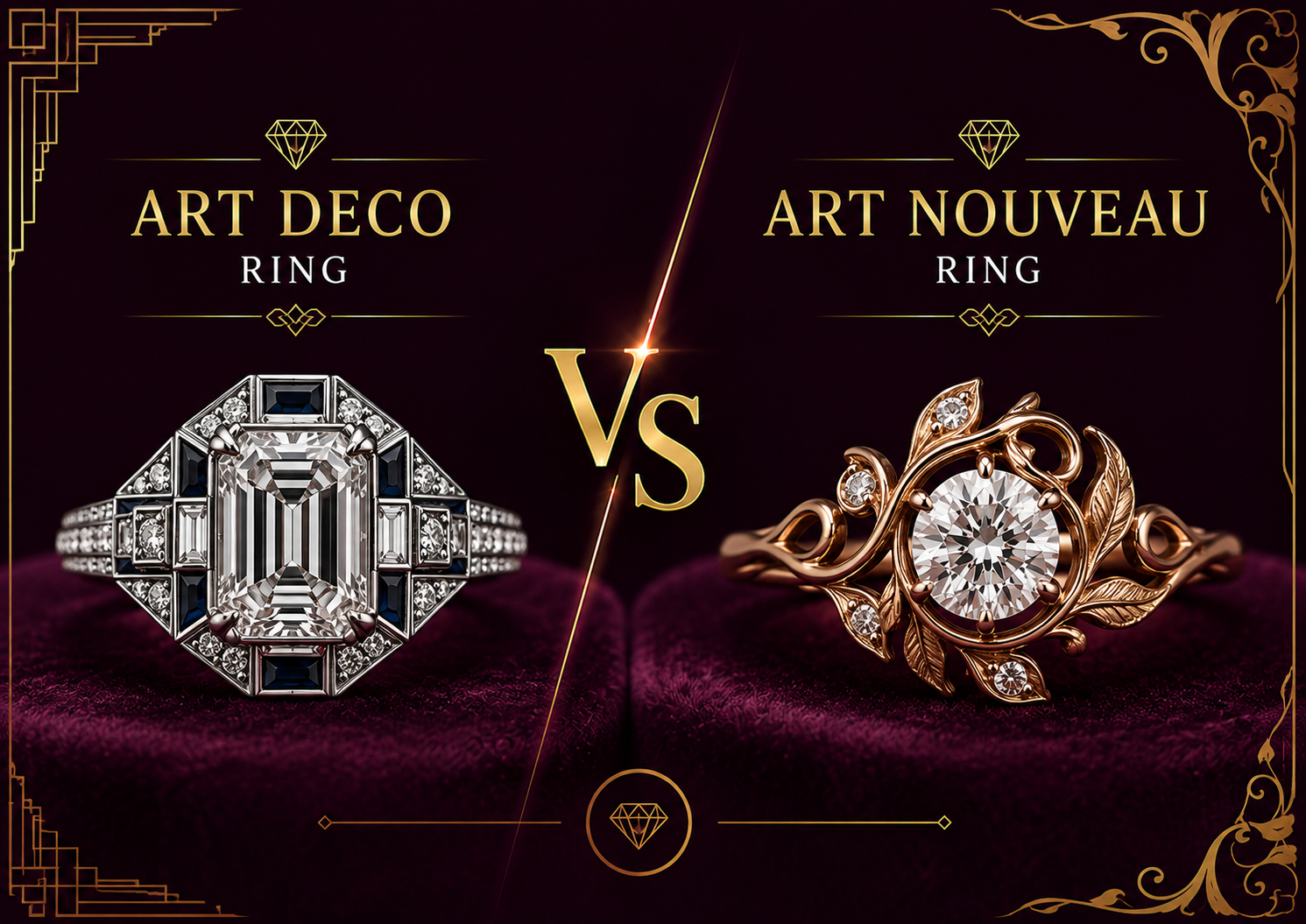
Choosing a vintage-inspired engagement ring can quickly turn into a choice between two very different design languages: Art Deco vs Art Nouveau rings.
Both styles have a strong connection to early 20th-century jewelry, and both can look incredible with a diamond. But they create very different impressions.
Art Deco rings feel structured, polished, symmetrical, and architectural. Art Nouveau rings feel romantic, organic, flowing, and inspired by nature.
So, if you’re deciding between an Art Deco engagement ring and an Art Nouveau engagement ring, the best place to start is the design itself. Do you prefer crisp geometry or graceful curves? A ring that looks carefully engineered, or one that feels like it grew naturally around the stone?
Let’s compare them.
Art Deco vs Art Nouveau Rings: Quick Comparison
| Feature | Art Deco Rings | Art Nouveau Rings |
|---|---|---|
| Main era | Primarily 1920s and 1930s | Primarily late 19th century to early 20th century |
| Design | Geometric and structured | Organic and flowing |
| Lines | Straight, angular, repeating | Curved, sinuous, whiplash |
| Symmetry | Usually strong symmetry | Often asymmetrical |
| Inspiration | Architecture, modernity, machine age | Flowers, plants, animals, nature |
| Common look | Bold, refined, sophisticated | Romantic, artistic, whimsical |
| Gemstone style | Diamonds and geometric cuts | Colorful gems, pearls, opals and unusual materials |
| Best for | Someone who loves clean, defined design | Someone who loves expressive, nature-inspired design |
The distinction isn’t simply modern versus old-fashioned. Art Nouveau came earlier, while Art Deco emerged later with a much more geometric visual language. GIA and major museum collections both identify this shift from Art Nouveau’s organic forms to Art Deco’s geometric designs.
What Is an Art Deco Ring?
Art Deco rings belong to a design tradition associated especially with the 1920s and 1930s.
The style embraced geometry, symmetry, repetition, strong contrast, and a sense of modernity. GIA notes that Art Deco designers favored geometric forms such as circles, triangles, squares, rectangles, and vertical lines.
In jewelry, this translated beautifully into engagement ring design.
Think of:
- Geometric patterns
- Clean lines
- Symmetrical layouts
- Baguette diamonds
- Emerald-cut diamonds
- Triangle and trapeze-shaped diamonds
- Platinum and white metals
- Pavé diamond details
- Strong contrast
- Repeating architectural motifs
The Smithsonian’s collection provides a particularly good real-world example. Its Cartier Art Deco marquise diamond ring uses platinum together with triangular, baguette, and round brilliant diamonds in a highly structured design.
That’s the appeal of an Art Deco ring design: every element feels intentional.
An Art Deco diamond engagement ring can look especially striking when the center diamond sits within a symmetrical halo or geometric frame. Emerald cuts and baguette diamonds naturally complement this aesthetic because their straight edges reinforce the architectural character of the setting.
What Is an Art Nouveau Ring?
Art Nouveau rings come from a much earlier design movement that developed from the late 19th century into the early 20th century.
Instead of looking to architecture and geometric precision, Art Nouveau designers looked to the natural world.
The Metropolitan Museum of Art describes Art Nouveau as drawing inspiration from the less orderly aspects of nature, with sinuous lines and distinctive “whiplash” curves influenced by botanical forms and natural organisms.
That gives Art Nouveau rings a very different personality.
You may see:
- Floral motifs
- Leaves and vines
- Curved designs
- Organic forms
- Asymmetrical compositions
- Insects and birds
- Enamel details
- Pearls and opals
- Nature-inspired gemstone arrangements
GIA also notes that Art Nouveau jewelry frequently incorporated flowers, animals, insects, celestial imagery, and unusual gem materials.
An Art Nouveau ring design therefore tends to feel more like a small piece of wearable artwork than a precisely arranged geometric composition.
And that’s exactly why some people fall for it.
Art Deco vs Art Nouveau: The Key Design Difference
If you remember only one thing from this comparison, remember this:
Art Nouveau flows. Art Deco structures.
Art Nouveau jewelry uses movement. Curves may twist around the center stone, branches may extend into the shoulders, and floral details can make the entire ring appear alive.
Art Deco jewelry does almost the opposite. Its lines meet, repeat, mirror, and form deliberate geometric patterns.
The V&A describes the famous Art Nouveau “whiplash” as a sensuous S-shaped curve derived from observations of the natural world.
Art Deco, meanwhile, embraced straight lines and geometric repetition as part of its fascination with modernity and the machine age.
So when comparing Art Deco vs Art Nouveau jewelry, don’t start by asking which one is older.
Start by asking which visual language feels more like you.
Art Deco Ring Design & Characteristics
The appeal of Art Deco style rings comes from their visual discipline.
A well-designed Art Deco ring often has a strong central point, then uses surrounding diamonds or metalwork to create balance.
Geometric Art Deco Rings
Geometry is one of the easiest ways to recognize the style.
Squares, rectangles, triangles, stepped shapes, arches, and repeating lines can all appear in Art Deco jewelry.
This is why geometric vintage engagement rings often have an unmistakably Art Deco character.
Emerald Cut and Baguette Diamonds
Certain diamond shapes work particularly well with Art Deco-inspired settings.
Emerald cut diamonds offer long, clean facets and a rectangular outline. Baguette diamonds can create crisp borders or stepped details around a center stone.
GIA specifically identifies baguette, triangle, trapeze, and half-moon diamond cuts as popular geometric forms in Art Deco jewelry.
That doesn’t mean every Art Deco engagement ring needs an emerald cut or baguette diamonds. Round diamonds can also work beautifully when the setting provides the geometric character.
Platinum and White Metals
Platinum became strongly associated with Art Deco jewelry, and museum collections contain notable examples combining platinum with diamonds and colored gemstones.
The result is often cool, crisp, and sophisticated.
If your dream ring looks like it belongs beside a black-tie outfit but still works with jeans, an Art Deco diamond ring deserves a serious look.
Art Nouveau Ring Design & Characteristics
Art Nouveau takes a softer route.
Rather than making the gemstone arrangement feel architectural, the setting can become part of a larger natural composition.
Floral Art Nouveau Rings
Flowers, leaves, vines, insects, and other natural forms are central to the style.
This makes floral Art Nouveau rings a natural choice for someone who wants a romantic engagement ring with more visual storytelling.
Flowing Lines
The famous whiplash curve is one of the defining visual ideas of Art Nouveau.
Instead of a shoulder traveling in a straight line toward the center stone, an Art Nouveau-inspired design might curve, twist, or branch around it.
The Metropolitan Museum notes that Art Nouveau jewelry often moved away from conventional gemstone-focused design and emphasized organic forms and materials such as enamel, glass, and horn.
Color and Unusual Gemstones
Art Nouveau jewelry was not simply about making diamonds look bigger.
GIA notes the use of materials including moonstone, opal, turquoise, tourmaline, horn, and ivory in Art Nouveau jewelry.
For a modern engagement ring, you don’t have to copy an antique piece exactly. You can borrow the floral shapes, flowing curves, asymmetry, or botanical details while choosing a diamond and metal that suit your preferences.
Art Deco vs Art Nouveau Engagement Rings
When the comparison becomes Art Deco vs Art Nouveau engagement rings, the decision becomes more personal.
Your engagement ring will sit on your hand every day, so its visual personality matters.
Choose an Art Deco Engagement Ring If You Love:
- Symmetry
- Clean lines
- Geometric patterns
- Emerald-cut diamonds
- Baguette accents
- Platinum or white-metal looks
- Bold vintage styling
- Structured halos
- Architectural details
An Art Deco engagement ring style can feel glamorous without looking overly ornate.
Choose an Art Nouveau Engagement Ring If You Love:
- Flowers and botanical motifs
- Curved designs
- Organic shapes
- Romantic details
- Asymmetry
- Enamel-inspired color
- Nature-inspired jewelry
- Softer vintage styling
An Art Nouveau engagement ring style tends to feel more artistic and expressive.
Neither is better.
They’re simply speaking different design languages.
Art Deco vs Art Nouveau Rings: Which One Should You Choose?
Here’s an easy way to narrow it down.
If you look at a ring and immediately notice its symmetry, angles, and diamond arrangement, you may prefer Art Deco.
If you notice the curves, flowers, vines, and movement first, Art Nouveau may be closer to your taste.
Your choice of center diamond can also help.
An emerald cut or another step-cut shape can reinforce an Art Deco look. A round or oval diamond can work with either style, depending on the setting. Antique-inspired cuts can also create a beautiful bridge between historical inspiration and a modern engagement ring.
The important point is not to choose a diamond shape simply because someone labels it “Art Deco” or “Art Nouveau.”
The setting creates much of the style.
A round diamond can look distinctly Art Deco in a geometric platinum setting. Likewise, an oval diamond can become distinctly Art Nouveau when surrounded by flowing botanical details.
Art Deco or Art Nouveau Engagement Ring: Which Is More Timeless?
This is where personal taste matters more than a trend report.
Art Deco has a naturally structured appearance, so its geometry can feel surprisingly contemporary even though the style has roots in the 1920s and 1930s.
Art Nouveau has a softer quality that can feel romantic and highly distinctive.
If you want a ring with crisp symmetry and strong diamond presence, Art Deco may have the advantage.
If you want something that feels like a tiny garden wrapped around your finger, Art Nouveau might win.
And yes, that is a perfectly respectable reason to choose a ring. You don’t need a 40-page design thesis to know what makes you smile.
Can You Combine Art Deco and Art Nouveau Elements?
Absolutely, especially with a modern ring.
Historical movements had recognizable characteristics, but today’s designers don’t have to follow a museum label word for word.
You might combine a geometric Art Deco-inspired halo with softer floral details. Or pair a clean emerald-cut center with curved, botanical shoulders.
The goal is balance.
Too many competing details can make the ring feel confused. A stronger approach is to choose one style as the foundation and use the other as an accent.
For example, an Art Deco-inspired ring could keep its symmetrical structure while adding a subtle organic detail beneath the center stone.
That gives you vintage character without turning the ring into a historical costume piece.
Frequently Asked Questions
How can you tell if a ring is Art Deco or Art Nouveau?
Look at the design first. Geometric shapes, strong symmetry, straight lines, and architectural diamond arrangements suggest Art Deco. Flowing curves, flowers, vines, insects, and other organic motifs suggest Art Nouveau. The design language matters more than the metal alone.
Are Art Deco rings older than Art Nouveau rings?
No. Art Nouveau came first, developing in the late 19th and early 20th centuries. Art Deco followed later and became especially prominent during the 1920s and 1930s. The two styles can therefore be distinguished partly by their historical periods as well as their design characteristics.
What do Art Deco engagement rings look like?
Art Deco engagement rings often feature geometric settings, symmetrical layouts, clean lines, and diamond combinations that create a structured appearance. Emerald-cut, baguette, and other geometric diamond shapes can complement the style, although many diamond shapes can work in an Art Deco-inspired setting.
What do Art Nouveau engagement rings look like?
Art Nouveau engagement rings typically have flowing lines, floral or botanical motifs, curved details, and organic shapes. Some designs may also incorporate colorful gemstones, enamel, pearls, or nature-inspired elements. The overall appearance tends to feel romantic and artistic rather than strongly geometric.
Which is better for an engagement ring, Art Deco or Art Nouveau?
Neither style is universally better. Art Deco is a strong choice if you prefer geometric shapes, symmetry, clean lines, and structured diamond designs. Art Nouveau may suit you better if you prefer floral motifs, flowing curves, organic forms, and nature-inspired details. The best choice depends on your personal style.
Can a modern engagement ring be Art Deco or Art Nouveau inspired?
Yes. A modern engagement ring can borrow design elements from either style without being an original antique. Geometric halos, baguette accents, and symmetrical settings can create an Art Deco look, while floral details, flowing curves, and botanical motifs can create an Art Nouveau-inspired design.
Final Words
The difference between Art Deco and Art Nouveau rings comes down to what you want your ring to communicate.
Art Deco rings are polished, geometric, symmetrical, and confident. They suit someone who loves architectural details, crisp diamond arrangements, and the glamour associated with the Jazz Age.
Art Nouveau rings are organic, expressive, romantic, and nature-inspired. They suit someone who prefers flowing lines, botanical details, and a less structured appearance.
So, when choosing between Art Deco vs Art Nouveau rings, forget the pressure to pick the “better” style.
Look at the ring and ask yourself one simple question:
Does your eye follow the angles, or does it follow the curves?
If it’s the angles, Art Deco may be your style.
If it’s the curves, Art Nouveau may be calling your name.
Either way, the right engagement ring is the one whose design still feels like you long after the vintage inspiration has stopped being a trend.