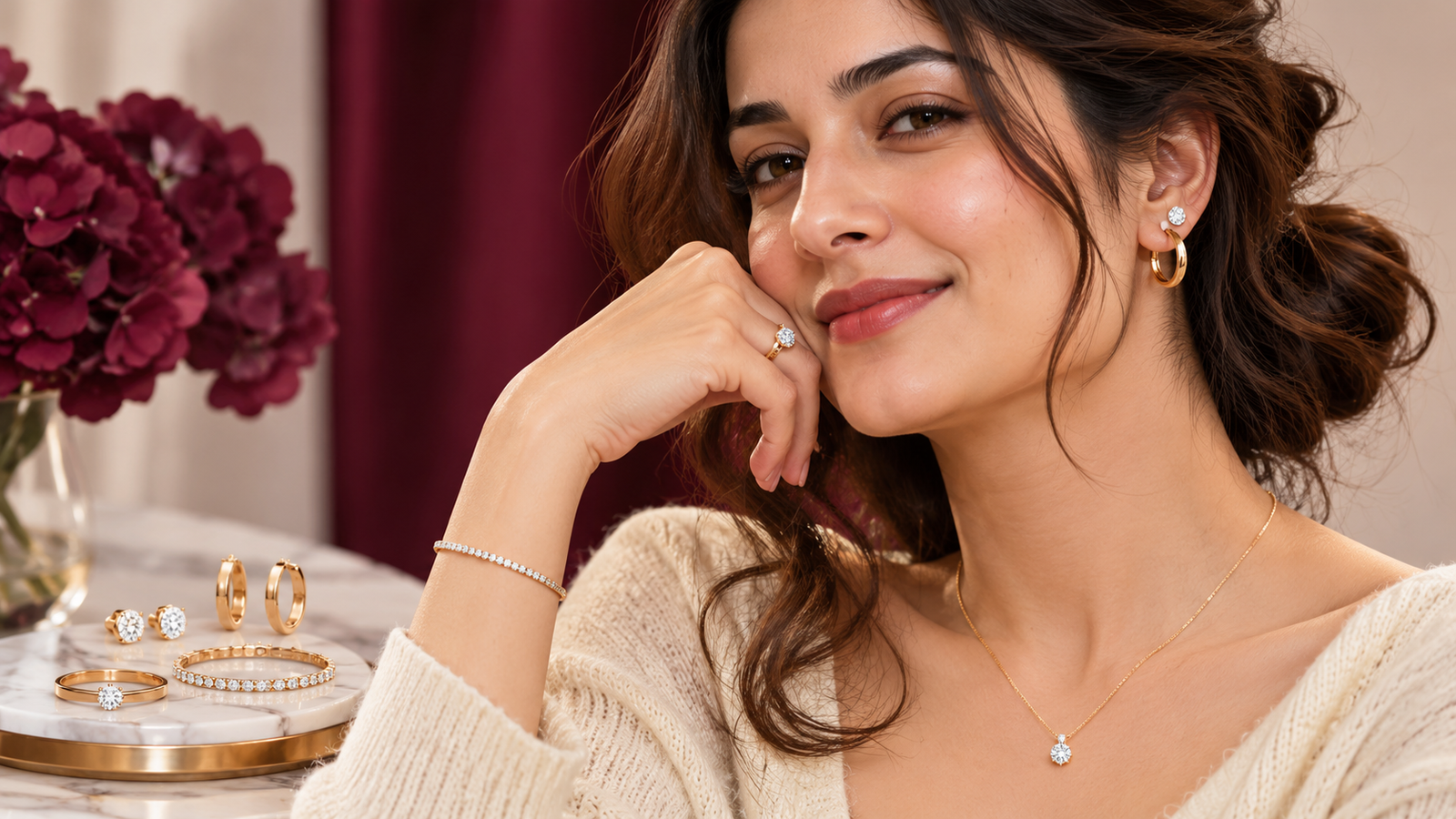
If you want jewelry that works with almost every outfit, start with a small collection of versatile essentials rather than buying pieces for individual occasions. A pair of simple stud earrings, small hoops, a delicate chain necklace, a meaningful pendant, a comfortable bracelet, and one everyday ring can cover most daily styling needs.
The trick is choosing designs that complement your wardrobe, feel comfortable throughout the day, and work well together. You don’t need an expensive jewelry box or dozens of accessories. You need a few well-chosen pieces that you genuinely enjoy wearing.
Here’s what to buy first, which materials to consider, and how to build an everyday jewelry collection without wasting money on pieces you’ll rarely use.
What Jewelry Should You Buy First for Everyday Wear?
If you’re starting from scratch, prioritize these seven jewelry essentials. Each piece serves a different purpose, but they should all be easy to combine with casual outfits, workwear, and dressier looks.
| Jewelry piece | Why it’s worth owning | Best for |
|---|---|---|
| Stud earrings | Simple and easy to coordinate | Everyday wear |
| Small hoop earrings | Add a little personality | Casual and office outfits |
| Delicate chain necklace | Works alone or with layers | Almost any neckline |
| Simple pendant | Adds a personal touch | Everyday styling |
| Minimal bracelet | Completes your wrist styling | Work and casual outfits |
| Everyday ring | Adds subtle detail | Daily outfits |
| Statement piece | Creates variety | Dinners and special occasions |
You don’t have to purchase all seven at once. Start with the pieces you naturally reach for most often and add the others when you identify a genuine gap.
1. A Pair of Simple Stud Earrings
Best for: People who want one pair of earrings they can wear with almost anything.
Stud earrings are one of the easiest places to start when building an everyday jewelry collection.
They sit close to the ear, don’t compete with most outfits, and work with everything from jeans and T-shirts to office clothing and evening dresses.
Consider these styles:
- Diamond studs: A classic choice if you enjoy a little sparkle.
- Gold ball studs: Simple, understated, and easy to coordinate.
- Pearl studs: A softer alternative with a timeless appearance.
- Gemstone studs: A good option if you want a subtle touch of color.
If you only want to purchase one pair, choose a size and design that feels comfortable for extended wear.
Small diamond studs are particularly versatile because they add sparkle without requiring the rest of your outfit to feel dressed up.
My recommendation: Start with plain metal studs or a simple pair of diamond studs. Choose the option that best matches your usual clothing and budget.
2. Small Gold or Silver Hoop Earrings
Best for: Anyone who wants an everyday earring with slightly more presence.
Hoop earrings offer something different from traditional studs. They add shape and movement without necessarily looking too formal.
Small hoops and huggie earrings are particularly useful because they work with casual outfits, office clothing, and dinner looks.
Here are three styles worth considering:
- Small hoops: A simple option for everyday outfits.
- Huggie earrings: Compact hoops that sit close to the earlobe.
- Medium hoops: Better if you prefer your earrings to be noticeable.
Gold hoops create a warmer appearance, while silver and white-metal designs offer a cooler finish.
You can also choose a slightly textured or sculptural design if you want something more distinctive.
Buying tip: Pay attention to the closure, weight, and dimensions. An attractive hoop isn’t a practical everyday choice if it feels uncomfortable or doesn’t stay securely fastened.
3. A Delicate Chain Necklace
Best for: People who want one necklace that works with different necklines and outfits.
A simple chain necklace is one of the most useful pieces in a jewelry wardrobe.
You can wear it on its own with a T-shirt, under a blazer, or alongside a pendant for a more layered appearance.
When shopping, consider:
- Cable chains: A classic link pattern that works with many styles.
- Box chains: A more structured appearance.
- Paperclip chains: A slightly bolder modern option.
- Fine curb chains: A simple choice for understated styling.
The necklace length matters too.
A shorter chain generally sits closer to the collarbone, while a longer chain can create a different visual line and work better with certain necklines.
Instead of buying several necklaces immediately, start with one comfortable length that suits the tops and dresses you wear most often.
A useful approach is to choose a chain that looks complete on its own but can also support a small pendant later.
4. A Simple Pendant Necklace
Best for: People who want everyday jewelry with a personal meaning.
A pendant necklace adds a little personality without requiring a complicated design.
You could choose a small diamond, a birthstone, an initial, a heart, a geometric shape, or a meaningful symbol.
The advantage is that the necklace can become part of your personal style rather than simply another accessory.
Consider these options:
| Pendant style | Overall look |
|---|---|
| Solitaire diamond | Classic and understated |
| Birthstone | Personal and colorful |
| Initial pendant | Personalized |
| Small heart | Romantic |
| Geometric pendant | Modern and minimal |
| Pearl pendant | Soft and elegant |
If you already own a delicate chain, check whether the pendant is compatible with its clasp and thickness before purchasing.
My recommendation: Choose a pendant that means something to you. A simple personal piece can become more valuable to your everyday wardrobe than an elaborate design you only wear occasionally.
5. A Minimal Bracelet or Bangle
Best for: People who want to add a finishing touch without wearing too much jewelry.
A bracelet is an easy way to make an outfit feel more complete.
You can wear a delicate bracelet with a watch, combine it with another simple chain bracelet, or let a single bangle stand on its own.
Consider these everyday styles:
- Fine chain bracelet: Lightweight-looking and understated.
- Simple bangle: Clean and structured.
- Tennis bracelet: A more noticeable option featuring a continuous line of stones.
- Beaded bracelet: Adds texture and color.
- Charm bracelet: Offers a more personal and customizable appearance.
For everyday use, pay attention to bracelet length and closure security.
A bracelet that slides around too much or catches on clothing may become inconvenient.
If you prefer understated accessories, a simple chain bracelet is a sensible starting point. If you enjoy sparkle, a tennis bracelet can be a more noticeable alternative.
6. One Everyday Ring
Best for: People who enjoy wearing jewelry on their hands without committing to a large statement design.
An everyday ring should feel like something you can wear regularly, not something you need to plan an entire outfit around.
Simple bands, signet rings, delicate gemstone rings, and slim stacking rings are all worth considering.
Here are a few options:
- Plain gold band: Minimal and easy to coordinate.
- Diamond band: Adds a little sparkle.
- Signet ring: Offers a more distinctive appearance.
- Gemstone ring: Introduces color and personality.
- Stacking ring: Works alongside other delicate bands.
If you enjoy wearing multiple rings, begin with two complementary designs rather than purchasing an entire stack immediately.
Think about ring width, height, fit, and whether the design interferes with your daily activities.
You can also explore the ring stacking guide for ideas on combining different ring styles, metals, and proportions.
7. One Statement Piece That Feels Like You
Best for: Anyone who wants an everyday collection that doesn’t look generic.
Not every piece in your jewelry collection needs to be plain or minimalist.
A slightly unusual pair of earrings, a sculptural ring, a colorful gemstone pendant, or a distinctive bracelet can become your signature accessory.
The important thing is choosing something you can actually imagine wearing with multiple outfits.
For example:
- A sculptural gold ring can complement simple clothing.
- A colorful gemstone pendant can add interest to neutral outfits.
- A distinctive pair of earrings can make a basic dress feel more polished.
- A textured bracelet can add personality to an otherwise simple combination.
Think of this as your personality piece. It doesn’t need to be the most expensive item in your collection.
It simply needs to be something you genuinely enjoy wearing.
Gold vs. Silver vs. Mixed Metals: Which Should You Choose?
Your choice of metal can make a big difference when building a versatile jewelry collection.
A coordinated collection is easier to style because the pieces already have a visual relationship.
However, you don’t have to follow a strict rule about wearing only one metal.
| Metal choice | Appearance | Who may prefer it |
|---|---|---|
| Yellow gold | Warm and classic | People who enjoy warmer tones |
| White gold | Bright, neutral appearance | People who prefer a white-metal look |
| Sterling silver | Cool-toned and versatile | People who prefer silver jewelry |
| Rose gold | Soft pinkish warmth | People who enjoy warmer, softer tones |
| Mixed metals | Contrasting and modern | People who like more styling flexibility |
When should you choose gold jewelry?
Gold jewelry is a good starting point if you prefer warm tones and want a coordinated collection.
Yellow gold pairs naturally with neutral clothing, warm colors, denim, and many classic wardrobe staples.
When shopping, check whether a piece is solid gold, gold-filled, gold vermeil, or gold-plated. These terms describe different constructions and should not be treated as interchangeable.
When should you choose silver jewelry?
Silver jewelry is a practical choice if you prefer cooler tones.
Sterling silver is commonly marked 925, indicating 92.5% silver content.
It can work particularly well with cool-toned clothing, black outfits, denim, and understated styling.
Silver also offers an alternative to purchasing every piece in gold.
Can you mix gold and silver jewelry?
Absolutely.
You can combine yellow gold, white gold, sterling silver, and other metal finishes without making your outfit look uncoordinated.
The easiest way is to repeat each metal somewhere in your outfit.
For example, you might wear gold hoops, a silver necklace, and a mixed-metal ring.
You can also use one mixed-metal bracelet or watch as a visual connection between different pieces.
The goal is to make the combination look intentional rather than perfectly identical.
Solid Gold vs. Gold-Plated vs. Sterling Silver: What Should You Buy?
Choosing the right material is just as important as choosing the design.
If you plan to wear jewelry frequently, understand what you’re paying for before making a purchase.
| Material | What it means | What to consider |
|---|---|---|
| Solid gold | Gold alloy throughout the piece; may be hollow or solid in construction | Karat, construction, cost |
| Gold-filled | A mechanically bonded gold layer over a base metal | Layer construction and markings |
| Gold vermeil | Gold plating over a sterling silver base | Gold layer and wear |
| Gold-plated | A gold coating over another material | Plating thickness and expected wear |
| Sterling silver | Typically 92.5% silver | Tarnish and maintenance |
| Platinum | A precious white metal | Alloy composition and budget |
A useful distinction: the term solid gold describes the material, not whether a piece is hollow. The FTC explains that a solid-gold item is not hollow, while karat markings describe the gold content.
According to the FTC:
- 14K gold contains 14 parts gold out of 24.
- 18K gold contains 18 parts gold out of 24.
- Sterling silver contains 92.5% silver.
- Gold plating can wear away with use, depending on factors such as wear and plating thickness.
Read the Federal Trade Commission’s guide to buying platinum, gold, and silver jewelry before purchasing expensive pieces.
Which material is best for everyday jewelry?
There isn’t one material that is best for everyone.
Solid gold and platinum may suit shoppers prioritizing precious-metal construction and a longer-term purchase.
Sterling silver can be a useful alternative for shoppers who prefer a lower-cost precious-metal option.
Gold-plated jewelry can work well when you want a particular look without paying for a solid-gold piece, provided you understand that the coating can wear over time.
Always check the actual material specifications rather than relying on descriptions such as premium, luxury, or long-lasting.
What Should You Buy First Based on Your Lifestyle?
Your everyday jewelry collection should reflect how you actually live.
Someone who works in a formal office may prefer different pieces from someone who wears casual clothing or travels frequently.
Best for a minimalist wardrobe
Start with:
- Small stud earrings.
- One delicate chain necklace.
- One plain ring.
- A fine bracelet.
Choose simple shapes and complementary finishes.
You can add more noticeable designs later if you find that your collection feels too understated.
Best for office and professional outfits
Consider:
- Small hoops or stud earrings.
- A simple pendant necklace.
- A slim bracelet.
- One understated ring.
These pieces add detail without making your accessories the main focus of your outfit.
Best for casual everyday outfits
Try:
- Small or medium hoops.
- A simple chain necklace.
- A personalized pendant.
- A comfortable ring.
You can experiment with mixed metals and slightly more expressive designs.
Best for someone who loves sparkle
Consider:
- Diamond or gemstone studs.
- A delicate diamond pendant.
- A tennis bracelet.
- A slim diamond band.
You don’t need every piece to be covered in stones. Combining one sparkling item with simpler jewelry can create a more balanced look.
Best for someone on a smaller budget
Start with three pieces:
- One pair of comfortable everyday earrings.
- One versatile necklace.
- One simple ring or bracelet.
Buy the pieces you will wear most frequently first. You can gradually add more expensive materials or additional styles when your budget allows.
How Much Should You Spend on Everyday Jewelry?
There is no universal budget for an everyday jewelry collection.
Your spending should depend on the materials you prefer, how often you expect to wear each piece, and which categories matter most to you.
A better approach is to divide purchases into three priorities.
| Priority | What to buy | Shopping approach |
|---|---|---|
| First | Studs, hoops, and a simple chain | Focus on comfort and everyday usefulness |
| Second | Pendant, bracelet, or everyday ring | Add pieces that fill a styling gap |
| Third | Diamond jewelry and distinctive designs | Spend more selectively on personal favorites |
Should you buy expensive jewelry for everyday use?
Not necessarily.
A higher price does not automatically mean that a piece will suit your lifestyle better.
Consider the actual metal, construction, finish, closure, stone setting, comfort, and retailer policies.
If you are uncertain about a design, start with a more affordable version and see whether you enjoy wearing that style before investing in a more expensive piece.
The most useful jewelry purchase is the one that fits your budget and becomes part of your regular wardrobe.
Celebrity-Inspired Everyday Jewelry: What Can You Learn From Their Style?
Celebrity jewelry can offer useful inspiration, particularly when you want to see how simple accessories can become part of a recognizable personal style.
The goal isn’t to copy an expensive celebrity collection. It’s to identify the design choices that make everyday jewelry feel personal.
Hailey Bieber: Simple Chains and Gold Hoops
Hailey Bieber is often associated with understated, modern styling.
A simple chain, gold hoops, and restrained accessories can create a similar direction without needing an elaborate jewelry collection.
The takeaway: Start with simple shapes and let your outfit do the rest.
Zoë Kravitz: Personal Rings and Layered Earrings
British Vogue has discussed Zoë Kravitz’s everyday jewelry collection, including simple bands, eternity rings, and layered earrings.
Her approach demonstrates how a small number of recognizable pieces can create a personal signature.
The takeaway: You don’t have to make every accessory match. Choose pieces that share a visual style or personal meaning.
Tamannaah Bhatia: Hoops and a Signature Pinky Ring
In an interview with Robb Report India, Tamannaah Bhatia identified hoops and her pinky ring as pieces she regularly wears.
Her approach is a useful reminder that everyday jewelry doesn’t have to be extremely delicate or minimal.
The takeaway: A signature ring or earring style can become part of your personal look.
Key sources: British Vogue on Zoë Kravitz’s jewelry and Robb Report India on Tamannaah Bhatia’s everyday jewelry.
What Jewelry Should You Avoid Buying for Everyday Wear?
Not every beautiful piece is a practical everyday purchase.
Before adding something to your collection, consider whether it will work with your routine.
Here are some common mistakes to avoid:
- Buying pieces for only one outfit: Prioritize jewelry that works with several outfits.
- Choosing uncomfortable earrings: Heavy designs can become inconvenient during long days.
- Ignoring necklace length: A beautiful chain may not sit properly with your usual necklines.
- Buying too many similar pieces: Several nearly identical necklaces may not add much variety.
- Ignoring material descriptions: Gold-plated, gold-filled, and solid gold are different constructions.
- Choosing complicated closures: Difficult clasps can make jewelry frustrating to wear.
- Following every trend: Buy trend-led designs when you genuinely like them, not because everyone else is wearing them.
The biggest mistake is buying more jewelry before understanding what you actually enjoy wearing.
How to Take Care of Jewelry You Wear Every Day
Everyday jewelry needs regular attention.
Even well-made jewelry can become scratched, tarnished, loose, or damaged when it is exposed to unsuitable conditions.
Follow these basic habits:
- Remove jewelry before swimming, using household cleaners, or performing activities that could damage it.
- Avoid exposing delicate gemstones and pearls to perfume, hairspray, and harsh chemicals.
- Wipe pieces with an appropriate soft cloth after wearing them.
- Store different pieces separately to reduce scratching and tangling.
- Check clasps, settings, and closures periodically.
- Follow the manufacturer’s care instructions for each material.
Pearls require particular attention. The Gemological Institute of America recommends keeping them away from harsh chemicals and wiping them with a soft cloth after wearing.
Read the GIA Pearl Care and Cleaning Guide for more specific advice.
For additional ring-care guidance, see how to clean a lab-grown diamond ring.
Remember that not every jewelry material can be cleaned in the same way. Avoid using ultrasonic or steam cleaners on pearls.
Frequently Asked Questions
What are the most versatile jewelry pieces to own?
The most versatile everyday pieces include stud earrings, small hoops, a delicate chain necklace, a simple pendant, a minimal bracelet, and an everyday ring. These designs can work with casual, professional, and dressier outfits.
What jewelry can I wear every day?
You can wear simple earrings, comfortable necklaces, bracelets, and rings regularly when their materials, construction, and settings suit your activities. Follow the manufacturer’s care recommendations and remove pieces when an activity could damage them.
Is gold or silver better for everyday jewelry?
Both can work well. Gold offers a warm appearance, while silver provides a cooler finish. Your preferred clothing colors, existing accessories, budget, and material preferences should guide the decision.
How many pieces of jewelry should I own?
There is no required number. A small starter collection of five to seven versatile pieces can provide plenty of styling options. You can build a larger collection if you enjoy having more variety.
Can I wear gold and silver jewelry together?
Yes. Mixing gold and silver can create an intentional, modern appearance. Repeating each metal in more than one place or choosing a mixed-metal piece can help connect the combination.
Is gold-plated jewelry good for everyday wear?
It can be suitable for regular use, depending on the plating, construction, and care. However, gold plating can wear away over time. Check the product specifications and understand the maintenance requirements before buying.
What is the best everyday necklace length?
The best necklace length depends on your neck, preferred fit, and clothing necklines. A shorter chain can sit near the collarbone, while a longer necklace can work better with certain open or layered outfits. Try the length with your usual clothing before buying.
Should everyday jewelry be expensive?
No. Expensive jewelry isn’t automatically more versatile or suitable for everyday use. Focus on comfortable designs, accurate material descriptions, reliable construction, and a budget you can afford.
What is the best everyday jewelry gift?
Stud earrings, a simple pendant, a delicate bracelet, or a classic chain necklace are useful gift ideas. If you’re buying a ring, make sure you know the recipient’s correct size.
Final Thoughts
If you want jewelry you can wear with everything, don’t start by buying an entire collection.
Begin with a comfortable pair of earrings, a versatile necklace, and one ring or bracelet. Choose a metal finish you enjoy, pay attention to materials and construction, and add more pieces only when you know what your wardrobe is missing.
Your everyday jewelry collection should make getting dressed easier, not give you another decision to worry about.
The best pieces aren’t necessarily the most expensive or fashionable. They’re the ones you reach for again and again because they feel like you.