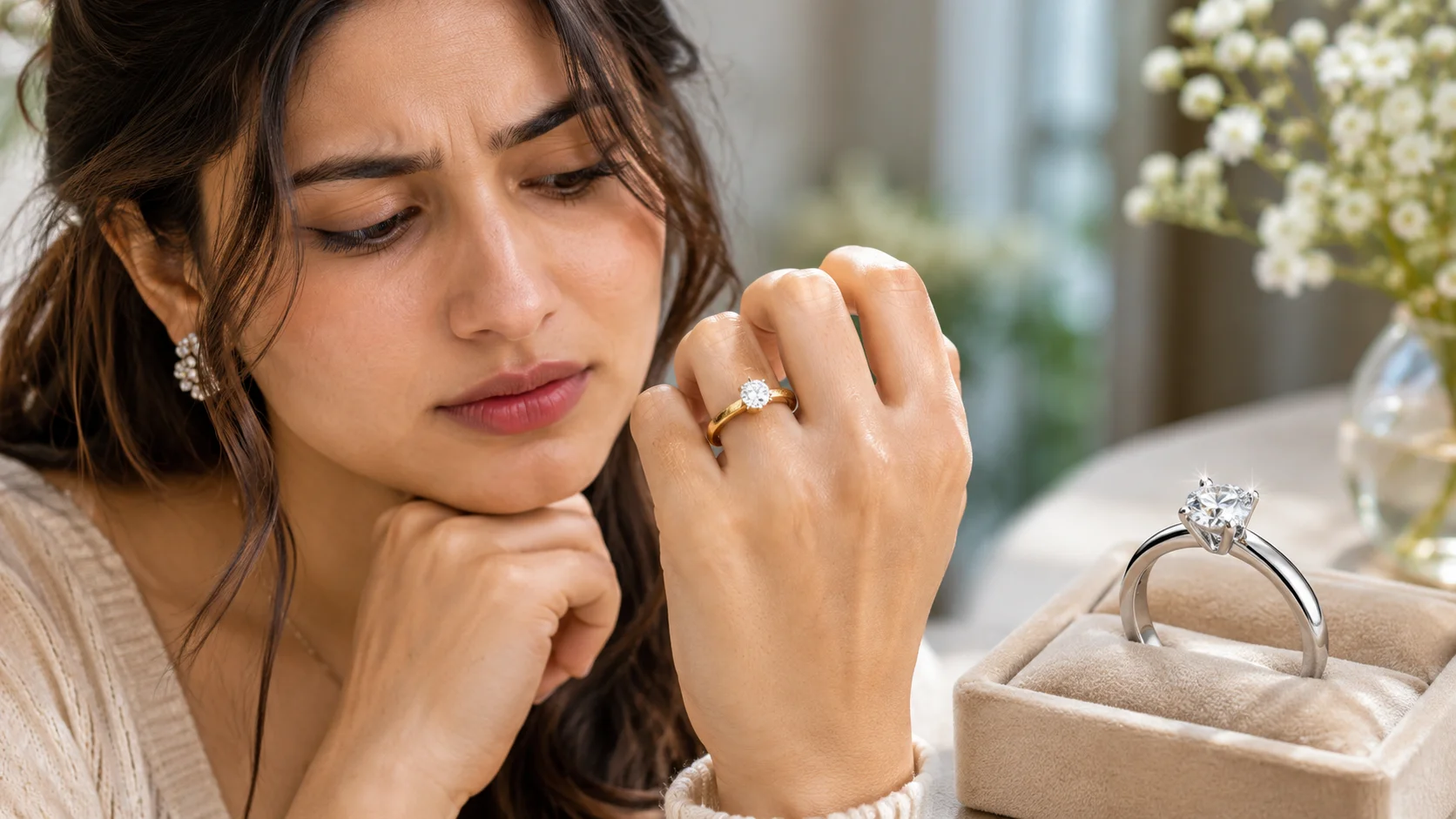
If your everyday ring keeps developing scratches, switching to another metal may help. But the right replacement depends on how much you dislike visible surface marks and what you’re willing to sacrifice in return.
Tungsten carbide is one of the strongest choices for scratch resistance, making it suitable for people who want a ring that maintains its polished appearance. However, it is brittle and generally cannot be resized. If you want a traditional fine-jewelry ring that can be repaired and worn for decades, platinum or 14K gold may be a better fit.
Titanium is another option for people who prefer a lightweight ring with good everyday durability.
Before buying another ring, compare scratch resistance, impact resistance, comfort, and repairability. The hardest metal isn’t automatically the best choice for everyday wear.
Why Does My Everyday Ring Keep Scratching?
Your ring comes into contact with more surfaces than you might realize.
Think about everything your hands touch throughout the day:
- Door handles and metal railings
- Keys and coins
- Desks and countertops
- Gym equipment and weights
- Tools and household objects
- Other jewelry
These repeated contacts can leave small marks on a ring’s surface.
The problem becomes more noticeable when you wear a highly polished ring. Its reflective surface makes tiny scratches easier to see.
However, not all ring metals respond to scratches in the same way.
Gold can gradually lose small amounts of surface metal through abrasion. Platinum tends to displace metal, creating a softer surface finish called patina. Tungsten carbide resists scratching much better, but it can fracture under a hard impact.
This difference matters when choosing a replacement.
Which Metal Should You Buy If Your Ring Keeps Scratching?
The best choice depends on your priorities.
- Best for maximum scratch resistance: Tungsten carbide.
- Best for a lightweight everyday ring: Titanium.
- Best for traditional fine jewelry and long-term repairability: Platinum.
- Best balance of practicality and precious-metal appeal: 14K gold.
These recommendations address different needs. They are not a universal durability ranking.
6 Ring Metals Compared for Everyday Wear
Here’s how the most relevant options compare.
| Ring metal | Scratch resistance | Impact behavior | Resizing | Best for |
|---|---|---|---|---|
| Tungsten carbide | Excellent | Can crack or shatter | Generally no | People who hate scratches |
| Titanium | Good, but finish-dependent | Strong and lightweight | Limited | Lightweight daily wear |
| Platinum | Develops visible patina | Durable and repairable | Usually yes | Traditional fine jewelry |
| 14K gold | Moderate | Can dent and scratch | Usually yes | Practical precious-metal rings |
| 18K gold | Lower than comparable 14K alloys | Can dent and scratch | Usually yes | Higher gold content |
| Sterling silver | Relatively low | Can scratch and bend | Usually yes | Occasional wear and budget |
These are general material comparisons. Actual performance varies with alloy composition, ring thickness, finish, construction, and how the ring is worn. GIA’s everyday ring material guide provides additional information about these metals.
1. Tungsten Carbide: Best If You Hate Visible Scratches
If your biggest frustration is seeing scratches on your ring, tungsten carbide deserves serious consideration.
Tungsten carbide is significantly harder than traditional precious metals used in jewelry. It resists everyday surface scratching exceptionally well.
That makes it appealing if you want a polished ring that maintains its appearance with relatively little maintenance.
Why Choose Tungsten Carbide?
- Excellent resistance to surface scratches.
- Maintains its polished appearance well.
- Available in modern gray and silver-toned finishes.
- Requires relatively little routine polishing.
- Generally more affordable than platinum or gold.
What Are the Disadvantages?
The biggest drawback is brittleness.
Tungsten carbide is extremely hard, but it can crack or shatter if dropped onto a hard surface or struck with sufficient force.
Traditional resizing is also generally not possible. If your finger size changes, you may need to replace the ring.
My recommendation: Choose tungsten carbide if scratch resistance matters more to you than repairability, resizing, or traditional precious-metal construction.
It is particularly worth considering for a simple wedding band rather than a complicated gemstone setting.
2. Titanium: Best for Lightweight Everyday Comfort
Titanium is a practical option if you want a durable ring that feels lighter on your finger.
Unlike tungsten, titanium does not have the same brittle behavior. It combines good strength with a lightweight feel.
This makes it attractive for people who wear rings throughout the day and dislike the weight of heavier metals.
Why Choose Titanium?
- Lightweight and comfortable.
- Strong for everyday use.
- Resistant to corrosion.
- Available in polished and brushed finishes.
- Often a more affordable alternative to platinum.
What Are the Disadvantages?
Titanium can still develop scratches.
Its surface finish affects how noticeable those marks become. A highly polished titanium ring may show wear differently from a brushed or matte finish.
Resizing can also be difficult, depending on the ring’s construction and the jeweler’s equipment.
My recommendation: Choose titanium if comfort and lightweight wear matter more than having a traditional precious-metal ring.
It is a particularly interesting option for someone who finds heavy rings uncomfortable.
3. Platinum: Best for Traditional Fine Jewelry and Long-Term Wear
If you want to replace your scratched ring with something suitable for long-term fine jewelry, platinum is worth considering.
However, there’s something important to understand:
Platinum is not scratch-proof.
It can develop scratches through normal daily wear. These small marks gradually change the surface from a bright polished appearance to a softer, satin-like finish.
Jewelry professionals call this change a platinum patina.
The interesting difference is that platinum tends to move or displace when scratched rather than losing as much surface metal through the same type of contact.
According to Blue Nile’s 2026 platinum patina guide, this gradual surface change is a natural result of everyday contact and does not mean the metal has become structurally weak.
Why Choose Platinum?
- Naturally white appearance.
- High precious-metal content in common jewelry alloys.
- Suitable for long-term fine jewelry.
- Does not require rhodium plating to maintain its white color.
- Can generally be resized and professionally refinished.
What Are the Disadvantages?
- It can still develop visible scratches.
- Its patina may not appeal to people who prefer a mirror-like shine.
- It is generally more expensive than comparable gold designs.
- Its heavier feel may not suit everyone.
My recommendation: Choose platinum if you want a traditional fine-jewelry ring that can be maintained and repaired over time.
But if your only goal is to avoid visible scratches, platinum may disappoint you.
You can explore platinum lab-grown diamond engagement rings if you prefer this type of precious-metal setting.
4. 14K Gold: Best for Everyday Precious-Metal Jewelry
You don’t necessarily need to abandon gold because your previous ring developed scratches.
14K gold is still a practical choice for everyday rings.
It contains approximately 58.3% pure gold, with the remaining portion made up of other metals.
Those additional metals help create an alloy with greater hardness than pure gold.
Compared with a similar 18K gold alloy, 14K gold is generally harder and more resistant to everyday scratching. However, the exact performance depends on the alloy composition.
Why Choose 14K Gold?
- Suitable for everyday jewelry.
- Generally harder than comparable 18K gold.
- Available in yellow, white, and rose gold.
- Can generally be resized and repaired.
- Offers a balance of gold content and practicality.
What Are the Disadvantages?
14K gold is not scratch-proof.
It can develop surface marks, dents, and signs of wear over time.
White gold may also require rhodium replating to maintain its bright white finish.
My recommendation: Choose 14K gold if you want a traditional precious-metal ring that balances everyday practicality, appearance, and repairability.
If you’re deciding between the two common gold purities, read our guide to 14K vs. 18K gold.
5. 18K Gold: Best for Higher Gold Content, Not Maximum Scratch Resistance
If you love the appearance of gold, 18K may still be worth buying.
However, don’t choose it expecting better scratch resistance than 14K gold.
18K gold contains 75% pure gold. Its higher gold content gives it a richer gold appearance in many alloys, but it is generally softer than comparable 14K gold.
Why Choose 18K Gold?
- Contains 75% pure gold.
- Offers a rich gold appearance.
- Available in different gold colors.
- Suitable for fine jewelry and engagement rings.
- Can generally be repaired and resized.
What Are the Disadvantages?
- More susceptible to scratching than comparable 14K alloys.
- Usually more expensive than 14K gold.
- Requires reasonable care during daily activities.
My recommendation: Choose 18K gold if gold purity and appearance matter more to you than maximizing scratch resistance.
If you already dislike visible scratches, 14K gold may be the more practical alternative.
Which Is Better: Tungsten vs. Titanium vs. Platinum?
These three metals are often considered by shoppers who want something different from traditional gold.
But they solve different problems.
| Comparison | Tungsten carbide | Titanium | Platinum |
|---|---|---|---|
| Scratch resistance | Excellent | Good | Moderate |
| Weight | Heavy | Very light | Heavy |
| Brittleness | Higher | Lower | Lower |
| Resizing | Generally impossible | Limited | Usually possible |
| Precious-metal appeal | No | No | Yes |
| Maintenance | Low | Low | Occasional polishing |
| Best reason to buy | Resist scratches | Comfort | Long-term fine jewelry |
Choose Tungsten If:
You want the ring to resist visible scratches as much as possible and are comfortable replacing it rather than resizing it.
Choose Titanium If:
You want something lightweight, comfortable, and suitable for regular wear.
Choose Platinum If:
You want a traditional precious-metal ring and are comfortable with its natural patina.
The important point is that scratch resistance, impact resistance, and repairability are separate qualities.
Which Ring Metal Is Best for Your Lifestyle?
The best replacement also depends on what you do every day.
Best for Office Workers
If you work at a desk and regularly place your hands against hard surfaces, consider 14K gold or platinum.
A brushed finish can also help make minor scratches less noticeable.
Best for People Who Work With Their Hands
If you regularly use tools or equipment, think carefully before wearing any ring during work.
Titanium offers a lightweight option, while tungsten offers better scratch resistance but can fracture under impact.
Removing the ring during high-risk activities is often the safer choice.
Best for Someone Who Wants a Ring That Always Looks Polished
Tungsten carbide is worth considering because of its excellent scratch resistance.
Just remember that its inability to be resized and its brittleness are meaningful trade-offs.
Best for Someone Buying an Engagement Ring
For a traditional diamond engagement ring, platinum and 14K gold are practical starting points.
The metal is only one part of the decision. The setting, band thickness, prongs, and gemstone protection also influence how well the ring handles daily wear.
For additional ideas, explore our guide to low-maintenance engagement rings.
Should You Buy a Different Metal or Just Change the Ring Finish?
Sometimes, the problem isn’t the metal itself.
The finish can make a significant difference in how noticeable everyday scratches become.
Consider these options before replacing your ring.
High-Polish Finish
A high-polish finish creates a bright, reflective appearance.
However, small surface scratches can stand out because they disrupt the reflection.
Choose this finish if you love a mirror-like shine and don’t mind occasional professional polishing.
Brushed Finish
A brushed finish creates fine, intentional surface lines.
These lines can help minor everyday marks blend into the existing texture.
It doesn’t make the underlying metal scratch-proof, but it can make ordinary wear less noticeable.
Matte Finish
A matte finish reduces reflection and creates a softer appearance.
It may be a practical choice if you dislike the appearance of tiny scratches on shiny jewelry.
Hammered Finish
A hammered finish uses small decorative indentations to create a textured appearance.
Its uneven surface can help disguise additional small marks.
My recommendation: If you love your current ring’s metal but hate its polished appearance, try a brushed or matte finish before switching metals.
How Can You Prevent Your Next Ring From Scratching?
Even the most scratch-resistant ring needs reasonable care.
Here are some practical habits that can help reduce unnecessary damage.
- Remove your ring before lifting weights or using heavy equipment.
- Avoid wearing it during gardening, construction, and demanding household work.
- Store it separately from other jewelry.
- Avoid throwing your ring into a drawer with other metal accessories.
- Follow the manufacturer’s cleaning instructions.
- Have gemstone settings and prongs inspected periodically.
- Choose a finish that suits how you want the ring to age.
Remember that no ring metal is completely immune to damage.
Even platinum, tungsten, and titanium have limitations.
What I Would Buy Instead
If I were choosing a replacement for an everyday ring that constantly shows scratches, I would start by identifying what bothers me most.
If I wanted the highest practical resistance to visible scratches, I would consider tungsten carbide.
If I wanted a comfortable, lightweight ring, I would compare titanium.
If I wanted a traditional precious-metal ring that could be repaired and resized, I would choose between platinum and 14K gold.
I would also seriously consider a brushed or matte finish rather than automatically choosing another high-polish ring.
The best replacement isn’t necessarily the hardest metal. It’s the metal that matches how you wear your ring, how you want it to look, and what you expect from it over time.
Frequently Asked Questions
What is the most scratch-resistant metal for rings?
Tungsten carbide is one of the most scratch-resistant materials commonly used for rings. Its exceptional hardness helps it resist everyday surface marks. However, it is brittle and generally cannot be resized.
Is platinum scratch-proof?
No. Platinum can develop scratches during everyday wear. These marks gradually create a softer surface appearance known as patina. The metal tends to displace rather than lose as much material through this type of surface wear.
Is titanium better than gold for everyday rings?
Titanium is generally lighter and offers good strength and corrosion resistance. Gold is easier to work with and generally offers more resizing and repair options. The better choice depends on your priorities.
Does 14K gold scratch less than 18K gold?
Generally, yes. Comparable 14K gold alloys are usually harder than 18K gold alloys because they contain a greater proportion of additional metals. However, exact scratch resistance varies with alloy composition.
Is tungsten better than platinum?
Tungsten is better if your main priority is resisting surface scratches. Platinum is better suited to traditional fine jewelry when repairability, resizing, and long-term precious-metal ownership matter more.
Can tungsten rings break?
Yes. Tungsten carbide is very hard but brittle. A sufficiently strong impact can cause a ring to crack or shatter.
Which ring finish hides scratches best?
Brushed, matte, and textured finishes can make minor surface marks less noticeable than a mirror-polished finish. They do not prevent the metal underneath from wearing.
Can a jeweler remove scratches from my ring?
Many gold and platinum rings can be professionally polished to reduce surface scratches. However, polishing removes some metal, so it should not be done unnecessarily. Repair options for titanium and tungsten depend on their construction and the manufacturer.
Should I stop wearing my ring if it gets scratched?
Not necessarily. Minor surface scratches are normal signs of wear. However, deep dents, cracks, loose gemstones, damaged prongs, or significant changes in the ring’s shape should be assessed by a professional jeweler before continued wear.
Is a scratch-resistant ring worth paying more for?
It can be, if maintaining a polished appearance is important to you. However, consider the complete ownership experience, including impact resistance, comfort, resizing, repairs, and replacement costs. A ring that resists scratches but cannot be repaired may not suit everyone.
Final Thoughts
If your everyday ring keeps scratching, switching metals can make a difference, but you should understand what you’re gaining and what you’re giving up.
Tungsten carbide offers excellent scratch resistance. Titanium provides lightweight comfort. Platinum offers traditional fine-jewelry durability and repairability, while 14K gold provides a practical balance of gold content and everyday use.
Before buying, compare the metal, finish, construction, and maintenance requirements.
A ring should suit your everyday life, not become another thing you constantly worry about damaging.