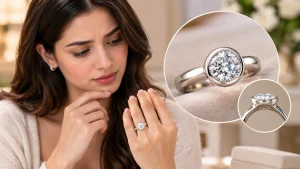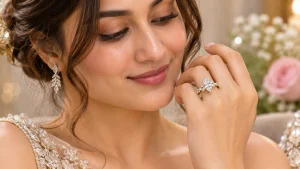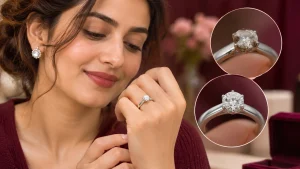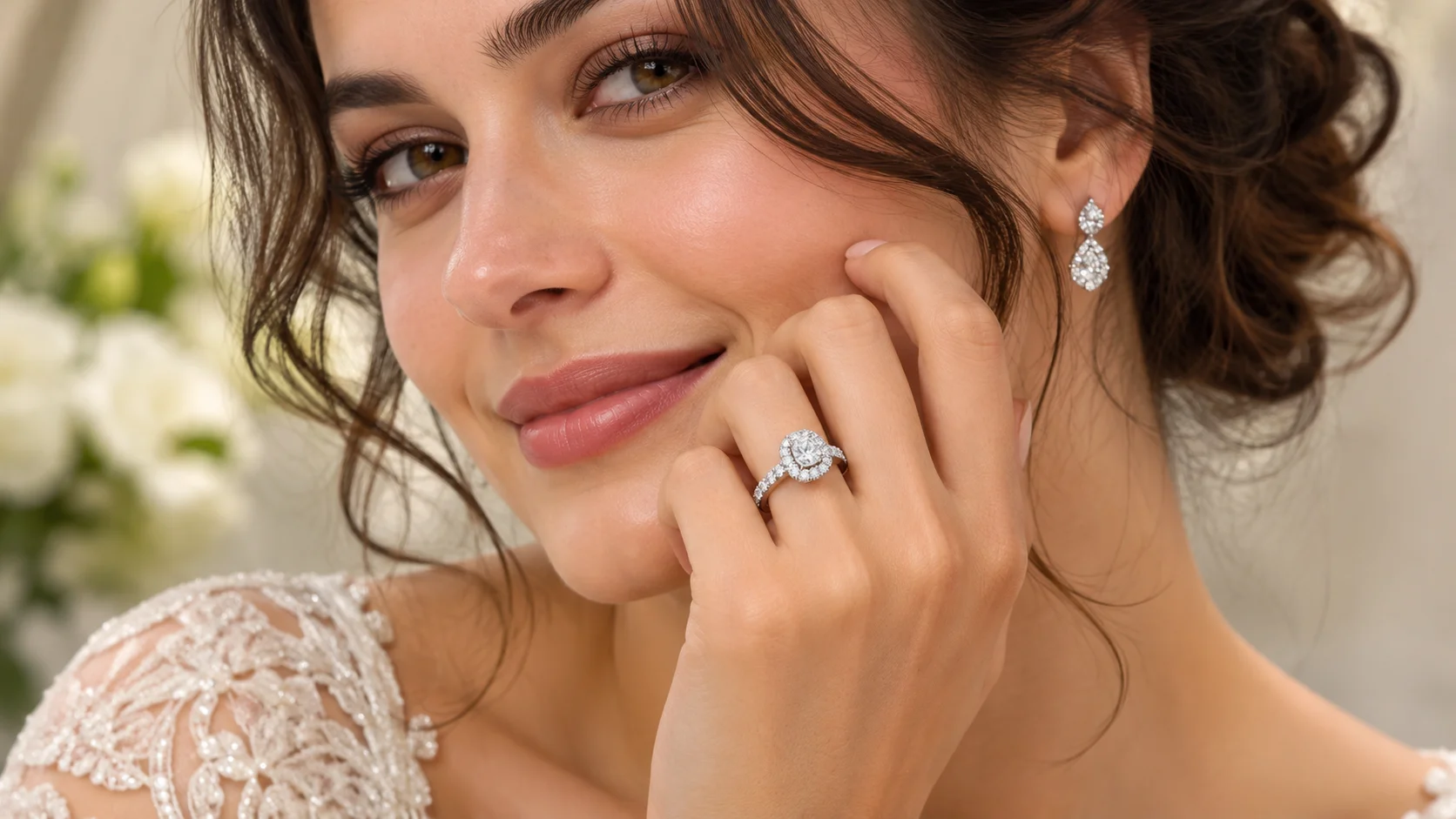
If your engagement ring has a tiny center stone, you don’t necessarily need to replace it with a bigger diamond to create a more impressive look. The right ring design can make a small center stone appear more noticeable, add visual width, and create a beautiful overall appearance.
A delicate halo, slim pavé band, three-stone setting, or elongated diamond shape can all help. However, they create different effects. A traditional halo is particularly effective when you want a larger-looking center area, while an oval or pear-shaped diamond can offer more visible length for its carat weight. A slim band can also help the center stone stand out.
The best choice depends on whether you want maximum visual size, extra sparkle, a classic appearance, or a more substantial design.
Key Takeaways: How to Make a Small Center Stone Look More Impressive
- Traditional halo: Creates a larger-looking outline around the center diamond.
- Oval or pear shape: Can provide more visible length than a round diamond of comparable carat weight.
- Slim pavé band: Adds sparkle while keeping the center stone visually prominent.
- Three-stone setting: Adds width and makes the entire ring look more substantial.
- Cluster setting: Groups smaller diamonds to create a larger overall visual effect.
- Tapered band: Directs attention toward the center stone.
- Hidden halo: Adds subtle sparkle underneath the center diamond but does not create the same face-up size effect as a traditional halo.
Which Engagement Ring Designs Make a Tiny Center Stone Look Bigger?
If your main concern is that your center diamond looks too small, start with the setting rather than immediately shopping for a larger stone.
Here are seven designs worth considering.
1. Halo Engagement Ring: Best for a Larger-Looking Center Area
A halo engagement ring is one of the strongest options when you want a small center stone to have more visual presence.
This design places a circle of smaller diamonds around the center stone. The surrounding diamonds create a wider outline, making the entire center area appear larger.
For example, a petite round diamond surrounded by a delicate halo can look much more substantial than the same diamond in a plain solitaire setting.
Why choose a halo?
- Creates a larger overall diamond outline.
- Adds extra sparkle around the center stone.
- Makes a petite center diamond look more prominent.
- Works with round, oval, cushion, pear, and other diamond shapes.
- Offers different looks through single, double, and floral halos.
One thing to consider: A halo contains multiple small diamonds and additional settings that need maintenance. The surrounding stones should be checked periodically to ensure they remain secure.
A well-proportioned halo is usually more attractive than an oversized halo that overwhelms the center stone.
2. Oval Engagement Ring: Best for More Visible Length
If you’re choosing a new center stone, an oval diamond is worth considering.
Oval diamonds have an elongated outline. Their shape can provide more visible face-up coverage than a round diamond of similar carat weight.
This can make a smaller oval diamond look more substantial without increasing its weight.
An oval diamond also creates a graceful appearance along the finger. When paired with a slim band, it can become the focal point of the entire ring.
Why choose an oval design?
- Creates an elongated appearance.
- Can offer strong face-up coverage for its carat weight.
- Works beautifully with solitaire and halo settings.
- Looks elegant with delicate pavé bands.
- Provides a softer alternative to traditional round diamonds.
One thing to consider: Oval diamonds can display a bow-tie effect, which appears as a darker area across the center. Compare actual diamond videos and measurements before purchasing.
If you like this style, explore the existing guide on why a diamond can look bigger than its carat weight.
3. Slim Pavé Engagement Ring: Best for Extra Sparkle
A pavé engagement ring features small diamonds set closely together along the band.
This design is especially attractive when the center stone is relatively small because the additional diamonds create a continuous sparkle effect.
A narrow pavé band can also make the center diamond look more prominent by providing visual contrast.
Unlike a traditional halo, pavé focuses more on decorating the band than creating a larger outline around the center stone.
Why choose a pavé band?
- Adds sparkle across the ring.
- Creates a more luxurious appearance.
- Keeps the design delicate and elegant.
- Complements round, oval, pear, and cushion diamonds.
- Can make a petite center stone feel more integrated into the overall design.
One thing to consider: Pavé diamonds need occasional inspection. Missing or loose accent stones can require professional repair. Some pavé designs can also make resizing more complicated.
If you prefer a simple ring with additional sparkle, a slim pavé band is worth comparing with a traditional halo.
4. Three-Stone Engagement Ring: Best for a More Substantial Appearance
A three-stone engagement ring uses one center stone and two smaller side stones.
This design can make a tiny center diamond look more impressive by adding width and visual balance.
The side stones help create a larger overall ring appearance without requiring the center diamond to carry all the attention.
You can choose matching side diamonds or experiment with different shapes for a more distinctive design.
Why choose a three-stone ring?
- Adds visual width to the ring.
- Makes the entire design look more substantial.
- Creates additional sparkle.
- Offers opportunities to combine different diamond shapes.
- Provides a meaningful design often associated with the past, present, and future.
One thing to consider: The side stones should complement the center diamond. If they’re too large, they can compete with the center stone instead of supporting it.
For a petite center diamond, carefully proportioned side stones usually create a more balanced appearance.
5. Cluster Engagement Ring: Best for Creating a Larger Diamond Effect
A cluster engagement ring groups several smaller diamonds together to create a larger overall shape.
Some cluster designs arrange the stones in a floral pattern, while others use geometric arrangements that resemble a single larger diamond.
This is an interesting alternative if you don’t want a traditional solitaire or halo.
Instead of relying on one small center stone, the overall design creates the visual impact.
Why choose a cluster ring?
- Combines multiple smaller diamonds.
- Can create a larger-looking overall design.
- Offers distinctive floral and geometric styles.
- Adds sparkle across the center area.
- Can provide an alternative to purchasing one larger center diamond.
One thing to consider: A cluster ring doesn’t have the same appearance as a single larger diamond. If you prefer a traditional center-stone look, a halo or solitaire may suit you better.
6. Tapered Engagement Ring: Best for Drawing Attention to the Center
A tapered band gradually becomes narrower as it approaches the center diamond.
This creates a visual transition between the band and the center stone.
The narrower shoulders can make a petite diamond appear more prominent because less metal surrounds it near the setting.
Tapered bands work particularly well with round, oval, and cushion diamonds.
Why choose a tapered design?
- Directs attention toward the center stone.
- Creates an elegant visual balance.
- Works with traditional solitaire settings.
- Can make a petite diamond stand out against the band.
- Offers a refined alternative to a completely straight band.
One thing to consider: The band still needs enough metal to support the ring securely. A very thin shank may not be appropriate for every design or lifestyle.
7. Hidden Halo Engagement Ring: Best for Subtle Extra Sparkle
A hidden halo places small diamonds underneath the center stone, usually around the setting’s gallery.
Unlike a traditional halo, the accent diamonds aren’t prominently visible from directly above.
Instead, they create additional sparkle when the ring is viewed from the side or at an angle.
A hidden halo is a good choice if you want a clean solitaire appearance with a little more detail.
Why choose a hidden halo?
- Keeps the top view relatively simple.
- Adds sparkle beneath the center stone.
- Works with several diamond shapes.
- Provides a more detailed side profile.
- Complements delicate and modern engagement ring designs.
One thing to consider: A hidden halo is not the strongest choice if your main goal is to make a tiny center stone look significantly larger from the top.
A traditional halo creates a more noticeable face-up outline.
You can explore the hidden halo engagement ring collection if you prefer this style.
Small Center Stone Engagement Ring Designs Compared
Not every setting makes a small center stone look bigger in the same way.
Use this comparison to identify the design that best matches your preference.
| Ring design | Visual effect | Best for | Main consideration |
|---|---|---|---|
| Traditional halo | Larger overall outline | Maximum apparent size | Extra maintenance |
| Oval solitaire | More visible length | Elegant, elongated appearance | Bow-tie effect |
| Slim pavé | Additional band sparkle | Delicate, glamorous look | Accent-stone maintenance |
| Three-stone | Greater overall width | Substantial appearance | Side-stone proportions |
| Cluster | Larger combined visual shape | Distinctive designs | Not a single larger diamond |
| Tapered band | Focuses attention on center | Minimalist elegance | Band construction |
| Hidden halo | Subtle side-view sparkle | Understated luxury | Limited top-view size effect |
My recommendation: If the only goal is making a small center stone look larger from above, start with a traditional halo. If you’re choosing a new diamond as well, compare an elongated oval or pear shape with a delicate setting.
Which Diamond Shape Makes a Small Center Stone Look More Impressive?
The diamond shape can influence how large a center stone appears.
Carat weight measures a diamond’s weight, not its face-up dimensions. Two diamonds with the same carat weight can have different length, width, and depth measurements.
That’s why comparing actual measurements is important.
Here are four shapes worth considering.
Oval Cut
Oval diamonds create an elongated outline that can provide strong visual coverage.
They’re particularly attractive in solitaire and halo settings.
Best for: Shoppers who want an elegant, elongated appearance.
Pear Cut
Pear diamonds combine a rounded end with a pointed tip.
Their distinctive shape creates an elongated appearance and can draw the eye along the finger.
Best for: Shoppers who prefer something more distinctive than a traditional round diamond.
Marquise Cut
Marquise diamonds have two pointed ends and a long, narrow outline.
Their elongated shape can provide substantial visible coverage for their carat weight.
Best for: Shoppers who want a dramatic, elongated appearance.
Round Brilliant Cut
Round brilliant diamonds are known for their symmetrical shape and brilliant-style faceting.
Although they don’t have the elongated outline of oval or marquise diamonds, a well-cut round diamond can create excellent sparkle.
Best for: Shoppers who prioritize traditional diamond brilliance and symmetry.
The most impressive shape depends on your preferred proportions, finger size, and setting.
Does Band Width Make a Small Center Diamond Look Smaller?
Yes, band width can influence how prominent a center diamond appears.
A relatively wide band may visually compete with a petite center stone. A slim band can create more contrast, allowing the center diamond to become the focal point.
However, thinner isn’t automatically better.
The band needs sufficient strength for its design and everyday use.
Consider these general design directions:
- Slim band: Creates contrast and keeps attention on the center diamond.
- Tapered band: Directs the eye toward the center setting.
- Pavé band: Adds sparkle without relying on a larger center stone.
- Wide band: Creates a bold, substantial appearance, even if the center diamond looks smaller by comparison.
The right width depends on whether you want the center diamond to dominate or prefer the entire ring to make a statement.
How Can I Make My Existing Small Center Stone Look More Impressive?
If you already own an engagement ring, you may not need to purchase a new diamond.
Changing the setting or improving the overall design can make a noticeable difference.
Here are five options to discuss with a qualified jeweler.
1. Replace the Plain Setting With a Halo
A jeweler may be able to create a custom halo around your existing center diamond.
This adds surrounding diamonds and increases the overall visual footprint.
The jeweler should first confirm that the existing stone can be safely reset.
2. Add a Diamond Wedding Band
A diamond-set wedding band can add sparkle alongside your existing engagement ring.
A straight, curved, or contoured band may work depending on the setting.
Try the two rings together before choosing a final design.
3. Consider a Custom Tapered Setting
A custom tapered setting can create more visual emphasis around the center stone.
It can also preserve the original diamond while changing the appearance of the ring.
4. Improve the Ring’s Cleanliness
Dirt, oils, and residue can reduce a diamond’s sparkle.
A clean diamond can look more lively because its facets are less obstructed.
Use a cleaning method suitable for your ring’s metal, setting, and accent stones. Ask a jeweler before using ultrasonic or steam cleaning, particularly if the ring contains fragile stones or delicate settings.
5. Ask About Resetting the Diamond
If your current setting doesn’t complement your center stone, a jeweler may recommend a different mounting.
For example, replacing a bulky setting with a better-proportioned design may make the center diamond more noticeable.
Before resetting, ask about the cost, stone security, compatibility, and whether the original mounting can be reused.
What Should You Avoid When Choosing a Design for a Tiny Center Stone?
Some ring designs can make a petite center diamond look less prominent.
Avoid these common mistakes.
1. Choosing an excessively thick band
A heavy band can visually compete with the center diamond. Make sure the proportions suit your preferred appearance.
2. Selecting an oversized halo
A halo should complement the center stone. If the surrounding diamonds dominate the design, the ring may look unbalanced.
3. Choosing bulky prongs
Prongs should securely hold the diamond. However, unnecessarily bulky prongs can cover more of its visible outline.
Never compromise the security of the stone just to expose more of it.
4. Choosing a setting only because it looks sparkly
Additional accent diamonds don’t improve the cut quality of the center diamond.
If brilliance matters to you, prioritize the center stone’s cut and light performance.
5. Ignoring the ring’s side profile
Some settings look attractive from above but sit too high for comfortable everyday wear.
Check the height, stability, and wedding-band compatibility before purchasing.
How to Choose the Best Design for Your Budget
You don’t need to spend the same amount on every part of an engagement ring.
The right approach is to decide which visual effect matters most and allocate your budget accordingly.
| Your priority | Design worth considering | Why |
|---|---|---|
| Larger-looking center area | Traditional halo | Surrounding diamonds expand the outline |
| More visual length | Oval or marquise | Elongated face-up appearance |
| More sparkle | Pavé band | Adds accent diamonds along the band |
| Wider overall appearance | Three-stone | Side stones increase visual width |
| Unique appearance | Cluster | Combines multiple smaller stones |
| Minimalist style | Tapered solitaire | Keeps the center in focus |
| Subtle decorative detail | Hidden halo | Adds side-view sparkle |
Is a halo more expensive than a solitaire?
It can be. A halo uses additional diamonds and requires more setting work.
However, the total cost depends on the center stone, accent stones, metal, craftsmanship, and retailer.
A halo can be worth comparing if your priority is visual presence rather than increasing the center diamond’s carat weight.
Should I spend more on the center diamond or the setting?
If the center diamond’s brilliance is your main priority, focus on its cut quality and light performance first.
If you already have a beautiful center stone but want more visual impact, a different setting may be a better use of your budget.
The best balance depends on whether you are buying a complete ring or redesigning an existing one.
Frequently Asked Questions
What is the best engagement ring setting for a very small diamond?
A traditional halo is one of the strongest choices when you want a small center diamond to have a larger overall visual outline. It surrounds the center with smaller diamonds and creates additional sparkle.
Can a 0.25-carat diamond look impressive in an engagement ring?
Yes. A 0.25-carat diamond can look attractive in a well-proportioned design. A delicate halo, slim pavé band, or carefully designed three-stone setting can give it more visual presence.
The final appearance depends on the diamond’s shape, measurements, cut quality, setting, and finger proportions.
Does a halo make a small diamond look bigger?
Yes. A traditional halo can make the center area appear larger by surrounding the diamond with smaller stones. It doesn’t increase the actual carat weight or dimensions of the center diamond.
Does an oval diamond look bigger than a round diamond?
An oval diamond can offer greater face-up coverage than a round diamond of similar carat weight because of its elongated outline. However, actual dimensions and proportions should always be compared.
Is a hidden halo good for a small center stone?
A hidden halo is a good option if you want subtle sparkle and a clean top view. However, a traditional halo is generally more effective when your main goal is increasing the apparent size of the center area.
Should I choose a thin or thick band for a small center stone?
A slim band can make a small center diamond look more prominent because it creates contrast. A thick band can make the entire ring look bolder, but it may visually compete with the center stone.
Choose a band that balances appearance with structural strength.
Can I make my existing engagement ring look bigger without buying a new diamond?
Yes. You can discuss adding a halo, changing the setting, choosing a complementary diamond wedding band, or creating a custom mounting with a jeweler.
Not every center stone or existing setting can accommodate every modification, so professional assessment is important.
Are cluster engagement rings good for small diamonds?
Yes. Cluster rings group several smaller diamonds to create a larger combined visual design. They’re worth considering if you like decorative styles rather than a single prominent center stone.
Does a bigger setting always make an engagement ring look better?
No. An oversized setting can overwhelm a small center diamond. The most attractive design usually balances the center stone, accent diamonds, band width, and overall proportions.
Final Words
If your engagement ring has a tiny center stone, you have several ways to make it look more impressive without automatically increasing the diamond’s carat weight.
My recommendations are:
- Choose a traditional halo if you want a larger-looking center area.
- Choose an oval or pear diamond if you are selecting a new stone and want more visible length.
- Choose a slim pavé band if you love extra sparkle and a delicate appearance.
- Choose a three-stone design if you want the entire ring to look wider and more substantial.
- Choose a cluster ring if you prefer a distinctive design built around multiple smaller diamonds.
Ultimately, the best engagement ring isn’t necessarily the one with the biggest center diamond. It’s the one where the stone, setting, and band work together to create the appearance you love.