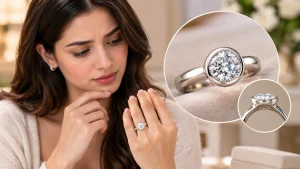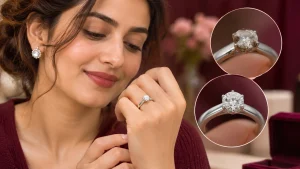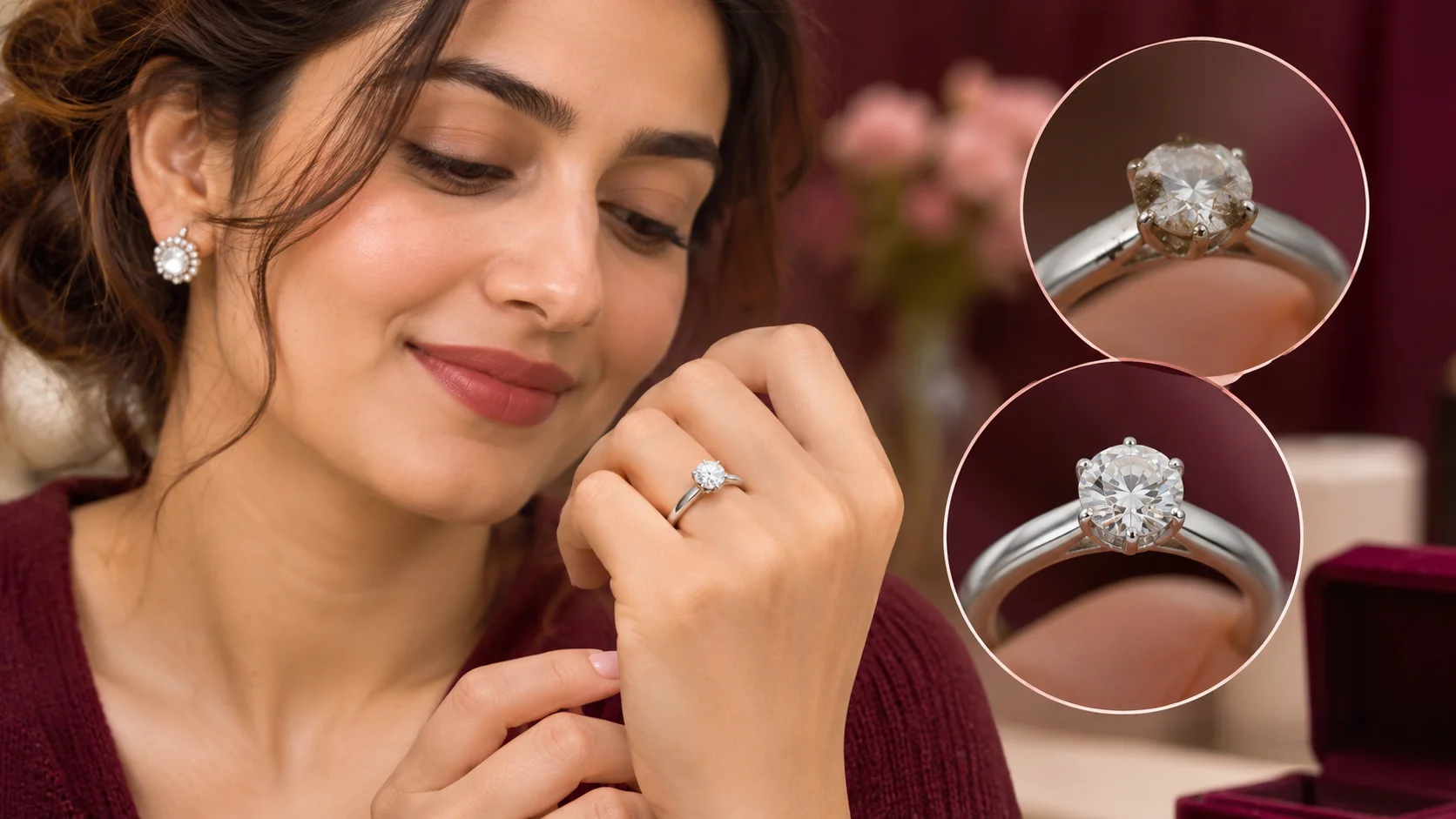
If your engagement ring gets covered in lotion, soap residue, and everyday grime, the setting may be part of the problem. A simple solitaire with an accessible gallery and minimal decorative details is often easier to clean than an intricate halo or pavé design. These simpler settings have fewer small spaces where dirt can collect.
However, an easy-to-clean ring isn’t necessarily the same as a low-maintenance or damage-resistant ring. A bezel setting offers excellent protection, while an open-gallery solitaire can provide easier access to the underside of the diamond. The right choice depends on whether you prioritize convenient cleaning, stone protection, or both.
Let’s compare the settings, explain where dirt collects, and identify what to look for before buying your next engagement ring.
Which Engagement Ring Setting Is Easiest to Clean?
A simple solitaire with an open gallery and minimal accent stones is one of the most practical choices for someone who wants easier ring cleaning.
The open structure makes it easier to reach the underside of the center diamond with a soft brush. A plain band also avoids the tiny spaces created by multiple accent stones.
Here are the main options to consider:
| Ring setting | Cleaning convenience | Main consideration |
|---|---|---|
| Open-gallery solitaire | Excellent | Easy access beneath the center stone |
| Simple bezel | Good | Check the space around the stone’s edge |
| Flush setting | Good | Smooth design, but cleaning access depends on construction |
| Half bezel | Good | Less metal coverage, with some exposed areas |
| Halo | More demanding | Small accent stones create additional cleaning areas |
| Pavé band | More demanding | Tiny settings need careful cleaning |
| Intricate trellis | More demanding | Decorative metalwork can collect residue |
These are practical comparisons of design features, not a standardized industry cleaning ranking. Actual cleanability depends on the ring’s construction and the type of gemstone.
The Gemological Institute of America (GIA) also explains that intricate halo and pavé settings can collect dirt more easily than simpler designs.
Why Does Your Engagement Ring Get Dirty So Quickly?
Your diamond probably hasn’t lost its sparkle. Everyday substances can create a film over the stone and make it appear cloudy.
According to GIA, even touching a diamond can transfer oils that affect its appearance. The underside of the diamond is particularly prone to collecting oil and dirt.
Common causes include:
- Hand lotion: Moisturizers leave an oily layer on the diamond and metal.
- Sunscreen: Creams can create residue around the setting.
- Soap: Handwashing can leave deposits around small metal details.
- Natural skin oils: Everyday contact transfers oils onto the gemstone.
- Cooking grease: Grease can stick to the diamond and surrounding metal.
- Makeup and hair products: These products can create a film that reduces visible sparkle.
- Dust and everyday debris: Small particles can settle around the setting.
The problem becomes more noticeable when your ring has multiple small stones, intricate metalwork, or difficult-to-reach areas.
This is why choosing a setting with a simpler structure can make everyday cleaning easier.
5 Engagement Ring Settings That Are Easier to Clean
Not every engagement ring needs an elaborate design to look beautiful. Some of the simplest settings are also the most practical for everyday wear.
1. Open-Gallery Solitaire – Best for Easy Cleaning
An open-gallery solitaire is an excellent choice if you regularly struggle with dirt underneath your diamond.
This design features one center stone held by prongs, with an open structure beneath the gemstone.
Unlike a solid decorative backing, an open gallery provides access to the underside of the diamond.
Why it’s easier to clean:
- The underside of the diamond is more accessible.
- A soft brush can reach areas where oil collects.
- A plain band has fewer decorative crevices.
- There are fewer small accent stones to maintain.
- Its simple construction makes routine cleaning more straightforward.
Potential drawback: Prongs still require periodic inspection. The exposed center stone also needs protection against accidental impacts.
Best for: Someone who loves traditional diamond engagement rings but wants a straightforward cleaning routine.
You can explore solitaire lab-grown diamond engagement rings for simple designs.
2. Bezel Setting – Best for Protection and Everyday Practicality
A bezel setting surrounds the outer edge of the center gemstone with a continuous metal rim.
This creates a smooth outline without exposed prongs.
The design offers excellent protection around the gemstone’s edge and reduces the chance of snagging on clothing.
Why it’s practical:
- No exposed prongs to catch on fabrics.
- Metal protects the gemstone’s outer edge.
- The smooth profile is comfortable for everyday activities.
- There are fewer exposed prong areas to inspect.
However, a bezel isn’t automatically the easiest setting to clean.
Dirt and oils can still collect around the gemstone’s perimeter. Some designs may also provide less access to the underside of the diamond.
Ask the jeweler whether the gallery is open and how easily the stone can be cleaned around its edges.
Best for: People who prioritize stone protection, a smooth profile, and fewer exposed setting components.
3. Flush Setting – Best for a Smooth, Minimalist Design
A flush setting places the gemstone into the metal band so its surface sits close to the surrounding metal.
The result is a smooth appearance with very little exposed gemstone.
Why it’s practical:
- No raised prongs.
- Minimal decorative details.
- Smooth surfaces are easy to wipe.
- Less chance of snagging on clothing.
- A clean, understated appearance.
The main consideration is the way the stone sits inside the metal. The surrounding metal can limit access to certain areas, so ask about cleaning access before purchasing.
Best for: Minimalist jewelry lovers who prefer subtle designs and smooth surfaces.
4. Half Bezel Setting – Best for a Balance of Protection and Openness
A half bezel uses metal on selected sides of the gemstone instead of surrounding its entire perimeter.
This design offers some of the protective benefits of a full bezel while exposing more of the stone.
Why it’s worth considering:
- Fewer exposed prong components.
- A modern, distinctive appearance.
- Less metal coverage than a full bezel.
- Some designs provide convenient access around the stone.
However, the open sections still need regular cleaning. The final result depends on how the jeweler constructs the setting.
Best for: Shoppers who like the appearance of a bezel but want a more open design.
5. Simple Six-Prong Solitaire – Best for a Traditional Look
If you prefer a classic engagement ring, a six-prong solitaire is another practical option.
The design uses six metal prongs to hold the center gemstone.
It doesn’t have the continuous metal rim of a bezel, so much of the diamond remains visible.
Why it’s worth considering:
- A simple design with minimal decorative details.
- An open structure can provide access underneath the diamond.
- Easy to pair with different wedding band styles.
- Traditional appearance that never feels overly complicated.
However, more prongs do not automatically make cleaning easier. The prongs still need to be checked for wear, and residue can collect around their bases.
Best for: People who want a traditional diamond appearance without an elaborate halo or pavé design.
Which Engagement Ring Settings Collect the Most Dirt?
Some ring designs contain more small details, metalwork, and gemstone settings than others.
These areas can make regular cleaning more time-consuming.
Halo Engagement Rings
Halo rings surround the center gemstone with smaller accent diamonds.
The design creates additional sparkle, but the surrounding stones introduce more small settings that need attention.
GIA notes that halo designs may require more frequent cleaning and maintenance because of their numerous small stones.
If you love halo rings, consider a simpler design with a modest halo rather than an elaborate multi-row arrangement.
You can browse halo lab-grown diamond engagement rings to compare different styles.
Pavé Engagement Rings
Pavé rings feature small diamonds placed closely together along the band or around the center stone.
They create continuous sparkle, but the tiny settings need careful cleaning.
They also require periodic checks to ensure the smaller stones remain secure.
If frequent cleaning bothers you, consider a plain metal band or a design with only a small amount of pavé detailing.
Intricate Trellis Settings
Trellis settings use crossing metalwork to support the center gemstone.
The decorative structure creates an attractive side profile, but overlapping metal and small spaces can make cleaning more difficult.
If you prefer this style, ask the jeweler how easily the underside of the ring can be accessed.
Bezel vs. Prong Setting: Which Is Easier to Clean?
This comparison deserves special attention because both settings have different practical advantages.
A bezel protects the gemstone’s outer edge. A prong setting exposes more of the diamond and can provide better access to its underside, depending on the gallery design.
| Feature | Bezel setting | Prong setting |
|---|---|---|
| Stone protection | Excellent edge protection | Depends on prong construction |
| Underside access | Depends on gallery design | Often more open |
| Cleaning around edges | Requires attention around the bezel rim | Requires attention around prong bases |
| Snagging | Generally less likely | Can catch on fabrics |
| Prong inspections | No traditional prongs | Periodic inspections needed |
| Appearance | Smooth, modern | Classic, open appearance |
Which should you choose?
Choose a bezel if your priority is protection, a smooth profile, and fewer exposed components.
Choose an open-gallery prong solitaire if your priority is easy access for cleaning underneath the center stone.
Neither design eliminates regular cleaning. Construction quality and the jeweler’s workmanship matter just as much as the setting style.
What Should You Look for When Buying an Easy-to-Clean Engagement Ring?
Before purchasing another ring, pay attention to more than the diamond’s size and appearance.
A few practical design features can make a noticeable difference.
Choose Fewer Small Accent Stones
Every additional stone introduces another setting that may need cleaning and inspection.
A single center diamond with a plain band is usually easier to maintain than an elaborate design with multiple accent stones.
Check the Underside of the Ring
Don’t just look at the ring from above.
Ask the jeweler to show you the gallery underneath the center stone.
Check whether you can access the back of the diamond with a soft cleaning brush.
Avoid Unnecessary Decorative Details
Filigree, intricate metalwork, and elaborate galleries can create additional areas where dirt collects.
If easy cleaning is your priority, choose a design with fewer complicated details.
Consider a Lower Profile
A lower-profile setting sits closer to your finger.
It can reduce snagging and accidental knocks, although ring height alone doesn’t determine how easy a design is to clean.
Ask About Professional Cleaning
Before buying, ask the retailer:
- Can the center stone be cleaned easily from underneath?
- Does the setting have an open gallery?
- Are there any small stones that require extra care?
- Can the ring be professionally cleaned?
- How often should the setting be inspected?
These questions can help you avoid buying a ring that looks beautiful but becomes frustrating to maintain.
How to Clean an Engagement Ring Without Damaging It
Even an easy-to-clean setting needs regular care.
For many diamond engagement rings, warm water, mild soap, and a soft brush are suitable for routine cleaning.
GIA recommends gentle cleaning and professional care when needed. However, cleaning methods can differ for other gemstones and delicate settings.
Here’s a straightforward routine for a suitable diamond ring:
- Prepare warm water: Fill a small bowl with warm water and add a few drops of mild dish soap.
- Soak the ring: Allow everyday residue to loosen.
- Use a soft brush: Gently clean around the diamond, prongs, and underside of the setting.
- Rinse carefully: Remove any remaining soap residue.
- Dry with a lint-free cloth: Pat the ring dry before wearing it again.
Always clean your jewelry over a bowl or a protected surface rather than directly over an open sink drain.
Avoid toothpaste, abrasive household cleaners, and chlorine-based products. These can damage the metal or setting.
Don’t automatically use an ultrasonic cleaner at home. GIA warns that ultrasonic cleaning can dislodge stones that are already loose. A jeweler should inspect the ring before using professional cleaning equipment.
For more detailed instructions, read our guide on the best way to clean a lab diamond ring at home.
Frequently Asked Questions
Which engagement ring setting is easiest to clean?
A simple solitaire with an open gallery and minimal accent stones is a practical choice. Its uncomplicated design provides easier access to the underside of the center diamond.
Do bezel engagement rings get dirty?
Yes. Bezel rings can still collect oil, lotion, and dirt around the gemstone’s edges. Their protective metal rim reduces exposed areas, but it doesn’t make the ring dirt-proof.
Why does dirt collect underneath my engagement ring?
The underside of a diamond can collect natural skin oils, lotion, soap residue, and everyday debris. The area may be harder to clean when the setting has limited access.
Are halo engagement rings harder to maintain?
They can be. Halo rings contain multiple small accent stones, which create additional areas that need cleaning and periodic inspection.
Are solitaire engagement rings easier to clean?
Generally, yes. A simple solitaire has fewer decorative details and accent stones. An open-gallery design can make cleaning underneath the center diamond easier.
Is a flush setting easier to clean than a prong setting?
A flush setting has smooth outer surfaces and no exposed prongs. However, its recessed gemstone can be harder to access from certain angles. The actual gallery construction determines how easy it is to clean.
How often should I clean my engagement ring?
The frequency depends on how often you wear the ring and how quickly it collects residue. A gentle weekly cleaning can be a useful routine for a frequently worn diamond ring, with professional cleaning and inspection as recommended by your jeweler.
Can I use an ultrasonic cleaner on my engagement ring?
Not without checking the setting and gemstone first. Ultrasonic cleaning can loosen stones that are already insecure and may not be suitable for every gemstone or treated stone.
Final Thoughts
If your engagement ring gets dirty too easily, look beyond its overall appearance.
A simple solitaire with an open gallery and minimal accent stones is an excellent starting point for easier cleaning. A bezel setting is worth considering if you care more about protecting the center stone and reducing exposed components.
Halo, pavé, and intricate trellis designs can still be beautiful choices, but their additional details may require more cleaning attention.
Before choosing your next ring, examine the underside, ask about cleaning access, and consider how much maintenance you are comfortable with.
The best engagement ring isn’t simply the one that looks beautiful in a jewelry display. It’s the one that fits your everyday life without making routine care feel like a chore.