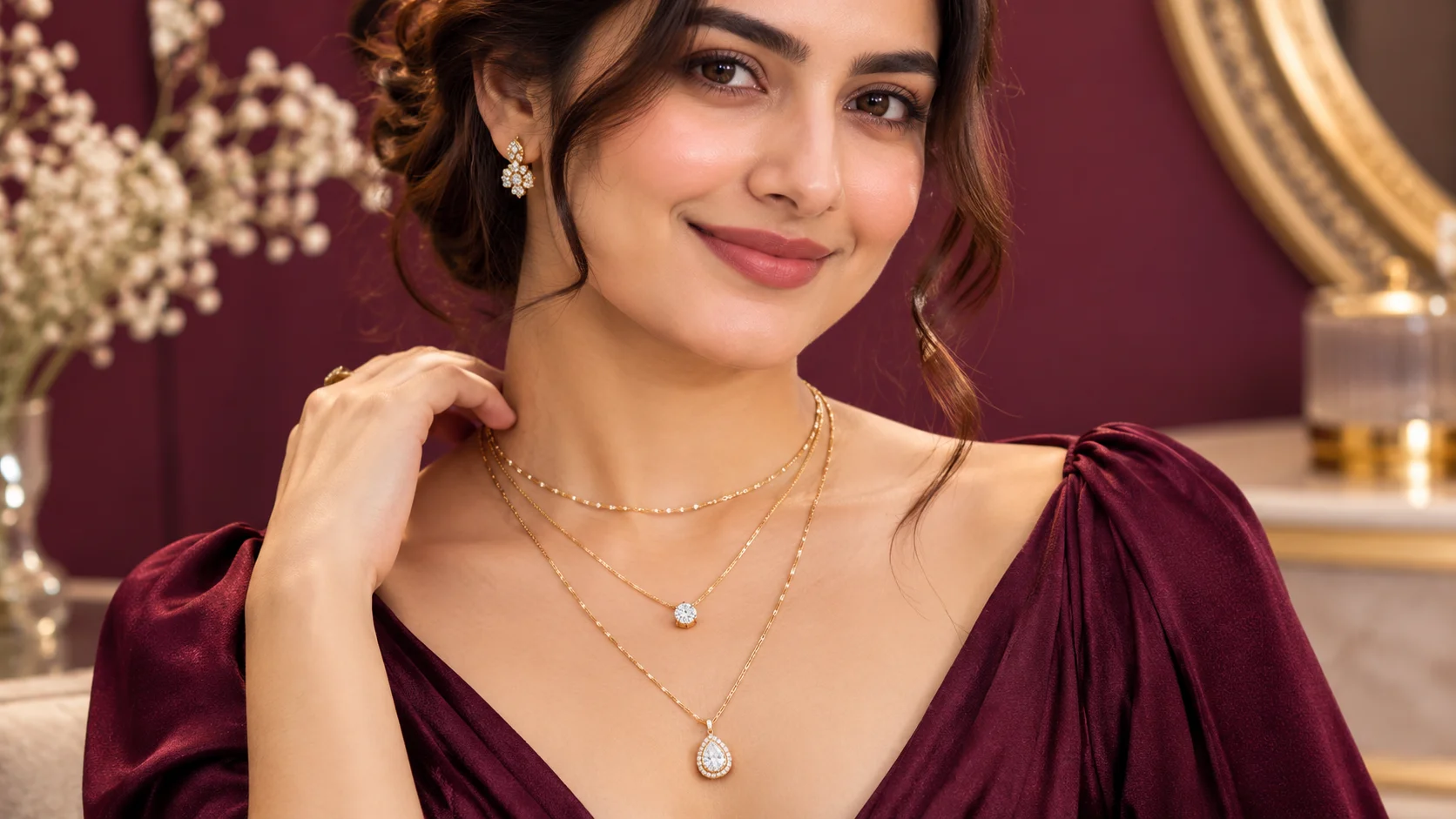
If your necklace keeps tangling, the best solution may be to choose a different necklace design rather than constantly untangling your chains. If you love the layered look, consider a one-piece layered necklace with connected strands or a multi-strand clasp. If you prefer wearing one necklace, a simple chain with a suitable length, fewer delicate details, and a secure clasp may be easier to manage.
The right choice depends on why your necklace tangles. Multiple chains often twist around each other because they sit too close together, while a single chain may knot during storage or catch on clothing. Here’s which necklace styles are worth considering, what to avoid, and how to choose a piece that is easier to wear every day.
Which Necklace Should You Buy If Your Necklaces Keep Tangling?
The best necklace depends on how you normally wear your jewelry.
If you regularly wear multiple necklaces, a fixed-layer design or necklace with a multi-strand clasp is a practical choice. If you prefer something simple, a single-strand pendant necklace or a classic chain can reduce the number of chains moving around your neck.
Here are the main options:
| Necklace style | Best for | Tangling considerations |
|---|---|---|
| Single-strand necklace | Everyday simplicity | Only one chain to manage |
| Fixed-layer necklace | People who love layered jewelry | Connected strands reduce independent movement |
| Necklace with a multi-strand clasp | Wearing multiple separate chains | Helps keep chains separated at the back |
| Pendant necklace | Minimalist styling | One focal point instead of several loose pendants |
| Beaded necklace | Adding texture without multiple chains | Beads can still catch on clothing or other jewelry |
| Short choker necklace | Wearing one close-fitting piece | Less loose chain length, but fit and comfort matter |
My recommendation: Start with a single-strand necklace if you want the simplest option. Choose a fixed-layer necklace if you love wearing multiple chains but dislike managing them separately.
Why Do Necklaces Keep Tangling?
Before buying another necklace, it helps to understand why your current one keeps knotting.
Necklace tangling usually happens because of chain movement, overlapping lengths, delicate links, or poor storage.
1. Your Necklaces Are Almost the Same Length
When two necklaces sit at nearly the same height, they can overlap and twist around each other.
For example, wearing two 18-inch chains creates more overlap than wearing an 18-inch chain with a 22-inch chain.
Different lengths give each necklace more room to move independently.
2. Your Chains Are Too Delicate
Very fine chains can twist, catch, and knot more easily when worn with other delicate necklaces.
This doesn’t mean every thin chain will tangle. However, delicate links require more care, particularly when several necklaces are worn together.
If you regularly experience knots, consider a slightly thicker chain that feels more substantial.
3. Your Pendants Keep Catching Each Other
Multiple pendants can create additional points where necklaces catch.
A pendant may slide against another chain or become caught in a nearby link.
If you enjoy pendant necklaces, consider wearing one main pendant with simpler chains rather than choosing several necklaces with large hanging charms.
4. Your Necklaces Are Stored Together
Necklaces can become tangled even when you aren’t wearing them.
Loose chains move around inside jewelry boxes, drawers, handbags, and travel pouches. Clasps and pendants can catch on neighboring chains.
For everyday storage, keep necklaces separated in individual compartments or hang them on separate hooks.
The Associated Press also recommends closing necklace clasps and storing pieces separately to reduce tangling and scratching.
6 Necklace Styles Worth Considering If You Hate Tangling
Not every necklace is equally convenient for everyday wear. Some designs are easier to manage because they have fewer separate chains, simpler arrangements, or more controlled connections.
Here are six options worth considering.
1. Single-Strand Necklace: Best for Everyday Wear
If you are tired of untangling multiple chains, a single-strand necklace is the simplest option.
It gives you one chain, one clasp, and one main piece of jewelry to manage.
You can choose a simple gold chain, silver chain, or a delicate pendant design depending on your personal style.
Why consider it?
- Only one chain moves around your neck.
- Easier to put on and remove.
- Simple to store separately.
- Works with casual and formal outfits.
- No need to coordinate multiple necklace lengths.
Who should buy it?
Choose a single-strand necklace if you prefer minimalist jewelry or regularly wear necklaces throughout the day.
One important consideration: a single chain can still develop knots, particularly when stored loosely or packed with other jewelry.
2. Fixed-Layer Necklace: Best for a Layered Look
Love wearing multiple necklaces but hate untangling them?
A fixed-layer necklace is worth considering.
Unlike wearing two or three completely separate necklaces, this design connects multiple strands into one coordinated piece.
Some designs use a shared clasp or connecting elements to keep the strands in position.
Why consider it?
- Creates a layered appearance with one coordinated design.
- Reduces the need to adjust several independent clasps.
- Makes matching necklace lengths easier.
- Saves time when getting ready.
Who should buy it?
This is a good option if you love layered jewelry but don’t want to build a necklace stack from separate pieces.
Remember that connected strands can still twist or knot during storage and movement. Look for a design with secure connections and enough space between the strands.
3. Necklace With a Multi-Strand Clasp: Best for Multiple Chains
If you already own several necklaces and don’t want to replace them, consider a necklace-layering clasp.
This small accessory connects multiple necklace ends through a single fastening system.
Instead of allowing every chain to move independently at the back of your neck, the clasp helps keep them organized.
Why consider it?
- Helps prevent chains from crossing at the back.
- Keeps multiple necklaces together.
- Makes putting on a necklace stack easier.
- Allows you to continue wearing necklaces you already own.
Who should buy it?
Choose a multi-strand clasp if you enjoy layering and want to keep your existing necklaces.
Check that the clasp is compatible with your chains before buying. Attachment size, chain thickness, and the number of strands all matter.
4. Pendant Necklace: Best for a Simple Statement
A pendant necklace is another good option if you want a noticeable design without wearing several chains.
It gives your outfit one central focal point.
You can choose a small gemstone, a simple geometric pendant, a pearl, or a personalized design.
Why consider it?
- Creates a finished look with one necklace.
- Reduces the need for multiple pendants.
- Easy to coordinate with different outfits.
- Available in minimalist and statement designs.
Who should buy it?
A pendant necklace is suitable for someone who wants a simple everyday accessory without creating a complicated necklace stack.
Pay attention to the pendant’s weight and bail design. A poorly balanced pendant may rotate or pull the chain to one side.
5. Beaded Necklace: Best for a Different Texture
If you enjoy adding texture to your jewelry, a beaded necklace can be an alternative to several fine metal chains.
Beaded designs use individual beads arranged along a strand. They are available in pearls, gemstones, glass, and other materials.
Why consider it?
- Adds visual interest without multiple metal chains.
- Works as a standalone accessory.
- Available in casual and elegant designs.
- Can complement simple pendant necklaces.
Who should buy it?
Consider a beaded necklace if you want something visually interesting without building a layered chain arrangement.
However, beaded necklaces are not automatically tangle-proof. Knots, stringing materials, and clasps still require proper care.
6. Short Choker Necklace: Best for a Close-Fitting Look
A choker sits close to the neck and can be a practical alternative to longer chains when you prefer wearing one necklace.
It creates a defined look without leaving a long chain hanging down your chest.
Popular options include simple gold chokers, silver designs, gemstone chokers, and pearl styles.
Why consider it?
- Creates a close-fitting silhouette.
- Works well as a standalone accessory.
- Can reduce loose chain movement compared with a longer necklace.
- Easy to pair with different necklines.
Who should buy it?
Choose a choker if you like shorter jewelry and want a simple alternative to long, layered chains.
Make sure the necklace fits comfortably. A choker that is too tight can become uncomfortable during everyday activities.
One-Piece Layered Necklace vs Separate Chains: Which Is Better?
This is one of the most important decisions if your main problem is necklace tangling.
Both options can create a beautiful layered appearance, but they offer different levels of convenience.
| Feature | One-piece layered necklace | Separate layered chains |
|---|---|---|
| Putting it on | Usually one fastening system | Several individual fastenings |
| Styling | Pre-coordinated design | More customization |
| Length adjustment | Depends on the design | Each necklace can be adjusted separately |
| Tangling risk | Can still happen between connected strands | Chains can cross and overlap |
| Flexibility | More limited | Greater styling freedom |
| Best for | Convenience | Personal styling |
When Should You Choose a One-Piece Layered Necklace?
Choose a one-piece layered necklace if:
- You wear the same layered look regularly.
- You want fewer clasps to manage.
- You prefer coordinated chain lengths.
- You don’t want to spend time arranging individual necklaces.
When Should You Choose Separate Chains?
Choose separate chains if:
- You like changing your jewelry combinations.
- You want to wear each necklace individually.
- You prefer different chain lengths and textures.
- You already own necklaces you want to keep wearing.
My verdict: A one-piece layered necklace is the more convenient starting point for someone who repeatedly struggles with separate chains. However, a multi-strand clasp can be a more economical solution if you already own necklaces you love.
What Necklace Lengths Should You Choose to Reduce Tangling?
Necklace length can make a significant difference when you wear multiple chains.
If your necklaces sit too close together, they have more opportunities to overlap.
A useful starting combination is 16, 18, and 20 inches. You can adjust these lengths depending on your neck size, pendant dimensions, and preferred neckline.
| Necklace length | Approximate placement | Common use |
|---|---|---|
| 14 inches | Close to the neck | Short choker |
| 16 inches | Around the base of the neck | Short necklace |
| 18 inches | Around the collarbone | Everyday necklace |
| 20 inches | Slightly below the collarbone | Mid-length pendant |
| 22 inches | Upper chest | Longer necklace |
| 24 inches | Lower chest | Long pendant necklace |
These are approximate placements. Actual positioning varies by body proportions and necklace construction.
Example: A Three-Necklace Combination
If you enjoy layering, try this combination:
- 16-inch necklace: A simple short chain.
- 18-inch necklace: A small pendant necklace.
- 20-inch necklace: A slightly more substantial chain.
The two-inch spacing creates more separation than choosing three necklaces with almost identical lengths.
Jewelry guidance from Jewelers Mutual and Brilliant Earth also recommends varying necklace lengths and weights to help reduce tangling.
Which Chain Styles Should You Avoid If Your Necklaces Keep Tangling?
You don’t need to avoid an entire chain category. However, certain designs may require more attention when you regularly wear several necklaces together.
Here are some considerations before buying.
Very Fine Chains
Delicate chains can be attractive, but they may require extra care.
If you frequently wear multiple necklaces, consider whether the chain is substantial enough for your everyday routine.
Complicated Multi-Pendant Designs
Multiple hanging charms create more points where jewelry can catch.
If you want a low-maintenance necklace, a simpler design with one main pendant may be easier to manage.
Chains With Very Similar Lengths
Buying two necklaces with almost identical lengths can make layering more difficult.
Look for pieces that create visible separation rather than sitting directly on top of each other.
Flat Chains That Can Kink
Some flat chain styles, including herringbone and snake chains, need careful handling.
They can be particularly unsuitable for rough handling or careless storage because sharp bends may damage their structure.
If you prefer these designs, store them flat and avoid folding or crushing them.
How Much Should You Spend on a Necklace That Doesn’t Tangle?
There is no specific price that guarantees a necklace will not tangle.
A higher price does not automatically mean a chain will be easier to maintain.
Instead of focusing only on the price, consider the construction, materials, clasp, chain thickness, and intended use.
Here are the factors worth comparing:
- Chain construction: Look for a design that feels suitable for your everyday activities.
- Clasp quality: Make sure the clasp closes securely and is easy to operate.
- Chain thickness: Consider a slightly more substantial design if delicate chains keep knotting.
- Length: Choose a length that works with your clothing and other jewelry.
- Maintenance: Check whether the necklace requires special storage or handling.
- Return policy: Review the retailer’s return conditions before purchasing.
A simple, well-chosen necklace may be a better purchase than an expensive design with features you don’t need.
How to Choose the Right Necklace Before Buying
Before spending money on another necklace, use this quick checklist.
Your Necklace Buying Checklist
- Decide whether your problem comes from one chain or multiple chains.
- Consider a single-strand design if you prefer simple jewelry.
- Choose a fixed-layer necklace if you want a coordinated layered look.
- Consider a multi-strand clasp if you already own several necklaces.
- Compare chain lengths before purchasing.
- Check the chain thickness and clasp construction.
- Avoid complicated pendant arrangements if you prefer low-maintenance jewelry.
- Check the retailer’s care and return policies.
- Make sure you have a suitable place to store your new necklace.
What If Your New Necklace Still Gets Tangled?
Even a well-designed necklace can knot under certain conditions.
If your new necklace keeps tangling:
- Remove it carefully rather than pulling on the chain.
- Close the clasp before storing it.
- Keep it separate from other necklaces.
- Avoid placing it loosely inside handbags or travel pouches.
- Follow the manufacturer’s storage and care recommendations.
For layered necklaces, consider a necklace separator if the chains keep crossing at the back.
The Associated Press recommends storing necklaces individually and closing their clasps to reduce knots and scratches.
Frequently Asked Questions
What is the best necklace style that doesn’t tangle?
A single-strand necklace is a simple choice because it removes the problem of multiple chains crossing each other. If you prefer a layered look, consider a one-piece layered necklace or a multi-strand clasp.
Neither option guarantees completely tangle-free wear.
Are thicker necklace chains less likely to tangle?
A slightly thicker chain may be easier to handle than an extremely delicate chain. However, thickness alone does not prevent knots. Chain construction, length, movement, pendants, and storage also matter.
Do layered necklaces always tangle?
No. Layered necklaces can be worn comfortably with the right combination of lengths, weights, and textures. However, movement can still cause chains to overlap.
What necklace lengths are best for layering?
A combination of 16, 18, and 20 inches is a useful starting point for three necklaces. Adjust the lengths according to your proportions and how you want each chain to sit.
Are necklace layering clasps worth buying?
Yes, they can be useful if you regularly wear multiple separate necklaces. A multi-strand clasp helps keep chains organized at the back of your neck and makes fastening a necklace stack easier.
Is a pendant necklace better than a layered necklace?
A pendant necklace may be more convenient if you want a simple look with fewer moving chains. A layered necklace offers more visual variety but requires more attention to spacing and movement.
How should I store necklaces to prevent tangling?
Store each necklace separately. Use individual hooks, divided jewelry-box compartments, or separate jewelry pouches. Close the clasps before storing the chains.
Which necklace is best for everyday wear?
A simple single-strand necklace is a practical everyday choice. A small pendant or classic chain can complement different outfits without requiring several separate pieces.
Final Words
If your necklaces keep tangling, don’t automatically buy another delicate chain and expect a different result.
Start by identifying the problem.
If you want a simple, everyday accessory, choose a single-strand necklace. If you love layering, consider a fixed-layer necklace with connected strands. If you already own several chains, a multi-strand clasp may be the most practical purchase.
The best necklace is not necessarily the most expensive or elaborate one. It’s the design that suits your style, feels comfortable, and requires less effort to wear and maintain.