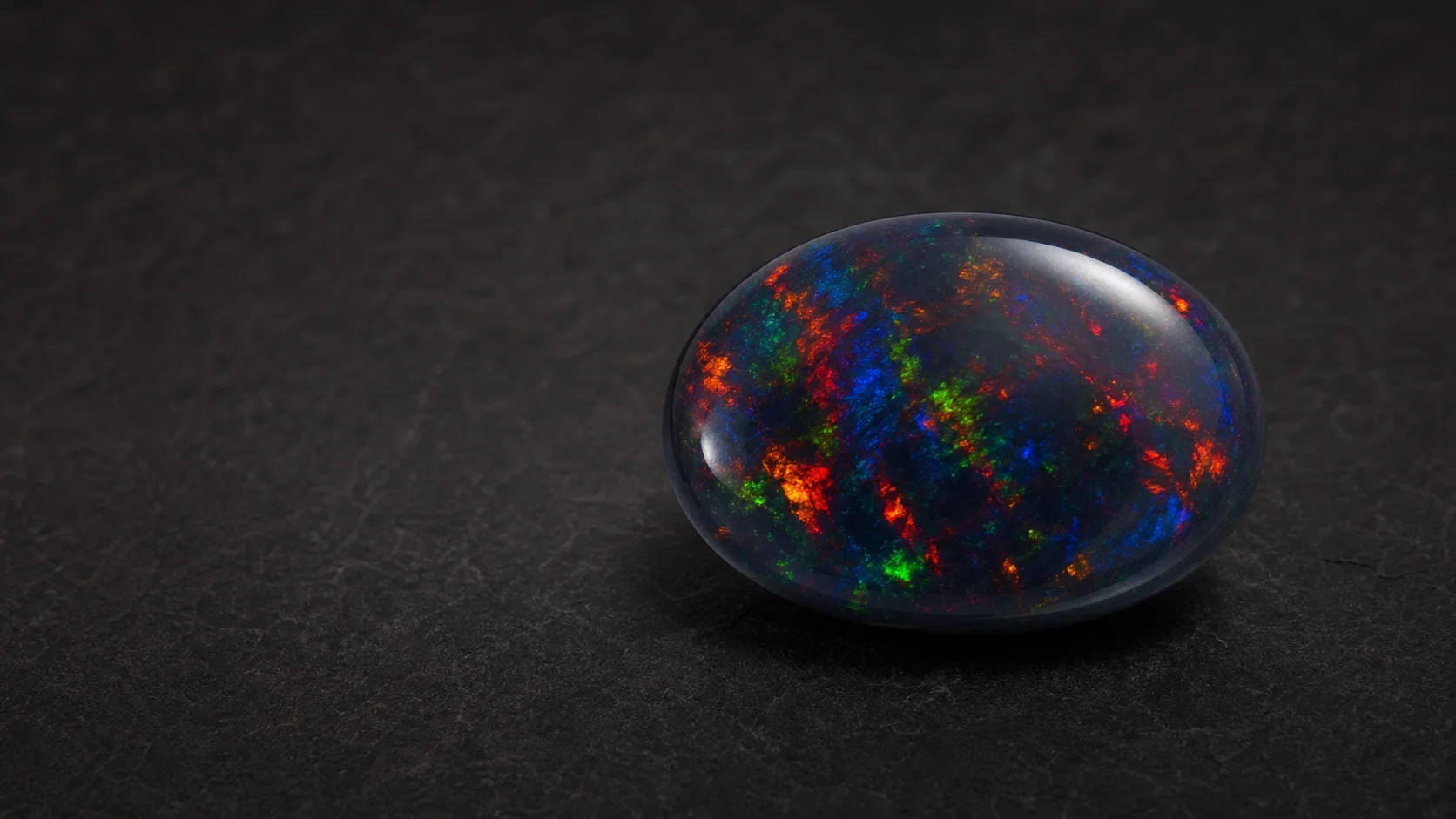
A 1-carat black opal can cost anywhere from around $100 to several thousand dollars, depending on its quality, color intensity, pattern, and whether it is a solid natural opal or an assembled stone. Exceptional black opals with vivid red flashes, a dark body tone, and rare patterns can cost considerably more.
For buyers in the United States, the most important thing to understand is that carat weight alone does not determine an opal’s price. Two black opals weighing exactly one carat can have dramatically different values because their colors, patterns, and overall appearance differ.
If you are considering buying a black opal for a ring, pendant, or gemstone collection, understanding these differences can help you judge whether the asking price is reasonable.
How Much Does a 1 Carat Black Opal Cost?
The price of a one-carat black opal depends primarily on its quality and construction. The following ranges are practical estimates for comparison, not fixed market prices.

These are broad indicative ranges synthesized from published pricing guides and market examples. Actual retail prices can fall outside them, particularly for unusual collector stones. Some assembled opals also sell for far less than solid natural black opals.
For example, a one-carat black opal with moderate blue-green flashes might sell for several hundred dollars, while a stone of the same weight with brilliant red and multicolored flashes could cost several thousand dollars.
The takeaway: Evaluate the individual stone before deciding whether its price is fair. A higher price does not automatically mean better quality, and a low price does not necessarily mean a bargain.
What Determines the Price of a 1 Carat Black Opal?
Several characteristics influence black opal value. Understanding them is more useful than relying on a single price-per-carat figure.

1. Body Tone
Body tone refers to the darkness of the opal’s background color.
Black opals are prized partly because their dark backgrounds make the flashes of color stand out. A darker background combined with vivid color can create a striking visual contrast.
However, a dark-looking stone is not automatically valuable. Its play-of-color, construction, condition, and overall appearance still matter.
The Gemological Institute of America (GIA) identifies background color and play-of-color as important aspects of opal quality. See its opal quality factors guide for more information.
2. Play-of-Color
Play-of-color is the changing display of spectral colors that appears when an opal moves under light.
This is one of the most important factors in determining a black opal’s value. Bright, well-defined flashes generally make a stone more desirable than weak or barely visible color.
A one-carat opal may display blue, green, red, orange, or several colors together. The intensity, distribution, and visibility of those colors can significantly influence its price.
When examining a stone, look at it from different angles rather than judging it under a single light source.
3. Dominant Color
The dominant color can also affect price.
Red and orange flashes are often highly prized, particularly when they appear against a dark background. Strong green and blue flashes can also be attractive and valuable, depending on their brightness, coverage, and pattern.
A bright red flash is not a guarantee of high value, however. A buyer should consider the entire stone rather than paying a premium for one attractive color in isolation.
4. Pattern
Pattern describes how the colors are arranged across the surface.
Some black opals display broad flashes of color, while others show smaller pinpoint flashes or distinct geometric patterns.
The harlequin pattern, characterized by closely arranged angular patches of color, is especially sought after by collectors when it is well defined and vivid.
Other patterns can also be valuable. The important considerations are the pattern’s visibility, color intensity, coverage, and overall appeal.
5. Origin
Australian black opal, particularly material associated with Lightning Ridge in New South Wales, is well known in the gemstone market.
Origin can influence desirability, especially when supported by reliable documentation. However, the mine or locality alone does not establish a stone’s value.
A beautifully colored opal from one source can be more desirable than a weaker stone from another. Buyers should evaluate the actual gemstone rather than relying entirely on an origin claim.
6. Condition and Cut
Surface pits, cracks, crazing, and other damage can reduce an opal’s value.
The cut also matters. A well-shaped, polished cabochon should display its colors effectively from useful viewing angles. Some exceptional opals are cut into unusual shapes to preserve their best color patterns rather than conforming to standard dimensions.
For a one-carat stone, consider whether the price reflects its appearance and condition, not simply its weight.
Why Is Australian Black Opal So Expensive?
Australian black opal can command high prices because fine material is relatively scarce and exceptional examples can display vivid color against a naturally dark background.

Lightning Ridge is particularly associated with fine black opal. However, not every stone from this locality is expensive, and not every expensive opal necessarily offers good value.
A premium stone may combine several desirable features:
- A naturally dark body tone
- Bright, well-defined play-of-color
- Multiple colors with strong contrast
- An attractive and distinctive pattern
- Good condition and a suitable cut
- Credible information about its identity and origin
These characteristics help explain why some black opals cost hundreds of dollars per carat while others reach thousands or more.
For a broader comparison of opal varieties, read Diamiv’s Australian Opal vs. Ethiopian Opal guide.
Solid Black Opal vs. Doublet vs. Triplet
One of the most important buying decisions is determining whether the stone is solid opal or an assembled product.

These materials can look similar in photographs, but their construction and prices can differ substantially.
| Type | Construction | What to know |
|---|---|---|
| Solid black opal | Natural opal material throughout the stone | Often more expensive when quality and color are comparable |
| Opal doublet | A thin opal layer attached to a backing | Can provide an attractive dark appearance at a lower price |
| Opal triplet | A thin opal layer between a backing and a clear protective dome | Often more affordable, but has a different construction from solid opal |
A doublet typically has a thin layer of precious opal attached to a backing. A triplet adds a clear top layer, often made from glass or quartz, over the opal.
These assembled stones are not necessarily worthless or unsuitable for jewelry. They simply should not be priced as though they were equivalent to solid natural black opals of comparable appearance.
Before purchasing a one-carat stone, ask the seller:
- Is the opal solid, a doublet, or a triplet?
- Is it natural or laboratory-grown?
- Has it been treated?
- Is its origin known or documented?
- Is there a return policy if its description proves inaccurate?
The GIA opal buyer’s guide explains opal identification, assembled stones, and important considerations for buyers.
Does Red Play-of-Color Make a Black Opal More Expensive?
It often can.
Red flashes are traditionally highly prized in black opal, especially when they are bright, clearly defined, and visible across a substantial portion of the stone.
However, the presence of red alone does not determine value. A small, faint red flash may contribute less to a stone’s desirability than strong, widespread blue-green or multicolored flashes.
When comparing two one-carat black opals, consider:
- How bright the colors appear
- How much of the stone displays color
- Whether the colors remain visible as the stone moves
- Whether the pattern is distinctive
- Whether the stone has noticeable areas without color
A balanced assessment is more reliable than assuming that any opal displaying red should carry a premium price.
How to Buy a 1 Carat Black Opal
If you are shopping for a one-carat black opal, use these steps to compare stones more confidently.
Compare Stones Under Different Lighting
Ask to see the opal under several lighting conditions. Some stones appear impressive under strong showroom lights but display less color in ordinary indoor lighting.
Observe how the pattern changes as you tilt the gemstone.
Confirm the Construction
Check whether the listing describes a solid opal, doublet, or triplet. If the description is unclear, ask for clarification before purchasing.
The construction should match the seller’s claims and the price you are paying.
Request Clear Photographs or Video
Look for close-up images that show the entire stone, its surface, and its color pattern.
Video can be especially useful because opal’s play-of-color changes with movement. For an expensive purchase, request additional views if the available images do not clearly represent the stone.
Check the Seller’s Return Policy
A return policy gives you an opportunity to inspect the stone after delivery. Read the terms carefully, including any restrictions, restocking fees, and deadlines.
For a premium purchase, consider an independent gemological evaluation when appropriate.
Compare the Price With Similar Stones
Compare gemstones with similar construction, size, color intensity, pattern, condition, and quality.
A one-carat solid black opal should not be compared directly with a one-carat triplet as though they were equivalent products.
Is a 1 Carat Black Opal Worth Buying?
A one-carat black opal can be a worthwhile purchase if its appearance suits your preferences and the price is justified by its quality.
For a buyer who wants an unusual gemstone for a pendant or occasional-wear ring, an attractive commercial-quality stone may be sufficient. Someone seeking a collector-grade specimen may be willing to pay considerably more for exceptional color and pattern.
However, opal requires more care than harder gemstones. Its hardness generally ranges from 5 to 6.5 on the Mohs scale, and it can scratch, chip, or fracture if handled roughly.
If you plan to wear a black opal ring frequently, choose a protective setting and remove it before activities that could damage the stone. Clean it with warm, soapy water and avoid extreme heat or sudden temperature changes.
GIA provides additional guidance in its opal care and cleaning guide.
If you are comparing other gemstone options, Diamiv’s 30 Types of Gemstones Every Woman Should Know guide offers a broader overview.
Frequently Asked Questions
How much is a 1-carat black opal worth?
A one-carat black opal may cost around $100 to several thousand dollars, with exceptional specimens exceeding $10,000. The exact value depends on its construction, body tone, play-of-color, pattern, condition, and overall quality.
Why are some one-carat black opals so expensive?
High-quality black opals can be scarce and visually distinctive. Strong color contrast, bright red or multicolored flashes, attractive patterns, and excellent condition can all contribute to a higher price.
Is black opal more expensive than white opal?
Fine black opal often commands higher prices than comparable white opal because of its rarity and the visual contrast created by its dark background. However, exceptional white opals can also be valuable, and quality matters more than color category alone.
Is a black opal doublet worth buying?
A doublet can be a reasonable choice if you like its appearance and understand its construction. It can offer the look of dark opal for less money than a comparable solid stone. Make sure the seller identifies it accurately.
Does a larger black opal always cost more?
No. Carat weight is only one factor. A smaller stone with vivid colors and an exceptional pattern can be more valuable per carat than a larger stone with weak color or visible damage.
Is a one-carat black opal suitable for an engagement ring?
Yes, but it requires careful consideration. Opal is more vulnerable to scratches and impact than diamond or sapphire, so a protective setting and careful wear are important. It may be better suited to someone comfortable with the additional maintenance.
Final Words
A 1-carat black opal can cost approximately $100 to several thousand dollars, while exceptional collector-grade stones may command substantially more.
Before buying, focus on five things: solid or assembled construction, body tone, brightness of play-of-color, pattern, and condition. These factors provide a much better basis for judging value than carat weight alone.
The best purchase is not necessarily the most expensive stone. It is the one whose quality, appearance, and documented characteristics justify its asking price.