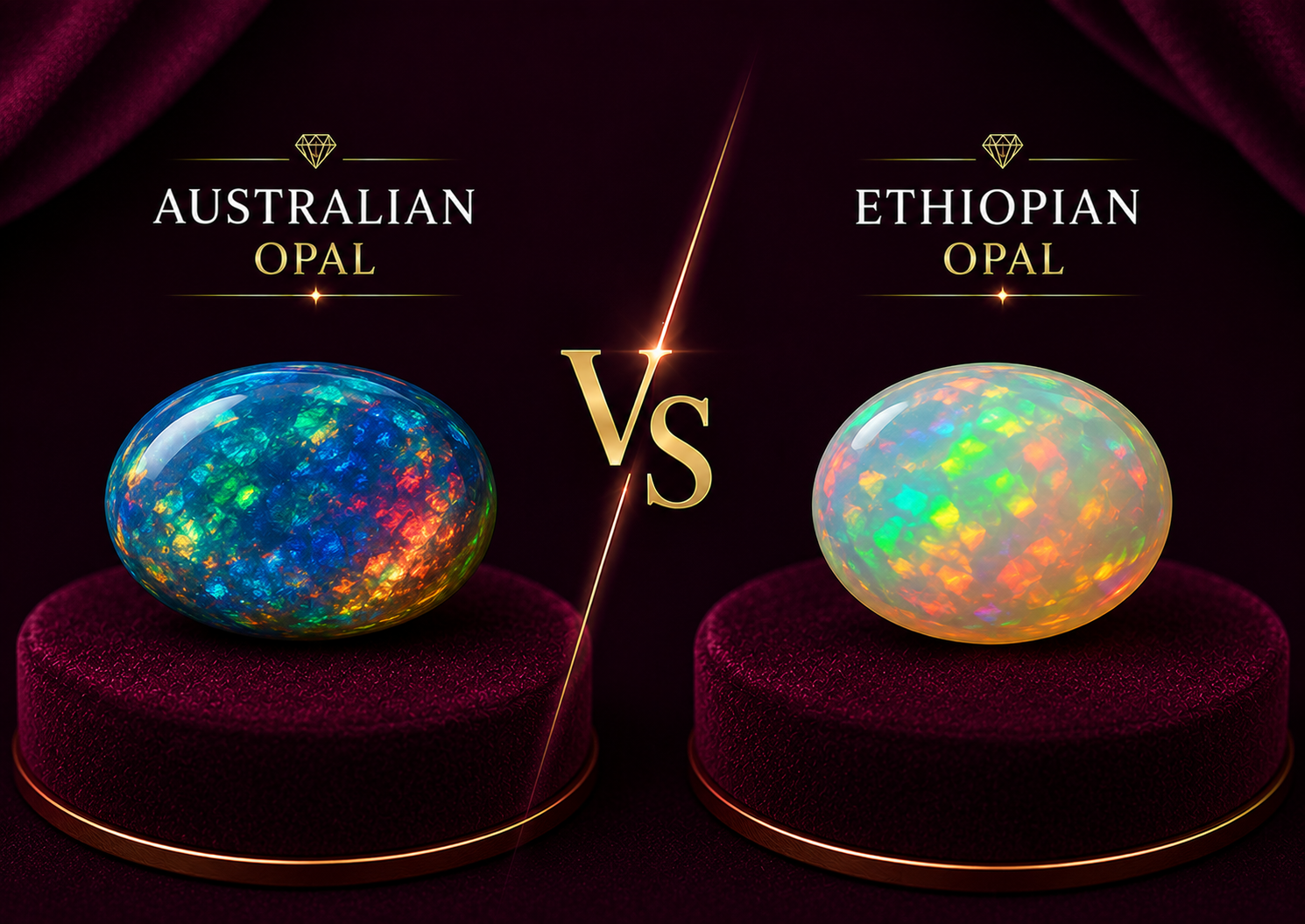
Australian opal and Ethiopian opal can both display spectacular flashes of red, blue, green, orange, and other colors. But they are not interchangeable.
The biggest differences are their geological origins, appearance, water sensitivity, durability, availability, and typical price. Australian opal is especially known for black, white, crystal, and boulder varieties, while Ethiopian opal—particularly material from Wollo—can have a bright, translucent appearance and dramatic play-of-color.
So which is better? For everyday jewelry and maximum stability, Australian opal is generally the safer choice. For buyers who want vivid color and a more accessible price, Ethiopian opal can offer excellent value, provided they understand its hydrophane behavior and care requirements.
Australian Opal vs Ethiopian Opal: Quick Comparison
| Feature | Australian Opal | Ethiopian Opal |
|---|---|---|
| Main sources | Australia, including Lightning Ridge, Coober Pedy, and Queensland | Ethiopia, particularly Wollo |
| Geological origin | Primarily sedimentary | Primarily volcanic |
| Common body tones | Black, dark, white, gray, crystal, brown | White, crystal, brown, reddish brown, and other tones |
| Play-of-color | Can be intense, directional, and highly patterned | Often vivid, broad, and sometimes distinctive in pattern |
| Hydrophane | Generally non-hydrophane | Much Ethiopian opal is hydrophane |
| Water sensitivity | Generally lower | Higher |
| Durability | Good for opal, but still needs care | Varies; hydrophane material requires more care |
| Typical price | Usually higher for comparable fine material | Often more affordable |
| Best use | Rings and jewelry with proper care | Pendants, earrings, occasional-wear jewelry, and carefully worn rings |
| Main advantage | Stability and established market demand | Color and value for the price |
| Main drawback | Fine material can be expensive | Moisture sensitivity and variable stability |
Opal itself is a relatively soft gemstone. Neither Australian nor Ethiopian opal should be treated like sapphire or diamond, so the setting and how you wear the stone matter considerably.
What Is Australian Opal?
Australian opal refers to natural opal mined in Australia, which has long been one of the world’s most important sources of precious opal.
Important Australian opal-producing regions include:
- Lightning Ridge — particularly famous for black opal
- Coober Pedy — especially known for white opal
- Queensland — well known for boulder opal
- Andamooka — another historic South Australian opal field
Australian opal is available in several visually different forms. Black opal, for example, has a dark body tone that can create dramatic contrast with its play-of-color. Boulder opal can combine colorful opal with natural ironstone backing.
That variety is one reason you should not think of “Australian opal” as a single appearance or price category.
Why Is Australian Black Opal So Valuable?
Black opal from Lightning Ridge is particularly famous for its dark body tone and intense play-of-color.
If you’re interested specifically in the economics and rarity behind this variety, take a look at this guide to why black opal can be so expensive.
The important point is that the Australian origin itself does not automatically make an opal expensive. Quality, color, pattern, body tone, size, and condition all play a role.
What Is Ethiopian Opal?
Ethiopian opal is a relatively newer commercial source of precious opal compared with Australia’s long-established industry.
One important deposit is around Wegel Tena in Ethiopia’s Wollo Province. Ethiopian opal from this region can show vivid play-of-color and distinctive visual patterns.
Ethiopian opal can occur in white, brown, reddish-brown, and more transparent-looking varieties.
One of its most important characteristics is hydrophane behavior.
What Does Hydrophane Mean?
A hydrophane opal is porous enough to absorb water.
When water enters a hydrophane opal, its transparency and appearance can change temporarily. In some stones, the play-of-color may become less visible while wet and return as the stone dries.
This is one of the most important differences to understand before purchasing Ethiopian opal.
Australian Opal vs Ethiopian Opal: Color
Both types can produce exceptional play-of-color, but they often create a different visual impression.
Australian Opal Color
Australian opal can have an exceptionally strong contrast between its body tone and play-of-color.
Black opal is the classic example. Its dark body can make red, orange, green, blue, and violet flashes appear especially intense.
White Australian opal generally has a lighter body tone, while crystal opal allows more light to pass through the material. Boulder opal can combine colorful opal with its natural ironstone backing.
Ethiopian Opal Color
Ethiopian opal can have a lighter, more translucent appearance that gives its play-of-color a different character.
Some stones show broad flashes of color, while others display distinctive patterns. Certain Ethiopian opals can appear almost three-dimensional because of their transparency and internal-looking color effects.
The best choice therefore comes down to personal preference.
Choose Australian opal if you prefer: strong contrast, darker body tones, classic black opal, or bold patterns.
Choose Ethiopian opal if you prefer: translucent material, bright flashes, lighter body tones, or unusual internal-looking color effects.
There is no universal winner for color. Opal quality varies enormously from stone to stone.
What Makes an Opal Valuable?
Origin alone does not determine whether an opal is valuable.
Important factors include:
- Body tone
- Color range
- Brightness and intensity
- Pattern
- Transparency
- Size
- Cut quality
- Natural versus treated material
- Presence of cracks or inclusions
- Whether the stone is solid, doublet, or triplet
This means an exceptional Ethiopian opal can be much more desirable than a mediocre Australian opal.
Likewise, simply seeing “Australian” on a listing does not automatically mean the stone is high quality.
For broader context, you can also explore gemstones rarer than diamonds to see how rarity differs across various gemstones.
Australian Opal vs Ethiopian Opal: Durability
Durability is where the comparison becomes especially important.
Both are relatively soft gemstones, but hydrophane Ethiopian opal introduces an additional consideration: water absorption.
Is Australian Opal Durable?
Australian opal is generally considered a stable choice for jewelry when properly cared for.
Most solid Australian opal is non-hydrophane, meaning it does not absorb water in the same way that hydrophane Ethiopian opal does.
However, “more durable” does not mean “indestructible.”
Opal can scratch, chip, or fracture. Protective settings are particularly useful for opal rings because the stone can be vulnerable to accidental impacts.
Australian opal can therefore work well in rings, but the design and your lifestyle still matter.
Is Ethiopian Opal Durable?
Ethiopian opal needs more careful consideration because much of the Wollo material is hydrophane.
When water enters porous material, the appearance can change. More importantly, some Ethiopian opal may be more vulnerable to cracking, depending on its internal structure, porosity, and inclusions.
Importantly, not every Ethiopian opal reacts identically.
Some Ethiopian opal can be relatively durable, so it is better to evaluate the individual stone rather than assume every Ethiopian opal has the same level of stability.
Australian Opal vs Ethiopian Opal: Price
Australian opal generally costs more than Ethiopian opal, particularly when comparing high-quality material.
But there is no reliable single price-per-carat figure that applies to every opal.
A fine black opal from Lightning Ridge and an ordinary white opal from Australia can have dramatically different values. The same is true for Ethiopian material.
Why Can Australian Opal Cost More?
Factors can include:
- Scarcity of fine material
- Collector demand
- Reputation of Australian deposits
- Quality of play-of-color
- Body tone
- Pattern
- Size
- Condition
Fine black opal from Lightning Ridge can command particularly high prices.
Why Is Ethiopian Opal Often Cheaper?
Ethiopian opal entered the international market more recently and has provided substantial quantities of attractive material.
This gives buyers an opportunity to find vivid, visually impressive stones without necessarily paying the premium associated with some fine Australian opal.
Bottom line: Ethiopian opal is often the more budget-friendly option, while exceptional Australian opal can command significantly higher prices.
Which Is Better for an Opal Ring?
If you’re choosing an opal specifically for a ring, durability and setting design deserve more attention than they would for a pendant.
Australian opal is usually the better choice for:
- Engagement rings
- Everyday rings
- Heirloom jewelry
- Rings worn frequently
- Buyers who want less water sensitivity
Ethiopian opal can work for:
- Statement rings
- Occasional-wear rings
- Protective settings
- Buyers who understand the care requirements
- Designs where affordability and visual impact are priorities
Neither should be treated as a completely carefree everyday gemstone.
For an opal ring, a protective bezel-style setting can help shield the stone’s edges from knocks and accidental impact.
Which Is Better for Everyday Wear?
Australian opal generally has the advantage.
Its non-hydrophane nature makes it less concerning around ordinary moisture exposure than hydrophane Ethiopian opal.
But everyday wear still requires care because all opal is relatively soft.
If you’re looking for a stone that you can wear constantly without thinking about scratches, impact, heat, or chemicals, neither variety is ideal.
If you’re willing to treat the jewelry carefully, Australian opal is generally the more practical option.
How to Care for Australian Opal
Australian opal still deserves gentle handling.
Follow these basic precautions:
- Avoid hard impacts.
- Keep it away from abrasive materials.
- Remove opal jewelry during strenuous activities.
- Avoid extreme temperature changes.
- Keep chemicals and harsh cleaners away from the stone.
- Clean it gently with warm, soapy water when appropriate.
How to Care for Ethiopian Opal
Hydrophane Ethiopian opal requires additional caution.
Avoid unnecessary exposure to:
- Water
- Pools
- Hot tubs
- Showering
- Household chemicals
- Perfume
- Lotions
- Cleaning solutions
- Ultrasonic cleaners
- Sudden temperature changes
Because hydrophane opal can absorb liquids, moisture can temporarily change the appearance of the stone. Susceptible material may also be more vulnerable to cracking.
If you’re buying an expensive Ethiopian opal, ask whether it has been treated and whether that treatment has been disclosed.
Australian Opal vs Ethiopian Opal: Pros and Cons
Australian Opal
Pros
- Generally stable in everyday jewelry
- Usually non-hydrophane
- Strong collector reputation
- Exceptional black opal available
- Wide variety of body tones and styles
- Excellent option for heirloom jewelry
Cons
- Fine material can be expensive
- High-quality stones can be difficult to source
- Still relatively soft and vulnerable to impact
- Origin alone does not guarantee quality
Ethiopian Opal
Pros
- Often more affordable
- Can show spectacular play-of-color
- Many stones have attractive translucency
- Unusual patterns and visual effects
- Good choice for buyers seeking strong visual impact
Cons
- Much Ethiopian opal is hydrophane
- Can absorb water
- Appearance may change when wet
- Some material has greater cracking risk
- Treatments need to be considered
- Requires more careful handling
Australian Opal vs Ethiopian Opal: Which Should You Buy?
The answer depends on what matters most to you.
Choose Australian opal if durability, stability, everyday wear, and long-term ownership are your priorities.
Choose Ethiopian opal if you want vivid color, interesting transparency, and a lower entry price—and you’re comfortable giving the stone more careful treatment.
For an engagement ring or another piece intended to become an everyday heirloom, I would generally favor a high-quality solid Australian opal in a protective setting.
For earrings, pendants, occasional-wear jewelry, or a more budget-conscious purchase, a carefully selected Ethiopian opal can be an excellent option.
Most importantly, don’t choose based on country of origin alone. Examine the actual stone’s play-of-color, pattern, body tone, transparency, condition, construction, and treatment history.
Final Words
Australian and Ethiopian opals can both be beautiful, but they offer different advantages.
Australian opal wins for stability and everyday wear.
Ethiopian opal wins for affordability and eye-catching visual effects.
The most important distinction is the hydrophane behavior found in much Ethiopian opal. It can absorb water and may change appearance or, in susceptible material, develop cracking.
If you’re buying an opal as an investment or heirloom, evaluate the individual stone carefully rather than assuming that Australian automatically means valuable or Ethiopian automatically means fragile.
The quality of the opal matters just as much as its origin.
Frequently Asked Questions
Is Australian opal better than Ethiopian opal?
Not necessarily. Australian opal is generally better for stability and regular wear, while Ethiopian opal can offer excellent color at a lower price. The best choice depends on the individual stone and how you plan to use it.
Is Ethiopian opal real opal?
Yes. Ethiopian opal is natural precious opal when it is sold as such. Major Ethiopian deposits produce opal with genuine play-of-color.
Why is Ethiopian opal cheaper than Australian opal?
Ethiopian opal is often more affordable because attractive material is available at lower price points than comparable fine Australian material. However, price varies greatly according to quality.
Can Ethiopian opal get wet?
Hydrophane Ethiopian opal can absorb water. The stone may temporarily change in transparency or appearance, and immersion can increase the risk of cracking in susceptible material.
Can you wear Ethiopian opal every day?
You can, but it requires more care than many other gemstones. Avoid unnecessary water exposure, chemicals, hard impacts, and rapid temperature changes. For frequent wear, Australian opal is generally the more practical choice.
Which opal is best for an engagement ring?
A high-quality Australian opal is generally the safer choice for an engagement ring because of its stability. Regardless of origin, use a protective setting and remember that opal is softer and more vulnerable to damage than many traditional engagement-ring gemstones.
Which opal has better color?
Neither has an automatic advantage. Australian opal can produce exceptionally intense color, particularly against dark body tones, while Ethiopian opal can produce vivid flashes and attractive translucent effects. Individual stone quality is more important than origin.
Is black Ethiopian opal natural?
Some Ethiopian opal has naturally dark body colors, but dark or black-looking Ethiopian material can also be treated. Because hydrophane opal can absorb dyes, buyers should ask about treatment disclosure when purchasing unusual body colors.
Does Australian opal absorb water?
Most solid Australian opal is non-hydrophane and does not absorb water in the same way as hydrophane Ethiopian opal. That said, opal is still sensitive to heat, sudden temperature changes, and physical damage.
Is Ethiopian opal a good investment?
It can be a beautiful gemstone purchase, but buyers should not assume that all Ethiopian opal will appreciate in value. Investment potential depends on rarity, quality, condition, demand, and other factors. For high-value purchases, independent gemological verification is sensible.