Black opal is one of the most valuable varieties of opal, but its price is not simply the result of being black. Its high value comes from a rare combination of factors: scarcity, a dark body tone that enhances color, vivid play-of-color, desirable patterns, strong color coverage, quality, and in many cases, Australian origin.
The most exceptional stones can command thousands of dollars per carat, while lower-quality examples can sell for much less. That enormous difference is important because not every black opal is automatically expensive.
So, why is black opal so expensive?
The short answer is that the finest stones combine several desirable characteristics that are difficult to find together. The darker background creates dramatic contrast, while bright flashes of red, orange, green, blue, and other spectral colors make each stone visually distinctive. GIA identifies play-of-color, pattern, clarity, color, and cut as important factors when evaluating opal.
What Makes Black Opal Different?
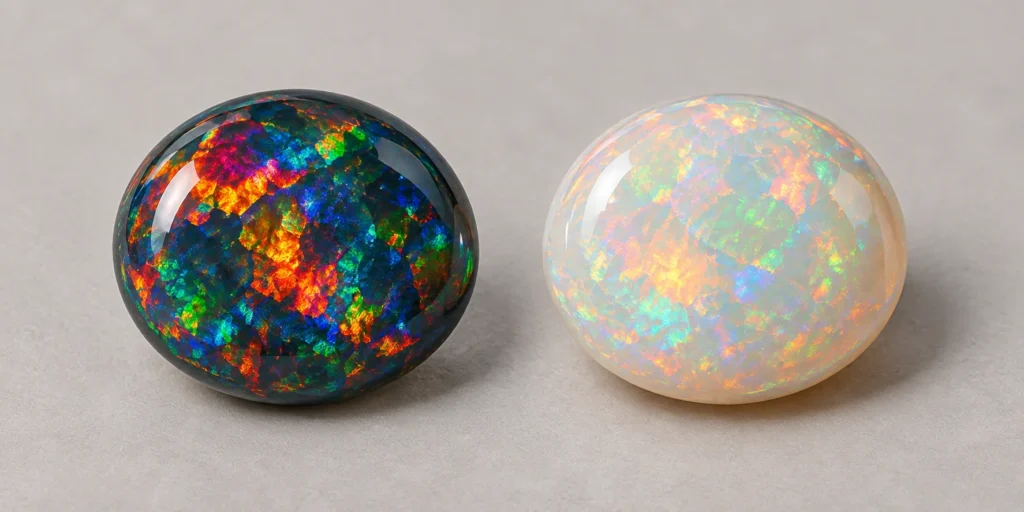
Black opal is a type of precious opal with a dark body color, ranging from very dark gray to black, beneath its play-of-color.
That dark background is one of its defining characteristics.
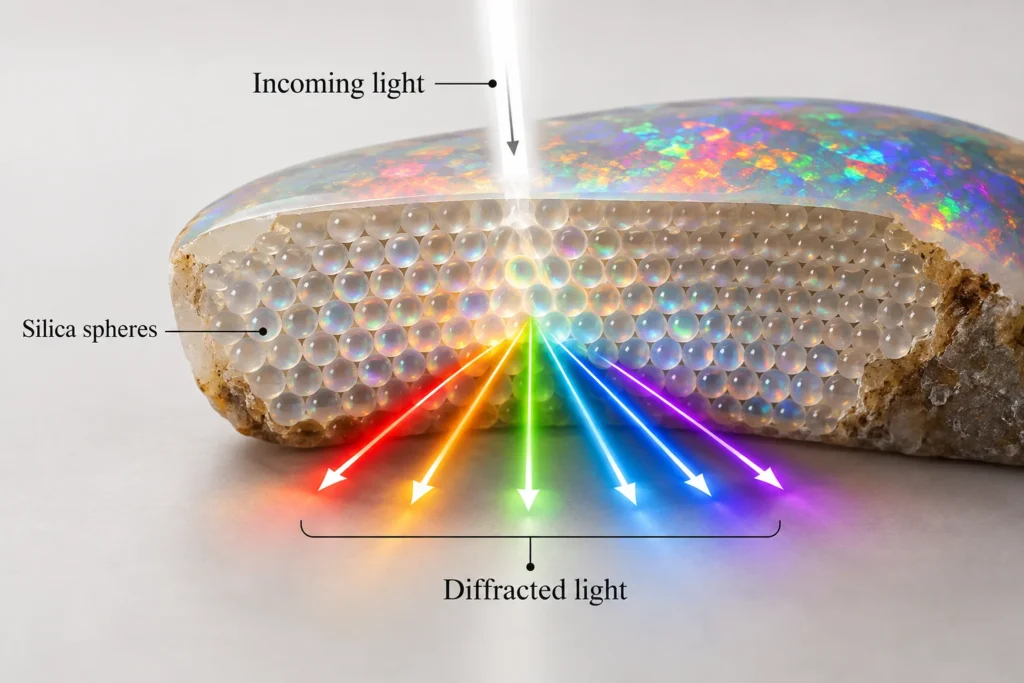
Opal’s famous flashes of color are produced by the interaction of light with the microscopic structure of the stone. Depending on the structure, different wavelengths of light are diffracted and appear as different colors.
Against a pale background, those colors can appear softer. Against a dark background, the contrast can be much more dramatic.
This is one reason buyers place a premium on fine black opal.
The distinction is also important when comparing black opal with other varieties. GIA describes black opal as having play-of-color against a black or dark background and notes that black opal is considered the rarest of the major opal types.
If you want a broader introduction to opal, you can also read Diamiv’s October Birthstone: Opal Meaning, Color & Jewelry.
1. Black Opal Is Rare
Rarity is one of the biggest reasons fine black opal can become expensive.
High-quality natural black opal is not produced in the same quantities as more common light or white opal. Australia’s Lightning Ridge is particularly famous for black opal, and material from this region has become closely associated with the finest examples.
But rarity needs some context.
Simply finding a dark-colored opal does not make it a valuable collector stone. The truly scarce material is black opal that also has exceptional play-of-color.
A stone with a dark body and weak, dull color is a very different proposition from one with a deep body tone and brilliant color covering much of its surface.
That distinction explains why two stones that both get called “black opal” can have dramatically different prices.
2. The Dark Body Tone Makes the Colors Stand Out
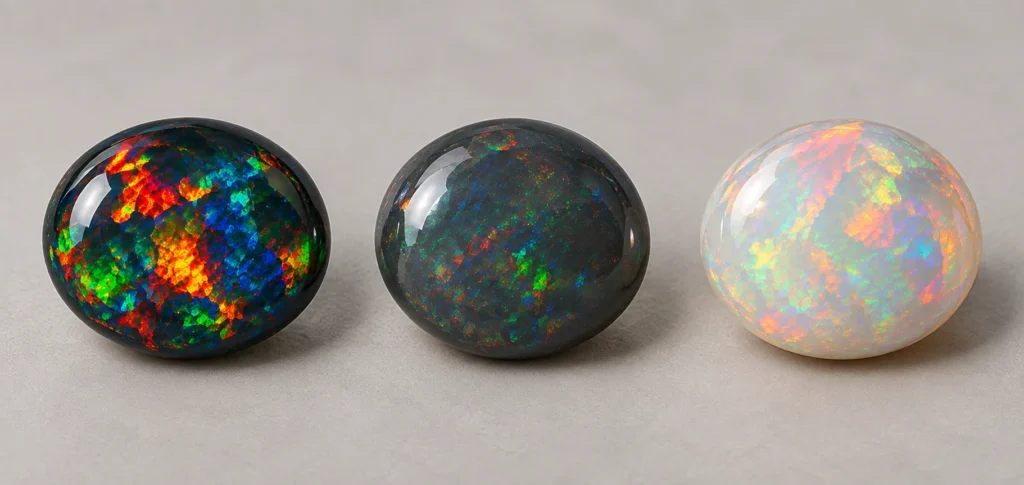
The dark background is arguably the most recognizable feature of black opal.
Think of it as the backdrop behind a light display. A dark background can make bright colors appear more intense because there is greater contrast between the body color and the play-of-color.
GIA notes that buyers often favor black opal because its dark background provides an attractive contrast with the play-of-color.
This does not mean that the darkest possible stone is automatically the most valuable.
A black opal with an extremely dark body but weak play-of-color may be worth less than a slightly lighter stone with exceptionally bright, widespread color.
The body tone creates the canvas. The quality of the color display determines what happens on that canvas.
3. Vivid Play-of-Color Is a Major Value Driver
If rarity explains part of the price, play-of-color explains much of the rest.
Play-of-color is the shifting display of spectral colors that appears when an opal is moved under light. It can include blue, green, yellow, orange, red, violet, and combinations of these colors.
GIA identifies play-of-color as the most important quality factor for opal and explains that brightness, color range, and distribution all affect desirability.
A high-quality black opal may show:
- Bright flashes rather than muted color
- Several colors across the stone
- Strong color from different viewing angles
- Broad areas of color rather than isolated tiny flashes
- Excellent contrast against the dark body
This is why looking only at the stone’s base color can be misleading.
A black-looking opal with little visible color is not necessarily a valuable black opal.
4. Red Play-of-Color Can Make a Black Opal Much More Valuable
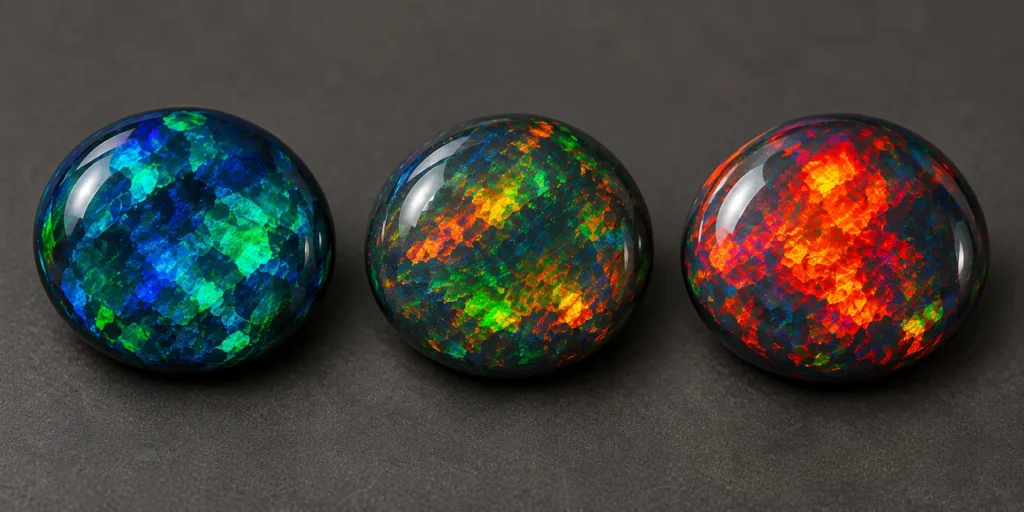
Color itself matters, and red has traditionally been one of the most prized colors in precious opal.
GIA explains that red is traditionally considered the most desirable prominent play-of-color, followed by orange and green, although preferences can vary.
The reason red can command a premium is partly related to the microscopic structure required to produce it.
Different sizes of silica structures interact with light differently. Larger structures can produce longer wavelengths, including red and orange, while smaller structures can produce shorter wavelengths such as blue and violet.
But seeing a tiny red flash does not automatically make an opal extremely valuable.
What matters is the overall presentation.
A stone with bright, dominant red across a substantial portion of its face is much more unusual than one with a small red spot that appears only at one angle.
5. Pattern Can Add to the Value
Color is only part of the story. The way that color is arranged across the stone also matters.
Opal can display numerous patterns, including:
- Pinfire
- Broad flash
- Rolling flash
- Harlequin
- Flame
- Peacock-style patterns
GIA specifically identifies patterns such as pinfire and harlequin and notes that large, closely arranged patches of bright color are generally favored over small, scattered flashes.
A striking pattern can make a black opal particularly desirable because it adds another layer of individuality.
For example, a harlequin pattern consists of broad, angular patches of color arranged in a distinctive mosaic-like appearance. When that pattern is exceptionally bright and covers much of a dark stone, it can contribute significantly to desirability.
6. Color Coverage Matters
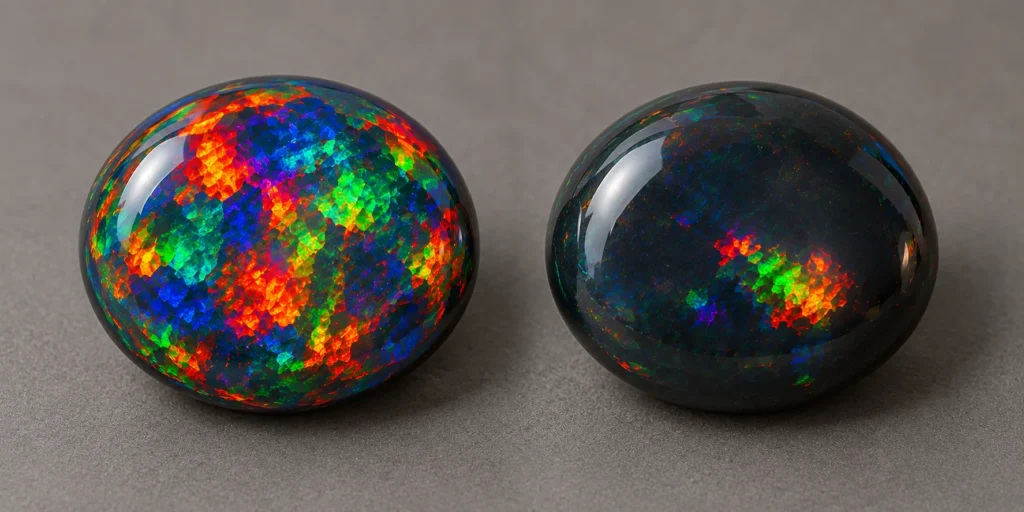
Imagine two black opals with similar body tones.
The first has vivid red, green, and blue covering most of its surface.
The second has a small bright patch surrounded by large areas where only the dark body is visible.
They may have similar weight, but they do not necessarily have similar value.
The amount of the stone displaying strong play-of-color matters because buyers are paying for the visual effect as well as the underlying material.
GIA’s evaluation process specifically considers the ratio of play-of-color to background color, as well as intensity, dominant hues, color range, and pattern.
This is why a smaller stone with exceptional color coverage can sometimes be more desirable than a larger stone with weak color.
7. Lightning Ridge Adds to the Story
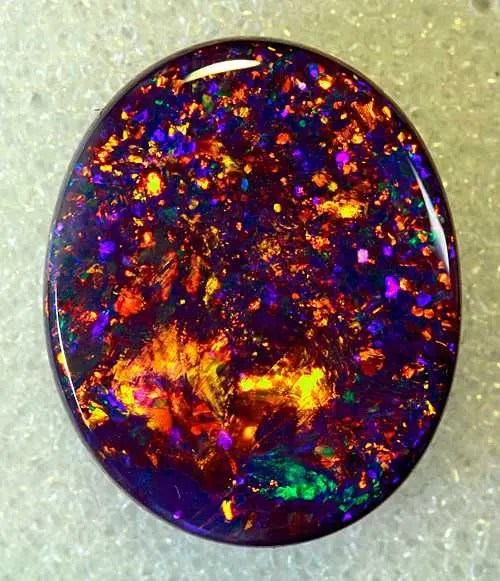
When people talk about premium black opal, Lightning Ridge in New South Wales, Australia, frequently enters the conversation.
The region is particularly associated with natural black opal, and material from Lightning Ridge has an established reputation in the opal market.
Origin does not guarantee quality, however.
A stone’s location alone cannot turn an ordinary specimen into a fine gemstone. Body tone, brightness, pattern, color, condition, and construction still need to be considered.
This is a useful principle when comparing different types of opal.
For example, Diamiv already covers the differences between Australian opal and Ethiopian opal, which can help readers understand why geographic origin and geological characteristics matter when comparing opals.
8. Exceptional Black Opal Is Difficult to Find

Mining precious opal is not like manufacturing a standardized gemstone.
A rough opal deposit can contain material with very different characteristics. A miner may encounter common opal, thin color bars, fractured material, or stones with little commercially desirable play-of-color.
The challenge is finding rough that contains enough high-quality material to produce a finished stone with strong visual appeal.
Then there is another challenge: cutting it.
A cutter must decide how to shape the rough without unnecessarily sacrificing the most attractive color.
GIA explains that exceptional opals may be cut into irregular shapes specifically to preserve and display as much play-of-color as possible.
That means some spectacular black opals are not perfectly symmetrical or standardized.
Their unusual shape can actually be part of the reason they are valuable.
9. Size Matters, But Carat Weight Is Not Everything
Carat weight matters for black opal, but it does not work exactly like a simple price-per-carat formula.
A larger stone with weak play-of-color is not automatically more valuable than a smaller stone with exceptional brightness and color.
Instead, quality generally needs to be considered first.
Once two stones have comparable quality, a larger stone can become significantly more desirable because large areas of exceptional color are harder to find.
This is one reason you should be cautious when comparing black opal prices solely by weight.
A 3-carat commercial stone and a 1-carat collector-quality stone can occupy completely different price categories.
The question is not simply:
“How many carats is it?”
A better question is:
“What quality of material is contained in those carats?”
10. Solid Black Opal Can Be Worth More Than a Doublet or Triplet
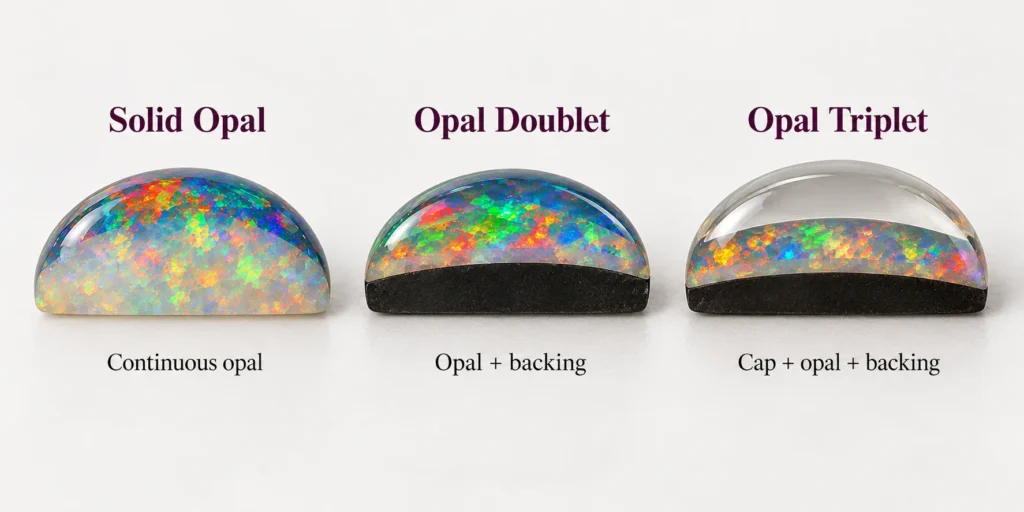
Construction is another important factor when evaluating an opal.
A solid opal is made from a continuous piece of natural opal material.
A doublet consists of a thin layer of opal attached to another material as a backing. A triplet adds another layer, typically with a transparent cap over the opal.
These assembled stones can still be attractive and useful in jewelry, but they should not automatically be compared with an equivalent-quality solid opal.
GIA notes that assembled opals are sold for only a fraction of the price of some solid opal material because they use a much thinner layer of precious opal.
This is particularly important when shopping online.
A photograph can make a doublet or triplet look very similar to a solid black opal. Buyers should therefore check how the stone is constructed before comparing prices.
11. Condition Can Affect Value
Black opal is beautiful, but opal is not among the hardest gemstones.
GIA gives opal a Mohs hardness of approximately 5 to 6.5, depending on the material.
The condition of an opal therefore matters.
Fractures, pits, surface damage, and crazing can reduce its desirability and practical usefulness in jewelry. GIA notes that excessive dryness, heat, bright light, or direct sunlight can contribute to crazing in some opals.
A beautiful stone with significant damage should not be valued the same way as a comparable stone in excellent condition.
This is another reason professional evaluation can be useful for particularly expensive specimens.
Why Are Some Black Opals So Much More Expensive Than Others?
The biggest misconception is that “black opal” represents one uniform price category.
It does not.
Consider two hypothetical stones:
Stone A
- Dark body
- Weak blue-green flashes
- Limited color coverage
- Several dead areas
- Average pattern
- Minor surface issues
Stone B
- Very dark body
- Extremely bright play-of-color
- Strong red, orange, green, and blue
- Broad color coverage
- Attractive pattern
- Excellent condition
- Solid construction
Both could reasonably be described as black opal.
But Stone B contains a much rarer combination of characteristics.
That is the fundamental reason prices can vary so dramatically.
The value is created by the combination, not by the word “black” alone.
Is Black Opal More Expensive Than White Opal?
Generally, fine black opal can command higher prices than comparable white or light opal because the dark body creates stronger contrast with the play-of-color and high-quality natural black opal is relatively scarce. GIA specifically identifies black opal as the rarest of the main opal types and notes the appeal of its dark background.
However, “black versus white” is still an oversimplification.
A spectacular white opal with exceptional brightness, pattern, and color can be more desirable than a mediocre black opal.
Quality comes first.
The body tone is one part of the evaluation rather than a guarantee of price.
How Much Can Black Opal Cost?
There is no single reliable price for black opal.
Current market guides show everything from lower-priced commercial stones to several thousand dollars per carat for fine material, with exceptional collector stones potentially reaching much higher prices.
Because opal varies so much from stone to stone, broad price ranges should be treated as general guidance rather than a valuation for a particular gem.
A seller’s asking price can also differ from an independently assessed market value.
For an expensive stone, the most useful approach is to evaluate:
- Body tone
- Brightness
- Color range
- Dominant color
- Color coverage
- Pattern
- Viewing angle
- Clarity and condition
- Cut
- Solid versus assembled construction
- Origin
- Overall visual appeal
What Should You Look For When Buying Black Opal?
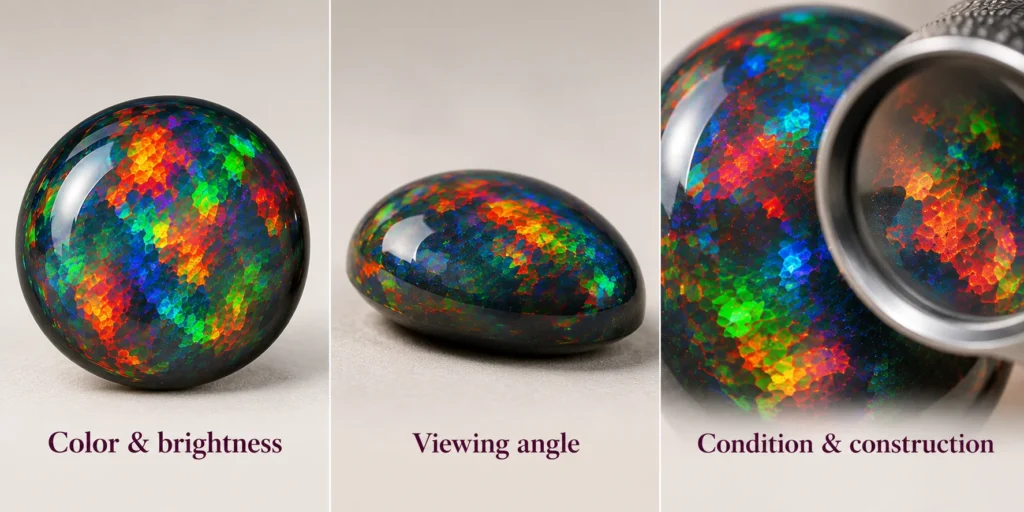
If you’re considering buying a black opal, don’t start with the price.
Start with the stone.
Look at the brightness
Strong color should be visible without needing extreme lighting.
Check the color coverage
Look at how much of the stone actually displays play-of-color.
Watch the stone from different angles
Some opals can look spectacular from one direction but much weaker from another. GIA notes that the most valuable opals can display play-of-color from multiple viewing angles.
Look for desirable colors
Strong red and orange can be particularly valuable, although bright green, blue, and multicolor stones can also be highly attractive.
Examine the pattern
Broad, organized patterns can be particularly desirable, especially when combined with high brightness.
Confirm the construction
Ask whether the stone is solid, a doublet, or a triplet.
Check for damage
Look carefully for cracks, crazing, pits, or other significant condition issues.
Consider the source
For expensive natural black opal, documentation about origin, treatment, and construction can be useful.
Black Opal’s High Price Comes From a Rare Combination
So, why is black opal so expensive?
It is not because every black opal is rare and valuable.
The highest prices come from stones that combine scarcity with exceptional visual quality.
The dark body provides a dramatic background. Bright play-of-color creates the characteristic flashes of light. Strong red, orange, green, and blue can add visual and market appeal. Desirable patterns and broad color coverage make the stone more distinctive. Large, high-quality material is difficult to find, while solid natural stones can be significantly more valuable than assembled alternatives.
And because every natural opal develops its own combination of colors and patterns, exceptional examples cannot simply be reproduced to a standard specification.
That individuality is ultimately a major part of the appeal.
For readers interested in exploring unusual gemstones more broadly, Diamiv’s guide to gemstones rarer than diamonds provides useful context on how rarity differs across the gemstone world.
Frequently Asked Questions
Why is black opal so expensive?
Black opal can be expensive because fine natural material is relatively scarce and exceptional stones combine a dark body tone with vivid play-of-color, desirable patterns, strong color coverage, and good condition. The best stones can command very high prices.
Is black opal the most expensive opal?
Fine black opal is generally considered the most valuable major opal type, but individual stone quality matters. An exceptional stone can be worth far more than an ordinary specimen of the same type.
Why is red so valuable in black opal?
Red is traditionally one of the most desirable play-of-color hues in opal and is less commonly produced strongly than some shorter-wavelength colors. Strong, widespread red can therefore contribute a substantial premium.
Is all black opal from Australia?
Australia, particularly Lightning Ridge, is strongly associated with natural black opal, but the term “black opal” describes the stone’s dark body color rather than guaranteeing a particular geographic origin.
Is a bigger black opal always worth more?
No. Carat weight is only one consideration. Brightness, color, pattern, coverage, body tone, condition, construction, and overall quality can matter much more than weight alone.
Is a black opal doublet valuable?
Black opal doublets can be attractive and have value, but they are constructed stones and generally should not be priced like comparable solid natural opal. Always confirm whether an opal is solid, a doublet, or a triplet before comparing prices.
Is black opal a good choice for an engagement ring?
Black opal can create a distinctive engagement ring, but its relatively moderate hardness means it requires more care than harder gemstones. If used in a ring, the setting and wearing habits should be considered carefully.