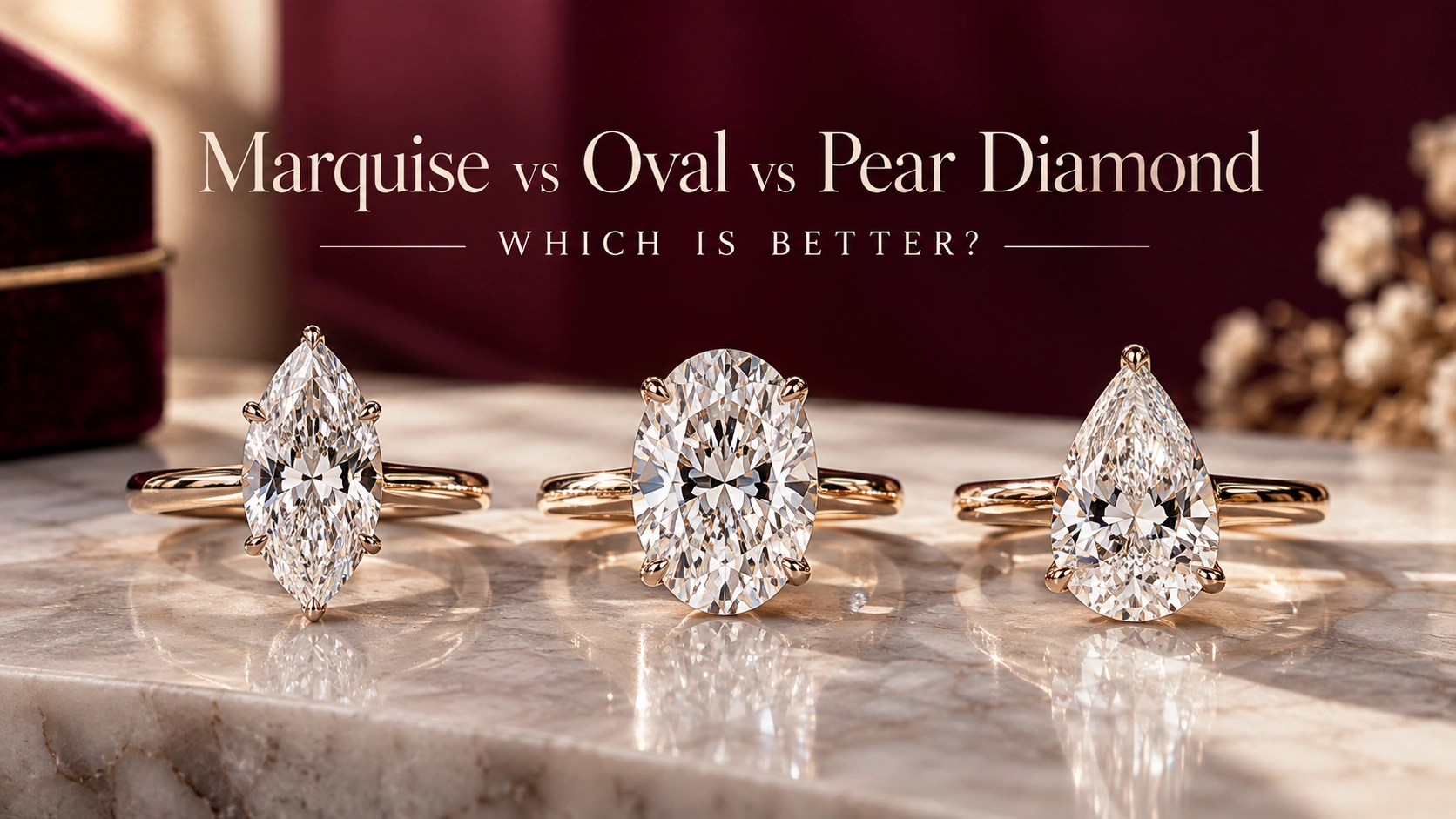
If you’re choosing between a marquise, oval, or pear diamond, the hardest part is that all three can look beautiful while creating very different impressions on the hand.
All three are elongated fancy-shaped diamonds with brilliant-style faceting, but their outlines, proportions, symmetry, point protection, and face-up appearance can vary considerably. GIA research also shows that oval, pear, and marquise diamonds can all display a bow-tie pattern, so choosing the right stone involves more than simply picking your favorite outline.
So which is best?
There isn’t one shape that is objectively best for everyone.
A marquise is particularly distinctive and creates strong visual length. An oval offers a softer outline and versatile appearance. A pear combines a rounded end with a pointed tip for a more individual silhouette.
The best choice depends on what you want your diamond to look like on your hand.
Marquise vs Oval vs Pear: Quick Comparison
| Feature | Marquise | Oval | Pear |
|---|---|---|---|
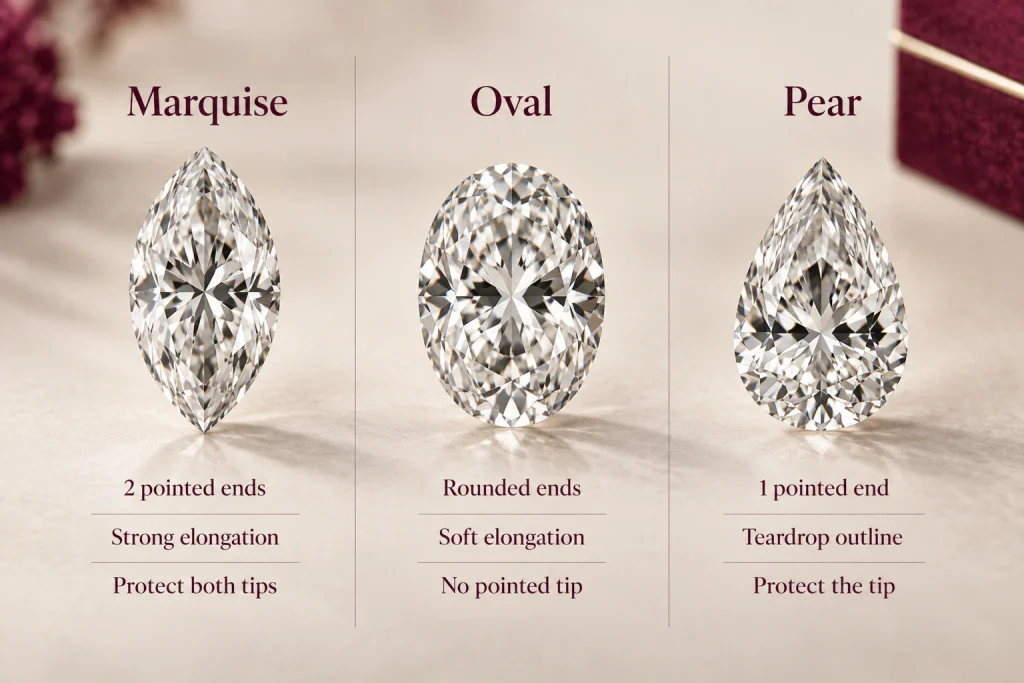
| Shape | Two pointed ends | Rounded elongated outline | One rounded end and one point |
| Overall look | Dramatic and elongated | Soft and classic | Elegant and distinctive |
| Finger elongation | Excellent | Excellent | Excellent |
| Visual spread | Often very strong | Strong | Strong |
| Symmetry | Very important | Important | Very important |
| Bow-tie potential | Yes | Yes | Yes |
| Point protection | Both ends | No pointed ends | One pointed end |
| Style flexibility | High | Very high | High |
| Best for | Bold, elongated looks | Versatility | Unique, graceful designs |
The biggest difference isn’t necessarily brilliance. It is how the outline changes the way the diamond looks on your hand.
What Makes Marquise, Oval, and Pear Diamonds Different?
The three shapes have overlapping characteristics, but their silhouettes are easy to distinguish.
Marquise diamond
A marquise has two pointed ends and a long, curved body.
Its pointed tips make the diamond look particularly elongated, while its symmetrical outline gives it a strong visual presence.
Because the tips are vulnerable areas, the setting deserves extra attention. GIA recommends protective approaches such as V-shaped prongs for marquise points.
Oval diamond
An oval diamond has a rounded outline without pointed corners.
It retains the elongated appearance of a marquise but has softer shoulders and ends. That makes it particularly adaptable to different engagement ring designs.
GIA describes the oval as combining the brilliance associated with round brilliant diamonds with an elongated silhouette that can visually lengthen the finger.
Pear diamond
A pear diamond combines a rounded end with a single pointed tip.
This creates the familiar teardrop silhouette. Depending on how it is set, the point can face toward the fingertip, toward the hand, or sit at an angle.
The pointed end needs protection because it can be more vulnerable to damage than the rounded portion of the stone.
Marquise Diamond: Best for a Dramatic, Elongated Look
The marquise is one of the most visually distinctive diamond shapes.
Its two pointed ends create a long silhouette that can make the diamond appear substantial when viewed from above.
That makes marquise especially appealing if you want:
- Strong finger elongation
- A distinctive silhouette
- A diamond with substantial visual spread
- A vintage-inspired appearance
- A less conventional alternative to an oval
Marquise diamonds are also highly dependent on symmetry. If the two sides do not mirror each other or the points do not align properly, the imbalance can be obvious.
GIA recommends paying close attention to symmetry when choosing a marquise and notes that marquise diamonds can show a bow-tie effect across the center.
If you’re considering a marquise, see the guide to marquise cut diamonds for a deeper look at proportions, clarity, color, and bow ties.
Marquise proportions
There isn’t one proportion that automatically makes a marquise beautiful.
GIA’s buying guidance gives a typical length-to-width range of about 1.75:1 to 2.25:1, but the right appearance ultimately depends on the outline and the individual diamond.
A longer marquise can create a very dramatic appearance, while a shorter one can look broader and less narrow.
Oval Diamond: Best for Versatility and a Softer Look
Oval diamonds are often the natural choice for shoppers who like the elongated appearance of a marquise but prefer rounded ends.
The shape is softer, symmetrical, and adaptable to a wide variety of ring styles.
An oval may suit you if you want:
- An elongated diamond without pointed ends
- A classic appearance with some personality
- A versatile center stone
- Strong brilliance
- A shape that works across modern and traditional settings
GIA notes that oval diamonds can visually lengthen the finger and create an impression of greater size because of their elongated outline.
If you’re deciding whether an oval is right for you, the oval cut diamond guide is a useful next step.
Oval proportions
Current GIA guidance places many oval diamonds around a 1.3:1 to 1.4:1 length-to-width ratio, while also emphasizing the importance of the stone’s actual outline and appearance.
Two ovals with the same ratio can still look noticeably different.
One might have fuller shoulders and a broader appearance, while another may have a narrower, more elongated outline.
That is why the ratio should be treated as a starting point rather than a complete buying rule.
Pear Diamond: Best for a Distinctive Teardrop Shape
Pear diamonds sit somewhere between the softness of an oval and the pointed character of a marquise.
The rounded end gives the shape a softer appearance, while the pointed tip creates visual direction.
A pear may appeal to you if you want:
- A distinctive engagement ring
- An elongated appearance
- A teardrop silhouette
- A diamond that can be worn in different orientations
- A balance between traditional and unusual styling
GIA describes pear diamonds as combining characteristics of rounded and pointed shapes, while emphasizing symmetry, table placement, bow-tie appearance, and protection of the point.
You can learn more about the shape in the pear cut diamond guide.
Marquise vs Oval: What’s the Difference?
The marquise and oval are probably the closest visual comparison of the three.
Both are elongated, but their personalities are very different.
Shape
A marquise has two points.
An oval has two rounded ends.
That small difference dramatically changes the appearance of the stone.
The marquise tends to look sharper and more dramatic, while the oval looks softer and more conventional.
Finger elongation
Both can make the finger appear longer.
The marquise’s pointed ends create a particularly strong directional effect, while the oval achieves elongation through its continuous curved outline.
If maximum visual length is your priority, compare actual face-up dimensions rather than relying only on the shape name.
Durability
An oval has no pointed tips, so it doesn’t present the same point-protection concern as a marquise.
A marquise has two vulnerable points.
If you choose a marquise, protective prongs become particularly important. GIA specifically recommends examining the points and considering V-shaped prongs.
For setting ideas, compare the best settings for marquise diamonds with the best settings for oval diamonds.
Oval vs Pear: Which Should You Choose?
Oval and pear diamonds can both provide an elongated appearance, but they create different visual personalities.
An oval is symmetrical from end to end.
A pear deliberately isn’t.
The pear’s pointed tip gives the eye a direction to follow, which makes it feel more dramatic than an oval.
The oval is generally easier to incorporate into a wide range of ring designs because there is no orientation to consider.
The pear, on the other hand, gives you another styling decision: which way should the point face?
GIA notes that pear diamonds can be worn point-up, point-down, or at an angle.
If you’re comparing the two specifically for the ring setting, see the guides to the best settings for oval diamonds and the best settings for pear diamonds.
Marquise vs Pear: Which Looks More Dramatic?
Both shapes have pointed ends, but only the marquise has two.
A marquise therefore creates a more symmetrical and directional appearance.
A pear is softer because one end remains rounded.
Choose marquise if you prefer:
- Symmetry
- Two pointed ends
- A longer, more dramatic outline
- Strong vintage influence
- Maximum visual direction
Choose pear if you prefer:
- A rounded-to-pointed transition
- An asymmetrical silhouette
- A softer alternative to marquise
- A distinctive teardrop appearance
Neither is inherently better.
The choice comes down to whether you prefer symmetry and two points or contrast between a rounded end and one point.
Which Diamond Shape Looks Biggest?
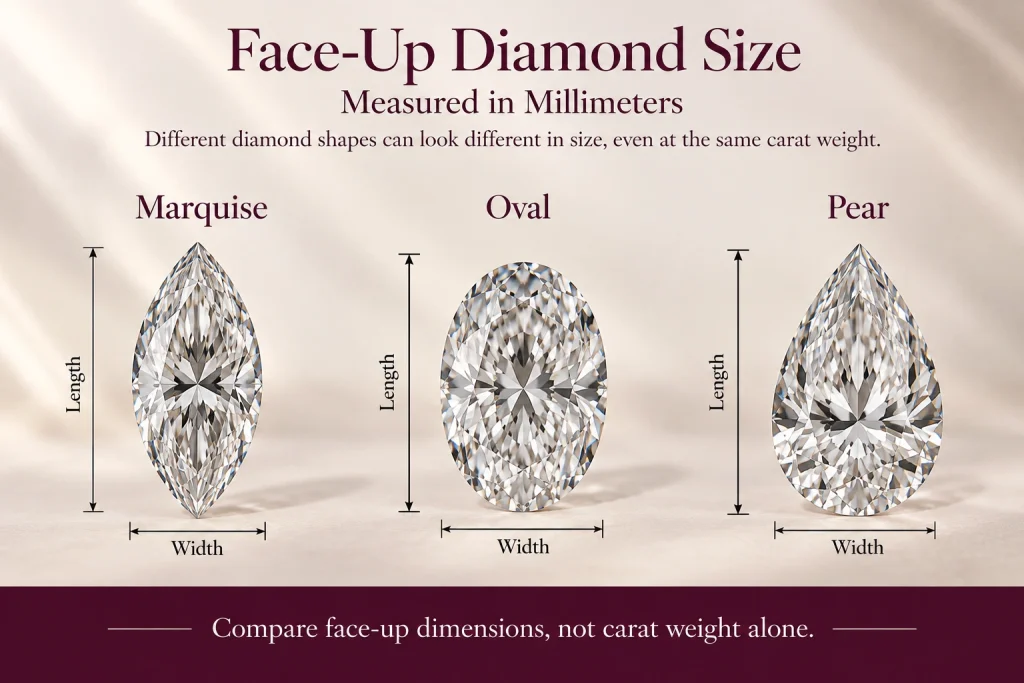
This is one of the most common reasons shoppers compare these three shapes.
But carat weight doesn’t tell you exactly how large a diamond will look from above.
A diamond’s face-up dimensions are influenced by its proportions and how its weight is distributed.
Marquise diamonds can create particularly strong visual spread because much of the outline extends across a long surface.
Ovals can also look large for their carat weight because of their elongated shape.
Pears can create substantial finger coverage, although their pointed tip can make the visual impression different from an oval of similar dimensions.
Instead of asking only:
“Which shape looks biggest?”
compare:
- Length in millimeters
- Width in millimeters
- Length-to-width ratio
- Total depth
- Face-up outline
- Actual carat weight
Diamiv’s guide on why a diamond can look bigger than its carat weight can help explain why two diamonds with the same carat weight may not look the same size.
Which Shape Makes Fingers Look Longer?
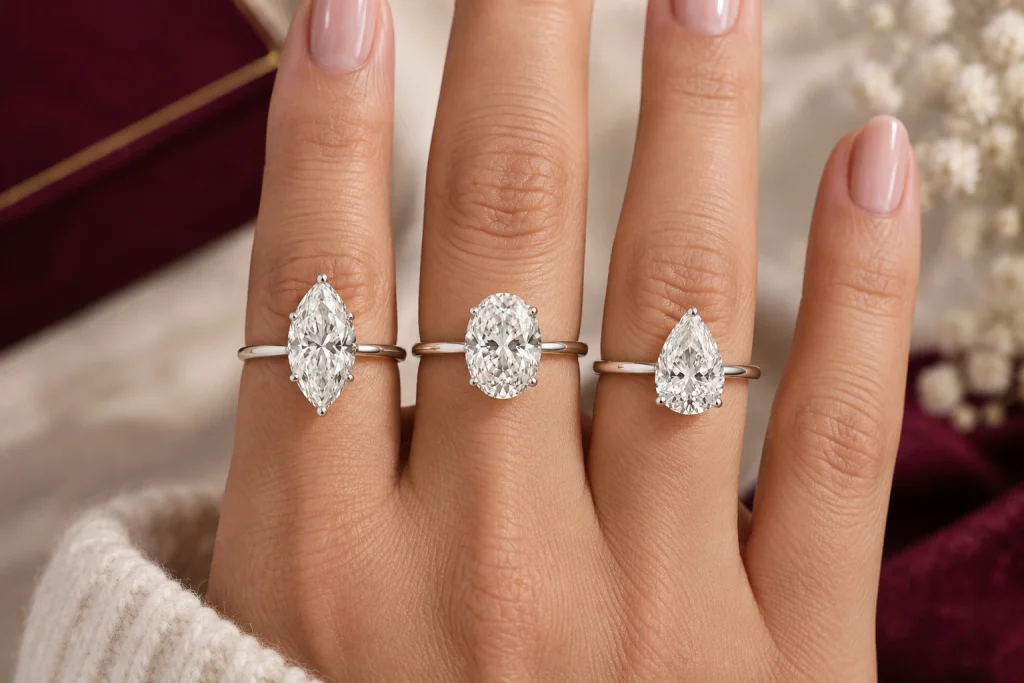
All three can create an elongating effect.
The difference is in how they achieve it.
Marquise
The two pointed ends create the strongest directional appearance.
Oval
The continuous elongated curve creates a softer lengthening effect.
Pear
The combination of the rounded end and pointed tip creates visual length with more asymmetry.
If finger elongation is important to you, don’t choose based solely on the shape label. Compare the actual dimensions and look at the diamond on a hand whenever possible.
Which Diamond Shape Sparkles the Most?
There isn’t a reliable universal winner between marquise, oval, and pear.
All three can be brilliant-style cuts, and the quality of the individual diamond matters enormously.
GIA’s research into these three shapes found that their visual appearance can include bow ties, different facet patterns, and areas often described in the trade as “crushed ice.” These patterns vary according to the diamond’s proportions and faceting arrangement.
That means a beautiful oval isn’t automatically going to outperform every marquise or pear.
When comparing stones, look for:
- Strong overall brightness
- Attractive contrast
- Good facet definition
- Minimal distracting darkness
- Good symmetry
- A lively appearance when the stone moves
Understanding the Bow-Tie Effect
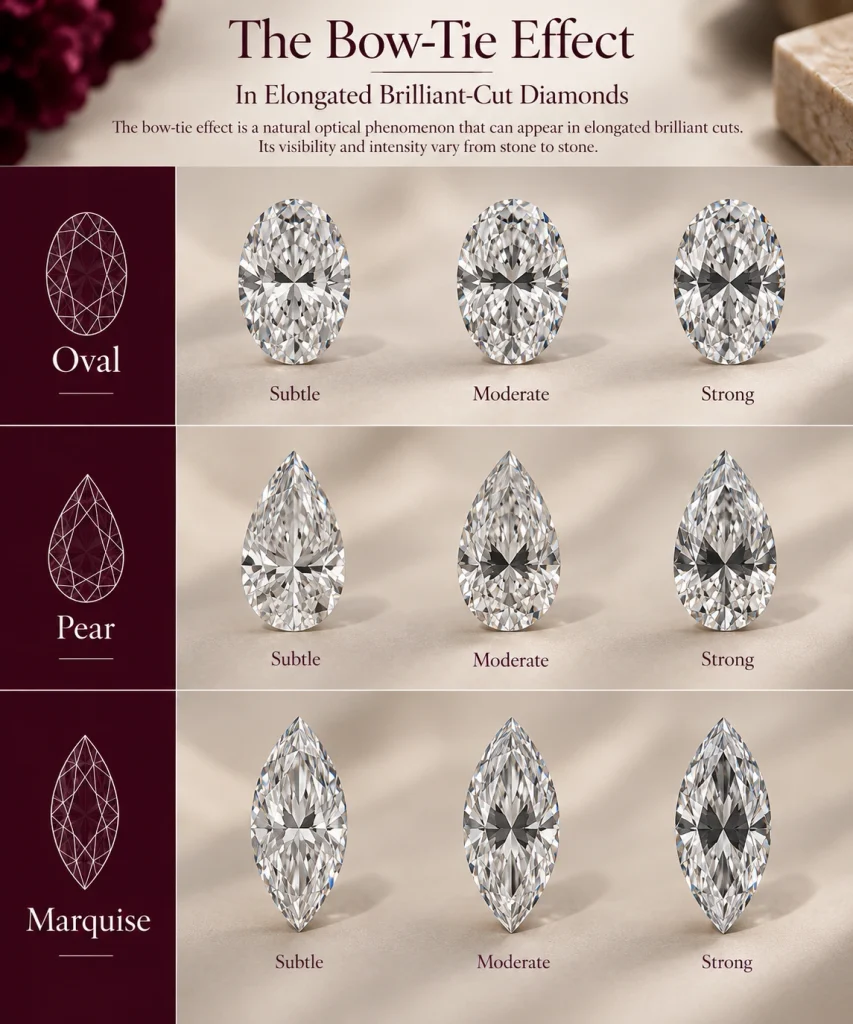
The bow tie is one of the most important things to understand before buying any of these three shapes.
A bow tie is a darker pattern that can appear across the center of an elongated brilliant diamond.
It can occur in:
- Oval diamonds
- Marquise diamonds
- Pear diamonds
GIA’s research found that bow-tie patterns are common across all three shapes and can range from subtle to more pronounced.
A bow tie isn’t automatically a defect.
The question is whether it is distracting.
GIA advises buyers to examine the diamond face-up under normal viewing conditions rather than judging it only from a grading report.
For a pear diamond specifically, GIA recommends examining the stone from different angles and lighting conditions because a noticeable bow tie can affect its face-up appearance.
How to check a bow tie
Before buying, look at:
- A face-up photograph
- A rotating video
- The stone under normal room lighting
- The diamond from several viewing angles
- The center of the stone while it is moving
Don’t judge an elongated diamond from one highly controlled photograph.
Durability: Marquise vs Oval vs Pear
Durability is another meaningful difference.
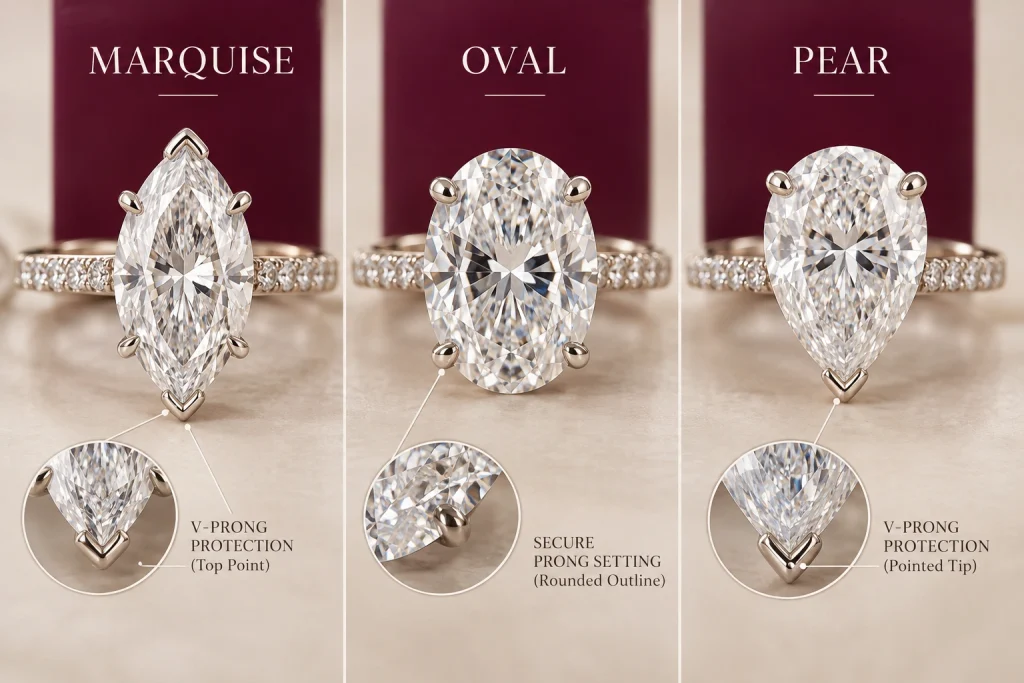
Oval
An oval has no pointed corners, which removes the specific vulnerability associated with pointed tips.
Pear
A pear has one pointed tip that needs protection.
Marquise
A marquise has two pointed tips, so both ends need protection.
Secure prongs are especially important for the pointed shapes. GIA recommends protective settings for marquise and pear points.
This doesn’t mean marquise or pear diamonds are unsuitable for everyday engagement rings.
It simply means the setting should be designed with the shape in mind.
Which Setting Works Best With Each Shape?
Your setting can significantly change the final appearance.
Marquise
Marquise diamonds can work especially well with:
- Solitaire settings
- Halo settings
- Hidden halos
- Three-stone designs
- East-west settings
- Vintage-inspired settings
Because of the pointed tips, protective prongs are particularly important.
See the best settings for marquise diamonds for more ideas.
Oval
Oval diamonds are highly adaptable and can work with:
- Solitaire settings
- Halo settings
- Hidden halos
- Three-stone rings
- Vintage designs
- Modern minimalist settings
Their rounded outline makes them especially easy to incorporate into different ring styles.
Pear
Pear diamonds can work beautifully with:
- Solitaire settings
- Halo settings
- Hidden halos
- Three-stone rings
- Modern designs
- Vintage-inspired rings
The orientation of the pear is another design choice.
For additional ideas, see the best settings for pear diamonds.
Which Shape Is Best for Your Priorities?
Instead of looking for one overall winner, start with what matters most to you.
If visual size is your priority
Consider a marquise, but compare actual millimeter dimensions rather than assuming every marquise will look larger.
If versatility is your priority
An oval is an easy shape to work with because its rounded outline suits a wide variety of ring styles.
If uniqueness is your priority
A pear offers a distinctive silhouette without the sharp appearance of a two-pointed marquise.
If you want maximum finger elongation
All three can work, but a marquise creates a particularly strong elongated effect.
If you dislike pointed tips
An oval avoids the point-protection issue associated with marquise and pear shapes.
If you want a symmetrical design
A marquise or oval may be more appealing because both have a symmetrical outline.
If you want something less conventional
A pear or marquise can provide more visual individuality than an oval.
What to Check Before Buying
Shape should be your starting point, not your only decision.
Before buying an elongated diamond, check the following.
1. Face-up appearance
Look at the actual diamond rather than relying only on its proportions on paper.
2. Symmetry
This is especially important for marquise and pear diamonds.
An uneven outline can be immediately noticeable.
3. Bow tie
Check how dark the center becomes under different lighting conditions.
4. Length-to-width ratio
Use the ratio to understand the general outline, but don’t treat one number as a guarantee of beauty.
5. Face-up measurements
Compare length and width in millimeters.
6. Point protection
If you choose a marquise or pear, make sure the setting protects the point or points.
7. Clarity around vulnerable areas
Pay particular attention to inclusions near pointed tips because these areas receive more attention during wear.
8. Movement
Watch the diamond in motion.
Some facet patterns that appear dark in one position can brighten as the diamond moves.
Frequently Asked Questions
Is a marquise diamond better than an oval?
Not universally. A marquise may be a better fit if you want a dramatic, highly elongated shape, while an oval may suit someone who prefers rounded edges and greater stylistic versatility.
Is an oval better than a pear diamond?
Neither is automatically better. An oval has a symmetrical rounded outline, while a pear offers a more distinctive teardrop silhouette and a pointed tip.
Which looks bigger, marquise or oval?
A marquise can have a particularly large face-up appearance for its carat weight, but the actual size depends on the diamond’s measurements and proportions. Compare millimeter dimensions rather than relying only on carat weight.
Which has the least noticeable bow tie?
There is no shape that guarantees a minimal bow tie. Oval, pear, and marquise diamonds can all display bow ties, and their intensity varies between individual stones.
Is a pear diamond durable enough for everyday wear?
Yes, a pear can be used for an engagement ring, but its pointed tip should be properly protected by the setting.
Which diamond shape makes fingers look slimmer?
All three elongated shapes can create a lengthening effect. Marquise tends to create a particularly strong directional effect, while oval and pear provide softer alternatives.
What is the most versatile of the three?
An oval is often the easiest to incorporate into different engagement ring styles because it has a symmetrical, rounded outline and no pointed tip.
Final Verdict: Marquise vs Oval vs Pear
The best choice depends on the look you want rather than a universal ranking.
Choose marquise if you want a dramatic, elongated silhouette with strong visual presence.
Choose oval if you want a softer, symmetrical shape that works easily across many engagement ring styles.
Choose pear if you want a distinctive teardrop design that combines a rounded end with a pointed tip.
Whichever shape you choose, don’t stop at the outline.
Compare the individual diamonds for symmetry, face-up appearance, proportions, bow-tie visibility, light performance, and setting protection. GIA’s research makes clear that oval, pear, and marquise diamonds can show substantially different visual patterns even within the same general shape.
The right diamond is ultimately the one whose actual appearance matches what you want to see on your hand every day.