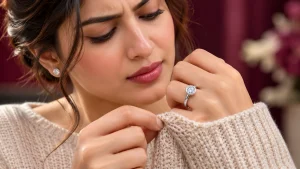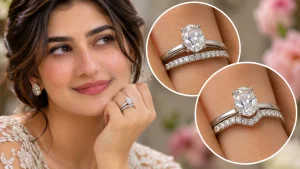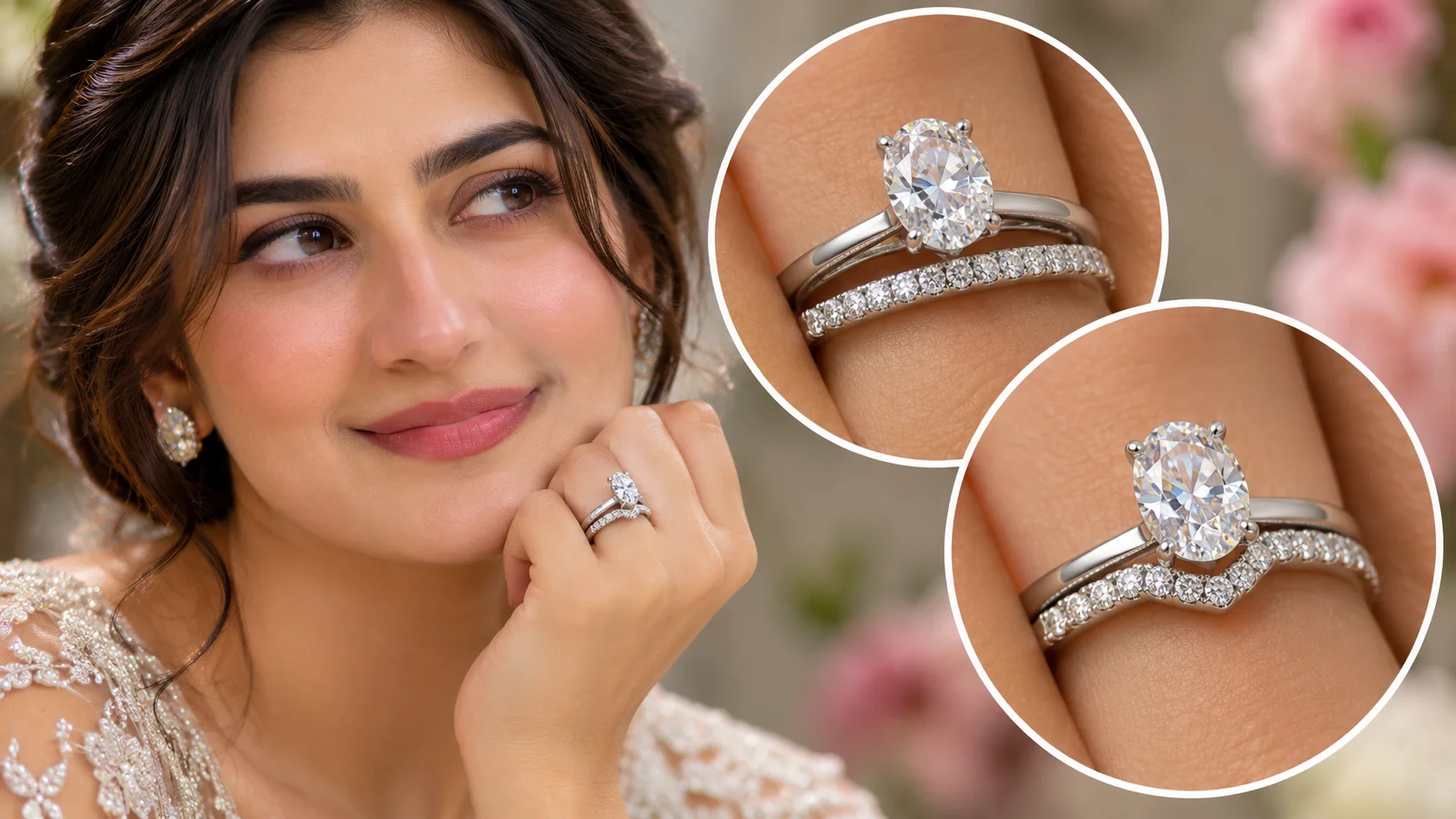
If your wedding band doesn’t sit properly against your engagement ring, don’t immediately replace either ring. The problem may be the engagement ring’s setting, rather than the wedding band’s design.
A curved or contoured wedding band is often a good solution when a straight band hits the center setting and leaves a gap. However, a notched band, open wedding band, spacer ring, or custom-fit design may work better depending on your ring’s shape.
Before buying, check your engagement ring’s side profile, setting height, center-stone position, and the areas where the two rings touch. The goal is to find a wedding band that fits comfortably, complements your engagement ring, and looks good when worn on its own.
Why Doesn’t My Wedding Band Fit Against My Engagement Ring?
A wedding band may not fit properly because the engagement ring’s setting occupies the space where the second ring needs to sit.
This is particularly common with low-profile settings, wide halos, decorative galleries, and rings with prominent side stones.
Here are the most common reasons.
1. Your Engagement Ring Has a Low-Profile Setting
A low-profile engagement ring places its center stone closer to your finger.
This design can feel less elevated during everyday wear. However, the lower setting may leave insufficient space for a straight wedding band.
When the wedding band reaches the bottom of the setting, it cannot move any closer.
What should you buy?
Consider a curved or contoured wedding band that follows the outline of the engagement ring.
2. Your Engagement Ring Has a Halo Setting
A halo engagement ring features smaller accent diamonds or gemstones surrounding the center stone.
Depending on its construction, the halo can extend outward and occupy the space needed by a straight wedding band.
A curved or notched band may provide additional clearance.
However, not every halo engagement ring requires a curved wedding band. The actual setting dimensions determine compatibility.
3. Your Engagement Ring Has a Large Basket
The basket is the metal framework that holds the center gemstone.
Some baskets extend toward the sides of the engagement ring. This can prevent a straight wedding band from sitting closely beside the engagement ring.
A contoured or custom-fit wedding band can follow the basket’s shape.
4. Your Engagement Ring Has Side Stones
Three-stone engagement rings and other elaborate designs may have diamonds extending toward the sides.
These stones and their settings can interfere with a traditional straight wedding band.
A V-shaped, curved, or custom-designed wedding band may provide a better fit.
5. Your Engagement Ring Has a Decorative Gallery
The gallery is the supporting structure underneath the center stone.
Some engagement rings feature intricate galleries, bridges, or decorative metalwork.
These details can prevent a second band from sitting flush.
A jeweler should inspect the underside of the engagement ring before recommending a replacement wedding band.
Which Wedding Band Should You Buy? 6 Options Compared
If your existing wedding band doesn’t fit, you have several alternatives.
The right option depends on the obstruction, your preferred appearance, and whether you plan to wear the wedding band independently.
1. Curved Wedding Band
Best for: Engagement rings with a low or wide center setting.
A curved wedding band has a shaped outline that creates additional space around the engagement ring’s setting.
Instead of following a completely straight path, the band bends around the area occupied by the center stone or its supporting structure.
This can create a closer-looking fit without changing your original engagement ring.
Advantages:
- Can accommodate certain low-profile settings.
- Creates a closer-fitting ring combination.
- Available in plain metal and diamond-accented designs.
- Works with some unusual engagement ring shapes.
Disadvantages:
- The curve must match your engagement ring.
- Some designs look unusual when worn alone.
- A generic curve may not provide the clearance you need.
A curved band is a strong starting point if you want the two rings to sit closer together.
2. Contour Wedding Band
Best for: Engagement rings with unusual or distinctive settings.
A contour wedding band is shaped to follow the specific outline of an engagement ring.
It can be designed around a halo, center setting, side stones, or decorative gallery.
Although people sometimes use curved and contour interchangeably, a contour band is generally more specifically fitted to an engagement ring’s profile.
Advantages:
- Can provide a more precise fit.
- Works with distinctive engagement ring designs.
- Can create a coordinated bridal set.
- Can be made with plain metal or diamond accents.
Disadvantages:
- May require custom measurements.
- Can be less versatile when worn alone.
- A deep contour may limit future stacking options.
If your engagement ring has an unusual shape, a contour wedding band is worth considering before purchasing another standard band.
3. Notched Wedding Band
Best for: Engagement rings with a wide center setting or protruding basket.
A notched wedding band has a small cut-out along its front edge.
The notch creates space for the engagement ring’s setting while allowing most of the band to retain a straight appearance.
This design can be useful when you want a relatively traditional wedding band but need extra room around the center setting.
Advantages:
- Maintains much of a straight band’s appearance.
- Can accommodate certain wide settings.
- Can look relatively simple when worn alone.
- Offers an alternative to a deep curved band.
Disadvantages:
- The notch must align correctly.
- It may not accommodate every setting.
- A poorly matched notch can still leave a gap.
Ask your jeweler to compare the notch dimensions with your actual engagement ring before ordering.
4. Open Wedding Band
Best for: Engagement rings that need space around the center setting.
An open wedding band has a deliberate opening rather than a completely closed front outline.
The opening can sit around or beside the engagement ring’s center setting, depending on the design.
Open bands are available in minimalist, diamond-accented, and more decorative styles.
Advantages:
- Provides room around certain center settings.
- Offers distinctive styling.
- Can work with unconventional ring shapes.
- Allows more creative combinations.
Disadvantages:
- The open design may not suit traditional preferences.
- Positioning matters when wearing the rings together.
- The ends need to be finished and positioned safely.
Choose an open band when you want flexibility around the setting and enjoy a more unconventional appearance.
5. Spacer Wedding Band
Best for: People who want separation between two rings.
A spacer band is a thin ring worn between the engagement ring and wedding band.
It creates intentional separation and can help reduce direct contact between certain surfaces.
This is different from a contour band, which attempts to follow the engagement ring’s outline.
A spacer does not automatically solve a setting obstruction. Its suitability depends on the geometry of all three rings.
Advantages:
- Creates a layered appearance.
- Can provide separation between adjacent rings.
- Offers another way to style a bridal set.
- Available in simple metal and decorative designs.
Disadvantages:
- Adds another ring to the stack.
- May make the combination feel wider.
- Does not necessarily create a flush fit.
- Requires checking the combined fit on your finger.
A spacer is worth discussing with a jeweler if you like the idea of keeping some distance between your rings.
6. Custom-Fit Wedding Band
Best for: Expensive, heirloom, or unusually shaped engagement rings.
If standard wedding bands don’t fit your engagement ring, a custom design may be the most practical solution.
A jeweler can examine your existing ring and create a wedding band around its actual dimensions.
The design can accommodate the center setting, side stones, halo, gallery, and other structural details.
Advantages:
- Designed around your existing engagement ring.
- Can accommodate unusual shapes.
- Offers more control over width and appearance.
- Can create a coordinated bridal set.
Disadvantages:
- Usually requires more design work.
- May cost more than a standard band.
- Production takes additional time.
- Requires careful measurements and approval.
A custom wedding band makes particular sense when you love your engagement ring and don’t want to compromise its original design.
Which Wedding Band Fits Your Engagement Ring Best?
Different engagement ring settings create different compatibility challenges.
Use this table as a starting point when deciding which band to try.
| Engagement ring problem | Wedding band to consider | Why |
|---|---|---|
| Low-profile setting | Curved or contour | Creates clearance around the setting |
| Wide halo | Notched or contour | Accommodates the wider center structure |
| Large basket | Contour or custom-fit | Follows the basket’s outline |
| Three-stone setting | Custom or curved | Can accommodate prominent side stones |
| Pear-shaped center | V-shaped or contour | Can complement the pointed silhouette |
| Marquise center | V-shaped or custom contour | Can follow the elongated outline |
| Decorative gallery | Custom-fit | Accounts for unusual underside details |
| Small intentional gap | Straight or spacer | Preserves the separated appearance |
These are starting recommendations, not guaranteed matches. The actual construction of your engagement ring determines what will fit.
Curved vs. Straight vs. Custom Wedding Band: Which Is Better?
If you’re deciding between a standard straight band, a curved band, and a custom design, consider their practical differences.
| Feature | Straight | Curved | Custom-fit |
|---|---|---|---|
| Shape | Continuous circle | Shaped outline | Made for your ring |
| Gap reduction | Depends on clearance | Can reduce gaps | Designed around the obstruction |
| Worn alone | Usually versatile | Depends on curve | Depends on design |
| Customization | Limited for standard styles | Available | Extensive |
| Cost | Depends on design | Depends on design | Requires a custom quote |
| Best for | Compatible settings | Low or wide settings | Unusual engagement rings |
My recommendation:
- Choose straight if your engagement ring has enough clearance and you want versatility.
- Choose curved if the setting blocks a straight band.
- Choose contour if you need the band to follow a distinctive ring profile.
- Choose notched or open if the center setting needs a specific opening.
- Choose custom-fit if standard designs cannot accommodate your engagement ring.
For a closer comparison, read Curved vs Straight Wedding Band: Which One Should You Choose?.
What Wedding Band Should You Buy for Different Engagement Ring Shapes?
The center diamond shape can influence the appearance of your bridal set, but the setting’s construction determines physical compatibility.
Here are some combinations worth exploring.
Oval Engagement Ring
Oval diamonds have an elongated outline that can create a distinctive bridal stack.
A straight band can work when the center setting provides enough clearance.
If the basket or side details extend outward, a curved band may create a closer fit.
Explore wedding bands for oval engagement rings for more pairing ideas.
Pear Engagement Ring
Pear-shaped diamonds have a pointed end and a rounded opposite end.
A V-shaped wedding band can complement the pointed silhouette, while a curved band may work around the setting.
The correct choice depends on the direction of the pear and how the center stone is mounted.
See wedding bands for pear engagement rings for additional inspiration.
Marquise Engagement Ring
Marquise diamonds have two pointed ends and an elongated outline.
A curved or V-shaped wedding band can complement the stone’s directional appearance.
However, check the setting before assuming a shaped band is necessary.
Emerald-Cut Engagement Ring
Emerald-cut engagement rings often have a geometric appearance.
A straight band can create a clean, balanced combination when there is sufficient clearance.
If the setting is wide or has prominent side details, consider a custom or curved design.
Explore wedding bands for emerald-cut engagement rings.
Three-Stone Engagement Ring
Three-stone engagement rings can have wider settings than simple solitaire designs.
A custom-fit band may provide the most control when the side stones interfere with a traditional wedding band.
A jeweler can measure the available space and suggest an appropriate profile.
How to Check Whether a Wedding Band Fits Before Buying
A product photograph cannot reliably show how two rings will fit together.
You should test the actual wedding band against your engagement ring before placing an order.
Follow these steps.
Step 1: Turn Your Engagement Ring Sideways
Look at the ring from the side rather than judging it from the top.
Check the basket, gallery, bridge, and any decorative details underneath the center stone.
These parts can interfere with a straight wedding band.
Step 2: Identify Where the Rings Touch
Place a potential wedding band beside your engagement ring.
Notice where the two rings meet.
Does the wedding band touch the basket? Does it hit the halo? Does it collide with the side stones?
Identifying the exact obstruction helps determine which band design you need.
Step 3: Compare Different Band Profiles
Try a straight band, a curved band, and a notched or contoured design if available.
Don’t assume that every curved band will fit simply because it has a curved shape.
The curve needs to match your engagement ring’s actual profile.
Step 4: Check the Fit From Multiple Angles
Examine the rings from the top, side, and underside.
Check whether the wedding band sits naturally and whether the rings create uncomfortable pressure.
Also check whether the engagement ring tilts or moves when both bands are worn together.
Step 5: Check for Unwanted Contact
A close fit is not automatically a safe fit.
Repeated rubbing between rings can wear metal or affect vulnerable setting components.
The GIA’s ring-stacking guide discusses potential wear from stacked jewelry and the importance of considering metal combinations.
If diamonds, prongs, or exposed metal components are rubbing against each other, ask a qualified jeweler to inspect the combination.
Step 6: Wear Both Rings Together Before Ordering
The two rings should feel comfortable when worn together.
Check that the combined width does not make your finger feel restricted.
If the wedding band is significantly wider than your engagement ring, the combination may feel different from wearing either ring separately.
For additional sizing guidance, see the wedding ring size guide.
How Much Does a Custom Wedding Band Cost?
The price of a custom wedding band depends on its design and materials.
A simple shaped gold band will generally involve different costs from a diamond-set band with detailed metalwork.
Important pricing factors include:
- Metal: Gold and platinum have different material costs.
- Band width: A wider design may require more metal.
- Diamonds: Stone size, quality, quantity, and setting method affect the price.
- Design complexity: Intricate contours and unusual shapes require additional work.
- Customization: Design consultations, measurements, and revisions may affect the final quote.
There is no reliable universal price for a custom-fit wedding band.
Request an itemized quote before approving the design. Ask whether the quote includes the metal, stones, setting, resizing, and any future adjustments.
How Long Does It Take to Get a Custom Wedding Band?
A standard wedding band may be available for immediate purchase, while a custom design requires additional time.
The process generally involves:
- Examining and measuring your engagement ring.
- Discussing the desired wedding band design.
- Preparing a design or model for approval.
- Manufacturing the band.
- Checking the final fit against the engagement ring.
Production time varies by jeweler, design complexity, material availability, and revisions.
If your wedding date is approaching, discuss the deadline before placing an order. Ask the jeweler for a written delivery estimate.
Common Mistakes to Avoid When Buying a Wedding Band
Choosing a wedding band based only on its appearance can lead to compatibility problems.
Avoid these mistakes:
- Buying without testing the fit: A band may look perfect online but collide with your engagement ring’s setting.
- Assuming every curved band fits: Curves have different depths and shapes.
- Ignoring the side profile: The underside of the engagement ring often determines compatibility.
- Choosing a band that is too wide: The combined ring stack may feel uncomfortable.
- Ignoring metal contact: Repeated rubbing can cause unnecessary wear.
- Forgetting standalone appearance: A deeply contoured band may look different when worn alone.
- Ordering a custom band without checking the design: Review the measurements and final design before production.
A little planning can prevent an expensive mismatch.
Frequently Asked Questions
What should I do if my wedding band doesn’t fit against my engagement ring?
First, identify what prevents the two rings from sitting together. If the engagement ring has a low basket, wide halo, or decorative gallery, consider a curved, contoured, notched, or custom-fit wedding band.
Is a curved wedding band better than a straight wedding band?
Neither is universally better. A straight band offers a more versatile appearance, while a curved band can provide additional clearance around certain engagement ring settings.
Can I wear a straight wedding band if my engagement ring has a gap?
Yes. A visible gap is not automatically a problem. If the rings feel comfortable and do not create damaging contact, you can keep the straight band and embrace the separated appearance.
What is the difference between a curved and contoured wedding band?
A curved wedding band has a shaped outline that creates additional space around an engagement ring. A contoured band is generally designed more specifically to follow the profile of an existing engagement ring.
Will a notched wedding band fit every engagement ring?
No. A notch only works when its dimensions and position match the area that needs clearance. Your jeweler should compare the actual rings before recommending one.
Can a jeweler make a wedding band to fit my existing engagement ring?
Yes. A jeweler can measure your engagement ring and design a custom wedding band around its profile. This can be especially useful for heirloom rings, unusual settings, and elaborate center-stone arrangements.
Should my wedding band touch my engagement ring?
Not necessarily. Some people prefer a flush appearance, while others like a small gap. The important consideration is whether the rings rub against vulnerable settings or create discomfort.
Can wearing two rings together cause damage?
It can. Repeated contact may cause scratches, metal wear, or damage to vulnerable components. A jeweler can inspect the contact points and recommend an appropriate combination.
Should I replace my engagement ring if my wedding band doesn’t fit?
Usually, no. A compatible wedding band can often be designed around an existing engagement ring. Consider changing the engagement ring only after discussing the available alternatives with a qualified jeweler.
Can I wear a spacer between my engagement ring and wedding band?
Yes. A spacer creates separation between the rings. However, it adds another band and does not automatically solve every fit problem. Check the combined stack for comfort and compatibility.
Final Words
If your wedding band doesn’t fit against your engagement ring, the best replacement depends on the reason for the mismatch.
A curved or contoured band is a good starting point for low-profile and wide settings. A notched or open band can accommodate specific obstructions. A custom-fit wedding band offers more control when your engagement ring has an unusual shape.
However, don’t feel pressured to eliminate every visible gap.
A straight wedding band can still be a beautiful choice if you like the appearance and the rings are comfortable together.
The smartest buying decision is to choose a wedding band that fits your actual engagement ring, protects its setting from unnecessary contact, and looks the way you want when worn every day.