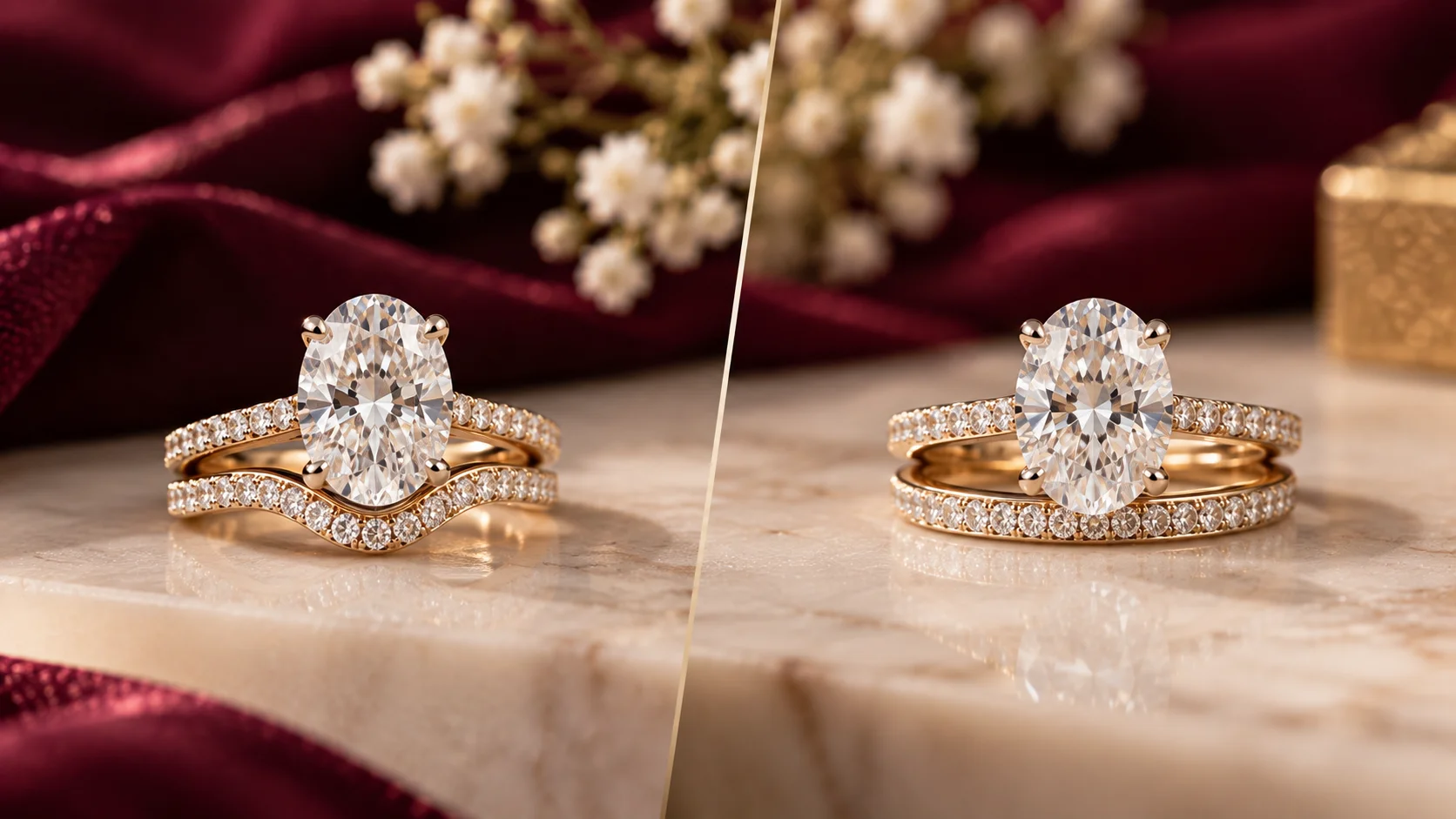
Choosing between a curved and straight wedding band is less about picking the “better” style and more about finding a band that works with your engagement ring.
A straight wedding band has a continuous, circular shape and can be worn on its own or paired with many engagement rings. A curved wedding band has a shaped outline designed to create additional clearance around an engagement ring’s setting.
The right choice depends on your engagement ring’s height, setting, shape, the amount of space available between the rings, and whether you want the two rings to sit closely together.
Curved vs Straight Wedding Band: Quick Answer
A straight wedding band is a good starting point when your engagement ring has enough clearance for the band to sit beside or underneath the setting. It is also a practical choice if you want a band that looks complete when worn by itself.
A curved wedding band can make more sense when the engagement ring’s setting extends into the space where a straight band would sit. The curve can create clearance around the setting and allow the two rings to sit closer together.
Neither style is automatically better. The important question is whether the band works with the physical shape of your engagement ring.
What Is a Straight Wedding Band?
A straight wedding band has a continuous circular outline with no intentional curve, notch, or V-shaped section.
“Straight” describes the band’s outline when viewed from above. It does not mean the band itself has to be flat.
A straight band can have:
- A rounded or domed surface
- A flat profile
- A comfort-fit interior
- Diamonds or gemstones
- Engraving or other details
- Different widths and thicknesses
One of the main advantages of a straight band is that it is independent of another ring. It can look finished when worn alone and can be easier to incorporate into different ring stacks.
For someone who expects to wear the wedding band by itself occasionally, this can be an important consideration.
What Is a Curved Wedding Band?
A curved wedding band has an intentional change in its front outline. Instead of forming a completely uninterrupted circle, the band may arc, dip, rise, or form a more pronounced shape.
Curved bands can include several different designs, such as:
- Softly curved bands
- Contoured bands
- Notched bands
- V-shaped or chevron bands
- Asymmetrical bands
- Bands specifically shaped around an engagement ring
These terms are sometimes used interchangeably, but there can be a practical difference.
A general curved band may have a broad arc that provides extra clearance. A contour band is more specifically shaped to follow the profile of a particular engagement ring.
That distinction matters because a curve that looks suitable in a product photo may not perfectly match the actual dimensions of your engagement ring.
Curved vs Straight Wedding Band: Key Differences
| Feature | Straight Wedding Band | Curved Wedding Band |
|---|---|---|
| Overall shape | Continuous circle | Shaped or curved outline |
| Main purpose | Independent, versatile band | Creates clearance or follows another ring |
| Worn alone | Usually straightforward | Depends on the depth of the curve |
| Pairing | Works when there is sufficient clearance | Useful when the engagement ring occupies more space |
| Orientation | Usually unrestricted | Some designs have a preferred orientation |
| Visual effect | Clean and classic | More sculpted or fitted |
| Flexibility | Generally high | Depends on the specific curve |
| Gap between rings | May leave a gap | Can reduce or eliminate some gaps |
The important point is that “curved” does not automatically mean “better fitting.” A curved band still needs to match the engagement ring’s actual shape and dimensions.
When a Straight Wedding Band Makes Sense
A straight wedding band is often the simplest option when your engagement ring provides enough clearance.
For example, a higher-set center stone may leave enough room underneath the setting for a straight band to sit close to the engagement ring.
A straight band can also be a good choice when you:
- Prefer a classic appearance
- Want to wear the wedding band alone
- Like the look of two distinct rings
- Plan to add more bands later
- Don’t mind a small intentional gap
- Want a band that does not depend on one specific engagement ring
Straight bands are particularly flexible for stacking because their shape does not require a particular orientation.
That means you can generally rotate the band without changing its appearance.
A Gap Does Not Automatically Mean Something Is Wrong
One common misconception is that a straight wedding band must sit completely flush with the engagement ring.
It doesn’t.
A small, even gap can simply be part of the way the two rings are designed to sit together. Some people prefer the visual separation because it makes each ring look more distinct.
The more important issue is whether the rings collide, rub against vulnerable settings, pinch, tilt, or otherwise interfere with each other during normal wear.
When a Curved Wedding Band Makes Sense
A curved wedding band becomes useful when the engagement ring’s structure occupies space that a straight band cannot easily use.
For example, the engagement ring may have:
- A low setting
- A wide basket
- A halo
- Prominent side stones
- A broad gallery
- An elongated center stone
- Decorative details extending toward the wedding-band position
In these situations, a curved band can follow the available space more closely.
Instead of trying to force a straight band underneath or alongside the engagement ring, the curve changes the path of the wedding band.
This can create a closer visual relationship between the two rings.
How Your Engagement Ring Setting Affects the Choice
The setting is often more important than the center-stone shape when deciding between a curved and straight band.
High-Set Engagement Rings
A high-set engagement ring may leave enough space beneath the center setting for a straight band to fit.
In that situation, you may not need a curved band simply because you have an oval, pear, or another elongated center stone.
The actual clearance matters more than the name of the diamond shape.
Low-Set Engagement Rings
A low-profile engagement ring can leave less room for a straight wedding band.
If the setting extends toward the area where the wedding band needs to sit, a curved or contoured band may provide more clearance.
Halo Engagement Rings
Halo settings can extend the overall footprint of the engagement ring.
Depending on the halo’s size and position, a straight wedding band may stop against the setting rather than sitting closely beside it.
A curved or contoured design can sometimes work around that additional width.
Three-Stone Engagement Rings
Three-stone rings can have substantial side-stone structures that affect how a wedding band approaches the engagement ring.
A curved band may help accommodate those proportions, although the exact fit depends on the setting.
Curved vs Straight Wedding Band by Engagement Ring Style
There is no universal rule that a particular diamond shape requires one type of wedding band.
The setting and side profile should be considered along with the center stone.
Round Solitaire
A round solitaire with a raised setting can often accommodate a straight band.
If the setting is low or the basket extends outward, a curved band may provide a closer fit.
Oval Engagement Ring
An oval center stone does not automatically require a curved band.
A high-set oval solitaire may work well with a straight band, while a lower or wider setting may benefit from a curved design.
If you’re comparing options specifically for an oval ring, see the guide to the best wedding band for an oval engagement ring.
Pear Engagement Ring
Pear-shaped rings can work with either style depending on the setting.
A V-shaped or curved band can visually follow the pointed end of the pear, while a straight band may create a different layered effect.
Marquise Engagement Ring
A marquise ring’s elongated shape can pair naturally with shaped wedding bands, particularly when the band is designed to complement the center setting.
However, the setting’s height and width still determine whether a straight band can fit.
For more specific guidance, see wedding bands for a marquise engagement ring.
Emerald-Cut Engagement Ring
An emerald-cut engagement ring can work with a straight band when there is sufficient clearance.
If the setting or side details extend outward, a curved design may create more room.
You can also compare options in the guide to the best wedding band for an emerald-cut engagement ring.
Does a Curved Wedding Band Fit Better?
Not necessarily.
A curved band can fit better for a particular engagement ring when its shape creates useful clearance. But a poorly matched curve can be just as problematic as a poorly matched straight band.
The curve needs to match factors such as:
- The engagement ring’s setting height
- The width of the setting
- The position of the center stone
- Side stones or halo details
- The band’s width
- The curve depth
- The position of the band on the finger
This is why buying based solely on the label “curved” or “contoured” isn’t enough.
Two curved bands can have noticeably different shapes.
Can You Wear a Curved Wedding Band Alone?
Yes, but the result depends on the design.
A shallow curve can still look natural when worn by itself. A deeply contoured, notched, or V-shaped band may look more obviously designed to pair with another ring.
If you expect to remove your engagement ring regularly, consider how the wedding band looks independently.
A straight band generally has an advantage here because its continuous shape does not visually depend on another ring.
What About a Straight Wedding Band With a Gap?
A straight band can leave a visible gap when paired with an engagement ring.
That does not automatically mean you chose the wrong band.
There are several reasons you might intentionally accept a gap:
- You like the separated-ring appearance
- You want each ring to remain visually distinct
- You prefer a straight band
- The engagement ring’s setting naturally creates space
- You want more flexibility when stacking additional rings
A gap becomes more important to investigate if the rings rub against each other, make contact with diamonds or delicate prongs, pinch your finger, or shift into an uncomfortable position.
The goal isn’t necessarily to eliminate every millimeter of space. The goal is to create a combination that works comfortably and safely for everyday wear.
Curved vs Straight Wedding Band for Stacking
If you plan to build a larger ring stack over time, the band’s shape becomes another consideration.
A straight band is generally easy to combine with other rings because it has no required orientation.
A curved band may have a specific shape that looks best in one position.
If you are planning multiple bands, think beyond your current engagement-ring combination. The band you choose today may eventually be worn with anniversary bands or other stackable rings.
A straight band can offer more freedom when the stack changes.
For more guidance, see the complete ring stacking guide or learn about ring stacking spacing.
How to Choose Between a Curved and Straight Wedding Band
Instead of starting with the band, start with your engagement ring.
Step 1: Look at the rings from the side
Check how far the engagement ring’s setting extends toward the wedding-band position.
This gives you a better idea of whether a straight band has enough clearance.
Step 2: Check the actual contact points
Look for areas where the two rings might touch.
Pay particular attention to diamonds, prongs, halo edges, and other delicate parts of the setting.
Step 3: Decide whether you want a flush look
If your priority is having the two rings sit closely together, a curved or contoured design may be worth considering when the engagement ring prevents a straight band from fitting closely.
If you like some separation between the rings, a straight band may still work well.
Step 4: Think about standalone wear
Ask yourself whether you will regularly wear the wedding band without the engagement ring.
If so, consider whether the curved design still looks complete on its own.
Step 5: Consider future stacking
If you expect to add additional rings, think about how the band’s shape will work with future combinations.
Step 6: Compare the actual bands with your engagement ring
This is more reliable than choosing based only on the center-stone shape.
If possible, try the actual wedding band against your engagement ring before buying.
Curved vs Straight Wedding Band: Pros and Cons
Straight Wedding Band Pros
- Classic and simple appearance
- Usually looks complete when worn alone
- Flexible for future stacking
- Does not require a particular orientation
- Works with many engagement-ring settings
- Easy to style as a separate piece
Straight Wedding Band Cons
- May leave a gap beside some engagement rings
- Can run into low or wide settings
- May not work with certain halos or side-stone configurations
- May not create the close-fitting look some people want
Curved Wedding Band Pros
- Can create additional clearance
- Can follow the shape of an engagement-ring setting
- May create a more unified bridal-set appearance
- Offers more design possibilities
- Can work around some low or wide settings
Curved Wedding Band Cons
- The curve may not match every engagement ring
- Some designs have a preferred orientation
- Deep contours may look less natural when worn alone
- A specific curved band may be less flexible for future combinations
- A stock curve may not provide a perfect fit for a uniquely shaped setting
Curved vs Straight Wedding Band: Which Should You Get?
The best starting point is your engagement ring’s setting and side profile, not simply its diamond shape.
Choose a straight wedding band if your engagement ring provides enough clearance, you like the classic look, or you want maximum flexibility for standalone wear and future stacking.
Consider a curved wedding band if the engagement ring occupies the space where a straight band would sit and you want the two rings to fit more closely together.
And remember that a visible gap isn’t automatically a problem. What matters is whether the rings interact comfortably, avoid problematic contact, and create the appearance you want.
The simplest way to decide is to compare both styles directly with your engagement ring rather than choosing based on the band shape alone.
Frequently Asked Questions
Is a curved wedding band better than a straight wedding band?
Neither is universally better. A straight band can be more versatile, while a curved band can provide additional clearance around an engagement-ring setting. The appropriate choice depends on the specific ring combination.
Do I need a curved wedding band for an oval engagement ring?
Not necessarily. An oval engagement ring can work with either a straight or curved band. The height, width, and structure of the setting determine whether a straight band can fit closely.
Do straight wedding bands always leave a gap?
No. A straight band can sit close to an engagement ring when there is sufficient clearance. A gap can occur when the engagement-ring setting extends into the band’s path.
Can a curved wedding band be worn alone?
Yes. Shallow curves can look natural on their own, while deeply contoured designs may look more obviously intended to pair with an engagement ring.
Is a contour band the same as a curved wedding band?
The terms are often used similarly, but a contour band generally refers to a band shaped more specifically around an engagement ring’s profile. A curved band can be a broader category that includes gentle arcs and other shaped designs.
Should my wedding band sit flush with my engagement ring?
It does not have to. A flush fit is one option, but a small intentional gap can also be part of the overall design. The important consideration is that the rings do not create problematic contact or discomfort during normal wear.
Can I wear a straight wedding band with a halo engagement ring?
Sometimes. It depends on the halo’s size, setting height, and overall structure. If the halo extends into the space where a straight band would sit, a curved or contoured band may provide additional clearance.
Can I stack a curved wedding band with other rings?
Yes, but pay attention to the curve’s orientation and how it interacts with the other rings. A straight band can generally offer more flexibility because it does not depend on a specific position.
Final Takeaway
Curved and straight wedding bands solve different design problems.
A straight wedding band offers a clean, independent shape that can work well for standalone wear, simple engagement-ring settings, and flexible stacking.
A curved wedding band changes the outline to create clearance or follow the shape of an engagement ring, which can be useful when a straight band cannot sit as closely as you want.
Rather than deciding based on which style is more popular, look at the actual space around your engagement ring. The setting’s height, width, side details, and contact points will tell you much more about which band shape is likely to work.