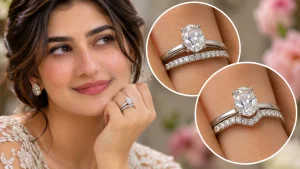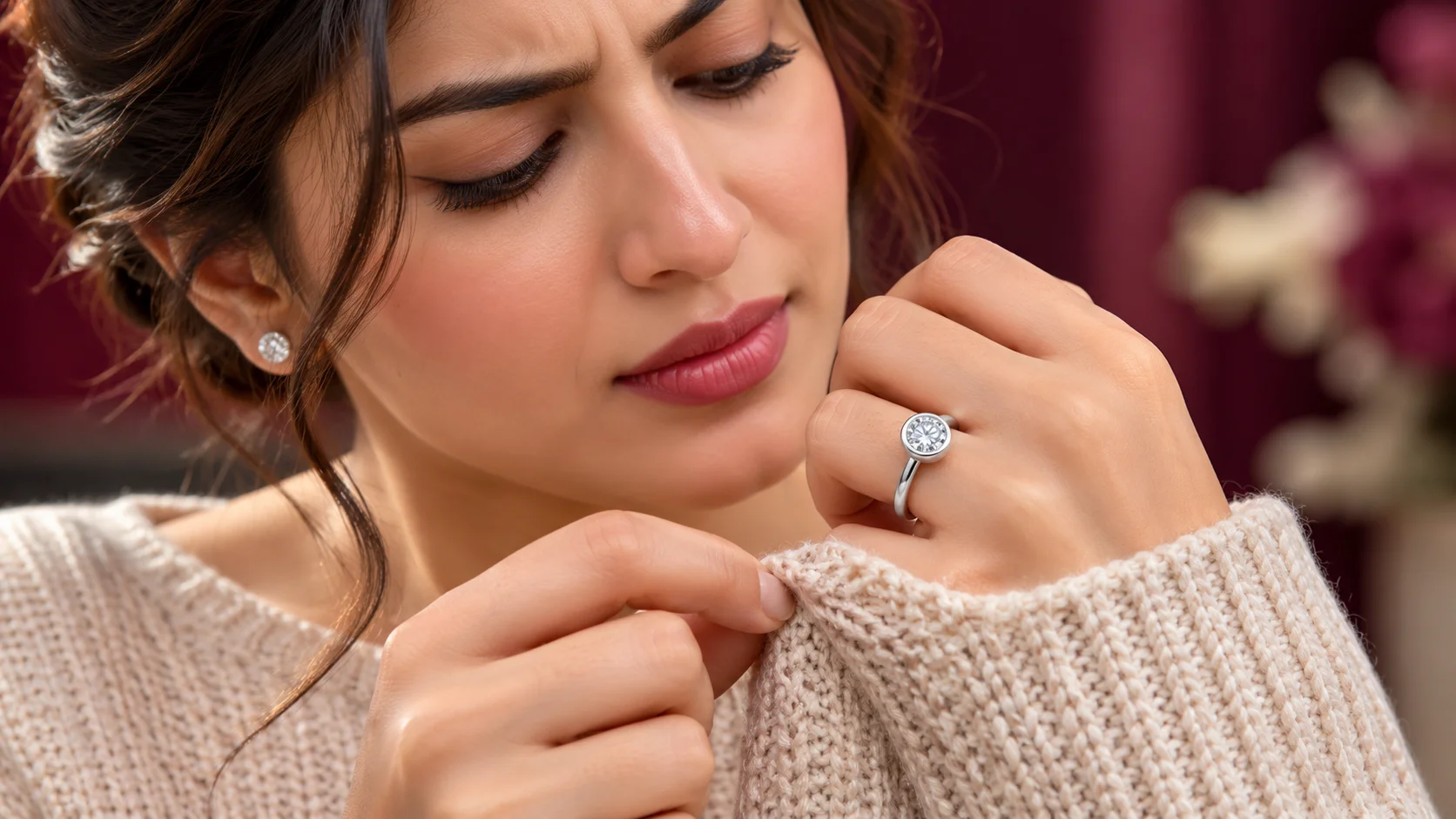
If your engagement ring keeps catching on sweaters, scarves, gloves, or delicate fabrics, consider a full bezel setting or a low-profile flush setting. Both designs reduce exposed edges around the center stone, making them practical alternatives to tall, exposed prong settings.
A low-profile solitaire with properly finished, rounded prongs can also work if you prefer a traditional diamond appearance. The best choice depends on how often you wear your ring, your daily activities, and how much of the diamond you want to keep visible.
Before buying another engagement ring, it’s also worth checking whether your current ring simply needs a prong repair or adjustment.
Here’s how to compare the options and choose a setting that feels comfortable without sacrificing the appearance you love.
Why Does Your Engagement Ring Keep Snagging on Clothes?
An engagement ring usually snags when a raised or uneven part of its setting catches on fabric.
The problem often comes from the prongs, center stone height, or decorative details around the diamond.
Here are the most common reasons.
1. Raised or Exposed Prongs
Prongs are small metal claws that hold a gemstone in place.
They allow more of the diamond to remain visible, but exposed prong tips can catch on knitted fabrics, gloves, and hair.
A bent, lifted, worn, or poorly finished prong can make this problem worse.
The Gemological Institute of America (GIA) notes that improperly finished prong tips can snag clothing, scratch skin, and break.
2. A High-Profile Setting
A high-profile engagement ring positions the center diamond farther above the finger.
This design can create a dramatic appearance and provide more visible space beneath the center stone.
However, the additional height can make the ring more likely to catch on clothing and other objects.
GIA explains that lower-profile designs are generally less likely to snag than higher-profile settings.
3. Decorative Side Details
Some engagement rings feature halos, pavé diamonds, intricate metalwork, and decorative prongs.
These details can create a beautiful appearance, but poorly finished edges or raised elements can catch on fabric.
The issue isn’t necessarily the number of diamonds. It’s how the jeweler finishes and positions the individual components.
4. A Loose or Damaged Setting
If your engagement ring suddenly starts snagging when it didn’t before, don’t immediately assume you need a new ring.
A prong may have become bent, worn, or lifted.
A loose setting can also allow the diamond to move.
Have a qualified jeweler inspect the ring before continuing to wear it. If the center stone moves or a prong looks damaged, stop wearing the ring until it has been checked.
Which Engagement Ring Settings Are Best for Avoiding Snagging?
The best engagement ring settings for reducing snagging have smooth edges, minimal exposed metal, and a center stone that sits closer to the finger.
Four options deserve particular attention.
1. Bezel Setting – Best Overall for Reducing Snagging
A bezel setting uses a rim of metal that surrounds the outer edge of the center gemstone.
Unlike traditional prong settings, it doesn’t rely on individual exposed claws to secure the diamond.
This creates a smoother outline and helps protect the gemstone’s edges.
Why choose a bezel setting?
- Reduces exposed edges that can catch on fabric.
- Helps protect the gemstone’s outer edge from accidental impacts.
- Creates a smooth and streamlined appearance.
- Works well with modern, minimalist, and vintage-inspired designs.
- Can be designed with a relatively low profile.
Potential drawbacks:
- The metal covers part of the gemstone’s outer edge.
- Some people prefer the more open appearance of prong settings.
- A poorly designed bezel can still have rough or raised edges.
- The appearance depends heavily on the gemstone shape and bezel proportions.
Best for: People who wear engagement rings every day, frequently wear sweaters or gloves, or prefer a smooth and protective design.
A full bezel is my first recommendation if minimizing snagging is your main priority.
2. Flush Setting – Best for a Smooth, Low-Profile Design
A flush setting places the gemstone directly into the metal band.
The stone sits close to the band’s surface instead of being elevated above it.
This creates a smooth appearance with fewer exposed edges.
Why choose a flush setting?
- The gemstone sits close to the band.
- The design has minimal exposed height.
- It offers a streamlined appearance.
- It can be practical for people who regularly use their hands.
- It reduces the number of raised components that can catch on clothing.
Potential drawbacks:
- The band needs enough metal to accommodate the gemstone.
- Larger center stones may require a more substantial ring design.
- The appearance is usually less traditional than a raised solitaire.
- Less of the gemstone may be visible from certain angles.
Best for: Minimalist jewelry lovers, people who prefer understated engagement rings, and shoppers who prioritize a smooth profile.
Flush settings are particularly worth considering if you dislike the feeling of a raised center stone.
3. Low-Profile Solitaire – Best for Traditional Engagement Ring Lovers
If you love the appearance of a classic solitaire, you don’t necessarily need to switch to a bezel.
A low-profile solitaire positions the center stone closer to the finger while retaining the familiar prong-set appearance.
The key is to choose a design with carefully finished prongs and a well-constructed setting.
Why choose a low-profile solitaire?
- Keeps the center diamond as the main attraction.
- Retains a traditional engagement ring appearance.
- Reduces the exposed height of the setting.
- Can accommodate different diamond shapes.
- Offers a balance between appearance and everyday practicality.
Potential drawbacks:
- Prongs can still catch on clothing.
- The setting requires periodic inspection.
- Some designs may limit the space available for a straight wedding band.
- The exact height depends on the diamond’s depth and mounting construction.
Best for: Shoppers who want a classic diamond engagement ring without the excessive height of a traditional high-profile setting.
If you love traditional solitaires, consider comparing lower-profile designs before ruling out prong settings entirely.
4. Half-Bezel Setting – Best for a Modern Look With Partial Protection
A half-bezel setting uses metal around selected portions of the gemstone rather than completely surrounding its perimeter.
This creates a more open appearance than a full bezel.
The design can provide a balance between gemstone visibility and a smoother setting profile.
Why choose a half bezel?
- Offers a modern, distinctive appearance.
- Leaves more of the gemstone’s outline visible.
- Reduces some exposed edges.
- Works with contemporary and minimalist ring designs.
Potential drawbacks:
- Some gemstone edges remain exposed.
- It may not provide the same perimeter protection as a full bezel.
- The open sections need careful design and finishing.
Best for: People who like bezel styling but want a more open, contemporary appearance.
Bezel vs. Flush vs. Low-Profile Solitaire vs. Half Bezel
Not every setting provides the same balance of snag resistance, appearance, and gemstone protection.
Compare the main options before choosing.
| Ring setting | Snagging potential | Stone protection | Appearance | Best for |
|---|---|---|---|---|
| Full bezel | Low | High around edges | Modern and smooth | Everyday practicality |
| Flush | Low | High around exposed edges | Minimalist | Hands-on routines |
| Low-profile solitaire | Low to moderate | Depends on prong design | Classic | Traditional ring lovers |
| Half bezel | Low to moderate | Partial edge protection | Contemporary | Open bezel styling |
| High-profile solitaire | Higher potential | Depends on construction | Elevated and prominent | Dramatic diamond presentation |
These are general design comparisons, not guarantees. A ring’s actual performance depends on its height, construction, workmanship, gemstone shape, and condition.
My recommendation: Choose a full bezel if snag resistance is your highest priority. Choose flush if you want the gemstone to sit especially close to the band. Choose a low-profile solitaire if you don’t want to give up the traditional prong-set look.
Which Snag-Resistant Engagement Ring Is Best for Your Lifestyle?
Your daily routine should influence your setting choice.
A ring that works well for someone with an office job may not be the most practical choice for someone who wears gloves or regularly handles tools.
Best for Nurses and Healthcare Professionals
If you frequently wear medical gloves, look for a smooth, low-profile ring.
A full bezel is a practical starting point because it reduces exposed prongs and raised edges.
However, workplace jewelry policies and infection-control requirements should take priority. Some procedures require rings to be removed entirely.
Best for People Who Work With Their Hands
Mechanics, construction workers, gardeners, and people who regularly handle equipment should consider a bezel or flush setting.
Both designs reduce exposed components that may catch on objects.
For potentially damaging activities, removing the ring is still the safer option.
Best for Office Workers
If your ring catches on blazers, sweaters, scarves, or delicate fabrics, consider a low-profile solitaire or bezel.
You can maintain an elegant appearance without choosing an excessively raised setting.
Best for Parents
If you regularly handle babies, children, blankets, and knitwear, a smooth setting can make daily wear more comfortable.
A bezel or properly finished low-profile design is worth considering.
Best for Traditional Diamond Lovers
You don’t need to abandon a classic engagement ring style.
A low-profile solitaire with rounded, properly finished prongs can offer a more practical alternative to a tall cathedral or raised basket design.
What If Your Existing Engagement Ring Keeps Snagging?
Before purchasing an entirely new engagement ring, find out whether the problem can be repaired.
In some cases, a jeweler can correct the issue without replacing the entire setting.
Here are the steps worth taking.
Step 1: Check whether the snagging is new.
If your ring previously felt smooth but suddenly catches on fabric, a damaged or lifted prong may be responsible.
Step 2: Look for visible damage.
Check for a bent prong, an uneven metal edge, or a diamond that appears out of position. Do not attempt to move the stone yourself.
Step 3: Visit a qualified jeweler.
Ask the jeweler to inspect the prongs, center stone, setting, and any decorative elements that could be catching on fabric.
Step 4: Compare repair and replacement.
If the existing setting is structurally sound, a repair may be sufficient.
If the design itself is too high or uncomfortable, ask about resetting your existing diamond into a lower-profile or bezel setting.
You can also read our guide on how to know if an engagement ring prong is loose.
What Should You Check Before Buying a Snag-Resistant Engagement Ring?
A setting name alone doesn’t guarantee that a ring will be comfortable.
Before purchasing, ask the retailer or jeweler about these details.
1. Ask About the Actual Setting Height
Request a side-view photograph or measurement of the ring’s height.
Don’t rely only on descriptions such as low profile, compact, or everyday friendly.
Compare the actual construction.
2. Inspect the Prongs and Metal Edges
If you choose a prong setting, check whether the tips are smooth and properly finished.
For bezel settings, inspect whether the surrounding metal has a smooth, even finish.
3. Check Your Diamond Shape
Different diamond shapes require different setting considerations.
Pear, marquise, and heart-shaped diamonds have pointed ends that need appropriate protection.
Ask the jeweler how the setting protects those areas.
4. Check Wedding Band Compatibility
A low-profile ring may have a different underside structure than a traditional solitaire.
Ask whether a straight wedding band will sit flush beside the engagement ring.
If not, you may need a curved or specially designed wedding band.
5. Understand the Maintenance Requirements
Even protective settings need occasional inspection.
Ask about professional cleaning, setting inspections, repairs, and aftercare.
A ring should be designed for your lifestyle, not just photographed beautifully.
How Much Does It Cost to Change an Engagement Ring Setting?
The cost of changing an engagement ring setting depends on the design, metal, gemstone, and amount of work required.
There is no single price that applies to every ring.
For example:
- Prong repair: May be sufficient if only one or more prongs need attention.
- New low-profile setting: Requires a new mounting that accommodates your existing gemstone.
- Bezel conversion: May require a custom-designed setting that fits the exact dimensions of your center stone.
- Complete ring redesign: Can involve a new mounting, additional gemstones, and more complex metalwork.
Before deciding to purchase a new engagement ring, ask a jeweler to compare the cost of repairing your existing setting with resetting your current diamond.
Also check whether your original retailer’s warranty or aftercare policy covers the issue.
Frequently Asked Questions
What engagement ring setting is least likely to snag on clothes?
A full bezel or flush setting is generally a good choice for reducing snagging. Both designs minimize exposed edges and raised components around the center gemstone.
Are bezel engagement rings completely snag-proof?
No. A well-made bezel setting has fewer exposed edges than a traditional prong setting, but no ring is completely snag-proof. Rough metalwork, decorative details, or an unsuitable design can still catch on fabric.
Do low-profile engagement rings snag?
They can, but their lower height generally reduces the chance of catching on clothing and other objects. Prongs and raised decorative details can still cause problems if they are poorly finished or damaged.
Are prong settings bad for everyday wear?
No. Properly constructed prong settings can be suitable for everyday wear. However, prongs require periodic inspection because they can wear down, bend, or become damaged.
Is a bezel setting better than a prong setting?
A bezel setting is generally better if your priorities are smooth edges and gemstone edge protection. A prong setting is better if you prefer a more open appearance that exposes more of the diamond. Neither is automatically best for everyone.
Can I make my existing engagement ring stop snagging?
Possibly. A jeweler may be able to smooth or repair a damaged prong, correct a raised edge, or adjust the setting. If the design itself is too high, resetting the diamond into a lower-profile mounting may be worth considering.
Do six-prong engagement rings snag less than four-prong rings?
Not necessarily. The number of prongs alone doesn’t determine snag resistance. Their height, shape, placement, and finishing matter more when assessing how a ring interacts with clothing.
What diamond shapes work well with bezel settings?
Round, oval, emerald, cushion, and several other diamond shapes can work with bezel settings. The bezel needs to be designed specifically for the gemstone’s outline and proportions.
Should I buy a new ring if my current ring keeps snagging?
Not immediately. Have a jeweler inspect your current ring first. If the problem comes from a damaged prong, a repair may solve it. If the setting is consistently uncomfortable because of its design, consider a new mounting or replacement ring.
Final Verdict: Which Engagement Ring Setting Should You Buy?
If your engagement ring keeps snagging on clothes, don’t focus only on the diamond’s size or shape. Pay attention to the setting’s height, exposed edges, and construction.
Here is the simplest way to decide:
- Choose a full bezel if reducing snagging and protecting the gemstone’s edges are your main priorities.
- Choose a flush setting if you prefer a smooth design with the gemstone sitting close to the band.
- Choose a low-profile solitaire if you love traditional prong-set engagement rings.
- Choose a half bezel if you want a modern look with some of the benefits of a protective setting.
For most shoppers who strongly dislike snagging, I would start by comparing full bezel and flush settings.
However, if you already own a ring you love, get it inspected before replacing it. A small setting repair may be all you need.
The right engagement ring should look beautiful, feel comfortable, and fit naturally into your everyday life.