If a traditional round diamond solitaire doesn’t feel like you, don’t force yourself to choose one. An engagement ring can look distinctive through its gemstone, diamond shape, setting, metal, or overall design.
If you want something genuinely different, start by deciding what you want to change. Choose a Toi et Moi ring if you love two-stone designs, a colored gemstone if you want something beyond a traditional white diamond, an east-west setting for a modern silhouette, or a salt-and-pepper diamond for a naturally unconventional appearance.
The best choice isn’t necessarily the strangest ring you can find. It’s a design that reflects your personality, feels comfortable for everyday wear, and still appeals to you years from now.
Here are eight distinctive engagement ring styles worth considering, along with their advantages, drawbacks, and the type of person each suits best.
1. Which Unique Engagement Ring Style Should You Choose?
Before looking at individual designs, think about what makes a ring feel different to you.
Some people want an unusual center stone. Others prefer an unconventional setting or a combination of gemstones.
Use this comparison to narrow down your options.
| Engagement ring style | What makes it different | Best for |
|---|---|---|
| Toi et Moi | Two prominent gemstones | Romantic, symbolic designs |
| East-West | Horizontal center stone | Modern, understated individuality |
| Colored gemstone | Sapphire, ruby, or other colored center stone | People who love color |
| Salt-and-pepper diamond | Distinctive natural inclusions | Organic, one-of-a-kind appearances |
| Black diamond | Dark center stone | Bold and dramatic aesthetics |
| Coffin or geometric cut | Unusual stone silhouette | Artistic and unconventional styles |
| Vintage-inspired | Antique details and intricate metalwork | Romantic, timeless character |
| Asymmetrical design | Uneven or unexpected stone arrangement | Creative, contemporary styling |
My recommendation: If you want something noticeably different without making the ring too unconventional, start with an east-west setting, a marquise diamond, or a colored sapphire. If you want a more distinctive design, explore Toi et Moi, salt-and-pepper, or geometric rings.
2. Toi et Moi Engagement Rings: Best for a Two-Stone Design
If one center stone feels too predictable, why not choose two?
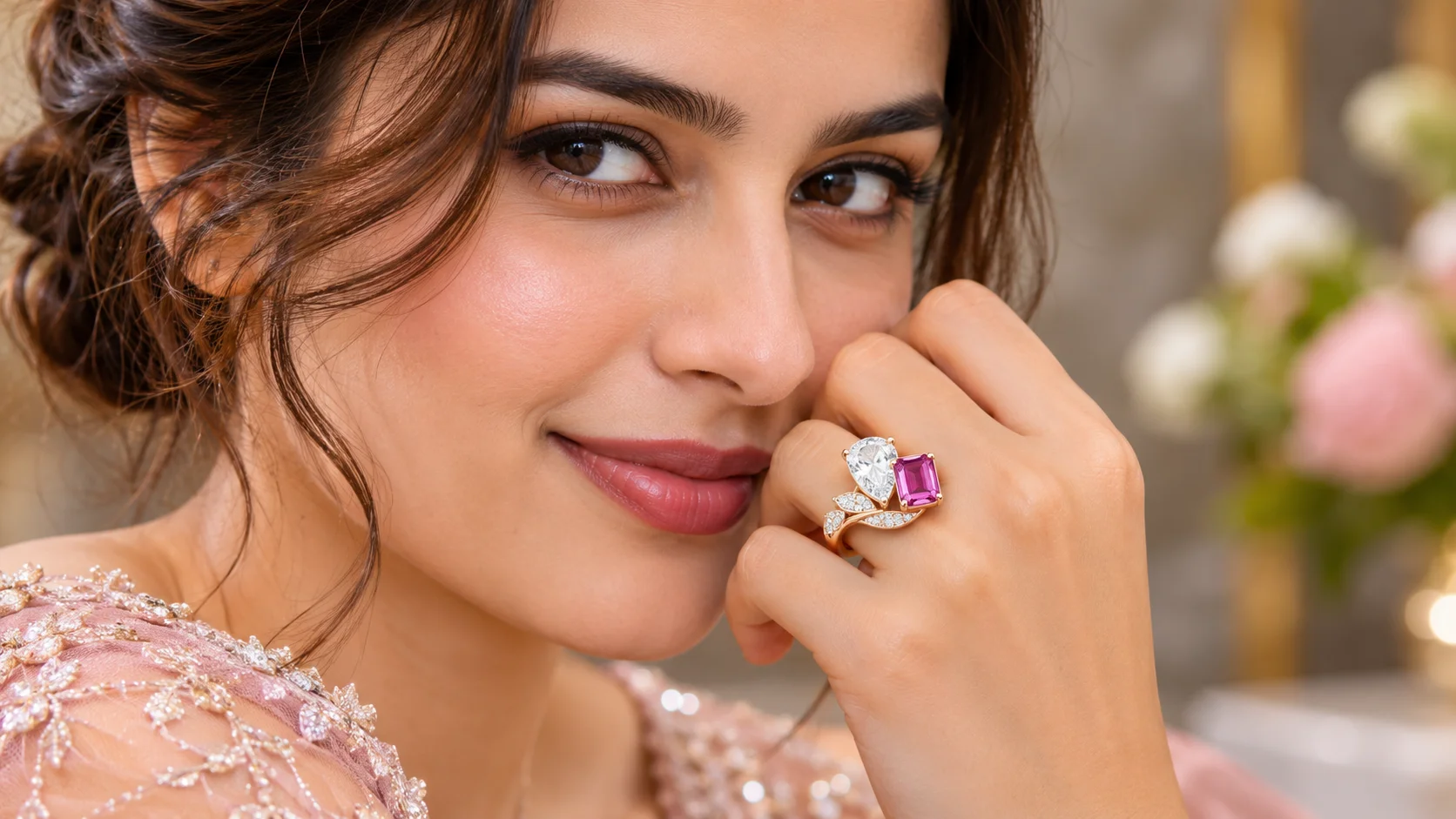
A Toi et Moi engagement ring features two prominent gemstones positioned together on one band. The name means “you and me” in French, making the style particularly appealing to couples who like the idea of two stones representing two individuals.
What makes this design interesting is the freedom to combine different shapes, gemstones, and colors.
For example, you could choose:
- A pear-shaped diamond paired with a princess-cut diamond.
- A white diamond alongside a colored sapphire.
- Two contrasting diamond shapes.
- Two gemstones with similar colors but different proportions.
The combination creates a distinctive silhouette that stands apart from a traditional solitaire.
Celebrity inspiration:
Emily Ratajkowski’s original engagement ring featured a pear-shaped diamond alongside a princess-cut diamond. Megan Fox also attracted attention with a Toi et Moi design featuring an emerald and a diamond.
You can explore their stories here:
Who should choose it?
Choose a Toi et Moi ring if you love meaningful design details, contrasting gemstones, and jewelry that doesn’t follow the traditional single-center-stone arrangement.
What to consider: Two prominent stones can require more space on the finger. Check how the gemstones sit together, whether the setting feels comfortable, and how the ring will pair with a wedding band.
3. East-West Engagement Rings: Best for a Subtle but Modern Look
You don’t always need an unusual gemstone to make an engagement ring look different.
Sometimes, changing the stone’s orientation is enough.
An east-west engagement ring positions an elongated center stone horizontally across the finger rather than vertically.
This setting works with several shapes, including:
- Oval.
- Emerald.
- Marquise.
- Pear.
- Elongated cushion.
- Baguette.
The result can look modern without feeling overly elaborate.
A horizontal marquise diamond, for example, creates a very different impression from the traditional north-south orientation.
Celebrity inspiration:
Miley Cyrus’s engagement ring has attracted attention for its east-west cushion-cut design and substantial yellow-gold band. It demonstrates how a familiar gemstone shape can feel distinctive through its setting and proportions.
Read more in our Miley Cyrus engagement ring guide.
Who should choose it?
This is a particularly good option if you want something different but don’t want a dramatic gemstone color or elaborate setting.
What to consider: Pay attention to the overall width of the ring. A horizontally positioned center stone can create a wider visual profile, so compare different proportions before choosing.
4. Colored Gemstone Engagement Rings: Best for People Who Love Color
Why does an engagement ring have to feature a colorless diamond?
Colored gemstones offer a completely different direction. They introduce personality through color while allowing you to keep a relatively simple ring design.
Some interesting options include:
Blue sapphire: A rich blue center stone creates a recognizable alternative to a white diamond. Sapphire also has a Mohs hardness of 9, making it a strong option for everyday jewelry when properly set and cared for.
Green sapphire: A less conventional color choice for someone who wants a natural, earthy appearance.
Ruby: Its rich red color creates a dramatic look without requiring an elaborate setting.
Alexandrite: A fascinating gemstone known for changing appearance under different lighting conditions.
Emerald: A beautiful green gemstone with a distinctive appearance, although it requires additional care because of its toughness and common clarity treatments.
The gemstone itself can become the defining feature of your engagement ring.
The Gemological Institute of America (GIA) explains that colored gemstone durability depends on more than hardness. Toughness and stability also matter when selecting a stone for regular wear.
Read GIA’s colored gemstone engagement ring buying guide before choosing a center stone.
Who should choose it?
Choose a colored gemstone if you have a favorite color, birthstone, meaningful gemstone, or simply prefer something other than a traditional white diamond.
What to consider: Ask whether the gemstone has been treated, how durable it is, and what care it requires. Don’t assume that every attractive gemstone is suitable for constant everyday wear.
5. Salt-and-Pepper Diamond Rings: Best for a Naturally Different Appearance
If you like diamonds but don’t want the perfectly clear appearance of a traditional white diamond, consider a salt-and-pepper diamond.
These diamonds contain visible black, gray, and white inclusions that create distinctive patterns inside the stone.
No two stones necessarily have the same visual appearance.
Some have subtle gray clouds, while others feature stronger black inclusions and contrasting patterns.
This makes salt-and-pepper diamonds especially interesting for shoppers who appreciate natural variation rather than conventional diamond clarity.
You can explore salt-and-pepper diamond engagement rings in different shapes and settings.
Who should choose it?
This style suits someone who likes organic textures, unconventional diamonds, and a less polished-looking aesthetic.
What to consider: Visible inclusions are part of the appeal, but they should still be evaluated carefully. Some internal characteristics can affect structural durability. Ask the seller about the stone’s condition rather than assuming every included diamond is equally suitable.
6. Black Diamond Engagement Rings: Best for a Bold and Dramatic Look
If you want your engagement ring to make a strong visual statement, a black diamond is worth considering.
Black diamonds move away from the familiar bright appearance of traditional colorless diamonds.
They can look especially distinctive in:
- Yellow-gold settings.
- White-metal settings with contrasting black stones.
- Vintage-inspired designs.
- Gothic settings.
- Minimalist solitaire arrangements.
A black center stone doesn’t automatically require an elaborate ring. Even a relatively simple setting can create a striking appearance.
Celebrity inspiration:
Gabbriette Bechtel’s engagement ring is a notable example of a dark, unconventional engagement ring aesthetic. Its reported black diamond design attracted attention for moving away from traditional colorless diamond styling.
Read more about Gabbriette Bechtel’s engagement ring.
If this is your preferred aesthetic, explore gothic engagement rings for darker gemstones, dramatic silhouettes, and intricate details.
Who should choose it?
Choose a black diamond if you prefer bold jewelry, dark romantic styling, or a ring that looks noticeably different from conventional bridal designs.
What to consider: Ask about the diamond’s origin, any color treatments, and the seller’s disclosure of its characteristics. Black diamond appearance and quality can vary considerably.
7. Coffin and Geometric Engagement Rings: Best for Artistic Personalities
If even traditional fancy diamond shapes feel too familiar, geometric engagement rings offer another direction.
Coffin-shaped gemstones are particularly unconventional. Their elongated outline and angled corners create a distinctive silhouette.
Other geometric options include:
- Hexagon.
- Kite.
- Trapezoid.
- Baguette.
- Dutch marquise.
- Shield-shaped designs.
These shapes can look particularly interesting when paired with simple metalwork.
For example, a coffin-shaped black gemstone in a minimalist setting can make a stronger statement than a conventional diamond surrounded by elaborate decorations.
Explore coffin-cut engagement rings for this aesthetic.
Who should choose it?
This direction suits creative shoppers who enjoy unusual architecture, modern art, geometric jewelry, or unconventional silhouettes.
What to consider: Some unusual cuts can be harder to find in a wide range of sizes and settings. Check the availability of compatible wedding bands and replacement or repair options before purchasing.
8. Vintage-Inspired and Asymmetrical Engagement Rings: Best for Something Personal
Not every distinctive engagement ring needs an unusual center stone.
Sometimes, the setting makes all the difference.
Vintage-inspired rings use design elements such as:
- Milgrain detailing.
- Intricate filigree.
- Engraved metalwork.
- Decorative shoulders.
- Antique-inspired stone arrangements.
- Geometric Art Deco patterns.
Asymmetrical rings take a different approach.
They use unexpected arrangements, uneven proportions, or offset accent stones to create a less conventional appearance.
You might choose a single center diamond with smaller stones arranged along only one side of the band.
Or you could choose a floral-inspired setting with an irregular arrangement of gemstones.
These designs can feel highly individual without requiring a large or unusually colored center stone.
Who should choose them?
Vintage-inspired designs suit shoppers who love historical jewelry and intricate craftsmanship.
Asymmetrical designs are better suited to people who prefer contemporary, artistic, or sculptural jewelry.
For a darker vintage aesthetic, browse gothic engagement rings.
9. Which Engagement Ring Should You Choose Based on Your Personality?
If you’re still unsure, start with the aesthetic you naturally gravitate toward.
| Your preferred aesthetic | Ring style to consider |
|---|---|
| Romantic and symbolic | Toi et Moi |
| Modern and minimal | East-west setting |
| Colorful and expressive | Sapphire or ruby |
| Natural and unconventional | Salt-and-pepper diamond |
| Bold and dramatic | Black diamond |
| Artistic and experimental | Coffin or geometric cut |
| Classic with character | Vintage-inspired |
| Creative and contemporary | Asymmetrical design |
There is no requirement to choose a ring simply because it is unusual.
For example, if you love traditional diamonds but dislike common settings, a classic diamond in an unconventional setting might be a better choice than replacing it with an unfamiliar gemstone.
Similarly, if you love colorful jewelry, a sapphire solitaire could be more personal than a complicated multi-stone design.
The objective is to find the right combination of details.
10. How to Make a Traditional Engagement Ring Look Different
You might already know that you want a diamond engagement ring.
You might also prefer a relatively simple design.
In that case, you don’t necessarily need to abandon traditional ring styles.
Consider changing one or two design elements.
Change the diamond shape.
Instead of a round brilliant, consider a marquise, pear, Asscher, or emerald-cut diamond.
Change the setting.
An east-west, bezel, or asymmetrical setting can give a familiar stone a different appearance.
Choose a different metal.
Yellow gold, rose gold, platinum, and other metal options can change the overall character of a ring.
Add meaningful details.
Consider engraving, hidden gemstones, birthstones, or personalized design elements.
Choose an unconventional band.
A sculptural, split-shank, twisted, or wider band can make the overall ring look different without changing the center stone.
This approach is particularly useful if you want a ring that feels individual but still has a relatively familiar foundation.
11. How Much Does a Unique Engagement Ring Cost?
A distinctive engagement ring isn’t automatically more expensive than a traditional solitaire.
Its price depends on several factors:
- Center stone type and quality.
- Diamond or gemstone size.
- Metal type and weight.
- Number of gemstones.
- Setting complexity.
- Custom design and manufacturing.
- Retailer and brand pricing.
For example, a simple sapphire solitaire may have a different price structure from a custom two-stone diamond ring.
A salt-and-pepper diamond may also be priced differently from a colorless diamond, depending on the stone’s characteristics and the seller.
Custom designs can introduce additional design and labor costs.
Rather than assuming that unusual means expensive, compare the actual materials, specifications, craftsmanship, and retailer terms.
Also ask whether the quoted price includes the center stone, setting, resizing, and any applicable warranty or after-sales service.
12. Should You Buy a Ready-Made Ring or Design Your Own?
If you have a very specific idea, a custom engagement ring may be worth considering.
However, custom design isn’t necessary for everyone.
| Factor | Ready-made ring | Custom engagement ring |
|---|---|---|
| Design | Existing design | Designed around your preferences |
| Selection | Choose from available options | More control over details |
| Timeline | Depends on stock and delivery | Includes design and production time |
| Budget | Easier to compare listed prices | Depends on materials and complexity |
| Changes | Limited customization may be available | More design flexibility |
| Best for | Shoppers who find a suitable existing design | Shoppers with a specific vision |
Before commissioning a custom ring, prepare a few reference images and identify the details you want.
Discuss the following with the jeweler:
- Which gemstone and shape do you want?
- Which metal do you prefer?
- How should the stone be positioned?
- What type of setting will hold it securely?
- What is the total quoted cost?
- How long will design, approval, and production take?
- What resizing, repair, warranty, and return options are available?
Ask for a written design specification before approving production.
This helps avoid misunderstandings about stone dimensions, metal, setting details, and the final appearance.
13. Mistakes to Avoid When Choosing an Unusual Engagement Ring
Choosing a distinctive design is exciting, but don’t let appearance become the only consideration.
Here are some common mistakes worth avoiding.
Choosing a gemstone without checking its durability
Some gemstones are more vulnerable to scratches, chips, or environmental damage than others. Consider hardness, toughness, stability, and treatment history.
Ignoring the setting
An unusual diamond shape may need a setting that protects its corners or pointed ends.
For example, pear and marquise diamonds have exposed points that require appropriate protection.
GIA explains these considerations in its guide to protecting diamond engagement rings.
Choosing a design that catches on everything
Tall settings, sharp decorative details, and exposed prongs may be inconvenient if you work with your hands or wear gloves regularly.
Assuming custom means better quality
A custom ring can offer more design flexibility, but craftsmanship, materials, stone quality, and seller reputation still matter.
Following a trend you don’t actually like
A ring can become popular because a celebrity wears it. That doesn’t mean the same design will suit your personal taste.
Use celebrity rings as inspiration, not instructions.
Forgetting about the wedding band
Some unusual engagement ring settings don’t sit flush with traditional wedding bands. Consider this before making your final decision.
14. Final Recommendation: Which Unique Engagement Ring Is Worth Choosing?
If you want an engagement ring that looks different from everyone else’s, you have several good directions.
My recommendation depends on how distinctive you want the final design to feel.
- Best for a modern look: East-west diamond engagement ring.
- Best for romantic symbolism: Toi et Moi engagement ring.
- Best for color: Sapphire or ruby engagement ring.
- Best for natural individuality: Salt-and-pepper diamond.
- Best for a dramatic aesthetic: Black diamond or gothic engagement ring.
- Best for an artistic personality: Coffin or geometric gemstone.
- Best for timeless individuality: Vintage-inspired engagement ring.
But there’s one more thing worth remembering.
You don’t need to combine every unusual feature into one ring.
A distinctive gemstone, an unexpected setting, or a meaningful design detail may be enough.
Choose something that reflects your taste rather than something that simply attracts attention. After all, you’ll be wearing the ring long after today’s engagement ring trends have changed.
Frequently Asked Questions
What is the most unique engagement ring style?
There isn’t one universally most unique style. Toi et Moi, coffin-cut, asymmetrical, salt-and-pepper diamond, and colored gemstone rings are all distinctive options. The best choice depends on your preferred appearance and lifestyle.
What engagement ring looks different but is still timeless?
An east-west diamond, colored sapphire solitaire, or vintage-inspired ring can offer individuality without relying on an extremely dramatic design. Focus on a silhouette and setting that you expect to enjoy for years.
Are alternative engagement rings more expensive?
Not necessarily. Price depends on gemstone quality, materials, setting complexity, and craftsmanship. Some alternative gemstones and simple settings may offer more budget flexibility, while intricate custom designs can cost more.
Are colored gemstones suitable for engagement rings?
Some colored gemstones are suitable for everyday engagement rings, but durability varies. Sapphire and ruby have a Mohs hardness of 9, while softer or less tough stones may require more careful wear and maintenance.
Can I design my own engagement ring?
Yes. Many jewelers offer custom engagement ring design. You can discuss gemstone shape, metal, setting, band design, and personal details. Always confirm the final specifications, cost, timeline, and return terms before approving production.
What is the difference between an alternative and a nontraditional engagement ring?
The terms are often used interchangeably. Alternative engagement rings generally describe designs that move away from conventional bridal styles, including unusual shapes, colored gemstones, and distinctive settings. Nontraditional is a broader description of anything that departs from familiar engagement ring conventions.
Can a unique engagement ring still look elegant?
Absolutely. A ring doesn’t need an oversized gemstone or elaborate decoration to look distinctive. An unusual diamond shape, an understated east-west setting, or a contrasting metal combination can create a refined but individual appearance.
Should I choose a unique engagement ring based on trends?
Trends can help you discover designs you haven’t considered, but they shouldn’t determine your purchase. Think about your personal style, daily activities, gemstone preferences, and long-term comfort before choosing.