If you love antique diamonds, you have probably come across two names again and again: Old Mine Cut and Old European Cut. They both have a romantic, vintage personality, but they are not the same diamond cut.
So, what is the Old Mine Cut vs Old European Cut difference?
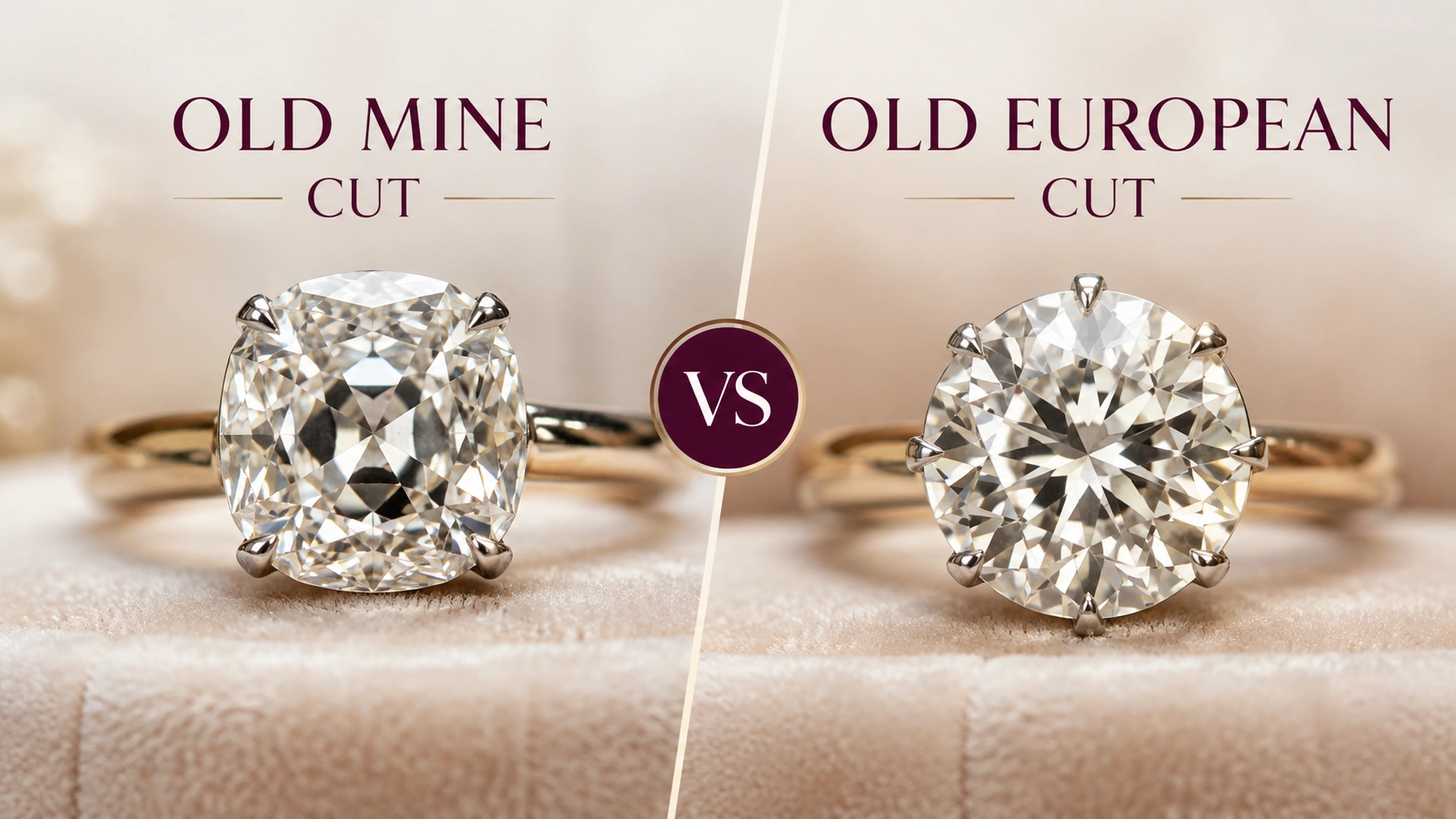
The simplest answer is this: Old Mine Cut diamonds usually have a squarish or cushion-shaped outline with a larger culet, while Old European Cut diamonds have a round outline with a smaller culet. Both cuts feature high crowns, small tables, and proportions that reflect the cutting methods of their time.
The differences become more interesting when you look at their shape, faceting, sparkle, history, and overall personality.
One looks like it belongs in a beautifully preserved antique jewelry box. The other feels like the round diamond’s elegant great-grandparent. Neither needs to compete with a modern brilliant cut. That is rather the point.
Let’s compare Old Mine Cut vs Old European Cut diamonds and see which one may suit your style.
What Is an Old Mine Cut Diamond?
An Old Mine Cut diamond is an antique brilliant-style diamond with a characteristic squarish or cushion-shaped outline and softly rounded corners.
The cut dates back to the 18th century and became especially common in Georgian and Victorian-era jewelry. GIA describes it as an early brilliant cut with many variations in proportions and appearance.
The Old Mine Cut diamond shape developed partly from the natural form of diamond rough and the limitations of historical cutting techniques. Cutters worked by hand and had fewer tools and less precision than modern diamond cutters. As a result, they often retained more of the rough crystal instead of removing large amounts of material to create perfectly standardized proportions.
This explains one of the most recognizable Old Mine Cut diamond characteristics: no two stones necessarily look exactly alike.
Typical features include:
- Squarish or cushion-like outline
- Rounded corners
- Small table
- High crown
- Deep pavilion
- Large, visible culet
- Broad, hand-cut facets
- Individual variations in symmetry and proportions
The Old Mine Cut large culet is one of its most noticeable visual features. When you look directly into the diamond, the culet may appear as a visible facet near the center.
This gives the stone a distinctive personality that modern diamond shoppers may find unusual at first. But for lovers of antique diamonds, that little detail can be part of the charm.
GIA also notes that Old Mine Cut diamonds typically have 58 facets, although historical examples show variation in proportions and cutting styles.
What Is an Old European Cut Diamond?
The Old European Cut diamond is a round antique diamond cut that became prominent as diamond-cutting technology developed in the late 19th century and continued into the early 20th century.
Unlike the squarish outline of an Old Mine Cut, the Old European Cut diamond shape is distinctly round.
This round outline represents an important step in the evolution of diamond cutting. Improvements in technology eventually made it easier for cutters to create round girdles with greater consistency. The Old European Cut later became an important predecessor to the modern round brilliant cut.
Typical Old European Cut diamond characteristics include:
- Round outline
- High crown
- Small table
- Deep proportions
- Broad facets
- Visible culet
- Hand-cut character
- Greater variation than modern round brilliant diamonds
The Old European Cut culet is generally smaller than the culet found on a typical Old Mine Cut, although it can still be visible.
This is an important point when comparing these antique diamond cuts: historical diamonds did not follow the strict standardization that modern diamonds often do. You can find variations from one stone to another, so the labels should act as useful descriptions rather than promises that every diamond will look identical.
GIA’s research also recognizes specific criteria used to identify classic Old European Cuts, while acknowledging that historical stones can vary.
Old Mine Cut vs Old European Cut: Key Differences
The Old Mine Cut vs Old European Cut comparison becomes much easier when you break it down into the features you can actually see.
1. Shape and Outline
This is the easiest difference to spot.
An Old Mine Cut generally has a squarish, cushion-shaped outline with rounded corners. It can look soft, romantic, and slightly irregular.
An Old European Cut has a round outline. It looks closer to the familiar round diamond shape, although its proportions and faceting differ significantly from a modern round brilliant.
So, if you want a cushion-like antique appearance, an Old Mine Cut may be the natural choice. If you want a round diamond with an unmistakably vintage personality, an Old European Cut may appeal more.
In simple terms:
Old Mine Cut = soft cushion or squarish outline
Old European Cut = round outline
That single difference can dramatically change the appearance of an engagement ring.
2. Faceting Pattern
Both cuts belong to the historical family of brilliant-style diamond cuts, but their faceting and proportions reflect their eras.
Old Mine Cuts often feature broad, chunky facets and a distinctive combination of a high crown, small table, deep pavilion, and large culet.
Old European Cuts also feature a high crown and small table, but their round outline and evolving faceting style place them closer to the modern round brilliant in the history of diamond cutting.
Because these stones were hand-cut, you should expect variation. A vintage diamond is not a factory-produced object with every measurement identical to the next.
That is part of the appeal.
The diamond may have a slightly different personality from its neighbor, even when both carry the same general cut description. GIA notes that Old Mine Cut diamonds can vary considerably in their proportions and that no two stones are necessarily identical.
3. Table and Crown
Both Old Mine and Old European Cuts typically have small tables and high crowns compared with modern round brilliant diamonds.
The crown is the upper portion of the diamond between the girdle and table. The table is the large facet at the top of the stone.
Old Mine Cut diamonds are known for their small table and high crown, while Old European Cuts also have a high crown and small table. Their deeper overall proportions contribute to their unmistakable antique appearance.
However, don’t judge an antique diamond only by a checklist.
Historical cutters worked with individual pieces of rough and hand-cut each stone. Therefore, actual proportions can vary significantly between examples.
4. Culet Size
The culet is another major difference.
An Old Mine Cut usually has a larger culet, which can be clearly visible when viewed from above.
An Old European Cut generally has a smaller culet than an Old Mine Cut, although it can still be visible compared with many modern round brilliant diamonds.
This central opening can affect how you experience the diamond.
Some people love seeing the culet because it immediately signals an antique cutting style. Others prefer a more seamless, modern appearance.
Neither approach is right or wrong. It is simply a matter of what your eye finds beautiful.
5. Sparkle and Light Performance
This is where things get interesting.
People often ask whether an Old Mine Cut diamond sparkle is better than Old European Cut diamond sparkle. The honest answer is that there is no universal winner.
Both cuts can produce beautiful light performance, but they do not necessarily look like modern brilliant diamonds.
Their historical proportions and broad facets can create a different visual experience, with flashes of fire and a softer pattern of brilliance. GIA describes Old Mine Cuts as typically showing less brilliance but more fire than modern round brilliant diamonds, while older European-style diamonds can show a softer, more candlelit appearance.
The individual stone matters, too.
Two diamonds with the same general antique cut label may perform differently because of their specific proportions, symmetry, clarity, and overall condition.
So, when comparing Old Mine Cut diamond brilliance and Old European Cut diamond brilliance, don’t assume that one automatically sparkles more.
Instead, think about the type of sparkle you prefer.
Modern brilliant cuts often aim for strong, optimized light return and a more standardized appearance.
Antique cuts offer something different: broader flashes, visible faceting, and a softer character that many people associate with candlelight and vintage jewelry.
In other words, if modern brilliance is a fireworks show, antique diamond sparkle is more like a beautifully lit ballroom.
Both can be memorable. They simply tell different stories.
Old Mine Cut vs Old European Cut: Side-by-Side Comparison
| Feature | Old Mine Cut | Old European Cut |
|---|---|---|
| General outline | Squarish or cushion-shaped | Round |
| Historical prominence | Common in Georgian and Victorian jewelry | Rose to prominence in the late 19th and early 20th centuries |
| Table | Typically small | Typically small |
| Crown | Typically high | Typically high |
| Pavilion | Typically deep | Generally deep |
| Culet | Typically larger | Generally smaller than Old Mine Cut |
| Faceting | Broad, hand-cut appearance | Broad antique-style faceting |
| Symmetry | Can be irregular | Can vary, but round outline is more defined |
| Overall character | Romantic, cushion-like, distinctly antique | Round, vintage, closer to the evolution of modern brilliant cuts |
These characteristics describe typical examples rather than strict rules for every historical diamond. Antique cutting styles can show considerable variation.
Old Mine Cut vs Old European Cut: History and Time Period
The history behind these cuts helps explain their differences.
The Old Mine Cut diamond history reaches back to the 18th century. The cut became strongly associated with Georgian and Victorian jewelry, and its squarish shape worked well with the natural forms of diamond rough available to cutters at the time.
As diamond cutting technology improved, cutters gained more ability to produce round girdles with greater precision.
This helped pave the way for the Old European Cut diamond history.
Old European Cuts became popular in the late 19th and early 20th centuries. They represent an important stage in the evolution toward the modern round brilliant cut.
This means the Old Mine Cut vs Old European Cut difference is not simply about shape.
It also reflects a broader change in diamond cutting technology.
Old Mine Cuts belong strongly to the earlier world of hand-cut, cushion-like brilliant diamonds. Old European Cuts arrived later, when advances in cutting technology made round diamonds more practical and consistent.
The story does not stop there.
Between the Old European Cut and today’s modern round brilliant, cutters developed transitional styles as technology continued to advance. GIA identifies the transitional cut as an important bridge in this progression.
Which Diamond Has More Sparkle?
If you are asking, “Which has more sparkle, an Old Mine Cut or Old European Cut?” the best answer is: it depends on the individual diamond and the type of sparkle you enjoy.
Neither should be judged using exactly the same expectations as a modern round brilliant.
The Old Mine Cut diamond sparkle often comes from broad facets and strong flashes of fire, while the Old European Cut diamond sparkle can offer a softer, rounder vintage appearance with broad flashes of light.
However, diamond light performance depends on more than the name of the cut.
The stone’s proportions, symmetry, clarity, color, and lighting environment can all affect what you see.
That’s why viewing an antique diamond under different lighting conditions is important. GIA specifically recommends looking at Old Mine Cut diamonds in different lighting environments because lighting can change their appearance.
If you want perfectly predictable sparkle patterns, a modern round brilliant may be a better fit.
If you want personality, history, and a little visual unpredictability, antique cuts have a strong argument in their favor.
Which Is Better for a Vintage Engagement Ring?
Both can make an exceptional vintage engagement ring, but they create different moods.
An Old Mine Cut engagement ring is a strong choice if you love:
- Cushion-shaped or squarish diamonds
- Romantic antique jewelry
- Georgian or Victorian-inspired designs
- Larger visible culets
- Hand-cut character
- Broad, chunky faceting
An Old European Cut engagement ring may suit you better if you prefer:
- Round diamonds
- Late Victorian or Edwardian-inspired designs
- Antique round brilliant faceting
- A smaller culet than an Old Mine Cut
- A vintage look that feels closer to a classic round diamond
The right choice depends less on which cut is “better” and more on which diamond looks right to your eyes.
After all, you are choosing a ring you will see far more often than a diamond grading chart.
Old Mine Cut vs Old European Cut: Which Should You Choose?
Choose an Old Mine Cut diamond if you want a distinctive cushion-like outline and a strongly antique appearance. Its squarish shape, larger culet, high crown, and broad facets give it a character that modern diamonds cannot perfectly replicate.
Choose an Old European Cut diamond if you love the round diamond shape but want an older cutting style with a high crown, small table, visible culet, and vintage faceting.
When shopping, don’t focus only on the label.
Look closely at the actual diamond.
Check the outline. Examine the symmetry. Look at the culet. Pay attention to the faceting pattern. View the stone in different lighting. If possible, review a reputable gemological report and work with a seller who can clearly explain the diamond’s characteristics.
Remember that antique diamonds were not cut to today’s standardized expectations. A little irregularity can be part of their historical identity, not automatically a flaw.
And if you are looking to buy an Old Mine Cut diamond or buy an Old European Cut diamond, take your time. These are diamonds where the individual stone matters enormously.
Frequently Asked Questions
What is the main difference between an Old Mine Cut and Old European Cut diamond?
The main difference is their outline and culet. An Old Mine Cut typically has a squarish or cushion-shaped outline and a larger culet. An Old European Cut has a round outline and generally a smaller culet.
Is an Old Mine Cut diamond the same as a cushion cut?
No. An Old Mine Cut is a historical brilliant-style diamond cut that often has a squarish or cushion-shaped outline. Modern cushion cuts can share a similar outline, but they are not automatically Old Mine Cuts. GIA describes the Old Mine Cut as a forerunner of today’s modern cushion brilliant.
Is an Old European Cut diamond the same as a modern round brilliant?
No. An Old European Cut is an earlier historical round diamond cut and an important predecessor to the modern round brilliant. Its proportions, faceting, and overall appearance differ from modern round brilliant diamonds.
Which has a larger culet, Old Mine Cut or Old European Cut?
Typically, an Old Mine Cut has a larger culet, while an Old European Cut generally has a smaller culet. However, antique diamonds can vary, so you should examine the individual stone rather than rely only on the cut name.
Which is better for a vintage engagement ring?
Both can work beautifully. Choose an Old Mine Cut for a squarish, cushion-like antique appearance. Choose an Old European Cut if you prefer a round diamond with historic faceting and vintage character.
Do Old Mine Cut diamonds sparkle?
Yes. Old Mine Cut diamonds can show beautiful fire and broad flashes of light. Their sparkle often looks different from modern brilliant cuts because of their historical proportions and faceting. GIA notes that Old Mine Cuts typically show less brilliance but more fire than modern round brilliant diamonds.
Are Old Mine Cut and Old European Cut diamonds rare?
Original antique examples can be harder to find than modern diamonds because these cuts belong to earlier periods of diamond cutting. However, rarity varies considerably by the diamond’s age, condition, provenance, size, and quality. It is better to evaluate each individual stone rather than assume rarity from the cut name alone.
Can I buy a new diamond in an Old Mine or Old European style?
Yes. The market includes newly cut diamonds designed to resemble historical cutting styles, as well as genuine antique diamonds. When shopping, ask the seller whether the stone is an original antique or a newly cut diamond inspired by an antique style.
Final Thoughts
The Old Mine Cut vs Old European Cut Diamond debate comes down to two beautiful chapters in the history of diamond cutting.
The Old Mine Cut brings a soft, squarish or cushion-shaped outline, a larger culet, high crown, small table, and unmistakable antique character.
The Old European Cut brings a round outline, smaller culet, high crown, small table, and a cutting style that helped lead the diamond industry toward the modern round brilliant.
Neither is simply the “best antique diamond cut.”
They offer different experiences.
If you want the romantic irregularity of an antique cushion-shaped diamond, the Old Mine Cut may be your perfect match. If you want the familiar round outline with unmistakable vintage character, the Old European Cut deserves a closer look.
The best choice is ultimately the diamond that makes you stop, look twice, and think, “Yes, that’s the one.”
And honestly, for an engagement ring, that’s a pretty good test.