If you’ve ever shopped for a natural gemstone online, you’ve probably seen labels like Heirloom, AAAA, AAA, or AA. At first glance, they look official. In reality, they often raise more questions than answers.
Is Heirloom Grade really better than AAAA? Does AAAA always mean the highest quality? Is AAA good enough for fine jewelry? And are these grades recognized by professional gemological organizations?
The short answer is this: gemstone quality grades such as Heirloom, AAAA, AAA, and AA are widely used by jewelry retailers, but there is no universal industry standard that defines them across all gemstone types. Different sellers may use different grading systems, making it important to understand what each grade generally represents before you buy.
This Gemstone Grade Comparison Guide explains how these quality levels work, where they differ, and which option offers the best value depending on your budget and purpose.
What Is Gemstone Grading?
Before comparing Heirloom vs Natural AAAA vs AAA vs AA, it’s important to understand one key fact.
Unlike diamonds, most colored gemstones do not follow a single worldwide grading scale. Organizations such as the Gemological Institute of America educate professionals about gemstone quality, identification, and treatments, but they do not assign universal commercial grades like AAAA or AAA to colored gemstones.
Instead, many jewelry retailers use their own gemstone grading system to help customers compare stones within their inventory.
Most sellers evaluate gemstones based on several visible characteristics:
- Color
- Clarity
- Cut quality
- Transparency
- Luster
- Surface quality
- Size consistency
- Overall appearance
Because these grades are retailer-defined, one company’s AAAA gemstone may not look exactly the same as another company’s AAAA gemstone. That’s why understanding the grading scale matters more than simply trusting the letters.
Why Do Retailers Use AAAA, AAA, and AA Grades?
Imagine buying coffee.
One café labels its best beans as “Reserve.” Another calls them “Signature.” A third names them “Estate Selection.”
They’re all describing premium products—but each business uses different branding.
Gemstone grades work in much the same way.
Retailers created quality labels like AAAA Quality, AAA Quality, and AA Quality to make shopping easier for customers who may not understand technical gemology terms.
Generally speaking, these grades represent increasing quality:
| Grade | General Quality Level | Common Use |
|---|---|---|
| Heirloom | Exceptional retail quality | Collector pieces & luxury jewelry |
| AAAA | Premium quality | High-end fine jewelry |
| AAA | Fine quality | Most engagement rings & everyday luxury |
| AA | Good quality | Affordable jewelry |
| A | Commercial quality | Entry-level pieces |
Keep in mind that this chart reflects common retail practices rather than an internationally standardized grading system.
What Is Heirloom Grade?
When comparing Heirloom Grade vs AAAA Grade, Heirloom is usually presented as the highest selection offered by a retailer.
The term Heirloom Grade is a marketing description rather than an official gemological classification. Retailers typically reserve this label for gemstones that display outstanding overall beauty.
These stones often feature:
- Exceptional color saturation
- Excellent transparency
- Very high clarity
- Strong natural brilliance
- Minimal visible inclusions
- Excellent cutting and polish
Because of these characteristics, Heirloom gemstones are frequently chosen for:
- Luxury engagement rings
- Anniversary jewelry
- Custom fine jewelry
- Collector-quality gemstone pieces
- Investment-grade jewelry (when supported by rarity, provenance, and market demand)
However, Heirloom does not automatically guarantee investment value. Long-term value depends on several additional factors, including gemstone species, rarity, origin, treatment history, certification, and overall market demand.
Think of Heirloom as the retailer saying:
“This is among the finest gemstones we currently offer.”
Rather than:
“This gemstone meets an official international Heirloom standard.”
That distinction is important.
What Does AAAA Mean?
One of the most searched questions is:
What Does AAAA Mean in Gemstones?
AAAA Quality generally refers to gemstones that display premium visual characteristics and are considered among the best stones available within a retailer’s inventory.
Most AAAA gemstones exhibit:
- Rich, vibrant color
- Excellent luster
- Very good transparency
- Few visible inclusions
- High-quality cutting
- Attractive overall appearance
For many buyers, AAAA gemstones provide an excellent balance between appearance and price.
In fact, many fine jewelry retailers use AAAA gemstones in:
- Engagement rings
- Pendants
- Earrings
- Luxury bracelets
- Custom jewelry
The difference between Heirloom vs AAAA is often subtle rather than dramatic.
A Heirloom gemstone may have:
- Slightly richer color
- Better optical performance
- Fewer inclusions
- Greater rarity
- More carefully matched cutting
To an untrained eye, the difference may be difficult to notice once the gemstone is set into jewelry.
That is why many jewelers consider AAAA one of the best values available.
AAAA Quality Meaning
Although there is no universal definition, AAAA gemstones generally represent stones that fall within the top quality range offered by an individual retailer.
Typical characteristics include:
- Premium gemstone color
- High clarity
- Excellent brilliance
- Attractive polish
- Minimal surface imperfections
- Fine jewelry quality
When shopping online, always review actual photographs, videos, and any available laboratory reports instead of relying solely on the grade label.
What Is AAA Quality?
If AAAA represents premium quality, where does AAA fit?
AAA Quality is often considered the standard for high-quality jewelry gemstones.
Many professional jewelers regard AAA gemstones as offering an excellent combination of beauty, durability, and affordability.
AAA gemstones usually display:
- Strong color
- Good transparency
- Minor natural inclusions
- Attractive brilliance
- Good polish
- Consistent appearance
These gemstones appear in a wide variety of jewelry, including:
- Engagement rings
- Wedding bands
- Necklaces
- Bracelets
- Earrings
- Everyday luxury jewelry
For many buyers, choosing AAAA vs AAA gemstones comes down to budget.
A AAA gemstone can still look stunning once mounted in a ring. In many cases, only experienced gemologists or side-by-side comparisons reveal the subtle differences between AAA and AAAA stones.
That makes AAA one of the most popular gemstone quality levels in today’s jewelry market.
What Is AA Quality?
Not every beautiful gemstone needs to carry a premium price tag. That’s where AA Quality comes in.
AA gemstones generally offer good overall appearance while remaining more affordable than AAAA or AAA stones. They often show natural characteristics that are easier to notice, but they can still make attractive jewelry.
Typical AA gemstones may have:
- Good color with slightly lighter or less even saturation
- Visible natural inclusions
- Moderate transparency
- Good polish
- Pleasant overall appearance
- Better affordability
AA gemstones are commonly used in:
- Fashion jewelry
- Casual everyday jewelry
- Budget-friendly gifts
- Larger gemstone designs where size is a priority
If you’re wondering, “Is AA gemstone quality worth buying?” the answer depends on your priorities.
If your goal is to own a natural gemstone without paying a premium, AA can be an excellent choice. Many inclusions become less noticeable once a gemstone is set into jewelry and viewed at a normal distance.
AA Quality Meaning
The AA Quality Meaning is generally straightforward.
It represents gemstones that offer solid beauty while displaying more visible natural characteristics than higher grades.
These stones may include:
- Slightly lighter color
- More noticeable inclusions
- Lower transparency
- Minor surface imperfections
- Less consistent cutting
That doesn’t mean they’re poor-quality gemstones. Natural gemstones almost always contain unique internal features. In fact, those natural inclusions can help distinguish a genuine gemstone from a synthetic imitation.
AA vs A Gemstones
If you’ve also seen A Grade gemstones, here’s the difference.
| Feature | AA Grade | A Grade |
|---|---|---|
| Color | Good | Fair |
| Clarity | Moderate | More noticeable inclusions |
| Transparency | Moderate | Lower |
| Jewelry Quality | Good | Commercial grade |
| Best For | Everyday jewelry | Budget jewelry |
A-grade gemstones are generally the entry level of many retailer grading systems. They remain suitable for affordable jewelry but usually lack the color and brilliance found in higher grades.
Heirloom vs AAAA vs AAA vs AA Comparison Table
The easiest way to understand the AAAA AAA AA Comparison is to compare their typical characteristics side by side.
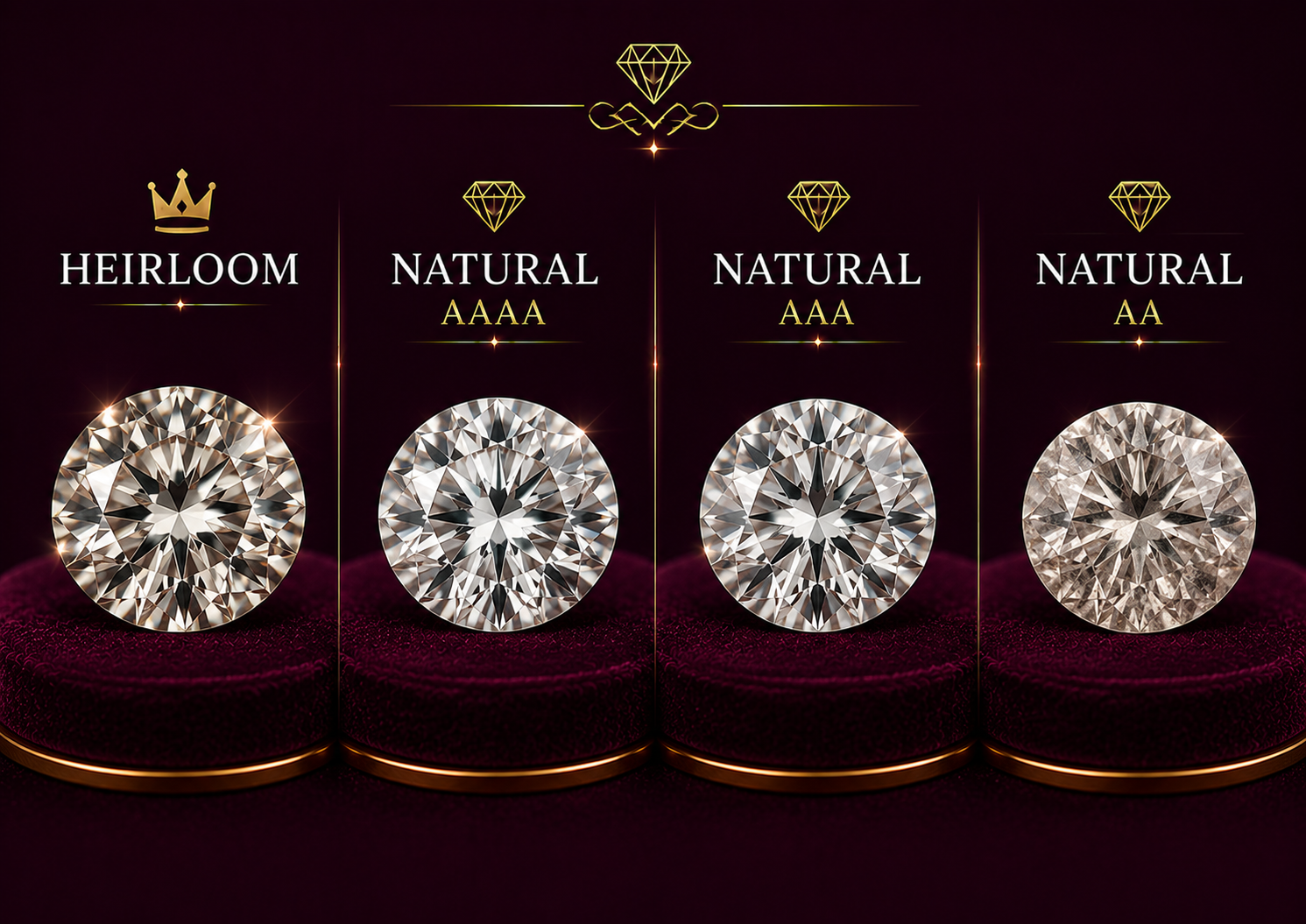
| Feature | Heirloom | AAAA | AAA | AA |
|---|---|---|---|---|
| Overall Quality | Exceptional | Premium | Fine | Good |
| Color | Outstanding | Rich | Strong | Good |
| Clarity | Excellent | Very High | High | Moderate |
| Luster | Exceptional | Excellent | Very Good | Good |
| Surface Quality | Minimal imperfections | Very clean | Minor imperfections | More visible natural features |
| Jewelry Use | Luxury & collector pieces | Fine jewelry | Everyday luxury | Fashion jewelry |
| Relative Price | Highest | High | Moderate to High | Affordable |
| Best Buyer | Collectors & luxury buyers | Premium shoppers | Most jewelry buyers | Budget-conscious buyers |
Remember that this Gemstone Grade Chart reflects common retail practices. Individual retailers may define these grades differently.
Heirloom vs AAAA
One of the biggest questions buyers ask is:
Is Heirloom better than AAAA?
In most retail grading systems, yes.
Heirloom gemstones are usually selected from the finest portion of a retailer’s inventory. However, the difference between Heirloom and AAAA is often smaller than many shoppers expect.
A Heirloom gemstone may offer:
- Slightly richer color
- Better optical performance
- Higher rarity
- Better overall matching for luxury jewelry
If you compare them individually rather than side by side, many people would struggle to spot the difference.
For buyers who want outstanding beauty without chasing the absolute top grade, AAAA often delivers excellent value.
AAAA vs AAA
The AAAA vs AAA comparison is where most jewelry shoppers spend their time.
Both grades typically belong in the fine jewelry category.
AAAA usually provides:
- Better color saturation
- Cleaner appearance
- Higher transparency
- Slightly stronger brilliance
AAA generally offers:
- Excellent everyday appearance
- Great durability
- Better affordability
- Outstanding value
For engagement rings, many jewelers consider AAA the “sweet spot” because the visual difference after setting can be quite small while the price difference may be more noticeable.
AAA vs AA
The gap between AAA vs AA becomes easier to see.
AAA gemstones generally have:
- Better color
- Higher clarity
- Greater brilliance
- More even cutting
AA gemstones may display:
- More visible inclusions
- Slightly lighter color
- Reduced transparency
- Lower overall brilliance
Even so, AA remains a practical option for buyers who value affordability over perfection.
Which Gemstone Grade Offers the Best Value?
There isn’t a single answer because every buyer has different priorities.
Here’s a simple buying guide.
Choose Heirloom Grade if:
- You want the highest-quality gemstone offered by a retailer.
- You’re creating bespoke luxury jewelry.
- You appreciate exceptional color and rarity.
- Budget isn’t your primary concern.
Choose AAAA Grade if:
- You want premium quality.
- You prefer luxury jewelry without paying for the very highest retail grade.
- You value outstanding appearance.
Choose AAA Grade if:
- You want the best balance of quality and price.
- You’re buying an engagement ring.
- You want beautiful everyday jewelry.
- You want excellent long-term satisfaction.
Choose AA Grade if:
- You’re shopping on a budget.
- You’re purchasing fashion jewelry.
- You prefer a larger gemstone over a higher grade.
- You don’t mind natural inclusions.
For many buyers, AAA gemstones offer the best overall value, while AAAA appeals to those seeking an extra level of refinement.
Which Grade Is Best for Engagement Rings?
Engagement rings are worn every day, so beauty and durability both matter.
Many shoppers compare Heirloom vs AAAA vs AAA before making such an important purchase.
A practical guide looks like this:
- Heirloom — Best for luxury custom engagement rings.
- AAAA — Excellent for premium fine jewelry.
- AAA — Outstanding balance of beauty and value.
- AA — Suitable for budget-conscious buyers.
Beyond the grade, also consider:
- Gemstone hardness
- Cut quality
- Secure setting
- Overall craftsmanship
- Any disclosed treatments
- Independent laboratory documentation when available
These factors often have a greater impact on long-term enjoyment than the retailer’s grade alone.
Common Misconceptions About Gemstone Grades
Myth 1: AAAA is an official international grade.
Reality: There is no worldwide grading standard that defines AAAA for all colored gemstones.
Myth 2: Every retailer uses the same grading system.
Not true.
One retailer’s AAAA gemstone may be another retailer’s AAA gemstone.
Myth 3: Higher grade always means better investment.
Investment value depends on many factors, including rarity, species, origin, treatment history, certification, provenance, and market demand – not just a retailer’s quality label.
Myth 4: AA gemstones are low quality.
AA gemstones can still be beautiful, natural, and suitable for fine jewelry. They simply display more natural characteristics than higher grades.
Tips for Choosing High-Quality Natural Gemstones
When buying gemstones online or in-store:
- Compare actual photos and videos whenever possible.
- Read the seller’s grading policy.
- Check whether any treatments have been disclosed.
- Ask about gemstone origin if it matters to you.
- Look for laboratory documentation when appropriate.
- Buy from reputable jewelers with transparent return policies.
- Focus on the gemstone’s overall appearance rather than the grade alone.
A trustworthy retailer should clearly explain what their grading terms mean instead of expecting buyers to guess.
Frequently Asked Questions
Is Heirloom grade higher than AAAA?
In most retail grading systems, yes. Heirloom grade is typically positioned above AAAA, although grading definitions vary from one retailer to another.
What is the difference between AAAA and AAA gemstones?
AAAA gemstones usually have better color saturation, fewer visible inclusions, and higher overall visual appeal. AAA gemstones still offer excellent quality and are often considered the best balance between beauty and price.
Is AA gemstone quality worth buying?
AA gemstones are a good choice for buyers who want natural gemstones at a more affordable price. They may have more visible inclusions but can still look beautiful when set in jewelry.
Are AAAA, AAA, and AA gemstone grades officially standardized?
No. Commercial grades like AAAA, AAA, and AA are created by individual retailers and are not standardized by gemological organizations.
How are natural gemstones graded?
Natural gemstones are typically evaluated based on color, clarity, cut, transparency, luster, surface quality, and overall appearance. Different retailers may use different grading scales.
Can two AAAA gemstones look different?
Yes. Because AAAA is not an internationally standardized grade, gemstones labeled AAAA by different retailers may vary in color, clarity, and overall quality.
What should I look for besides gemstone grade?
Focus on color, clarity, cut, transparency, luster, durability, treatments, certification, and the jeweler’s reputation. These factors often matter more than the grade label itself.
Is Heirloom grade worth the extra cost?
If you want the finest gemstone a retailer offers and appreciate exceptional color and clarity, Heirloom grade may be worth the premium. For many buyers, however, AAAA or AAA provides excellent beauty at a lower price.
Final Thoughts
Understanding Heirloom vs Natural AAAA vs AAA vs AA becomes much easier once you know that these are retailer-defined quality grades, not universal industry standards.
Rather than focusing only on the letters, evaluate the gemstone’s color, clarity, cut, luster, transparency, and authenticity. Review clear photos, ask questions about treatments, and choose a reputable jeweler who explains their grading system openly.
A beautiful gemstone isn’t defined by its label alone. The right choice is the one that matches your expectations, your budget, and the piece of jewelry you’ll enjoy wearing for years to come.