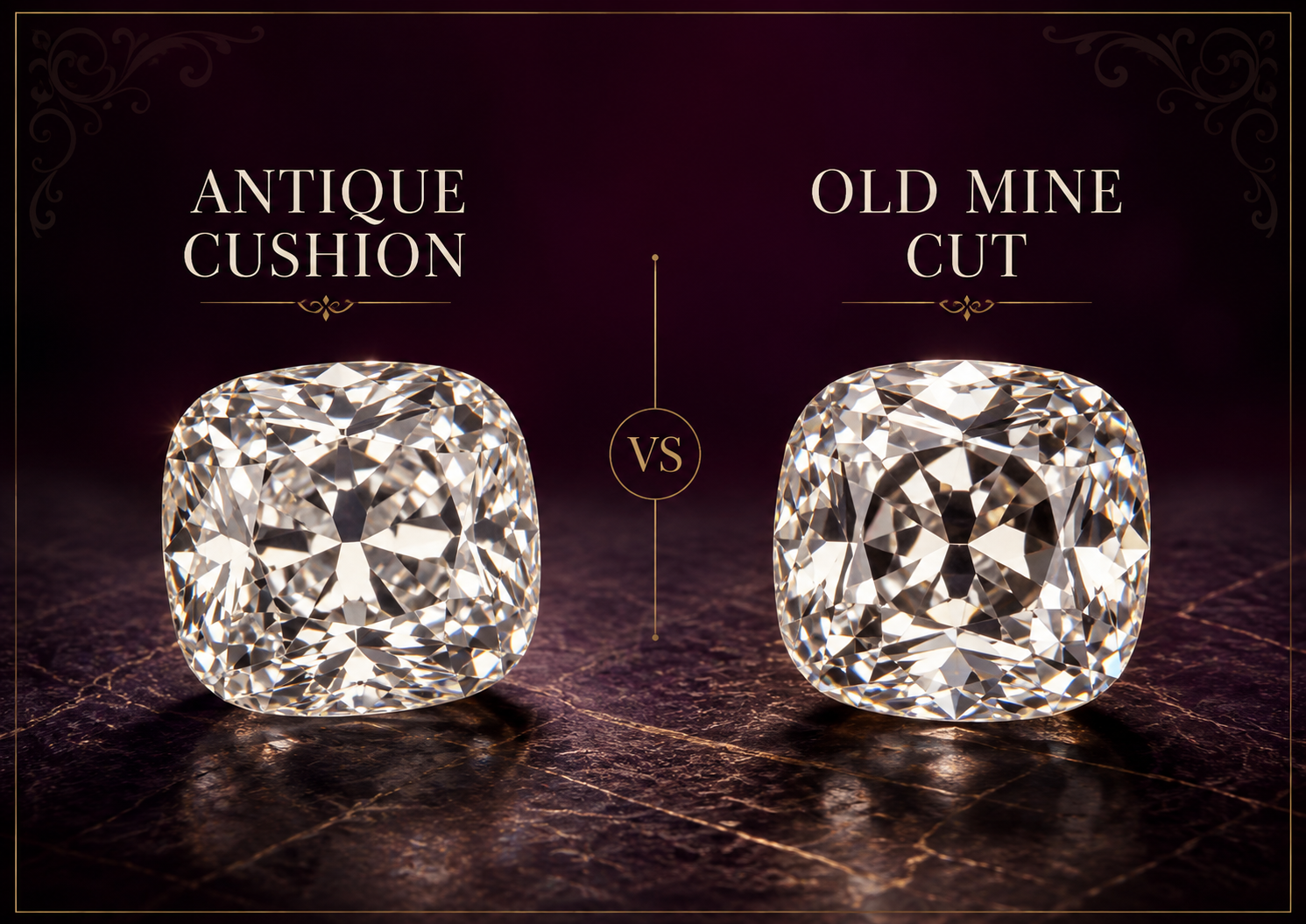
Antique Cushion and Old Mine Cut diamonds can look remarkably similar. Both are associated with vintage jewelry, soft cushion-shaped outlines, chunky facets, high crowns, and the broad flashes of light that make antique diamonds so distinctive.
The confusion comes from the fact that “Antique Cushion” is not always used as a strict historical cut name, while Old Mine Cut refers to a specific historic cutting style.
An Old Mine Cut is one of the early cushion-shaped brilliant cuts that preceded the modern cushion cut. An Antique Cushion can be used more broadly for a historic or vintage-inspired cushion diamond that has characteristics associated with older hand-cut stones.
So, while the two terms overlap, they are not necessarily interchangeable.
Antique Cushion vs Old Mine Cut: Quick Answer
The simplest way to understand the difference is:
- Old Mine Cut: A specific historic diamond-cutting style that became common from the 18th century through the 19th century.
- Antique Cushion: A broader term used for cushion-shaped diamonds with antique or vintage-style characteristics.
- Shape: Both can have soft, cushion-like outlines and rounded corners.
- Facets: Both can have large, chunky facets that create broad flashes of light.
- Culet: An Old Mine Cut typically has a noticeable open culet.
- Symmetry: Authentic Old Mine Cuts were hand-cut, so irregularity is common.
- Modern availability: Antique-style cushions can be newly cut, while an authentic historic Old Mine Cut is an antique stone.
GIA describes the Old Mine Cut as the forerunner of today’s modern cushion brilliant and notes its characteristic squarish shape, high crown, small table, deep pavilion, and large culet.
What Is an Antique Cushion Cut?
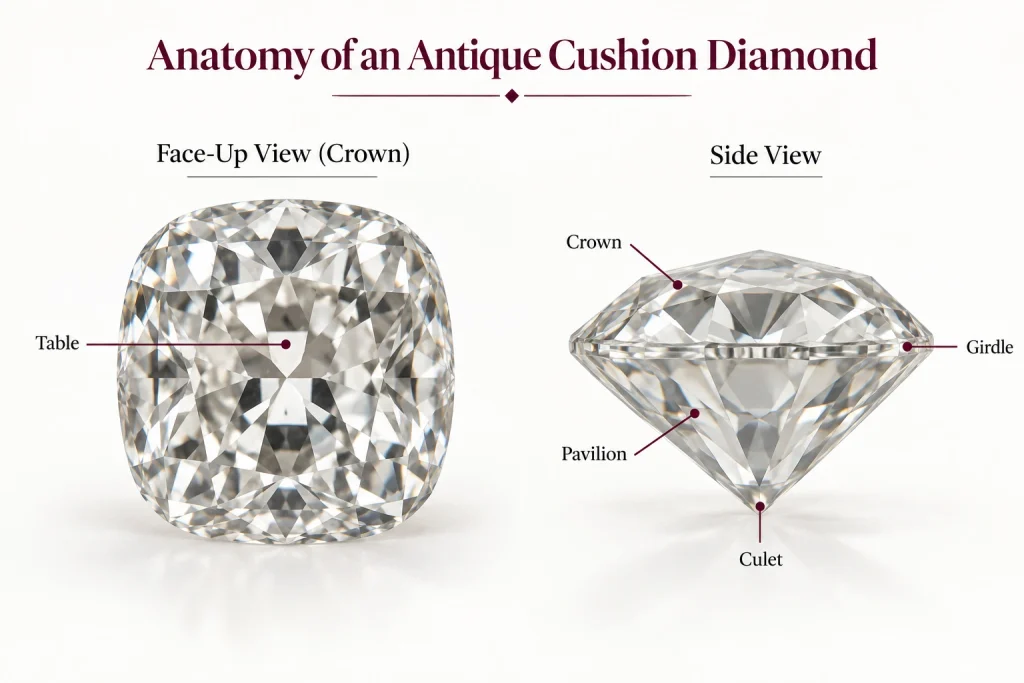
An Antique Cushion Cut is a cushion-shaped diamond with characteristics associated with older diamond-cutting styles.
Unlike a modern cushion cut, which is produced with contemporary cutting equipment and aims for greater consistency, an antique-style cushion may emphasize:
- A soft square or rectangular outline
- Rounded corners
- Larger facets
- A relatively high crown
- A smaller table
- A visible culet
- Less-than-perfect symmetry
- Broad, slower-looking flashes of light
The term can describe an authentic antique diamond, but it can also be used for a newly cut diamond designed to reproduce the appearance of historic cushions.
That distinction matters when shopping.
A diamond described as an “antique cushion” is not automatically an antique diamond. Always ask whether the stone itself is old or whether it is a modern diamond cut in an antique-inspired style.
What Is an Old Mine Cut Diamond?
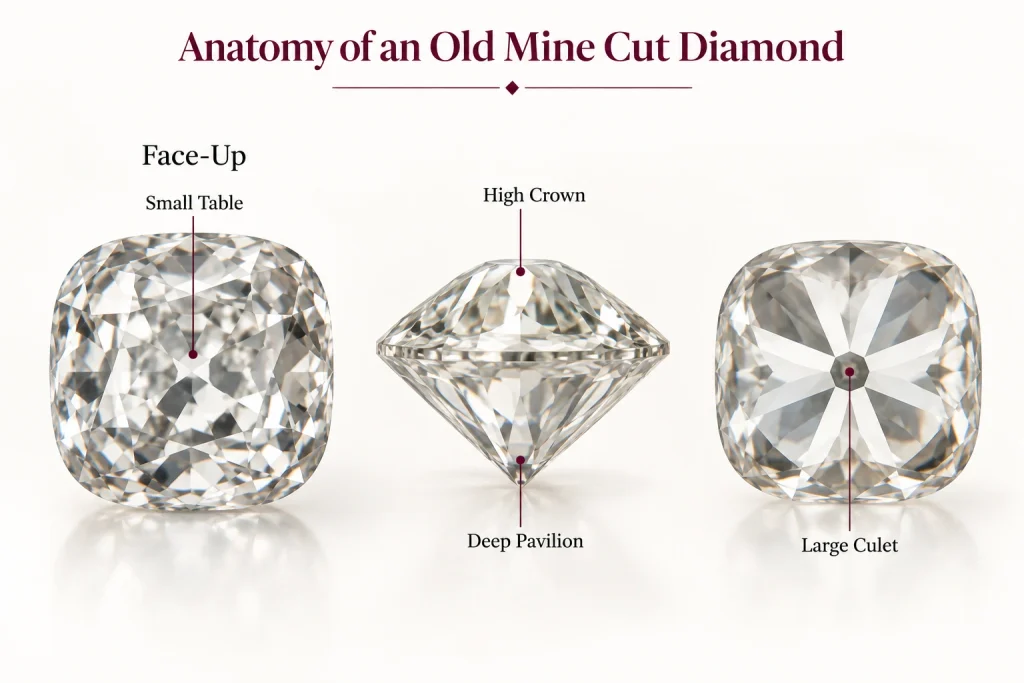
An Old Mine Cut is a historic brilliant-style diamond cut that became widely used during the 18th and 19th centuries.
GIA identifies the Old Mine Cut as the predecessor of the modern cushion brilliant. It was particularly suited to the cutting technology and diamond rough available at the time.
Classic Old Mine Cut characteristics include:
- A squarish or cushion-shaped outline
- Rounded corners
- High crown
- Small table
- Deep pavilion
- Large culet
- Chunky facets
- Hand-cut or hand-finished appearance
- Individual variations in symmetry and proportions
These proportions produce a very different visual effect from a modern brilliant diamond.
Instead of the small, rapid scintillation many shoppers associate with modern brilliant cuts, an Old Mine Cut tends to produce broader flashes of light.
The original cutting style also developed before modern electric lighting and computerized diamond planning. Cutters worked with the technology and rough material available to them rather than today’s mathematical optimization methods.
Are Antique Cushion and Old Mine Cut the Same?
Not exactly, but the terms overlap heavily.
This is the most important point to understand.
An Old Mine Cut is a defined historical cutting style. “Antique Cushion” is more flexible and can be used to describe a range of cushion-shaped diamonds with antique characteristics.
Historically, the Old Mine Cut represents an important part of the evolution of the cushion shape. GIA specifically describes it as the forerunner of the modern cushion brilliant.
However, modern jewelers may use “antique cushion” to describe:
- An authentic antique cushion-shaped diamond
- An Old Mine Cut diamond
- A vintage cushion with antique-style faceting
- A newly cut diamond designed to reproduce antique proportions
That means you should not assume that every diamond labeled “Antique Cushion” is an authentic Old Mine Cut.
Likewise, a diamond labeled Old Mine Cut is telling you something more specific about its historical cutting style.
Antique Cushion vs Old Mine Cut: Side-by-Side Comparison
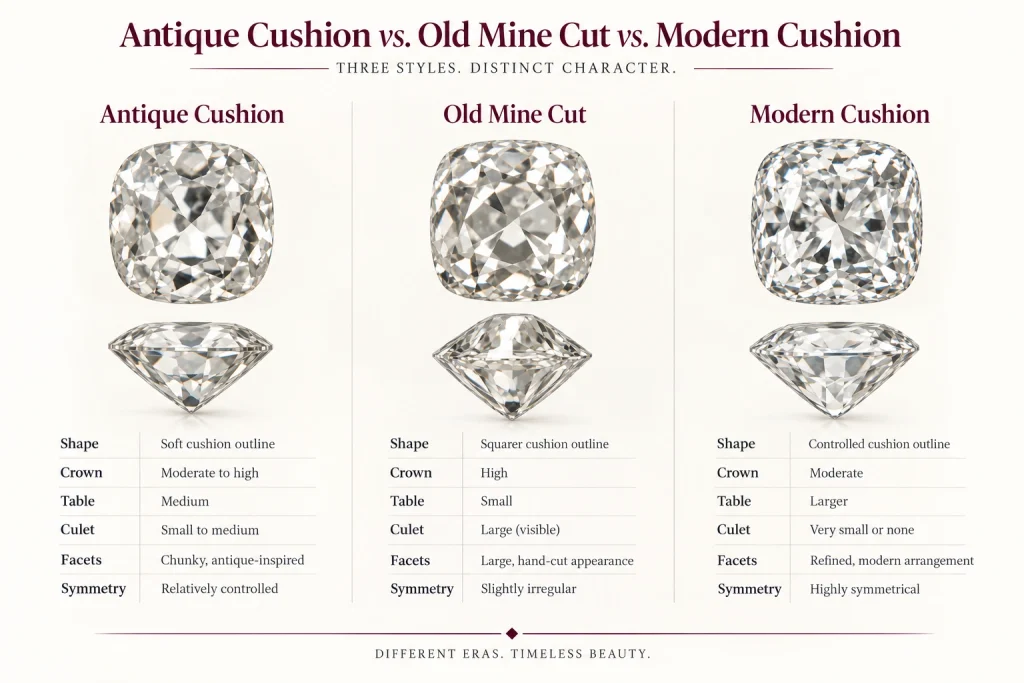
| Feature | Antique Cushion | Old Mine Cut |
|---|---|---|
| Meaning | Broad description of an antique-style cushion | Specific historic cutting style |
| Historical connection | Can refer to several antique cushion styles | Strongly associated with 18th- and 19th-century cutting |
| Shape | Cushion, square, or slightly rectangular | Usually squarish cushion with rounded corners |
| Crown | Often relatively high | Typically high |
| Table | Often small | Typically small |
| Culet | May be open or closed | Usually large and open |
| Facets | Chunky antique-style facets | Large, chunky hand-cut facets |
| Symmetry | Depends on the stone | Often irregular |
| Sparkle | Broad, softer flashes | Broad, chunky flashes |
| Modern versions | Commonly available | Modern reproductions are available, but they are not antique stones |
| Authentic antique examples | Relatively uncommon | Increasingly collectible |
The table illustrates why the terminology can be confusing: there is considerable visual overlap.
Shape and Proportions
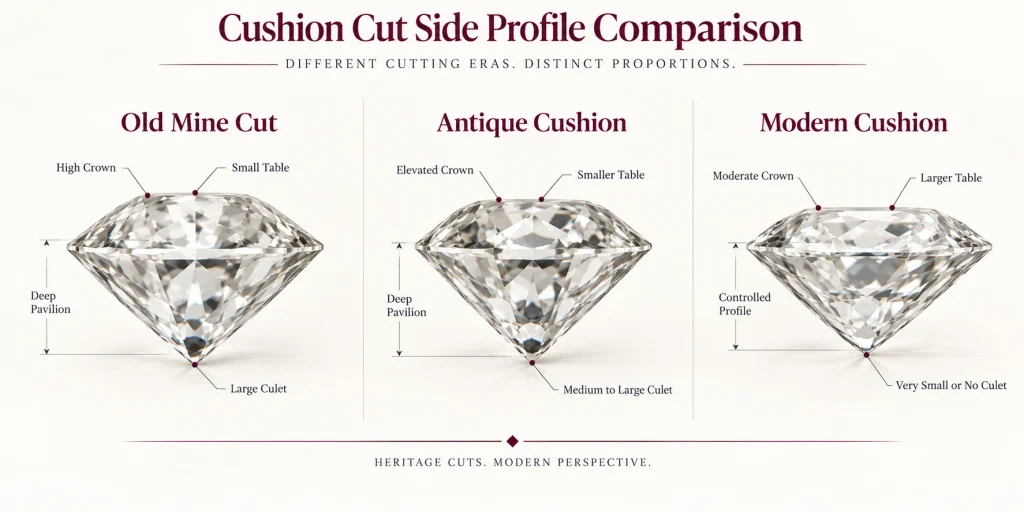
One of the easiest ways to distinguish an Old Mine Cut is to look at its outline and proportions.
Old Mine Cuts tend to have a softly squared cushion outline rather than the highly controlled shape of a modern cushion. Their high crown and small table can make the stone look taller and more dimensional when viewed from the side.
Their deep pavilion and large culet are also important characteristics. GIA identifies the high crown, small table, deep pavilion, and large culet as defining features of the Old Mine Cut.
Antique Cushion is less predictable because the term can cover a wider range of stones.
One Antique Cushion might closely resemble an Old Mine Cut, while another might have more refined proportions and a smaller culet.
For that reason, the label alone is not enough. Look at the actual diamond.
Facets and Sparkle
The biggest visual difference between these antique-style diamonds and modern cushions is often the character of their sparkle.
Old Mine Cut diamonds have large, chunky facets that create broad flashes rather than the rapid, glittering scintillation associated with many modern brilliant cuts.
This appearance is part of their appeal.
Instead of looking perfectly symmetrical and uniformly bright, an Old Mine Cut may appear to change dramatically as the diamond moves.
An Antique Cushion can produce a similar effect when it uses traditional proportions and large facets. Modern antique-inspired cushions may also be cut with greater precision while retaining some of the visual character associated with older stones.
So if you prefer:
Broad flashes and an irregular, romantic appearance: look toward an authentic Old Mine Cut or a strongly antique-style cushion.
A vintage appearance with more controlled cutting: consider a modern Antique Cushion.
What About the Culet?
The culet is particularly important when comparing these two styles.
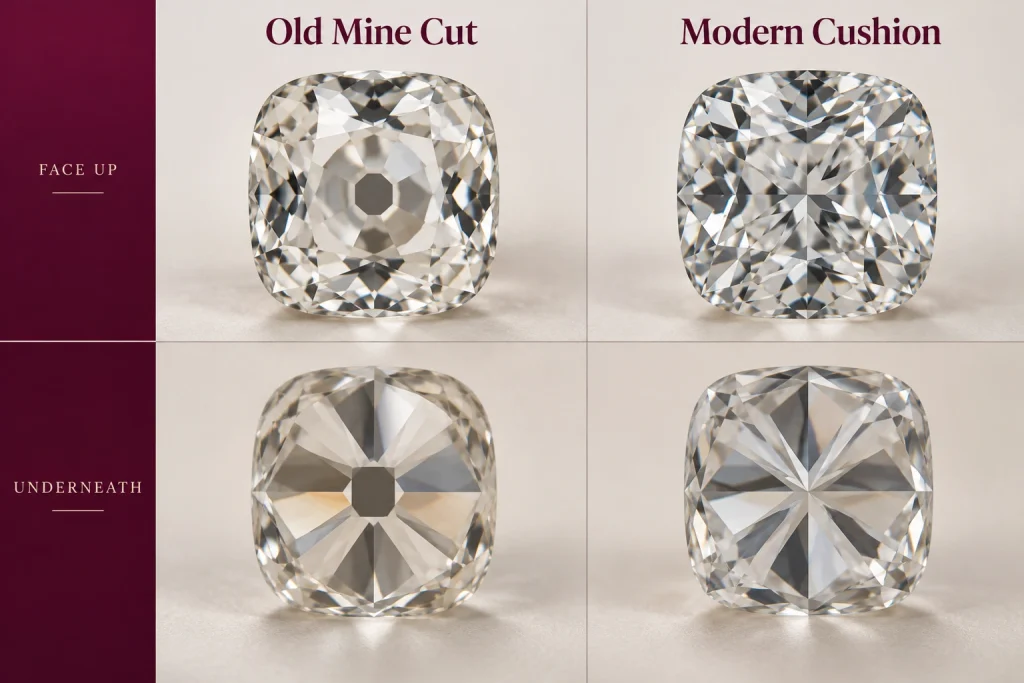
A culet is the facet or small area at the bottom of a diamond’s pavilion. On modern diamonds, it is often extremely small or effectively invisible from the face-up view.
Old Mine Cuts commonly have a large, open culet that can be seen through the table.
This is one of the most recognizable characteristics of the style.
If you’re unfamiliar with culets, understanding what a diamond culet is can make antique diamonds much easier to evaluate.
A visible culet should not automatically be treated as a defect. In an Old Mine Cut, it is part of the historical cutting style.
Why Do Old Mine Cuts Look Different From Modern Cushions?
The difference comes down largely to how diamonds were cut.
Historic cutters did not have today’s computer modeling, precision equipment, or modern understanding of optimized light performance.
They worked with hand tools and the natural shape of the rough diamond.
GIA notes that Old Mine Cuts were shaped to accommodate the limitations of historical cutting technology while retaining as much weight from the rough as practical.
Modern cushion cuts, by contrast, are produced with contemporary techniques that allow much greater consistency.
For a broader explanation of cushion shapes and proportions, see the cushion cut diamond guide.
How Can You Tell an Old Mine Cut Diamond?
If you’re looking at a diamond that may be an Old Mine Cut, examine several characteristics together rather than relying on one feature.
Look for:
1. A squarish cushion outline
The stone should generally have a soft square or cushion-like shape with rounded corners.
2. A small table
The table often looks noticeably smaller than that of a modern brilliant diamond.
3. A high crown
Old Mine Cuts tend to have a tall crown, which contributes to their distinctive profile.
4. A deep pavilion
The lower portion of the diamond is typically deeper than what you would expect from many modern cuts.
5. A large culet
Look through the table and check whether a noticeable culet is visible near the center.
6. Irregularity
Authentic hand-cut stones often show asymmetry or variations in facet alignment.
None of these characteristics should be considered in isolation. A modern diamond can imitate several of them, so the stone’s history and documentation are also important if authenticity matters to you.
Antique Cushion vs Old Mine Cut for an Engagement Ring
The choice largely depends on what you want the diamond to communicate visually.
An Old Mine Cut may suit you if you like:
- Authentic antique jewelry
- Historical craftsmanship
- Hand-cut individuality
- Chunky facets
- Broad flashes
- Visible culets
- A one-of-a-kind appearance
An Antique Cushion may suit you if you want:
- A vintage-inspired appearance
- More choice in shape and proportions
- The look of an antique diamond with modern cutting
- The option of newly cut stones
- A cushion shape with softer, traditional faceting
There is no single specification that makes one automatically preferable. The individual diamond matters considerably, especially with antique-style stones.
Antique Cushion vs Old Mine Cut vs Modern Cushion
The three terms become easier to understand when placed on a spectrum.
Old Mine Cut
This is the historical option.
Think:
hand-cut + cushion-shaped + high crown + small table + large culet + irregular character
Antique Cushion
This is the broader category.
Think:
cushion shape + antique-inspired proportions + chunky facets + vintage appearance
It may be an authentic antique or a newly cut stone, depending on the seller and description.
Modern Cushion
This is the contemporary option.
Think:
precision cutting + controlled proportions + greater consistency + modern light performance
Modern cushions are available in several facet arrangements and shapes, which is why two modern cushion diamonds can look quite different from each other.
Are Old Mine Cut Diamonds Rare?
Authentic Old Mine Cut diamonds are no longer being produced using the historical cutting process.
That makes genuine examples different from newly cut diamonds that imitate the style.
Their rarity can also vary considerably depending on the stone’s condition, size, color, clarity, provenance, and overall appearance.
If you’re shopping for one, don’t assume that the word “antique” guarantees rarity or value. Documentation and the actual characteristics of the diamond matter.
Can You Buy a Lab-Grown Old Mine Cut Diamond?
Yes.
A lab-grown diamond can be cut with an Old Mine-inspired faceting pattern and proportions.
However, there is an important distinction:
A lab-grown Old Mine-style diamond is modern, even if its cutting style is based on a historic Old Mine Cut.
The same principle applies to Antique Cushion lab-grown diamonds.
What Should You Check Before Buying?
When shopping for an Antique Cushion or Old Mine Cut, don’t focus only on the name.
Check:
Face-up appearance
Look at the diamond under different lighting conditions. Antique cuts can change dramatically depending on the environment.
Culet
Decide whether you like a visible culet and how prominent it appears.
Symmetry
Some asymmetry is expected in genuine hand-cut stones, but you should decide how much variation you’re comfortable with.
Outline
Compare the actual shape rather than relying on the listing’s name.
Facet pattern
Look for the broad flashes and chunky pattern associated with antique cutting.
Condition
For an antique stone, inspect the girdle, culet, edges, and any signs of wear or damage.
Documentation
If the seller claims the stone is an authentic antique or Old Mine Cut, ask what evidence supports that description.
This is particularly important because terminology is not always used consistently across jewelry listings.
Which Has More Sparkle?
There is no simple answer because “sparkle” can mean different things.
Old Mine Cuts generally produce large, broad flashes rather than the rapid scintillation associated with many modern brilliant diamonds.
An Antique Cushion can produce a similar effect, particularly when it retains traditional proportions and chunky faceting.
A modern cushion may appear brighter or more consistently brilliant depending on its specific facet design and proportions.
If you like the slower, broader flashes of antique diamonds, compare the actual stones rather than choosing based solely on the cut name.
Which One Should You Choose?
If your priority is historical character, an authentic Old Mine Cut is the more specific choice.
If your priority is a vintage appearance with more flexibility, an Antique Cushion may give you more options.
If your priority is modern precision and consistent brilliance, a contemporary cushion cut may make more sense.
The key is to understand that “Antique Cushion” and “Old Mine Cut” describe overlapping territory rather than two completely separate visual categories.
Frequently Asked Questions
Is an Antique Cushion the same as an Old Mine Cut?
Not necessarily. Old Mine Cut is a specific historic cutting style, while Antique Cushion is a broader term that can describe cushion-shaped diamonds with antique characteristics.
Is an Old Mine Cut a cushion cut?
An Old Mine Cut generally has a squarish, cushion-like outline. GIA describes it as the forerunner of today’s modern cushion brilliant.
Do Old Mine Cut diamonds have large culets?
Yes. A large, visible culet is one of the classic characteristics of an Old Mine Cut.
Are Old Mine Cut diamonds always square?
No. They are generally squarish or cushion-shaped, but historical hand cutting produced significant variation between individual stones.
Are Antique Cushion diamonds modern or antique?
Either. “Antique Cushion” can refer to an authentic antique diamond or a modern diamond cut to reproduce an antique appearance. Ask the seller about the stone’s actual age and cutting history.
Can an Antique Cushion be lab grown?
Yes. A modern lab-grown diamond can be cut in an antique-inspired cushion style.
Are Old Mine Cut diamonds valuable?
Some are highly desirable among collectors, but value depends on the individual stone, including its size, color, clarity, condition, provenance, and appearance. The cut name alone does not determine value.
Which is better for a vintage engagement ring?
Both can work well. Old Mine Cut offers a more specifically historic character, while an Antique Cushion can provide more flexibility in appearance and availability. The right choice depends on the look and characteristics you prefer.
Final Takeaway
The difference between Antique Cushion and Old Mine Cut is mainly a matter of terminology, history, and specificity.
An Old Mine Cut is a recognizable historic cutting style with a squarish cushion outline, high crown, small table, deep pavilion, chunky facets, and typically a large culet.
Antique Cushion is a broader description that can include Old Mine Cuts as well as other antique or modern vintage-inspired cushion diamonds.
If you want genuine historical character, pay close attention to the stone’s actual cutting characteristics and provenance rather than relying only on the label. If you simply love the antique look, modern Antique Cushion and Old Mine-inspired diamonds can provide that aesthetic with more availability and consistency.