Choosing an engagement ring involves more than picking a diamond shape and metal. Small design details can affect the ring’s appearance, durability, and how well the center stone is supported.
One of those details is the prong style.
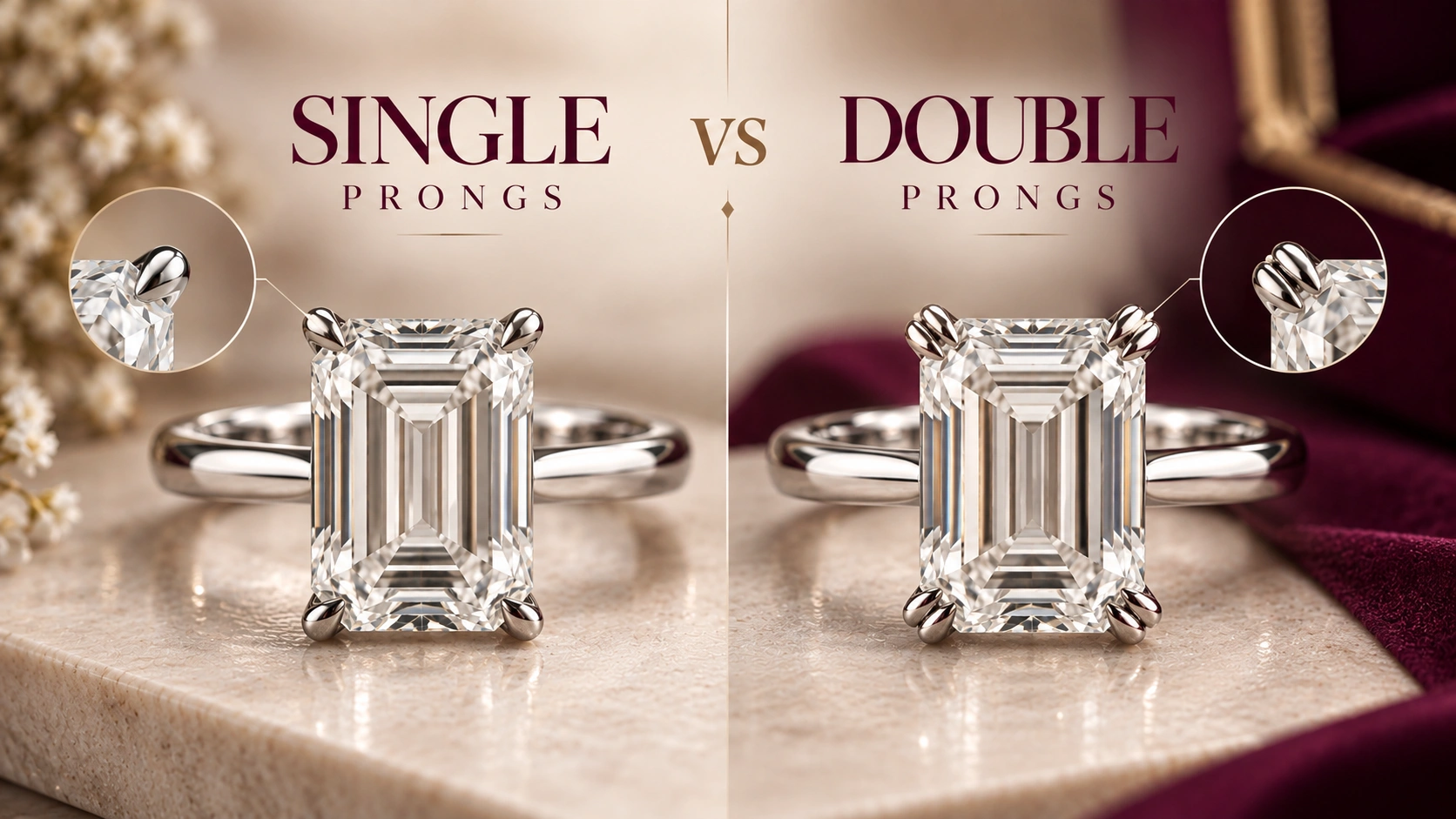
Double prongs use two slim prongs at each point of contact, while single prongs use one prong at each position. The difference may look subtle, but it can noticeably change the character of an engagement ring.
So, which is better: double prongs or single prongs?
The answer depends on your diamond’s shape and size, the overall ring design, how much metal you want around the stone, and the level of protection you need. Double prongs can provide additional support and work especially well with larger or geometric stones, while single prongs create a cleaner and more minimal appearance.
Double Prongs vs Single Prongs at a Glance
| Feature | Single Prongs | Double Prongs |
|---|---|---|
| Prongs at each position | One | Two |
| Overall appearance | Clean and minimal | Detailed and refined |
| Metal around the stone | Less | More |
| Visual emphasis | Diamond-focused | Setting-focused |
| Support | Good when properly designed | Additional points of contact |
| Best suited to | Minimalist designs and many classic settings | Larger stones and geometric shapes |
| Style | Simple, timeless | Vintage, architectural, or distinctive |
| Maintenance | Generally simpler | More individual prongs to inspect |
Neither style is universally better. The right choice depends on the stone and the design.
What Are Single Prongs?
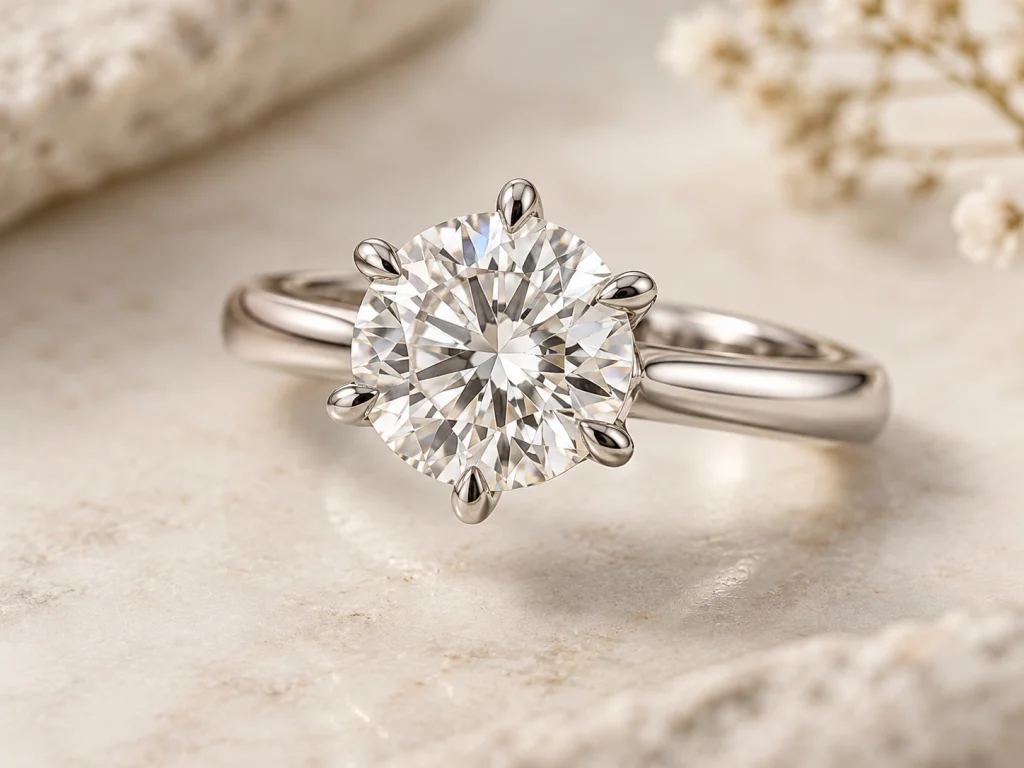
A single-prong setting uses one prong at each designated position around the center stone.
For example, a traditional four-prong ring has four individual prongs holding the diamond. A six-prong ring has six.
The main advantage is simplicity. Because each position uses one prong, the setting can have a clean appearance with relatively little metal around the diamond.
This can help the center stone remain the visual focus of the ring.
Single prongs are particularly appealing if you prefer:
- A minimalist appearance
- Less visible metal
- A classic engagement ring design
- A simple solitaire setting
- A setting that doesn’t visually compete with the diamond
A properly made single-prong setting can still provide excellent security. The quality and positioning of the prongs matter just as much as whether they are single or double.
What Are Double Prongs?
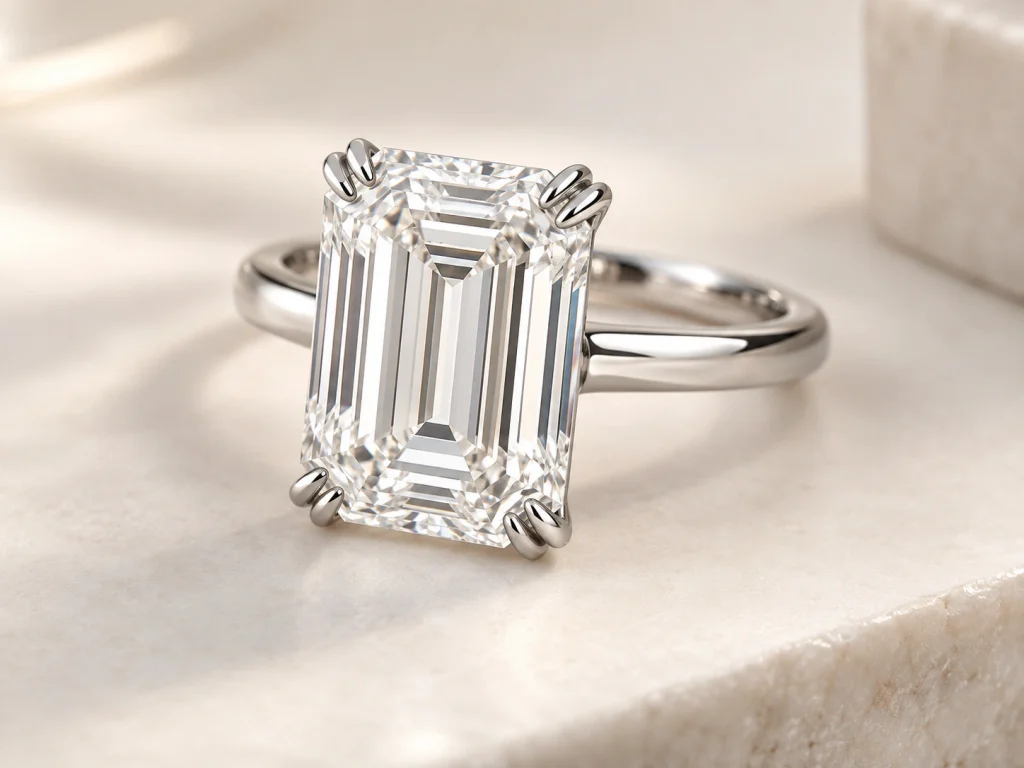
Double prongs use two smaller prongs side by side at each designated position around the stone.
Instead of one larger-looking claw, the jeweler uses a pair of slimmer claws. This can create a more intricate appearance while providing additional contact around the stone.
Double prongs are often associated with larger center stones and geometric diamond shapes such as emerald and Asscher cuts. They can also complement cushion and other shapes where paired prongs suit the outline of the stone.
The paired-prong design can also create a distinctive vintage or architectural appearance.
Double Prongs vs Single Prongs: What’s the Difference?
The biggest difference is the number of individual prongs used at each position.
With single prongs, one piece of metal contacts the stone at each position.
With double prongs, two slimmer pieces work together.
That difference affects several aspects of the ring.
1. Security
Double prongs can provide additional support because there are more individual contact points around the stone. This can be useful for larger center stones or diamond shapes with corners that benefit from careful protection.
However, it would be misleading to say that every double-prong ring is automatically safer than every single-prong ring.
A well-made single-prong setting can be extremely secure, while a poorly fitted double-prong setting can still have problems.
The quality of the setting matters.
The prongs should be properly seated against the stone, appropriately proportioned, and finished so they don’t create unnecessary snagging or weak points.
2. Appearance
Single prongs generally create a simpler look.
From a distance, they can almost disappear into the design, allowing the center diamond to dominate.
Double prongs are more noticeable because there are two claws instead of one. Rather than trying to hide the setting completely, they can become part of the ring’s design.
This makes double prongs particularly attractive if you like a detailed, vintage-inspired, or architectural appearance.
3. Metal Coverage
Double prongs generally introduce more visible metal around the stone.
However, this doesn’t necessarily mean they cover a dramatically larger portion of the diamond.
A well-designed double-prong setting often uses two narrow claws instead of one larger prong. The paired claws can therefore look delicate despite having more individual pieces of metal.
The actual coverage depends on the prong size, shape, placement, and the diamond itself.
4. Maintenance
A double-prong ring has more individual prongs to inspect.
That doesn’t mean it is difficult to maintain, but there are more small components that need to remain properly positioned.
Any engagement ring with exposed prongs should be inspected periodically, especially if it is worn every day.
If a prong becomes bent, loose, or damaged, the stone may no longer be held as intended.
For related information, see this guide on how often ring prongs should be checked.
Are Double Prongs More Secure Than Single Prongs?
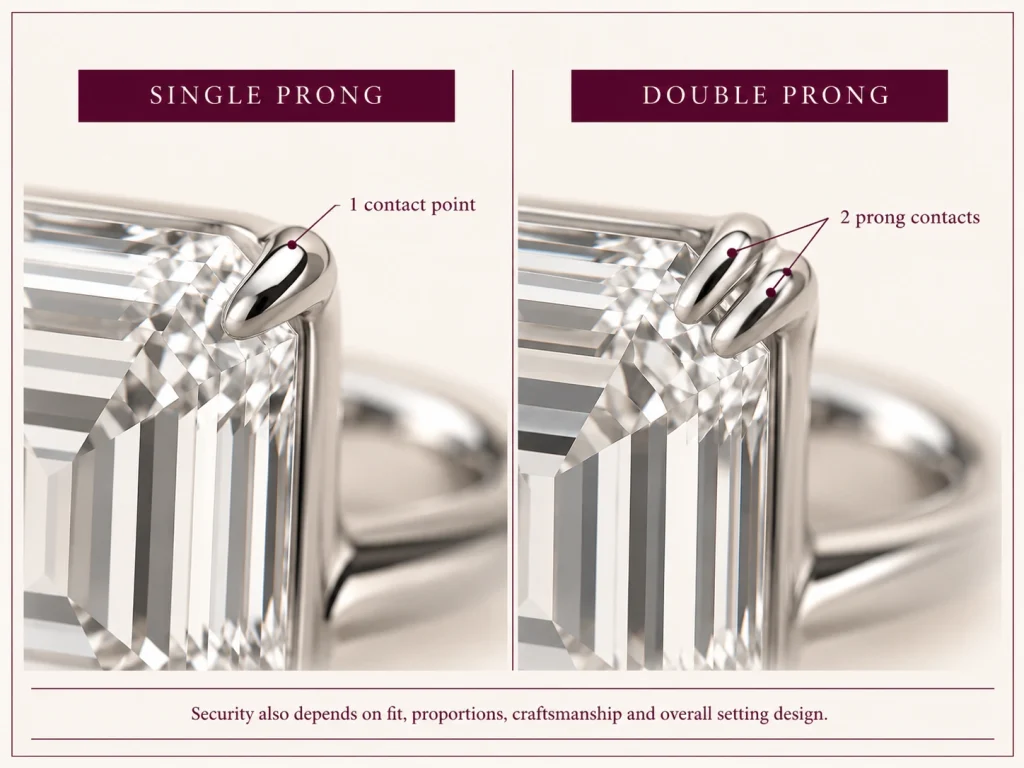
They can provide additional security, but prong count alone doesn’t determine how secure a ring is.
Double prongs create more individual points of contact, which can be beneficial for certain stones. They are often chosen for larger diamonds and for shapes where additional support around the corners is useful.
But the quality of the setting is critical.
Consider:
- How well the diamond is seated
- Whether the prongs make proper contact
- The thickness and proportions of the prongs
- The number of total prongs
- The diamond’s shape and size
- How high the stone sits above the finger
- How the ring will be worn
For example, a properly constructed six-prong single-prong setting can offer excellent security, while a poorly constructed double-prong setting isn’t automatically superior.
If you are concerned about a loose or damaged prong, see how to know if a prong is loose.
Which Diamond Shapes Work Best With Double Prongs?
Double prongs can be especially attractive on diamonds with defined corners or geometric outlines.
Emerald Cut
Emerald-cut diamonds are a natural match for double prongs.
Their long, straight edges and cropped corners create a structured outline that pairs well with two slim claws at the corners.
The additional support can also be useful for larger emerald-cut stones.
Asscher Cut
Asscher diamonds have a strongly geometric appearance, so double prongs can reinforce that architectural character.
They are frequently paired with double prongs, particularly in larger stones.
Cushion Cut
Double prongs can also work beautifully with cushion cuts.
The paired claws can emphasize the stone’s corners while giving the setting a more detailed appearance.
Radiant Cut
Radiant diamonds have cropped corners and a combination of brilliant-style faceting and a rectangular or square outline.
Double prongs can complement this shape while providing additional support around the corners.
For more information about settings for this shape, see the best setting for a radiant diamond
What About Round and Oval Diamonds?
Double prongs aren’t limited to square or rectangular shapes.
They can also be used with round and oval diamonds when the buyer prefers the look.
A round diamond with double claw prongs can have a refined, delicate appearance, particularly when the claws are narrow and well proportioned.
Oval diamonds can also benefit aesthetically from paired prongs because the additional detail can emphasize the elongated outline.
However, if your goal is to make the diamond appear as open and unobstructed as possible, single prongs may be more appealing.
Double Prongs vs Single Prongs for Large Diamonds
Diamond size is one factor that can influence the decision.
Larger center stones can place greater demands on the ring’s setting, so additional support may be desirable. Double prongs are commonly used for larger stones because the paired prongs can provide additional contact without requiring one large, visually heavy prong.
That doesn’t mean every large diamond requires double prongs.
The complete setting should be considered, including the total number of prongs and how the stone is positioned.
For a large center diamond, it is worth discussing the setting with a qualified jeweler rather than choosing prongs based only on appearance.
Pros and Cons of Single Prongs
Pros
Cleaner appearance: Single prongs keep the setting visually simple.
Less visible metal: The diamond can remain the dominant feature.
Classic style: They work naturally with traditional solitaire designs.
Simple design: Fewer individual prongs can make the setting look less intricate.
Cons
Less redundancy at each position: If an individual prong is damaged, that specific contact point is lost.
May look less distinctive: Buyers wanting a vintage or architectural style may prefer double claws.
Not always ideal for certain stones: Some larger or geometric stones may benefit from a different prong arrangement.
Pros and Cons of Double Prongs
Pros
Additional contact: Two prongs at each position can provide additional support.
Excellent for geometric stones: They pair especially well with emerald, Asscher, cushion, and radiant shapes.
Works well for larger stones: Paired claws can add support without relying on one visually heavy prong.
Distinctive appearance: Double claws can give a ring a refined, vintage-inspired character.
Cons
More visible metal: The paired prongs are more noticeable than a simple single-prong design.
More components to inspect: There are more individual prongs that can potentially require maintenance.
Can look busy on small stones: If the center diamond is relatively small, oversized double prongs may overwhelm its appearance.
Requires careful craftsmanship: Poorly finished paired prongs can look uneven or catch on fabrics.
If your ring’s prongs feel unusually sharp or catch on clothing, these issues are worth addressing rather than simply assuming the style is the problem. See why diamond prongs can feel sharp.
Double Prongs vs Single Prongs: Which Looks Better?
Two Styles. One Very Important Choice.
Looking for a lab-grown engagement ring but not sure which style feels right? Compare these two standout designs and see which one fits your idea of the perfect ring.

A Timeless 4-Prong Solitaire
A clean, classic setting that keeps the center diamond front and center. A strong choice if you prefer simple, elegant engagement rings.
View current price, options & ring details

The Claire Full-Eternity Look
Prefer more sparkle around the band? This low-profile design pairs an oval center diamond with a pavé-set full-eternity shank.
View current price, options & ring details
Prices and availability can change. Product details and pricing are shown for comparison and may vary on the retailer’s website.
This is largely a matter of personal preference.
Choose single prongs if you want:
- A clean, understated ring
- A classic solitaire appearance
- Minimal visible metal
- The diamond to be the main focus
Choose double prongs if you want:
- A more detailed setting
- A vintage-inspired appearance
- A stronger architectural look
- Paired claws that complement the diamond’s shape
There isn’t a universal winner.
The best-looking option is the one that works with the proportions of the stone and the rest of the ring.
Which Should You Choose?
A simple way to approach the decision is to start with your diamond.
Choose single prongs when:
- You prefer a minimalist design.
- Your diamond is relatively small or moderate in size.
- You want the setting to visually recede.
- You prefer a classic solitaire appearance.
Consider double prongs when:
- You have a larger center stone.
- You like a vintage or architectural look.
- Your diamond has strong geometric corners.
- You want additional contact around the stone.
- You like the appearance of paired claws.
You should also consider the number of prongs overall.
A four-prong ring and a six-prong ring can behave differently regardless of whether the individual prongs are single or double. If you’re deciding between those options, see four prongs vs six prongs.
For a broader overview of how prong choices work together, the engagement ring prong guide is the best starting point.
Final Words
Double prongs aren’t automatically better than single prongs, and single prongs aren’t automatically less secure.
Double prongs offer additional points of contact and can be particularly well suited to larger or geometric diamonds. They also create a more detailed look that works beautifully with vintage-inspired and architectural designs.
Single prongs offer a cleaner appearance and allow the center stone to take more visual priority. They can be an excellent choice for buyers who prefer a simple, classic engagement ring.
The most important factor is not simply whether you see one claw or two. The setting should be properly designed for the specific diamond, with well-fitted and correctly proportioned prongs.
If you’re choosing between the two, consider your diamond’s shape, size, overall ring style, and how much visual detail you want before making the final decision.
Frequently Asked Questions
Are double prongs stronger than single prongs?
Double prongs can provide additional support because they create more individual contact points around the stone. However, overall security depends on the entire setting, including craftsmanship, prong placement, stone seating, and the total number of prongs.
Do double prongs hide more of the diamond?
They can introduce more visible metal, but the difference depends on the size and shape of the prongs. Two slim claws may actually look more delicate than one thick prong.
Are double prongs good for emerald-cut diamonds?
Yes. Double prongs are particularly well suited to emerald-cut diamonds because the paired claws complement the stone’s geometric outline and can provide additional support around its corners.
Are single prongs good for large diamonds?
They can be. A large diamond doesn’t automatically require double prongs. The jeweler should consider the stone’s dimensions, weight, shape, and the overall setting when determining the appropriate design.
Do double prongs cost more?
They can, because the setting involves additional metal and more detailed workmanship. The actual price difference depends on the jeweler, metal, setting design, and complexity of the ring.
Are double prongs harder to maintain?
They can require closer attention because there are more individual prongs. Like any prong setting, they should be checked periodically for bending, loosening, wear, or damage.