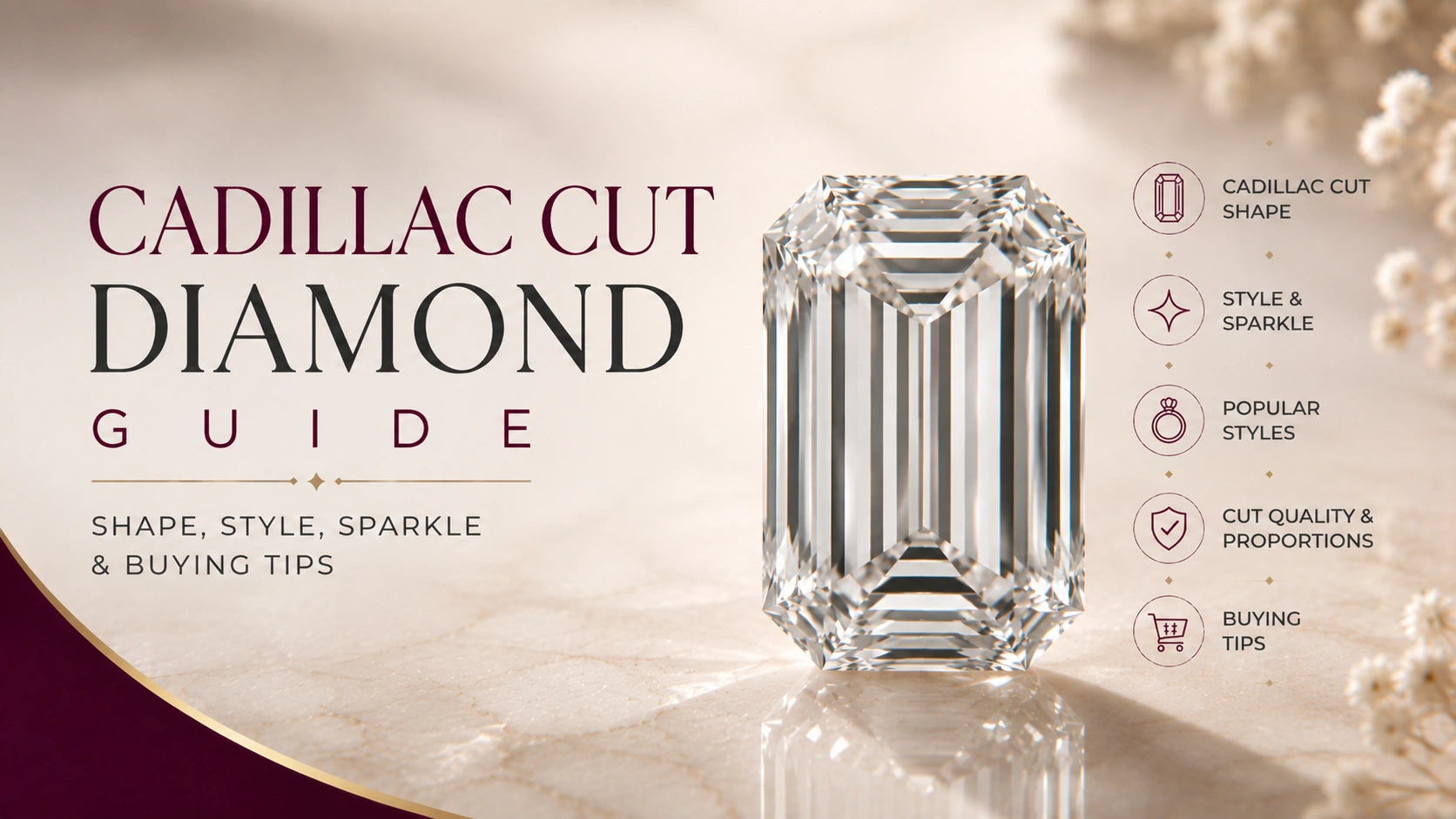
A Cadillac cut diamond is an uncommon geometric diamond shape known for its distinctive five-sided outline and architectural appearance. While it can be used as a center stone, Cadillac diamonds are most commonly seen as side stones, particularly in three-stone engagement rings where they frame a larger center diamond.
Their appeal comes from clean lines, symmetry, and a sophisticated step-cut appearance rather than the intense sparkle associated with traditional brilliant cuts. If you like emerald, baguette, or other geometric diamonds but want something less conventional, a Cadillac cut may be worth considering.
In this guide, we’ll explain what a Cadillac cut diamond is, how it looks, how it sparkles, where it works best in a ring, and what to consider before buying one.
What Is a Cadillac Cut Diamond?
A Cadillac cut diamond is a distinctive five-sided diamond shape with a broad straight edge, angled sides, and a tapered end. Its outline has a shield-like or architectural appearance that makes it immediately recognizable.
Cadillac diamonds are generally associated with step-cut faceting. Instead of the triangular facets commonly found in brilliant-cut diamonds, step cuts use elongated, linear facets that can create broad flashes and a mirror-like appearance.
The term “Cadillac” describes the stone’s distinctive outline rather than being a separate diamond type. This is important because diamond shape and diamond cut are related but different concepts.
For a broader explanation of diamond shapes and how they differ, see the guide to diamond shapes.
Cadillac diamonds are also sometimes called epaulette diamonds in the jewelry trade. Their unusual geometry makes them especially useful when a designer wants side stones that look more distinctive than traditional baguettes or trapezoids.
Why Is It Called a Cadillac Cut?
The name comes from the shape’s resemblance to the shield-like crest associated with the Cadillac automobile brand.
There is no indication that the diamond shape represents an official diamond product from the automaker. Instead, “Cadillac” became a jewelry term used to describe the distinctive five-sided outline.
The name is fitting because the shape has a luxurious, structured appearance. It is particularly suited to designs where symmetry and architectural details are more important than conventional round-diamond brilliance.
What Does a Cadillac Diamond Look Like?
The easiest way to recognize a Cadillac diamond is by its geometric outline.
A typical Cadillac shape has:
- Five sides
- A broad, straight base
- Angled outer edges
- A tapered upper section
- A pointed or sharply defined end
- A symmetrical, architectural appearance
The result is somewhat reminiscent of a combination of a shield, elongated hexagon, and tapered geometric diamond.
The exact outline can vary depending on the stone and the jeweler, so not every Cadillac diamond will have identical proportions.
That variation is part of what makes these stones interesting. They can be selected and matched specifically for a particular center stone and ring design.
How Does a Cadillac Cut Diamond Sparkle?
Cadillac diamonds generally have a more restrained appearance than brilliant-cut diamonds.
Their step-cut style can produce broad flashes of light and a reflective, mirror-like effect. Rather than producing the rapid scintillation and intense fire associated with many brilliant cuts, the visual appeal comes from clean reflections, symmetry, and the contrast between light and dark facets.
This means clarity deserves particular attention.
Step-cut diamonds can make inclusions easier to see because their larger, open facets can provide a clearer view into the stone. When choosing a Cadillac diamond, don’t focus only on the carat weight or color. Examine the stone carefully and consider whether its clarity is visually clean.
For a broader introduction to the factors that influence diamond quality, see the 4Cs of diamond quality.
How Are Cadillac Diamonds Used in Engagement Rings?
Cadillac diamonds are most commonly used as accent or side stones.
Their angular silhouette makes them particularly effective when placed beside a longer center diamond. The tapered geometry can create a smooth visual transition between the center stone and the ring’s band.
They are especially interesting in three-stone engagement rings.
A typical design may place:
Cadillac side stone + center diamond + Cadillac side stone
This symmetrical arrangement gives the ring a distinctive architectural look while helping the center stone remain the focal point.
Cadillac side stones have been highlighted by jewelry-industry sources as a notable option for balancing a ring’s symmetry, particularly around elongated center stones.
Cadillac Cut as a Center Stone
Although Cadillac diamonds are more commonly used as side stones, they can also work as center stones.
Using one as the centerpiece creates a much more unusual engagement ring. Instead of relying on the familiar outline of a round, oval, cushion, or emerald diamond, the Cadillac shape becomes the defining feature of the design.
A Cadillac center stone may appeal to someone who wants:
- An uncommon diamond shape
- Strong geometric lines
- A contemporary or Art Deco-inspired look
- A symmetrical design
- A diamond that stands apart from conventional shapes
However, the unusual outline can make finding the right setting more challenging than it would be with a common diamond shape.
For this reason, a Cadillac center stone is often best approached as a custom or design-led choice rather than a standard off-the-shelf option.
Cadillac Cut as a Side Stone
This is where the Cadillac shape really stands out.
Cadillac diamonds can frame a larger center stone while adding more visual character than a conventional narrow baguette. Their angled outline helps direct the eye toward the center of the ring.
They are particularly suited to elongated center diamonds, including shapes such as:
- Emerald
- Radiant
- Oval
- Elongated cushion
- Elongated fancy shapes
Jewelry examples frequently use Cadillac side stones around elongated or rectangular center diamonds, reinforcing their role as a framing stone rather than simply a decorative accent.
The result can be a ring that looks wider and more substantial across the top while maintaining a clean, symmetrical appearance.
Cadillac Cut Diamond Settings
The right setting depends on whether the Cadillac diamond is being used as a center or accent stone.
Three-Stone Settings
Three-stone rings are one of the most natural applications for Cadillac diamonds.
Two matching Cadillac stones can sit on either side of a larger center diamond. The symmetry emphasizes the unusual geometry while creating a cohesive overall design.
Bezel Settings
A bezel can emphasize the clean outline of a Cadillac diamond by surrounding its edges with metal.
This can create a modern, architectural appearance, although the setting needs to be precisely made for the stone’s unusual shape.
Prong Settings
Prongs can provide a lighter appearance by leaving more of the diamond visible.
With an unusual shape such as a Cadillac, however, the prong arrangement needs to be carefully designed around the stone’s specific corners and proportions.
If you’re interested in why prongs are used and how they protect diamonds, see why engagement rings have prongs.
Art Deco-Inspired Settings
The strong geometric lines of Cadillac diamonds naturally complement Art Deco-inspired jewelry.
Pairing them with other straight-edged diamonds, platinum or white gold, and geometric details can produce a distinctly vintage-inspired look.
Cadillac Cut Diamond vs. Baguette Diamond
Cadillac and baguette diamonds can both have a step-cut appearance, but their outlines are very different.
A baguette is typically a long, narrow rectangular shape with parallel sides. A Cadillac diamond has a more complex five-sided outline with angled edges.
Baguette: narrow, rectangular, understated
Cadillac: geometric, tapered, more distinctive
Baguettes are often chosen when a designer wants clean linear accents. Cadillac diamonds provide a similar structured aesthetic while adding more shape and visual movement.
If you’re considering both styles, compare them with the baguette cut diamond guide.
Cadillac Cut Diamond vs. Trapezoid Diamond
Trapezoid diamonds have four sides and a tapered shape, while Cadillac diamonds have five sides and a more distinctive shield-like outline.
Both can work beautifully as side stones.
Trapezoids tend to create a simpler transition from the center stone toward the band. Cadillac diamonds add more geometric character and can become a noticeable part of the ring’s overall design.
The better choice depends largely on whether you prefer understated geometry or a more distinctive accent.
Cadillac Cut Diamond vs. Bullet Cut Diamond
Bullet diamonds are another geometric option often used as side stones.
Like Cadillac diamonds, they can provide strong linear structure and work particularly well around step-cut or elongated center stones.
The main difference is the outline. A bullet shape is typically longer and more pointed, while a Cadillac has a broader, five-sided profile.
This makes Cadillac diamonds particularly appealing when you want the side stones to have a stronger visual presence.
You can learn more about the alternative in the bullet cut diamond guide.
Cadillac Cut Diamond vs. Trilliant Diamond
Trilliant diamonds are triangular and are generally associated with more dramatic brilliance.
Cadillac diamonds, by comparison, emphasize geometric structure and step-cut reflections.
Choose a Cadillac if you prefer:
- Clean lines
- Broad reflections
- Architectural symmetry
- A quieter sparkle
Choose a trilliant if you prefer:
- A triangular silhouette
- More noticeable brilliance
- A more dramatic side-stone effect
For another perspective on geometric side stones, explore the trilliant cut diamond guide.
Cadillac Cut Diamond vs. Emerald Cut
An emerald cut and a Cadillac diamond can share a sophisticated step-cut appearance, but they serve very different visual roles.
Emerald diamonds typically have a rectangular outline with cropped corners and are commonly used as center stones.
Cadillac diamonds have a five-sided, tapered outline and are more frequently used as accent stones.
If you like the long, clean reflections of emerald cuts but want a more unusual shape for side stones, Cadillac diamonds may be an appealing alternative.
See the emerald cut diamond guide for more information about the emerald shape.
Pros and Cons of Cadillac Cut Diamonds
Pros
Distinctive appearance: Cadillac diamonds are much less common than traditional diamond shapes.
Strong geometric design: Their angular outline works beautifully in structured and architectural jewelry.
Excellent for three-stone rings: Matching Cadillac side stones can create a balanced frame around a center diamond.
Sophisticated sparkle: Step-cut faceting can create broad flashes and a reflective appearance.
Pairs well with elongated centers: The shape can complement emerald, radiant, oval, and other elongated diamonds.
Cons
Less common: Cadillac diamonds are not as widely available as popular shapes such as round, oval, or emerald.
Fewer ready-made settings: Because of their unusual outline, finding a perfectly fitted setting may require more customization.
Clarity can matter more: Step-cut facets may make inclusions easier to notice.
Not the most brilliant style: If maximum fire and scintillation are your priority, a brilliant-cut diamond may be a better fit.
Matching can be difficult: Finding two Cadillac diamonds with closely matched dimensions and appearance may require additional selection.
What to Look for When Buying a Cadillac Cut Diamond
Because Cadillac diamonds are relatively specialized, buying one requires more attention than simply checking the carat weight.
1. Examine the Shape
Look closely at the outline.
The stone should have a balanced appearance, with the angled sides and tapered section working together naturally.
For a pair of side stones, matching proportions is particularly important.
2. Pay Attention to Symmetry
Symmetry matters greatly with geometric diamonds.
Uneven angles or noticeably different proportions can become obvious when the stone is mounted beside another diamond.
For matched pairs, ask the jeweler to confirm that the stones have been selected to work together.
3. Check Clarity Carefully
Step-cut diamonds can reveal inclusions more easily than many brilliant cuts.
Rather than automatically choosing the highest clarity grade, inspect the actual stone and determine whether it looks clean to the eye.
A diamond’s clarity grade should be considered alongside its appearance, not in isolation.
4. Compare Color
Color can be particularly noticeable in step-cut diamonds because of their larger, open facets.
If you’re pairing a Cadillac side stone with a center diamond, consider how the colors will look together.
A mismatch may be visible depending on the stones and setting.
For more information, see the guide to diamond color.
5. Look at the Actual Stone
With unusual diamond shapes, photographs and basic specifications don’t always tell the complete story.
Whenever possible, review high-resolution images, videos, or the actual stone from multiple angles.
Pay attention to:
- Symmetry
- Facet reflections
- Edge definition
- Visible inclusions
- Color
- Proportions
- Matching with other stones
6. Consider the Center Stone
If you’re buying Cadillac diamonds as side stones, don’t evaluate them separately from the center diamond.
The proportions should make sense as a complete composition.
A well-matched pair should frame the center stone without competing with it.
7. Think About the Setting Before Buying
Because Cadillac diamonds have an unusual outline, it is wise to determine the setting design before purchasing the stones.
A custom jeweler can design the setting around the exact dimensions of the diamonds.
Are Cadillac Cut Diamonds Good for Engagement Rings?
They can be an excellent choice for the right design.
Cadillac diamonds are especially appealing for shoppers who want something different from conventional side stones. Their geometric outline works well in three-stone rings and can give a familiar center diamond a much more distinctive appearance.
They may be less suitable for someone who wants:
- A traditional solitaire
- Maximum diamond brilliance
- An easily replaceable standard-shaped stone
- A large selection of ready-made settings
For someone who values uniqueness, symmetry, and architectural design, however, a Cadillac diamond can be a compelling option.
Who Should Choose a Cadillac Cut Diamond?
A Cadillac diamond may be right for you if you:
- Prefer unusual diamond shapes
- Like geometric jewelry
- Want distinctive side stones
- Are considering a three-stone engagement ring
- Like step-cut diamonds
- Appreciate Art Deco-inspired designs
- Want something less conventional than baguettes or trapezoids
It may not be the best choice if your priority is maximum sparkle or the widest possible selection of ready-made rings.
Frequently Asked Questions
Is a Cadillac cut diamond rare?
Cadillac diamonds are less commonly encountered than mainstream shapes such as round, oval, cushion, or emerald. They are especially associated with specialized side-stone designs, which can make finding well-matched stones more challenging.
Is a Cadillac cut diamond a step cut?
Cadillac diamonds are commonly made with step-cut faceting, producing the long, linear reflections associated with step-cut diamonds. However, the term Cadillac primarily identifies the distinctive shape.
Are Cadillac diamonds usually side stones?
Yes. Cadillac diamonds are most commonly used as side stones, particularly in three-stone engagement rings. Their tapered geometric outline can frame an elongated center diamond effectively.
Can a Cadillac diamond be a center stone?
Yes. A Cadillac diamond can be used as a center stone, particularly in a custom engagement ring. However, its unusual shape makes it more specialized than traditional center-stone choices.
Do Cadillac diamonds sparkle?
They can have attractive sparkle, but their visual effect is different from a brilliant-cut diamond. Step-cut faceting tends to create broader flashes and reflective patterns rather than the intense scintillation associated with many brilliant cuts.
Are Cadillac diamonds expensive?
There isn’t a single price premium that applies to every Cadillac diamond. Price depends on factors such as carat weight, color, clarity, cut quality, matching, certification, and availability.
Because Cadillac diamonds are less standardized and less common, sourcing a well-matched pair can also affect the overall cost of a ring.
What diamonds pair well with Cadillac side stones?
Cadillac side stones can work especially well with elongated center diamonds, including emerald and radiant shapes. They can also be used with other center shapes when the proportions and overall design are carefully balanced.
Are Cadillac diamonds good for three-stone rings?
Yes. Three-stone rings are one of the most natural applications for Cadillac diamonds. Two matching Cadillac stones can create a symmetrical frame around a larger center diamond.
Final Thoughts
A Cadillac cut diamond is a distinctive choice for anyone who wants geometric character without relying on the most common diamond shapes.
Its five-sided, shield-like outline and step-cut appearance give it a sophisticated architectural quality. While Cadillac diamonds can be used as center stones, they are particularly effective as side stones in three-stone engagement rings, where they can frame an elongated center diamond and add symmetry to the design.
If you are comparing unusual diamond shapes, don’t judge a Cadillac diamond by carat weight alone. Look carefully at its proportions, symmetry, clarity, color, facet reflections, and how well it works with the center stone and setting.
For shoppers who value individuality and structured design, a well-selected Cadillac diamond can turn a familiar engagement-ring concept into something considerably more distinctive.