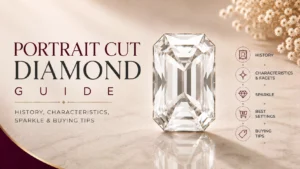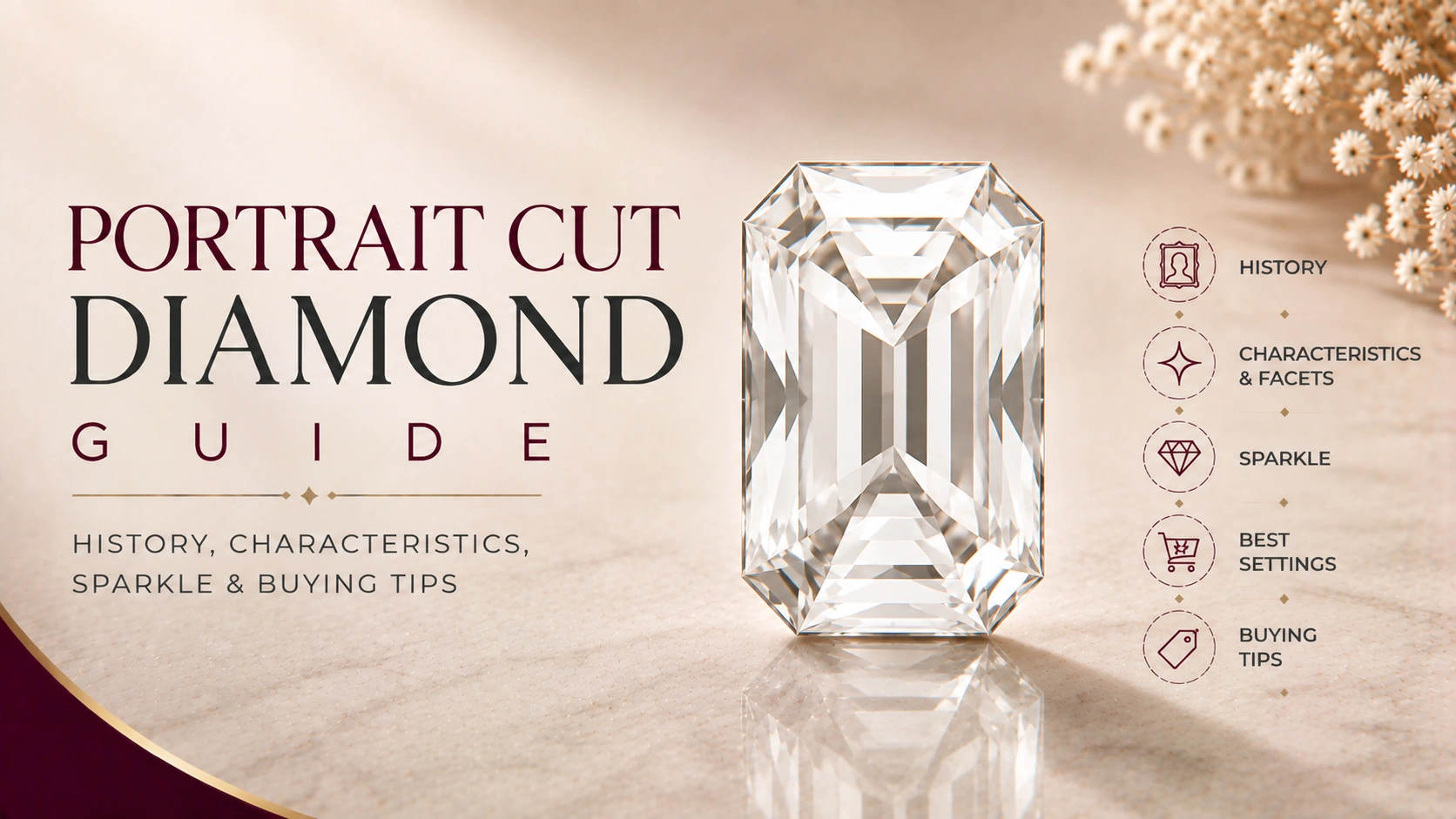
A portrait cut diamond is one of the most unusual diamond cuts you can find. Instead of being designed for maximum brilliance, it emphasizes transparency, a remarkably thin profile, and a smooth, almost glass-like appearance.
At first glance, a portrait cut can look surprisingly simple. It may have a broad, flat surface with little visible faceting, allowing you to see through the stone rather than seeing a constant display of sparkle.
That unusual appearance is exactly what makes it appealing.
Portrait cut diamonds have historical roots in jewelry associated with miniature portraits, and the style has found new attention among people who prefer minimalist, artistic, and unconventional jewelry.
If you’re considering one for an engagement ring or simply want to understand this rare style, this guide explains what makes portrait cut diamonds different, what to look for when buying one, and how they compare with other unusual cuts.
What Is a Portrait Cut Diamond?
A portrait cut diamond is an extremely thin, flat diamond with a broad surface and minimal faceting, designed primarily to emphasize transparency rather than brilliant sparkle.
Traditional brilliant-cut diamonds use numerous carefully arranged facets to return light to the viewer. A portrait cut takes a very different approach. Its shallow construction creates a more open, transparent appearance that can resemble a polished piece of glass.
The exact appearance can vary because portrait cuts can be produced in different outlines. Rectangular and elongated forms are common, but the defining feature is not simply the outline of the diamond. It is the extremely thin construction and emphasis on transparency.
The style is also sometimes associated with the older term lasque, although terminology can vary depending on the historical or modern context.
Portrait cut diamond characteristics
Common characteristics include:
- Extremely thin profile
- Broad, flat-looking surface
- Minimal faceting
- Strong transparency
- Low-profile appearance
- Subtle reflections rather than intense brilliance
- Greater visual emphasis on clarity
- Unusual, minimalist character
Because the design is so different from a modern brilliant cut, it is best to judge a portrait diamond according to what the cut is intended to achieve rather than expecting it to behave like a round diamond.
Portrait Cut Diamond History
The history of the portrait cut is one of the most interesting things about this unusual style.
Historical accounts connect extremely thin, transparent diamonds with jewelry traditions in India. These stones could be placed over miniature portraits, allowing the artwork underneath to remain visible while the diamond provided a protective covering. The connection with portrait miniatures is the reason for the name.
This historical use also explains something important about the cut: transparency was the point.
The diamond did not need to produce the intense flashes associated with a modern brilliant cut. Instead, it needed to be sufficiently thin and clear for the image underneath to remain visible.
That makes the portrait cut an interesting example of how diamond cutting has not always been about maximizing sparkle.
Today, the style is being reinterpreted in contemporary jewelry. Designers and collectors have embraced its flat, architectural appearance because it can look both historic and modern at the same time.
What Makes a Portrait Cut Diamond Different?
The biggest difference is the way the stone interacts with light.
A round brilliant is engineered around brilliance, fire, and scintillation. A portrait cut is much more restrained. Its large, open surface and minimal faceting allow light to pass through the stone and create subtle reflections rather than a traditional explosion of sparkle.
This means you may notice:
- A glass-like appearance
- Soft reflections
- Strong transparency
- A clean, open face-up look
- Subtle flashes around the edges
- Less conventional sparkle
If you are researching different diamond styles, it can help to understand the broader distinction between diamond shape and cut. A useful overview of different types of diamond cuts can help put portrait cuts into context.
The important thing is not to judge a portrait cut by the same standard you would use for a round brilliant.
A portrait cut is not trying to win a sparkle contest.
Its appeal is that it looks different.
How Much Does a Portrait Cut Diamond Sparkle?
Portrait cut diamonds generally have much less traditional sparkle than brilliant-cut diamonds.
That is intentional.
The extremely shallow profile and limited faceting do not create the same internal light performance as a well-cut brilliant diamond. Instead, the stone can produce a soft glow or mirror-like reflection as it moves.
Think of the difference this way:
| Cut | Main visual character |
|---|---|
| Round brilliant | Bright, energetic sparkle |
| Princess cut | Sharp, geometric brilliance |
| Emerald cut | Broad flashes and hall-of-mirrors effect |
| Rose cut | Soft, antique-style shimmer |
| Portrait cut | Transparency and subtle reflection |
If maximum sparkle is your priority, a portrait cut probably isn’t the best starting point.
If you prefer a diamond that looks understated, architectural, and almost transparent, its lower sparkle level may actually be one of its biggest advantages.
Why Clarity Matters So Much in a Portrait Cut Diamond
Clarity can be especially important in a portrait cut diamond because the stone is so transparent.
In heavily faceted diamonds, facets can break up the visual appearance of inclusions. A highly transparent portrait cut provides fewer places for inclusions to hide visually.
That means an inclusion that might be difficult to notice in another cut could be easier to see in a portrait cut.
This doesn’t mean you automatically need the highest possible clarity grade.
Instead, examine the actual diamond.
Look at:
- Whether inclusions are visible face-up
- Whether they affect the transparent appearance
- Whether the stone looks cloudy or hazy
- Where inclusions are located
- The overall visual cleanliness of the stone
For this style, a clarity certificate alone shouldn’t replace inspecting the individual diamond.
The broader 4Cs of diamond quality can help you understand how clarity fits into the overall buying decision.
Portrait Cut Diamond Shapes
Portrait cut diamonds are not limited to one outline.
The style can be adapted to different shapes and proportions, including elongated rectangular and other geometric outlines.
This gives designers considerable freedom.
An elongated portrait cut can create a long, sleek appearance on the finger, while a squarer outline can feel more architectural or vintage-inspired.
When choosing the outline, consider the entire ring rather than focusing only on the stone.
Ask yourself:
- Does the outline complement the setting?
- Does the length work with the finger?
- Does the stone look balanced from different angles?
- Does the transparent appearance work with the metal?
- Is the shape consistent with the overall style of the ring?
For shoppers comparing elongated diamond styles, a guide to the best diamond shapes for long fingers may also be useful.
Portrait Cut vs. Rose Cut Diamond
Portrait cuts and rose cuts are sometimes grouped together because both have historical roots and relatively shallow profiles.
But they are not the same.
A rose cut generally has a flat bottom and a domed crown covered with triangular facets. Those facets create a soft, diffuse shimmer.
A portrait cut is much flatter and thinner, with transparency playing a much larger role in its appearance.
The main difference
Choose a rose cut if you like:
- Antique character
- Soft shimmer
- A domed appearance
- Visible triangular faceting
Choose a portrait cut if you prefer:
- Transparency
- A very flat profile
- Minimal faceting
- A glass-like appearance
- Modern minimalist design
For a more detailed comparison, see this guide to portrait cut vs. rose cut diamonds.
Portrait Cut vs. Emerald Cut Diamond
An emerald cut can sometimes look similar to a portrait cut from a distance because both can have elongated rectangular outlines and a relatively clean appearance.
But the construction is very different.
An emerald cut is a step cut with broad, linear facets designed to produce distinctive reflections and a hall-of-mirrors effect.
A portrait cut is substantially thinner and places much greater emphasis on transparency.
So while both can appeal to someone who prefers understated diamond jewelry, they create different visual effects.
If you are deciding between step-cut and brilliant-cut styles more broadly, you can also explore this step-cut vs. brilliant-cut diamond comparison.
Are Portrait Cut Diamonds Durable?
This is one area where shoppers should pay close attention.
A portrait cut is exceptionally thin. That thin construction is part of its beauty, but it also means the stone needs a setting that provides appropriate protection.
Thin, flat diamond slices can be more vulnerable at their edges than conventional diamonds with substantial crowns, pavilions, and girdles.
That doesn’t mean you cannot wear a portrait cut as an engagement ring.
It means the setting matters.
Before purchasing one, ask the jeweler:
- How is the diamond protected?
- Are the edges exposed?
- Is the setting appropriate for everyday wear?
- Would a bezel or protective frame be better?
- How should the ring be maintained?
- Is the stone suitable for the way you intend to wear it?
A beautiful diamond is only part of a durable engagement ring. The setting and construction deserve equal attention.
Portrait Cut Diamond Engagement Rings
A portrait cut can make a striking engagement ring for someone who doesn’t want a traditional diamond.
It is particularly well suited to people who appreciate:
- Minimalist jewelry
- Vintage-inspired designs
- Architectural shapes
- Low-profile rings
- Unusual diamond cuts
- Understated luxury
- Jewelry with historical character
The setting can completely change the personality of the finished ring.
A simple bezel can emphasize the stone’s clean geometry. An open or artistic setting can make the diamond appear to float above the finger. A vintage-inspired frame can reinforce its historical character.
Because the diamond is so transparent, the area beneath the stone can also affect its appearance.
That makes the relationship between the diamond, metal, setting, and skin particularly important.
What Is the Best Setting for a Portrait Cut Diamond?
There is no single best setting for every portrait cut diamond.
However, a protective setting can make sense because the stone is so thin.
Bezel setting
A bezel can provide protection around the diamond’s edges while creating a clean, modern appearance.
Framed setting
A decorative metal frame can emphasize the outline of the stone and reinforce its architectural character.
Minimalist setting
A simple design can let the unusual diamond remain the focus without adding unnecessary visual elements.
Custom setting
Because portrait cuts are unusual, a custom setting can sometimes be the best way to accommodate the exact shape and dimensions of the stone.
The right choice depends on the individual diamond and how it will be worn.
How to Choose a Portrait Cut Diamond
Buying a portrait cut requires a slightly different mindset from buying a conventional brilliant diamond.
1. Prioritize transparency
Transparency is central to the personality of the cut.
Look for a stone that has the clean, open appearance you want rather than simply choosing based on carat weight.
2. Inspect clarity carefully
Because inclusions can be easier to notice, look at the actual stone whenever possible.
Don’t assume a particular clarity grade automatically guarantees the appearance you want.
3. Check the polish
The smooth, glass-like surface is a major part of the appeal.
Poor finishing can reduce the clean appearance that makes a portrait cut special.
4. Examine the edges
Because the stone is so thin, inspect the edges carefully and ask how they will be protected by the setting.
5. Consider the outline
Look at the stone on the finger or alongside the intended setting.
A shape that looks beautiful by itself may look very different once mounted.
6. Consider the setting
The background beneath a transparent diamond can influence how it looks.
Ask to see the stone in the actual setting whenever possible.
7. Buy the individual stone, not just the name
“Portrait cut” tells you something important about the style, but it does not tell you everything about the quality of the individual diamond.
Pay attention to:
- Transparency
- Clarity
- Polish
- Symmetry
- Shape
- Edge condition
- Setting quality
- Documentation
This approach is more useful than shopping by the cut name alone.
How Much Does a Portrait Cut Diamond Cost?
There is no single standard price for a portrait cut diamond.
The price can depend on factors such as:
- Natural or laboratory-grown origin
- Carat weight
- Clarity
- Color
- Craftsmanship
- Rarity
- Shape
- Custom cutting
- Jewelry design
- Historical provenance, where applicable
Because portrait cuts are relatively unusual, pricing can also be less standardized than it is for popular commercial diamond cuts.
Don’t assume that an unusual cut automatically means a higher resale value.
If you’re buying a portrait cut because you love its appearance, focus first on the quality and design of the individual piece. If you’re considering it as an investment, research provenance and market demand separately rather than assuming rarity alone guarantees appreciation.
Portrait Cut Diamond Pros and Cons
Pros
- Extremely distinctive appearance
- Minimalist and artistic
- Strong transparency
- Very low profile
- Historical connection
- Can look larger across the finger because of its broad surface
- Excellent choice for non-traditional jewelry
Cons
- Much less sparkle than brilliant cuts
- Inclusions can be easier to see
- Very thin construction requires careful setting
- Can be difficult to evaluate compared with conventional diamonds
- Availability can be limited
- Not ideal for shoppers who want traditional diamond brilliance
Is a Portrait Cut Diamond Good for an Engagement Ring?
Yes, but it depends heavily on your expectations.
A portrait cut can be an excellent engagement-ring choice if you want something unusual, understated, artistic, and personal.
It may not be the right choice if you want:
- Maximum sparkle
- Traditional diamond appearance
- Easy comparison between many commercially available stones
- A conventional grading-based shopping experience
The key is understanding what you’re buying.
A portrait cut is not a compromised brilliant diamond. It is a different aesthetic altogether.
If you love transparency and subtle reflections, its unusual appearance can be the reason you choose it.
Who Should Consider a Portrait Cut Diamond?
A portrait cut may be a particularly good fit if you:
- Prefer minimalist jewelry
- Want a nontraditional engagement ring
- Love vintage or historical influences
- Don’t need maximum sparkle
- Appreciate unusual craftsmanship
- Want a low-profile diamond
- Prefer visual subtlety over conventional brilliance
On the other hand, shoppers who want a diamond that immediately catches the light from across a room may be happier with a brilliant-cut option.
Final Thoughts
A portrait cut diamond is defined by what it doesn’t try to do.
It doesn’t chase the intense sparkle of a round brilliant. It doesn’t rely on dozens of facets to create constant flashes of light.
Instead, it emphasizes transparency, simplicity, thinness, and craftsmanship.
Its historical connection to miniature portrait jewelry gives the style an unusual story, while contemporary designers have found ways to make that old idea feel surprisingly modern.
If you’re considering one, focus on the individual stone. Examine its transparency and clarity, inspect the edges, consider the setting carefully, and make sure you genuinely love its understated appearance.
For the right buyer, that is exactly what makes a portrait cut diamond special.
Frequently Asked Questions
What is a portrait cut diamond?
A portrait cut diamond is an extremely thin, flat diamond with minimal faceting and a strong emphasis on transparency. The style has historical associations with transparent diamonds placed over miniature portraits.
Is a portrait cut a real diamond?
Yes. Portrait cut describes the cutting style, not whether the diamond is natural or laboratory-grown.
Does a portrait cut diamond sparkle?
It can produce subtle reflections, but it generally does not sparkle like a modern brilliant-cut diamond. Its main visual qualities are transparency and a glass-like appearance.
Why is it called a portrait cut?
The name is associated with the historical use of thin, transparent diamonds as coverings for miniature portraits, allowing the artwork underneath to remain visible.
Is a portrait cut the same as a rose cut?
No. A rose cut has a domed, faceted crown, while a portrait cut is generally much flatter and thinner, with transparency playing a greater role in its appearance.
Is portrait cut diamond clarity important?
Yes. Because the stone is highly transparent, inclusions may be easier to notice than they are in a heavily faceted diamond. Inspecting the actual stone is particularly important.
Can you wear a portrait cut diamond every day?
It can be worn as everyday jewelry, but its exceptionally thin construction means the setting and edge protection are particularly important. Discuss everyday-wear suitability with the jeweler before purchasing.
Is a portrait cut diamond good for an engagement ring?
It can be an excellent choice for someone who prefers minimalist, artistic, historical, or unconventional jewelry. It is less suitable for someone whose main priority is maximum diamond sparkle.
Are portrait cut diamonds expensive?
Prices vary considerably depending on the diamond’s origin, size, clarity, craftsmanship, rarity, and setting. There is no universal price for portrait cut diamonds.
What should I look for when buying a portrait cut diamond?
Pay particular attention to transparency, visible inclusions, polish, edge condition, outline, and the quality of the setting. Evaluate the actual stone rather than relying only on its cut name or clarity grade.