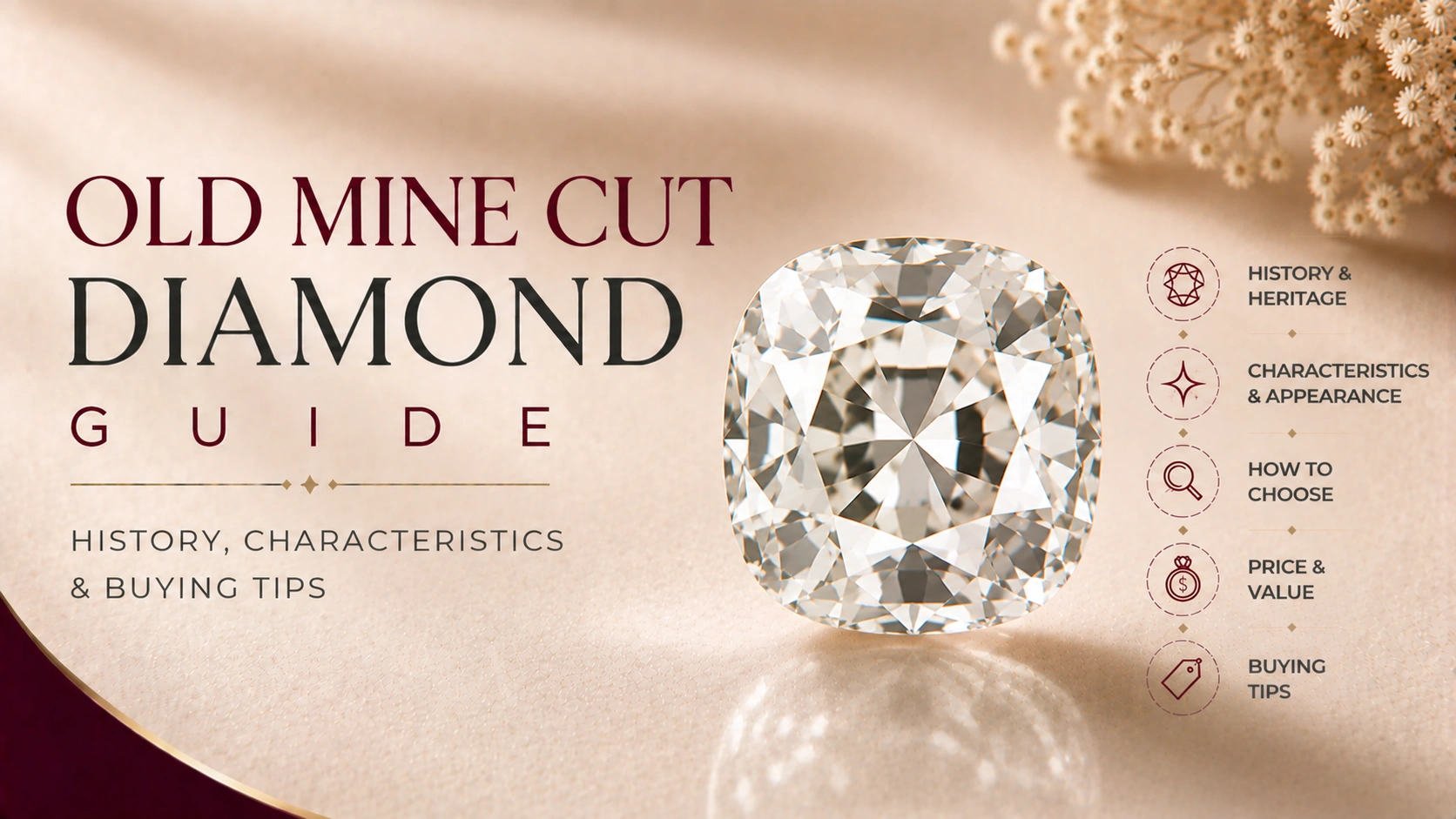
An Old Mine Cut diamond is one of the earliest brilliant-style diamond cuts and one of the most distinctive choices for a vintage or antique-inspired engagement ring.
Unlike modern diamonds, which are cut according to highly precise proportions, Old Mine Cut diamonds were shaped by hand. Their soft, cushion-like outlines, high crowns, small tables, large culets, and broad facets give them a noticeably different appearance from today’s round brilliant diamonds.
That difference is exactly what makes them appealing.
Instead of perfectly uniform sparkle, an Old Mine Cut diamond can produce larger, softer flashes of light and subtle asymmetry that reflects the craftsmanship of the person who cut it.
If you’re considering one for an engagement ring, this guide explains what an Old Mine Cut diamond is, how to recognize one, how it compares with other antique cuts, and what to look for before buying.
What Is an Old Mine Cut Diamond?
An Old Mine Cut diamond is a historic, hand-cut diamond style that was especially common from the 18th through the 19th century.
It typically has a square or cushion-shaped outline with rounded corners, a high crown, a relatively small table, a deep pavilion, and a prominent culet. Traditional descriptions generally identify the cut as having 58 facets, although historical facet-counting conventions can vary.
GIA describes Old Mine Cuts as having 58 facets like modern round brilliants, but with very different proportions, including a smaller table, larger culet, higher crown, and short lower-half facets.
The important distinction is that an Old Mine Cut isn’t simply an old-fashioned version of a modern cushion cut.
It represents a particular period in diamond-cutting history when cutters worked primarily by hand and shaped stones according to the natural rough crystal rather than following today’s mathematical cutting standards.
Because of this, no two genuine antique Old Mine Cut diamonds are necessarily identical.
Small differences in outline, facet size, symmetry, depth, and culet are part of their character.
A Brief History of Old Mine Cut Diamonds
Old Mine Cut diamonds became popular during the Georgian and Victorian eras.
Before modern cutting equipment and electric lighting, diamond cutters had very different priorities from today’s manufacturers. They worked with the natural shape of rough diamonds and sought to balance weight retention, durability, and visual appeal.
The cut is particularly associated with antique jewelry from the 18th and 19th centuries. GIA notes that Old Mine Cuts were among the most common diamond cuts from the early 18th century through the late 19th century and are frequently found in Georgian and Victorian jewelry.
The name “Old Mine Cut” also has a historical connection to the early sources of diamonds. Diamonds from India and Brazil were important during the period before the major South African discoveries changed the diamond industry.
As diamond cutting technology developed, cutters gradually moved toward more standardized shapes and proportions.
Old Mine Cut eventually gave way to later antique cutting styles, including the Old European Cut, and eventually to the modern round brilliant.
For a broader look at how diamond cutting styles developed over time, a guide to the evolution of engagement rings can provide useful historical context.
What Does an Old Mine Cut Diamond Look Like?
The easiest way to picture an Old Mine Cut is to imagine a softly squared cushion shape with a domed top and chunky facets.
Common visual characteristics include:
- Square-to-cushion outline
- Rounded corners
- High crown
- Small table
- Deep pavilion
- Large open culet
- Broad, chunky facets
- Slightly irregular symmetry
- Noticeable depth
- Softer, broader flashes of light
The outline is usually the first thing you’ll notice.
A modern round brilliant is designed to appear circular, while an Old Mine Cut generally looks more like a cushion with rounded corners.
The second major clue is the culet.
Instead of terminating in a sharp point, the bottom of an Old Mine Cut usually has a relatively large flat facet called an open culet. When looking directly into the diamond, the culet may appear as a small circle, square, or dark-looking opening near the center.
Old Mine Cut Diamond Characteristics
1. Cushion-like Shape
Old Mine Cuts typically have a squarish or cushion-shaped outline.
However, the exact shape can vary considerably because these diamonds were hand-cut rather than manufactured to a strict template.
One stone may look almost square, while another may appear more rectangular.
That variation is normal.
2. High Crown
The crown is the upper portion of the diamond above the girdle.
Old Mine Cuts generally have a noticeably higher crown than modern brilliant cuts. This gives the diamond a taller, more substantial appearance when viewed from the side.
A high crown is one reason Old Mine Cuts can look particularly dramatic in antique-style settings.
3. Small Table
The table is the large flat facet at the top of a diamond.
Old Mine Cuts typically have smaller tables than modern round brilliants.
A smaller table means you can often see more of the surrounding crown facets when looking straight into the stone, contributing to the distinctive chunky facet pattern.
4. Large Culet
The culet is the facet at the bottom of the pavilion.
Modern round brilliants are usually cut with a pointed bottom, so the culet is extremely small or effectively nonexistent when viewed face-up.
Old Mine Cuts often have a much larger open culet.
This is one of their easiest identifying features.
5. Deep Pavilion
Old Mine Cuts tend to be deeper than modern diamonds.
This can mean that an Old Mine Cut diamond has a relatively high carat weight compared with its face-up dimensions.
In other words, two diamonds with the same carat weight can have noticeably different visible sizes depending on their proportions.
6. Broad Facets
The facets on an Old Mine Cut are generally larger and more visibly defined than those on many modern brilliant cuts.
This contributes to the cut’s characteristic chunky sparkle.
Rather than producing lots of tiny flashes, the diamond can show larger areas of light and dark as it moves.
7. Hand-Cut Irregularity
Slight asymmetry is common in genuine antique examples.
The outline might not be perfectly symmetrical. Facets may differ slightly in size or angle. The culet may not sit perfectly centered.
For an antique diamond, these characteristics aren’t automatically defects.
They’re evidence of the hand-cut nature of the stone.
Why Do Old Mine Cut Diamonds Sparkle Differently?
Old Mine Cuts were created long before modern diamond-cutting technology.
Today’s brilliant cuts use carefully calculated proportions to optimize light return under modern lighting conditions.
Old Mine Cuts were shaped in a very different environment.
Their proportions were influenced by the natural rough diamond, the available cutting tools, and the lighting of their era.
The result is a different visual experience.
An Old Mine Cut can produce:
- Broad flashes
- Softer scintillation
- Chunkier facet reflections
- Warm-looking light
- More noticeable contrast between light and dark areas
Some people describe the appearance as romantic, candlelit, or antique.
That’s not the same as saying an Old Mine Cut is objectively more brilliant than a modern diamond.
It isn’t.
If maximum modern brilliance is your priority, a well-cut modern brilliant may be a better choice.
If you want character, history, and a distinctive pattern of larger flashes, the Old Mine Cut has an appeal that modern precision cutting can’t completely reproduce.
How to Identify an Old Mine Cut Diamond
If you’re looking at an antique diamond or an online listing, look for several characteristics together rather than relying on a single feature.
Look for a Soft Square or Cushion Outline
The diamond should generally have a cushion-like or softly squared shape.
A perfectly round outline is more characteristic of an Old European or modern round brilliant.
Check the Culet
Look directly into the center of the stone.
A noticeable open culet is one of the strongest visual clues.
It may look like a small circle or square near the center of the diamond.
Examine the Crown
Old Mine Cuts typically have a relatively tall crown.
Viewed from the side, the diamond often looks deeper and more domed than a modern brilliant.
Look at the Facets
The facets should generally look broad and chunky rather than perfectly uniform and tightly optimized.
Slight irregularity is expected in authentic antique stones.
Don’t Expect Perfect Symmetry
A completely symmetrical outline isn’t required for an Old Mine Cut.
In fact, slight asymmetry can be part of the appeal.
However, there’s a difference between charming irregularity and significant damage or poor craftsmanship.
If the stone is severely distorted, chipped, or damaged, that deserves separate consideration.
Old Mine Cut vs. Old European Cut
Old Mine Cut and Old European Cut diamonds are often confused because both are antique brilliant-style cuts.
The biggest visual difference is their outline.
| Feature | Old Mine Cut | Old European Cut |
|---|---|---|
| General outline | Square or cushion | Round |
| Corners | Rounded | No corners |
| Crown | High | High |
| Table | Relatively small | Small to medium |
| Culet | Often large | Usually smaller |
| Faceting | Broad and chunky | More refined |
| Overall appearance | Soft, antique, cushion-like | Round, vintage brilliant |
| Typical historical period | Earlier | Later |
The Old Mine Cut generally predates the Old European Cut.
The Old European Cut moved toward a round outline while retaining many of the high-crown and large-culet characteristics associated with earlier antique cuts.
If you’re choosing between the two, the decision often comes down to shape preference.
Choose an Old Mine Cut if you love a soft square or cushion outline.
Choose an Old European Cut if you prefer a round diamond with antique character.
You can also compare the two in more detail in this Old Mine vs. Old European diamond comparison.
Old Mine Cut vs. Antique Cushion Cut
Old Mine Cut and Antique Cushion Cut can look extremely similar.
That’s because they share much of the same historical aesthetic.
However, the terms aren’t always used in exactly the same way.
Old Mine Cut generally refers to a historic cutting style associated with hand-cut antique diamonds.
Antique Cushion can be used more broadly to describe antique or antique-inspired cushion-shaped diamonds.
This means an Antique Cushion may resemble an Old Mine Cut without necessarily being an original Old Mine Cut diamond from the historical period.
The distinction matters when buying.
If you’re specifically looking for an authentic antique diamond, ask the seller about:
- The diamond’s age
- Whether it was hand-cut
- Its provenance, if available
- Whether the stone has been recut
- The grading report
- Whether the stone is an antique or a newly cut diamond designed to imitate an antique style
For a closer comparison, see the guide to Antique Cushion vs. Old Mine Cut.
Old Mine Cut vs. Modern Cushion Cut
The modern cushion cut is one of the closest contemporary alternatives to an Old Mine Cut.
Both can have:
- Soft corners
- Squarish outlines
- Romantic proportions
- Large facets
- Vintage-inspired appearance
But their cutting philosophy is very different.
A modern cushion can be precision-cut using computer modeling and modern equipment.
An authentic antique Old Mine Cut was hand-cut many generations ago.
This creates an important choice.
A modern cushion may give you:
- More predictable proportions
- More consistent symmetry
- Easier online comparison
- More standardized grading
- Potentially stronger modern light performance
An Old Mine Cut may give you:
- Historical authenticity
- Individual character
- Hand-cut faceting
- A distinctive open culet
- Antique charm
- Greater variation from stone to stone
Neither is universally better.
They’re designed for different preferences.
How to Choose an Old Mine Cut Diamond
Buying an Old Mine Cut requires a somewhat different approach from buying a modern round brilliant.
Start With Appearance
Don’t begin by trying to find the “perfect” proportions.
Old Mine Cuts weren’t designed around a single modern ideal.
Instead, look at the actual diamond.
Ask yourself:
- Does the stone have attractive light return?
- Do you like the facet pattern?
- Is the outline pleasing?
- Is the culet attractive?
- Does the diamond look lively when it moves?
- Does it perform well in different lighting?
The individual stone matters enormously.
Evaluate Color
Antique diamonds often have warmer appearances.
That’s not necessarily a disadvantage.
Creamier or warmer tones can complement yellow gold and rose gold particularly well.
If you prefer a crisp, icy appearance, you may want to prioritize a higher color grade.
If you love an authentic antique aesthetic, warmer color can sometimes enhance the overall look.
For more information about evaluating color, see this diamond color guide.
Evaluate Clarity
Don’t automatically reject an Old Mine Cut because it has inclusions.
Many antique diamonds have inclusions, and the larger facets can make some inclusions easier to see.
The key question is whether the diamond is eye-clean enough for you.
A slightly lower clarity grade can sometimes offer better value if the inclusions aren’t visible without magnification.
Learn more about evaluating clarity in this diamond clarity guide.
Pay Attention to the Outline
The outline is especially important for an Old Mine Cut.
Look for a shape you genuinely like.
Some stones are nearly square.
Others are slightly rectangular.
Some have more pronounced rounded corners.
Because these diamonds aren’t standardized like modern cuts, personal preference plays a major role.
Check for Damage
If you’re buying an authentic antique stone, inspect the girdle and corners carefully.
Older diamonds may have chips or abrasions from decades or centuries of wear.
Pay particular attention to:
- Corners
- Girdle
- Culet
- Surface abrasions
- Chips
- Cracks or durability concerns
A beautiful antique diamond can still require careful evaluation before being placed into an engagement ring.
Ask Whether the Diamond Is Antique or Newly Cut
This is particularly important.
A diamond can be cut in an Old Mine-inspired style today without being an antique.
There’s nothing inherently wrong with that.
In fact, modern antique-style diamonds can offer the appearance people love about Old Mine Cuts while making it easier to find a particular carat weight, shape, or specification.
But you should know which you’re buying.
Are Old Mine Cut Diamonds Valuable?
The value of an Old Mine Cut diamond depends on much more than its carat weight.
Factors can include:
- Carat weight
- Color
- Clarity
- Overall appearance
- Proportions
- Condition
- Historical age
- Provenance
- Whether it has been recut
- Whether it is a genuine antique
- Quality of the surrounding setting
A genuine antique diamond with documented history can have additional appeal to collectors.
However, an Old Mine Cut label alone doesn’t guarantee a premium price.
Two stones with similar carat weights can have very different values depending on their condition, appearance, history, and desirability.
This is why comparing antique diamonds solely by price per carat can be misleading.
Are Old Mine Cut Diamonds Good for Engagement Rings?
Yes, an Old Mine Cut can be an excellent choice for an engagement ring if you appreciate its distinctive character.
It’s particularly well suited to someone who wants a ring that feels:
- Vintage
- Romantic
- Individual
- Historic
- Less conventional
- Soft and organic
Old Mine Cuts pair naturally with vintage-inspired settings, including halo, cluster, bezel, and traditional prong designs.
If you prefer maximum sparkle and highly predictable proportions, however, a modern brilliant may be a better fit.
The choice comes down to what you value most.
Modern brilliant: precision, consistency, and intense contemporary sparkle.
Old Mine Cut: history, individuality, broad flashes, and antique character.
For a broader explanation of diamond cutting and why different cuts behave differently, see this guide to diamond cuts and their characteristics.
Pros and Cons of Old Mine Cut Diamonds
Pros
- Distinctive antique appearance
- Rich history
- Hand-cut character
- Broad, chunky flashes of light
- Soft cushion-like outline
- Large visible culet
- Every stone can feel unique
- Excellent choice for vintage-inspired rings
Cons
- Often less brilliant than a well-cut modern brilliant
- Proportions can vary significantly
- Antique stones may have chips or wear
- Slight asymmetry may not appeal to everyone
- Genuine antique examples can be difficult to source
- Comparing stones can be harder because modern cut standards don’t apply neatly
Frequently Asked Questions
Are Old Mine Cut diamonds real diamonds?
Yes. An Old Mine Cut describes the way a diamond was cut, not a different type of gemstone.
An Old Mine Cut can be a natural diamond, and modern diamonds can also be cut in an Old Mine-inspired style.
Are Old Mine Cut diamonds rare?
Genuine antique Old Mine Cut diamonds are relatively limited because they were produced during an earlier period of diamond cutting and are no longer being made in exactly the same historical manner.
Modern diamonds can also be cut to resemble the style, so not every Old Mine-style diamond available today is an antique.
Do Old Mine Cut diamonds have 58 facets?
Traditional descriptions generally identify Old Mine Cuts as having 58 facets, similar to modern round brilliants. However, historical facet-counting conventions can differ, particularly when the girdle is treated differently.
The more useful identifying features are the overall combination of the cushion-like outline, high crown, small table, deep pavilion, broad facets, and large culet.
Why does my Old Mine Cut diamond look dark in the center?
The large culet and antique proportions can create a noticeable central pattern.
A dark center isn’t automatically a defect.
However, excessive darkness or a persistent “window” can indicate that the particular stone isn’t returning light well.
This is why it’s better to evaluate the actual diamond rather than relying only on its label.
Can an Old Mine Cut diamond be lab-grown?
Modern diamonds can be produced and cut to recreate the appearance of an Old Mine Cut.
However, a newly produced stone isn’t an antique simply because it uses an Old Mine-inspired faceting style.
If you’re specifically looking for an authentic historical diamond, ask about its age, cutting history, and documentation.
Is an Old Mine Cut the same as a cushion cut?
No.
Old Mine Cut refers to a historical cutting style, while cushion is a broader shape category.
The two can look very similar, but a modern cushion cut doesn’t automatically qualify as an Old Mine Cut.
Is an Old Mine Cut better than a modern round brilliant?
Neither is inherently better.
A modern round brilliant is generally the better choice if you prioritize standardized proportions and modern light performance.
An Old Mine Cut is more appropriate if you value antique character, hand-cut individuality, and broad flashes of light.
Final Takeaway
An Old Mine Cut diamond is less about perfection and more about personality.
Its softly squared outline, high crown, small table, deep pavilion, broad facets, and large culet create an appearance that is immediately different from a modern brilliant.
The hand-cut nature of genuine antique examples also means that small variations are part of the experience.
If you’re shopping for one, don’t judge it by modern diamond standards alone. Look at the individual stone, study its light performance, inspect its condition, and make sure you understand whether you’re buying an authentic antique or a modern diamond inspired by the Old Mine style.
For the right buyer, that individuality is exactly what makes an Old Mine Cut so special.