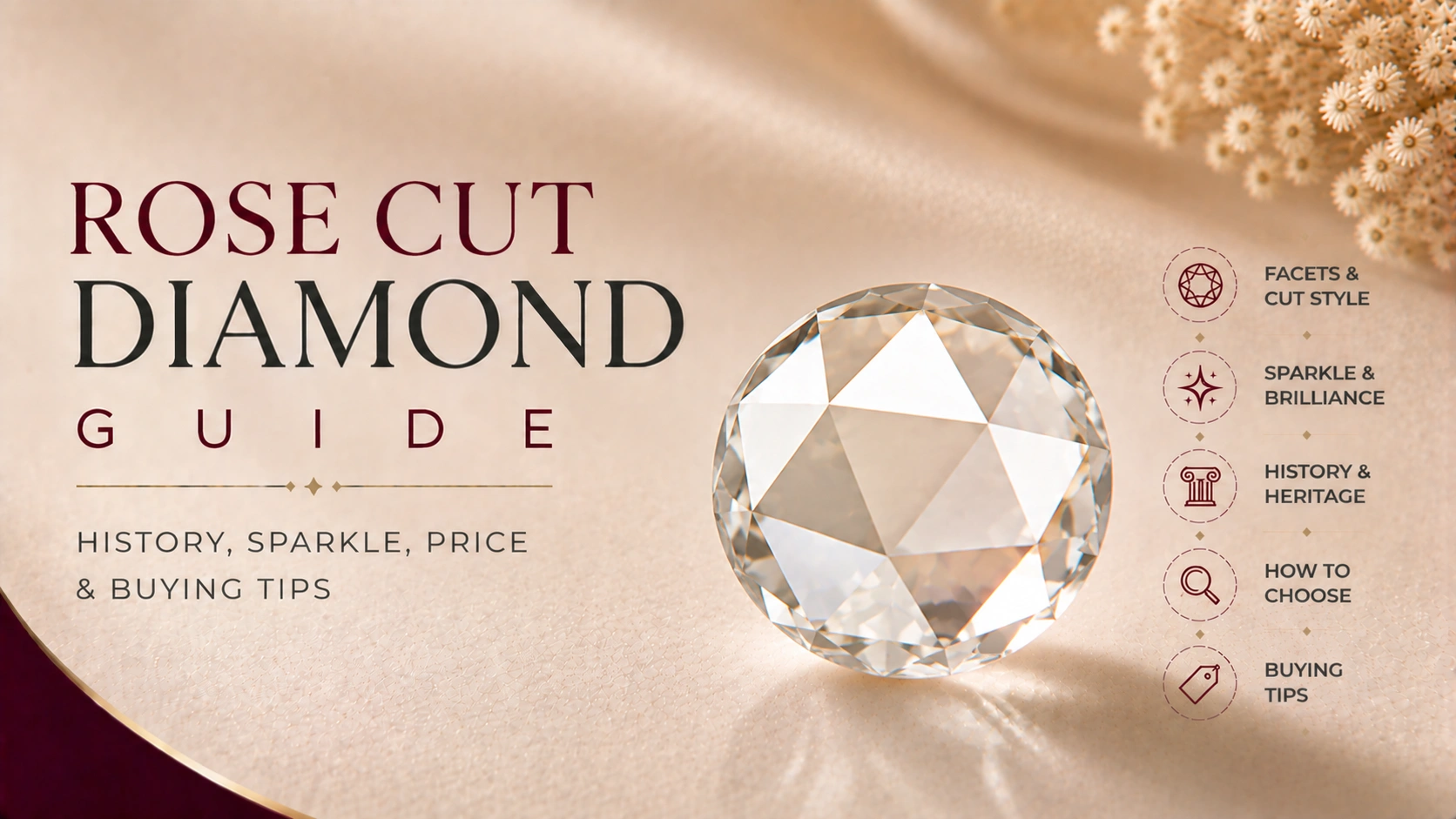
A rose cut diamond is one of the most distinctive antique diamond cuts you can choose. Instead of the deep pavilion and intense brilliance associated with modern brilliant cuts, it has a flat base and a domed crown covered with triangular facets.
The result is a diamond with a softer, more reflective glow rather than the sharp sparkle of a modern brilliant.
Rose cuts are especially appealing if you like vintage jewelry, low-profile rings, unusual diamond styles, or a more understated look. They can also appear surprisingly large for their carat weight because much of their weight is spread across the stone rather than concentrated in depth.
But rose cut diamonds require a different approach to shopping. Traditional cut-grading criteria designed around modern brilliant diamonds do not tell the whole story here. Shape, symmetry, clarity, surface condition, proportions, and overall appearance deserve close attention.
This guide explains what a rose cut diamond is, how it looks, how it compares with other diamond cuts, and what to look for before buying one.
What Is a Rose Cut Diamond?
A rose cut diamond is an antique-style diamond cut with a flat bottom and a domed, faceted top.
The crown is made from triangular facets that rise toward a central point, creating a pattern that resembles the petals of a rosebud. Unlike a modern brilliant cut, a traditional rose cut does not have a conventional pavilion.
The construction gives the diamond a shallow profile and a distinctive appearance.
Rather than being designed primarily for maximum light return, the rose cut creates broad reflections and a gentle glow. That difference is central to its appeal.
If you are researching different diamond cuts, it helps to understand the broader distinction between a diamond’s shape and its cut. A useful overview of different types of diamond cuts can help put the rose cut in context.
What Does a Rose Cut Diamond Look Like?
From the top, a rose cut diamond usually has a faceted dome with triangular sections converging toward the center.
From the side, its shallow construction becomes much more obvious. Instead of a deep lower section, the diamond has a relatively flat base.
This creates several visual characteristics:
- A low-profile appearance
- Broad, subtle flashes of light
- A softer glow than a brilliant cut
- A distinctive antique character
- A potentially large face-up appearance
- Less intense scintillation than a modern brilliant
Rose cuts are not limited to perfectly round stones. They can be found in shapes such as oval, pear, hexagonal, cushion, and other outlines.
That makes the term “rose cut” more about the faceting style and construction than one specific outline.
Rose Cut Diamond Anatomy
The easiest way to understand a rose cut is to look at its basic structure.
Flat Base
The bottom of a traditional rose cut is flat rather than forming the pointed or faceted pavilion found on many modern diamonds.
This is one reason rose cuts can sit relatively close to the finger.
Domed Crown
The upper portion forms a dome. Triangular facets cover the surface and meet toward the top.
The dome is what creates the cut’s characteristic rosebud-like appearance.
Triangular Facets
Rose cuts typically have fewer facets than modern brilliant cuts. Traditional examples can vary considerably in their facet arrangement.
Those larger, simpler facets contribute to the cut’s broad flashes and soft visual effect.
No Traditional Pavilion
A modern brilliant diamond uses a pavilion to help direct light back through the crown.
A rose cut’s flat-backed construction works differently, so it should not be judged solely by the same expectations you would have for a modern brilliant.
For a broader explanation of how cut influences diamond appearance, see this diamond cut guide.
History of the Rose Cut
The rose cut is an old diamond-cutting style with roots going back centuries.
It became especially associated with antique jewelry before the development and widespread adoption of modern brilliant cuts. Rose cuts were used extensively during periods when jewelry was viewed under candlelight and other relatively low-intensity light sources.
Their soft glow worked particularly well in those conditions.
The name comes from the shape of the faceted crown, which resembles the petals of a rosebud when viewed from above.
Rose cuts later became less common as diamond cutting technology developed and cutters increasingly focused on maximizing brilliance and light return.
Today, the style has experienced renewed interest among people who prefer antique-inspired, vintage, handmade, and unconventional jewelry.
That revival is part of a larger appreciation for historic diamond cuts rather than treating modern brilliant cuts as the only standard.
How Does a Rose Cut Diamond Sparkle?
A rose cut diamond can sparkle, but its sparkle is different from what you see in a modern brilliant.
A well-cut round brilliant is designed to produce strong brightness, fire, and scintillation through a carefully engineered arrangement of facets and proportions.
A rose cut generally produces a softer combination of reflection and glow.
Think of the difference as:
Rose cut: soft, broad, subtle flashes
Round brilliant: bright, lively, high-contrast sparkle
Neither appearance is automatically better.
The right choice depends on what you want from your diamond.
If you want your stone to catch attention with intense sparkle, a brilliant cut will usually be the better fit. If you prefer something quieter and more atmospheric, the rose cut can be much more appealing.
Do Rose Cut Diamonds Look Bigger?
One of the biggest attractions of a rose cut diamond is that it can look large for its carat weight.
Because the stone is shallow and much of its weight is distributed across its width rather than depth, a rose cut can have substantial face-up spread.
This means a rose cut may visually cover more of the finger than a deeper diamond with the same carat weight.
However, do not assume that every rose cut will look larger than every other diamond.
When comparing stones, look at their actual measurements, especially:
- Length
- Width
- Overall proportions
- Face-up dimensions
Carat weight tells you how much a diamond weighs. It does not tell you exactly how large it will appear from above.
For shoppers comparing diamond sizes more generally, a diamond carat guide can help explain why carat weight and visual size are not the same thing.
Rose Cut Diamond Shapes
Although round rose cuts are common, the rose-cut style can be applied to several outlines.
You may encounter:
- Round rose cuts
- Oval rose cuts
- Pear-shaped rose cuts
- Cushion-shaped rose cuts
- Hexagonal rose cuts
- Elongated or irregular antique rose cuts
The outline you choose affects how the finished ring looks.
For example, an elongated rose cut can visually lengthen the finger, while a round rose cut can create a softer, more traditional appearance.
The important distinction is that shape and cut are not interchangeable terms. The shape describes the outline; the rose cut describes the faceting and overall construction.
If you are still deciding between diamond outlines, a diamond shape guide is a useful starting point.
Rose Cut Diamond Clarity: Does It Matter?
Yes. Clarity can be particularly important with a rose cut diamond.
Because rose cuts generally have fewer facets and less intense light return than brilliant cuts, inclusions may be easier to notice.
The stone’s surface and overall transparency can therefore play a major role in its appearance.
However, this does not mean you automatically need the highest clarity grade available.
Instead, inspect the individual diamond.
Ask:
- Are inclusions visible to the naked eye?
- Do they affect transparency?
- Are there obvious marks near the center?
- Does the stone look cloudy or hazy?
- Does the diamond still appear attractive in normal lighting?
The goal should be a beautiful stone rather than simply buying the highest clarity grade on paper.
A broader explanation of diamond clarity can be found in this diamond clarity guide.
What Color Should a Rose Cut Diamond Be?
There is no single ideal color grade for every rose cut diamond.
Because rose cuts have a different visual character from brilliant cuts, the setting, metal color, and personal preference can influence the best choice.
A warmer-looking stone may work beautifully in yellow or rose gold, particularly in a vintage-inspired design.
A higher color grade can be attractive in platinum or white gold when you want a brighter, more neutral appearance.
As with clarity, do not choose a color grade in isolation. Look at the actual diamond and how it interacts with the setting.
Are Rose Cut Diamonds Durable?
A rose cut’s flat-backed construction can be practical for a low-profile ring, but that does not make every rose cut automatically durable.
The condition and thickness of the stone matter.
You should pay particular attention to the edges and corners of unusual shapes. A stone with exposed edges may require a protective setting.
The setting also plays an important role.
A bezel or other secure setting can provide more protection around the diamond than a design that leaves much of the stone exposed.
If you plan to wear the ring every day, consider your lifestyle before choosing an especially delicate rose cut.
A rose cut can absolutely work in an engagement ring, but the individual stone and setting should be evaluated together.
Rose Cut Diamond Engagement Rings
Rose cut diamonds are particularly well suited to engagement rings with a vintage or artistic aesthetic.
They can work beautifully with:
- Bezel settings
- Low-profile settings
- Vintage-inspired settings
- Milgrain detailing
- Halo designs
- Simple solitaire settings
- Antique-style gold rings
- Handmade or unconventional designs
The flat base can also make the finished ring feel closer to the finger.
That can be useful if you dislike the taller profile of some traditional engagement rings.
For shoppers interested in historic ring styles, the difference between vintage and antique engagement rings is worth understanding before choosing a setting.
Best Settings for Rose Cut Diamonds
Bezel Setting
A bezel surrounds the diamond with metal, providing protection around its edges.
This can be an especially practical option for a shallow or unusually shaped rose cut.
Low-Profile Setting
Because the stone itself is shallow, rose cuts can work naturally with rings designed to sit close to the finger.
This creates a minimalist appearance and may reduce the chance of catching the ring on clothing.
Halo Setting
A halo can make a rose cut appear even larger while adding additional sparkle around the center stone.
The contrast between the softer center and brighter surrounding stones can be visually striking.
Solitaire Setting
A simple solitaire allows the rose cut itself to remain the focus.
This is a good option if you appreciate the stone’s unusual shape and want to avoid a setting that competes with it.
Rose Cut Diamond Pros and Cons
Pros
Distinctive appearance: Rose cuts look very different from the modern brilliant cuts found in many engagement rings.
Vintage appeal: They naturally complement antique and vintage-inspired jewelry.
Low profile: Their shallow construction can create a close-to-the-finger design.
Large face-up appearance: Their spread can make them look substantial for their carat weight.
Subtle sparkle: Their softer glow appeals to people who do not want maximum brilliance.
Unique personality: A rose cut can make an engagement ring feel much less conventional.
Cons
Less brilliance: A rose cut generally does not produce the intense sparkle of a well-cut round brilliant.
Clarity can be more noticeable: Inclusions may be easier to see because the stone does not have the same level of brilliance to disguise them.
Greater variation: Rose cuts can differ significantly in facet arrangement, symmetry, proportions, and appearance.
Less standardized evaluation: They do not have the same standardized cut-grading framework used for standard round brilliant diamonds.
Individual inspection matters: Buying based only on a grading report or a basic specification list can be less useful than examining the actual stone.
Rose Cut vs Round Brilliant
The biggest difference between a rose cut and a round brilliant is the philosophy behind the cutting.
A rose cut emphasizes its shallow, domed shape and broad reflective facets.
A round brilliant is engineered around light performance.
| Feature | Rose Cut | Round Brilliant |
|---|---|---|
| Base | Flat | Pavilion |
| Profile | Shallow | Deeper |
| Facets | Fewer, larger triangular facets | 57 or 58 facets |
| Sparkle | Soft and subtle | Bright and lively |
| Face-up spread | Often large for weight | More depth relative to spread |
| Style | Antique, romantic, unconventional | Classic, modern, versatile |
| Best for | Character and understated beauty | Maximum brilliance |
If you are specifically deciding between these two, see the detailed rose cut vs round cut comparison for a closer look at their differences.
Rose Cut vs Portrait Cut
Rose cuts and portrait cuts can look somewhat similar because both can have shallow profiles, but they are not the same type of diamond cut.
A rose cut has a faceted domed crown.
A portrait cut is generally much flatter and emphasizes a broad, transparent or reflective surface rather than the triangular faceting characteristic of a rose cut.
The visual difference is important:
- Rose cut: faceted, softly shimmering surface
- Portrait cut: flatter, more glass-like appearance
- Rose cut: recognizable triangular facets
- Portrait cut: minimal or subtle faceting
If you are choosing between the two, the portrait cut vs rose cut diamond comparison provides a more detailed breakdown.
Rose Cut vs Old Mine Cut
The rose cut and old mine cut are both associated with historic diamond cutting, but their structures are different.
An old mine cut has a more substantial pavilion and a chunky, rounded outline designed to produce its own distinctive form of antique sparkle.
A rose cut is flatter and simpler.
If you want an antique appearance but still want more depth and traditional faceting, an old mine cut may be worth considering.
If your priority is a shallow profile, broad glow, and unusual appearance, the rose cut may be more appropriate.
Rose Cut vs Old European Cut
An old European cut is another historic diamond style that preceded the modern round brilliant.
It generally has a round outline and a more substantial pavilion than a rose cut.
The two can therefore look very different on the hand.
A rose cut tends to feel flatter, softer, and more understated.
An old European cut has more of the chunky brilliance and lively flashes associated with antique brilliant-style diamonds.
For another useful comparison, you can explore the differences between old mine and old European cuts.
How Much Does a Rose Cut Diamond Cost?
There is no fixed price for a rose cut diamond.
The price can depend on:
- Carat weight
- Face-up dimensions
- Color
- Clarity
- Shape
- Symmetry
- Cut quality
- Natural or lab-grown origin
- Antique versus newly cut
- Craftsmanship
- Provenance
- Market demand
An antique rose cut with unusual characteristics may be more valuable than a newly cut stone with similar carat weight.
Likewise, a larger-looking rose cut is not automatically more expensive.
This is another reason not to compare diamonds using carat weight alone.
When evaluating a rose cut, consider the complete package: appearance, dimensions, condition, quality, setting, and price.
How to Buy a Rose Cut Diamond
Buying a rose cut requires a slightly different checklist from buying a standard round brilliant.
1. Look at the Actual Diamond
Photos and specifications are useful, but rose cuts can vary significantly from one stone to another.
Whenever possible, examine the diamond in multiple lighting conditions.
2. Check Face-Up Size
Compare the length and width rather than relying only on carat weight.
A shallow stone can have considerable spread.
3. Inspect Clarity
Look carefully for inclusions, haze, or transparency issues.
Because the stone can have less brilliance, visible imperfections may stand out more.
4. Examine Symmetry
Perfect symmetry is not necessarily the defining characteristic of every antique rose cut, but obvious unevenness can affect the stone’s appearance.
Look at the facet pattern and outline from above.
5. Check the Edges
Pay particular attention to corners and edges, especially with elongated or unusual shapes.
These areas may need protection from the setting.
6. Consider the Setting
Think about how exposed the stone will be.
If the ring is intended for daily wear, a protective setting may make more sense than an extremely exposed design.
7. Decide How Much Sparkle You Want
This is perhaps the most important question.
Do not buy a rose cut expecting it to behave like a round brilliant.
Choose it because you appreciate what makes it different.
8. Compare the Complete Value
A rose cut that looks beautiful on your hand may be a better purchase than a technically higher-graded diamond that does not suit your taste.
Use the 4Cs of diamond quality as a foundation, but remember that the visual character of a rose cut deserves individual attention.
Is a Rose Cut Diamond Good for an Engagement Ring?
Yes, a rose cut can be an excellent engagement-ring diamond if its appearance matches your preferences.
It is especially appealing if you:
- Prefer vintage jewelry
- Want a distinctive engagement ring
- Like understated sparkle
- Prefer a low-profile ring
- Appreciate antique diamond cuts
- Want a large-looking stone without necessarily increasing carat weight
- Prefer character over maximum brilliance
It may not be the best choice if your priority is intense sparkle, strong scintillation, and the classic appearance of a modern brilliant diamond.
The key is to choose the cut intentionally rather than treating it as a substitute for a round brilliant.
Are Rose Cut Diamonds Worth Buying?
A rose cut diamond can absolutely be worth buying.
Its value comes from more than traditional diamond specifications.
For the right buyer, the combination of antique character, shallow construction, large face-up appearance, and soft glow is precisely what makes the cut desirable.
The important thing is to evaluate the individual diamond.
A rose cut should look attractive to you in real lighting, have an appropriate setting, and be priced fairly for its characteristics.
If you love the stone’s appearance, its lower brilliance is not a flaw. It is part of the design.
Frequently Asked Questions
Are rose cut diamonds real diamonds?
Yes. A rose cut describes the way a diamond is cut, not whether the stone is a different material. Rose cuts can be made from natural diamonds and can also be produced using lab-grown diamonds.
Do rose cut diamonds sparkle?
Yes, but they generally produce a softer glow and broader flashes rather than the intense scintillation of a modern brilliant cut.
Why are rose cut diamonds so flat?
The rose cut does not use the deep pavilion found in many modern diamond cuts. Its flat base and shallow domed crown are fundamental parts of its design.
Do rose cut diamonds look bigger?
They can. Their shallow construction allows more of the stone’s weight to contribute to its face-up spread, so a rose cut can look large relative to its carat weight.
Are rose cut diamonds good for engagement rings?
They can be excellent for engagement rings, especially for buyers who like vintage, antique-inspired, low-profile, or unconventional designs.
Are rose cut diamonds expensive?
Prices vary widely. Carat weight, dimensions, color, clarity, craftsmanship, origin, age, and market demand can all affect the price.
Are rose cut diamonds durable?
They can be suitable for everyday rings, but the individual stone and setting matter. Protective settings can help shield edges and vulnerable areas.
What is the difference between a rose cut and a brilliant cut?
A rose cut has a flat base and domed crown with triangular facets, while a brilliant cut uses a more complex three-dimensional structure designed to maximize light return.
What is the best setting for a rose cut diamond?
There is no single best setting. Bezel, low-profile, halo, and solitaire designs can all work well. The best option depends on the stone’s shape and how much protection you want.
Should you prioritize clarity in a rose cut diamond?
Clarity deserves careful attention because inclusions can be more noticeable in a shallow, less brilliant stone. However, the best clarity grade is not necessarily the best value. Inspect the actual diamond.
Final Verdict: Is a Rose Cut Diamond Right for You?
A rose cut diamond is not trying to be a round brilliant.
Its appeal comes from being different.
The flat base, domed crown, triangular facets, shallow profile, and soft glow give it an unmistakably vintage personality. It can look larger than expected for its carat weight and works particularly well in antique-inspired and low-profile engagement rings.
But the same characteristics that make the rose cut distinctive also mean it has less traditional brilliance and requires more attention when shopping.
Choose a rose cut if you love:
- Vintage character
- Subtle sparkle
- Low-profile designs
- Large face-up spread
- Unusual engagement rings
- Antique-inspired jewelry
Choose another cut if your priority is maximum brilliance, intense scintillation, and the classic modern diamond look.
Ultimately, the best rose cut diamond is not necessarily the one with the highest grade or biggest carat weight. It is the one that looks beautiful to you, fits your lifestyle, and works with the ring design you want to wear every day.