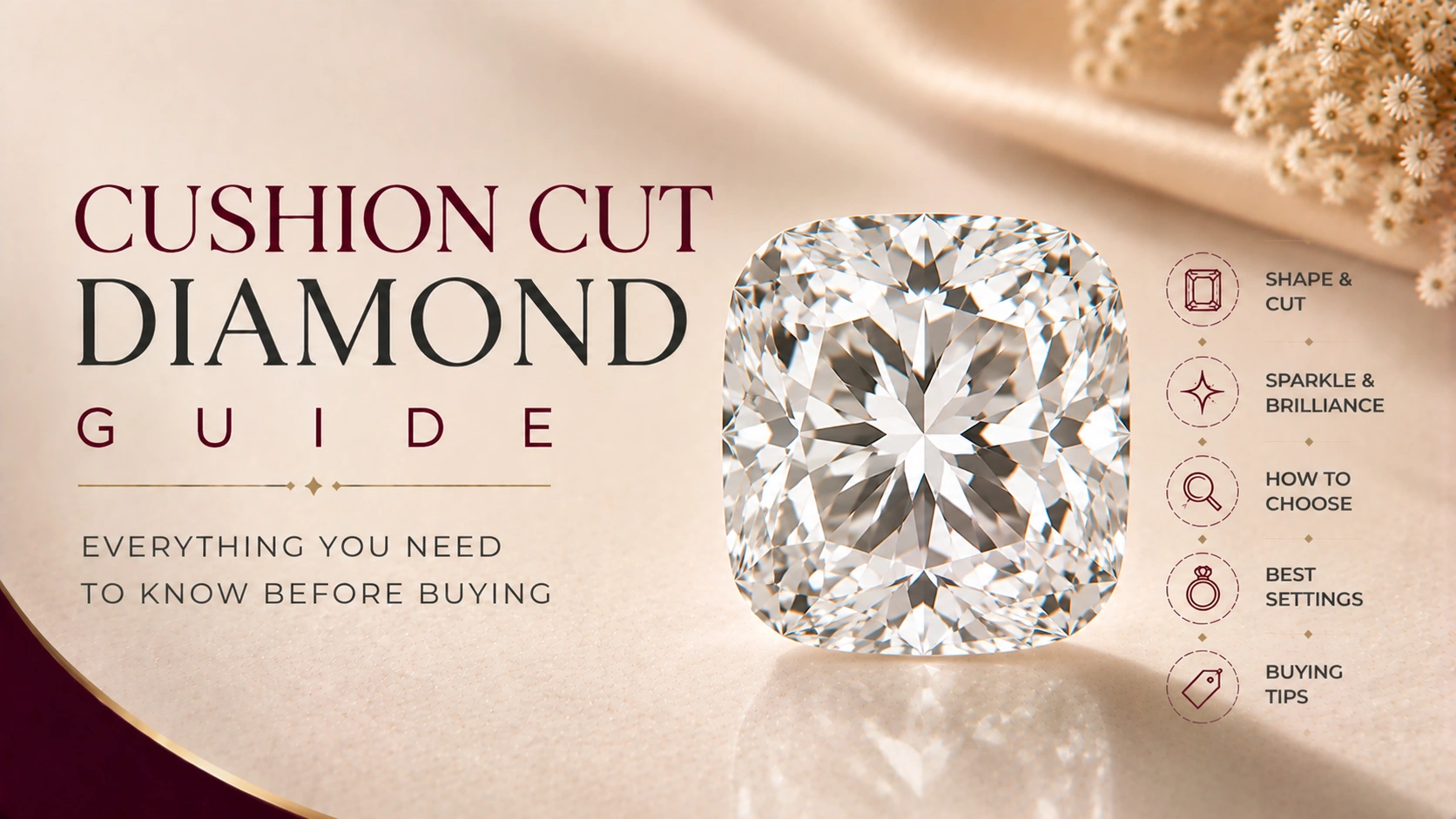
A cushion cut diamond combines the soft, romantic shape of an old-fashioned diamond with the sparkle expected from a modern engagement ring. Its defining features are a square or rectangular outline, rounded corners, and gently curved sides that give the stone a pillow-like appearance.
But choosing a cushion cut diamond is not as simple as picking a carat weight and color grade. Two cushions with the same carat weight can look dramatically different because of their proportions, faceting pattern, color, clarity, and face-up size.
This cushion cut diamond guide explains what to look for, including cushion brilliant vs. modified brilliant cuts, crushed-ice vs. chunky faceting, length-to-width ratios, the 4Cs, popular settings, and the most important things to check before buying.
What Is a Cushion Cut Diamond?
A cushion cut diamond is a fancy-shaped diamond with a square or rectangular outline and rounded corners. The curved edges soften the geometry of the stone and create the pillow-like appearance that gives the shape its name.
Cushion diamonds are available in both nearly square and elongated rectangular proportions. Some have broad, clearly defined facets that produce larger flashes of light, while others have many smaller reflections that create the familiar crushed-ice appearance.
The shape is also closely associated with vintage and antique jewelry because modern cushion cuts evolved from older diamond cutting styles, particularly the Old Mine Cut.
Cushion cuts therefore sit somewhere between traditional and contemporary. They have enough rounded softness to feel vintage, but modern faceting can give them plenty of brilliance and fire.
If you’re still learning the difference between a diamond’s shape and its actual cut characteristics, it can help to start with this overview of diamond cut.
Why Is It Called a Cushion Cut?
The name comes from the shape’s resemblance to a cushion or pillow.
Unlike sharp-cornered square shapes, cushion diamonds have rounded corners and curved sides. Those curves give the stone a softer appearance and help distinguish it from shapes such as the princess cut.
The exact outline can vary considerably. One cushion may look almost perfectly square, while another may have a noticeably rectangular appearance.
That variation is one of the reasons cushion diamonds offer so many different looks within the same basic shape.
Cushion Cut Diamond History
The cushion cut has roots going back centuries. Its historical predecessor, the Old Mine Cut, was commonly used during the 18th and 19th centuries.
Older diamond-cutting techniques were very different from today’s precision cutting. Cutters worked with the limitations of their tools and sought to retain as much of the rough diamond as practical.
The Old Mine Cut typically had a high crown, deep pavilion, smaller table, and large culet. Modern cushion brilliant diamonds retain some of the visual character associated with these older stones while using contemporary cutting techniques to improve light performance.
GIA describes the Old Mine Cut as a forerunner of the modern cushion brilliant and notes that today’s cushion diamonds can have either square or squarish-rectangular proportions.
For shoppers interested in historical diamond styles, an antique cushion vs. Old Mine cut comparison can help clarify the differences.
What Does a Cushion Cut Diamond Look Like?
The easiest way to recognize a cushion diamond is by its combination of:
- Rounded corners
- Curved or gently bowed sides
- Square or rectangular proportions
- Brilliant-style faceting
- A soft, romantic outline
Its appearance can change significantly depending on the faceting pattern.
Some cushion diamonds have large, easily recognizable facets. These can create bold flashes that are sometimes described as a chunky appearance.
Others have many small facets that produce a more diffuse pattern of reflections. This is commonly called crushed ice.
Neither appearance is automatically better. The choice largely comes down to the type of sparkle you prefer.
Types of Cushion Cut Diamonds
Cushion Brilliant
A cushion brilliant generally has larger, more clearly defined facets. This can create broad flashes of light and a more distinct facet pattern.
If you like a diamond with noticeable flashes rather than a finely textured sparkle, this style may appeal to you.
It can also have a more traditional appearance that complements the cushion’s vintage character.
Modified Brilliant Cushion
A modified brilliant cushion has additional faceting compared with a traditional cushion brilliant.
These extra facets can create more intense-looking scintillation and often produce the appearance known as crushed ice.
Modified cushions are extremely common, so it is important not to assume that every cushion will have the same type of sparkle simply because both diamonds are listed as cushion cuts.
Crushed Ice Cushion
“Crushed ice” describes a visual appearance rather than a separate diamond shape.
Instead of seeing a few large, clearly defined flashes, you see many small reflections packed closely together.
Some shoppers love this shimmering look. Others prefer cushions with larger, more organized flashes.
If possible, compare videos or images of multiple diamonds before deciding which pattern you prefer.
Chunky Cushion
A chunky cushion typically displays larger facets and broader flashes of light.
The contrast between chunky and crushed-ice cushions is particularly important when shopping online because two stones can have similar specifications on paper but look very different in photographs or videos.
The best choice is the one whose actual facet pattern matches your taste.
Square vs. Elongated Cushion Diamonds
Cushion diamonds generally fall somewhere between square and rectangular.
A square cushion has a length-to-width ratio close to 1.00, meaning its length and width are nearly identical.
An elongated cushion has a higher ratio and looks more rectangular.
Neither is inherently better.
Square cushion
A square cushion can have a balanced, symmetrical appearance and works particularly well for buyers who want the classic pillow-shaped silhouette.
It can also create a more substantial-looking center stone when surrounded by a halo.
Elongated cushion
An elongated cushion has greater length relative to its width.
This can create a more slender appearance on the finger and gives the cushion shape some visual similarity to other elongated diamond shapes.
If you’re deciding between the two, comparing cushion vs. elongated cushion can help you determine which outline better suits your preferences.
Cushion Cut Diamond Length-to-Width Ratio
The length-to-width ratio is calculated by dividing the diamond’s length by its width.
For example, a diamond measuring 6.0 mm long and 5.0 mm wide has a ratio of 1.20.
As the ratio approaches 1.00, the cushion appears squarer. As the number increases, it becomes more elongated.
There isn’t one universally correct ratio for every shopper.
Instead, use the ratio to understand the diamond’s outline, then judge the actual stone.
A ratio around 1.00 creates a square appearance, while ratios around 1.15 to 1.30 can create a noticeably elongated cushion. The exact appearance can still vary because corner shape, outline symmetry, and facet arrangement also influence what you see.
How to Choose a Cushion Cut Diamond Using the 4Cs
The 4Cs remain important when buying a cushion diamond:
- Cut
- Color
- Clarity
- Carat
However, cushion cuts require a slightly different approach than round brilliant diamonds.
A general overview of the 4Cs of diamond quality is useful, but cushion shoppers should also pay close attention to the individual stone’s visual appearance.
Cushion Cut and Cut Quality
Cut quality has a major effect on sparkle.
The challenge is that cushion diamonds don’t have the same standardized cut-grade system shoppers may be accustomed to seeing with round brilliant diamonds.
That means you should not rely on one number to determine whether a cushion is beautiful.
Instead, look at:
- Overall symmetry
- Facet pattern
- Light return
- Dark areas
- Face-up appearance
- Length-to-width ratio
- Depth and table measurements
- The diamond’s actual video or photographs
GIA recommends paying attention to symmetry and the overall outline because an uneven cushion shape can be obvious.
Cushion Cut Diamond Color
Cushion diamonds can show more body color than some other diamond shapes.
This makes color an important consideration, particularly if you’re choosing a larger cushion or a white-metal setting.
However, the best color grade depends on the individual stone, faceting style, setting, and your personal tolerance for warmth.
You don’t necessarily need the highest color grade to get a beautiful-looking diamond.
For a broader explanation of color grades, see this guide to diamond color.
If you’re specifically deciding how much color you need for an engagement ring, the best diamond color for an engagement ring guide provides a useful comparison.
Cushion Cut Diamond Clarity
Clarity refers to internal and external characteristics within a diamond.
Because cushion diamonds can have larger or more open facets, certain inclusions may be easier to notice than they would be in a more heavily faceted stone.
At the same time, some modified cushions and crushed-ice patterns can make small inclusions less noticeable.
Rather than automatically paying for the highest clarity grade, look for an eye-clean diamond.
That means inclusions aren’t visible to the naked eye at a normal viewing distance.
For more information, compare different grades using this diamond clarity guide.
You can also review the best diamond clarity for an engagement ring when balancing clarity against budget.
Cushion Cut Diamond Carat Weight
Carat measures diamond weight, not physical size.
This distinction is particularly important with cushion diamonds because deeper proportions can cause a diamond to face up smaller than another diamond with the same carat weight.
For that reason, don’t compare cushions based on carat alone.
Look at the actual millimeter measurements.
For example, if two 2-carat cushions have noticeably different length and width measurements, they may look different in the ring despite weighing the same.
You can learn more about how diamond weight works in this diamond carat guide.
How Much Does a Cushion Cut Diamond Cost?
There isn’t one fixed price for a cushion cut diamond.
Price depends on several factors, including:
- Natural or lab-grown origin
- Carat weight
- Color
- Clarity
- Cut quality
- Faceting pattern
- Certification
- Symmetry
- Overall visual performance
Cushion diamonds can sometimes offer better value per carat than round brilliant diamonds, but price comparisons should always be made between diamonds with similar quality characteristics.
A cheaper cushion isn’t necessarily a better deal if it has poor light performance, excessive depth, weak symmetry, or an unattractive facet pattern.
For that reason, price should be considered alongside appearance rather than treated as the deciding factor.
Cushion Cut Diamond Pros and Cons
Pros
Soft, romantic appearance:
Rounded corners give the cushion a distinctive look without the sharp geometry of a princess or emerald cut.
Vintage character:
The shape has strong historical connections to older diamond-cutting styles.
Many appearance options:
You can choose between square and elongated outlines, as well as different faceting patterns.
Strong fire and sparkle:
Well-cut cushions can display attractive brilliance and colorful flashes of fire.
Versatile settings:
Cushions work with solitaire, halo, three-stone, vintage-inspired, and contemporary settings.
Distinctive without being unusual:
The shape is recognizable but less ubiquitous than a round brilliant.
Cons
Cut quality can be difficult to judge:
There isn’t a single cut grade that tells you everything you need to know.
Some cushions show more color:
Body color can be more noticeable depending on the diamond.
Face-up size varies:
Two cushions with the same carat weight can have noticeably different dimensions.
Faceting preferences are subjective:
Some shoppers love crushed ice, while others find it too busy.
Proportions vary widely:
There is no single cushion shape that will suit every buyer.
Best Settings for Cushion Cut Diamonds
Cushion diamonds are remarkably versatile when it comes to engagement ring settings.
Solitaire
A solitaire puts all the attention on the center diamond.
This is a strong option if you particularly like the outline and facet pattern of your cushion.
Halo
A halo surrounds the center diamond with smaller stones.
Because cushion diamonds already have rounded corners, a halo can emphasize the shape while adding visual size and sparkle.
A hidden halo ring guide is also worth exploring if you want additional sparkle without creating a traditional visible halo.
Three-Stone
A cushion center can be paired with side stones for a more substantial three-stone design.
The proportions of the side stones should complement the center stone rather than overwhelm its rounded silhouette.
Vintage-Inspired Settings
Cushion diamonds naturally complement vintage and antique-inspired settings because of their historical connection to older cutting styles.
Milgrain details, engraving, delicate prongs, and ornate metalwork can reinforce that aesthetic.
Cathedral Settings
A cathedral setting can elevate the center stone and create a more prominent profile.
If you’re deciding between different setting profiles, comparing cathedral vs. low-profile engagement rings can help.
Cushion Cut vs. Other Diamond Shapes
Cushion vs. Round
Round brilliant diamonds are known for their strong, highly optimized brilliance.
Cushions offer a softer outline and a different sparkle pattern.
Choose a cushion if you want rounded corners, vintage character, and more flexibility in shape and faceting.
Choose a round if maximum traditional brilliance and symmetry are your priorities.
Cushion vs. Princess
Princess cuts have sharp corners and a more geometric appearance.
Cushions soften those corners and create a more romantic silhouette.
If you’re comparing the three popular square-style shapes, the cushion vs. princess vs. Asscher comparison can help clarify the differences.
Cushion vs. Emerald
Emerald cuts typically use step-cut faceting that creates broad flashes and a hall-of-mirrors effect.
Cushions generally offer more brilliance and fire, depending on their faceting pattern.
The two shapes therefore create very different visual personalities.
Cushion vs. Oval
Both can have elongated proportions, but their outlines are very different.
An oval has a continuous curved outline, while an elongated cushion retains its rounded corners and softer rectangular structure.
How to Choose a Cushion Cut Diamond
If you’re shopping for a cushion diamond, use this process.
1. Decide whether you want square or elongated
Start with the outline.
Do you prefer a classic square cushion or a longer rectangular appearance?
Don’t choose a ratio simply because it is considered popular. Choose the silhouette you actually like on the finger.
2. Decide what kind of sparkle you prefer
Look at several examples of:
- Chunky cushions
- Cushion brilliants
- Modified cushions
- Crushed-ice cushions
This can make a bigger difference to your satisfaction than a small difference in color or clarity grade.
3. Compare millimeter dimensions
Don’t compare carat weight alone.
Look at the length and width of each diamond and compare how much face-up coverage you’re getting.
4. Check symmetry
The four sides and corners should create a balanced outline.
An asymmetrical cushion can be noticeable, especially when viewed from directly above.
5. Check for excessive darkness
A diamond can have attractive contrast, but large areas that remain dark under normal viewing conditions may reduce its visual appeal.
Look at videos and photographs from different angles and lighting conditions.
6. Prioritize an eye-clean clarity
Don’t automatically pay for flawless clarity.
If an SI or VS diamond looks clean to the naked eye and performs well, the money saved may be better spent elsewhere.
7. Choose color according to the setting
White metals can make warmth more noticeable, while yellow or rose gold can make a warmer diamond feel intentional.
The diamond’s actual appearance matters more than blindly choosing the highest available color grade.
8. Compare the actual stones
This is perhaps the most important step.
Cushion diamonds can vary substantially even when their certificates show similar specifications.
Whenever possible, compare multiple stones side by side.
Cushion Cut Diamond Buying Checklist
Before purchasing, ask:
- Is the diamond square or elongated?
- Do I prefer chunky or crushed-ice faceting?
- Does the outline look symmetrical?
- How does the diamond perform in different lighting?
- Are there noticeable dark areas?
- Is the diamond eye-clean?
- Does the color look comfortable to me?
- What are the actual length and width measurements?
- Is the diamond excessively deep?
- Does the face-up size seem appropriate for the carat weight?
- Does the setting protect the corners and girdle appropriately?
- Have I compared it with other cushion diamonds?
If you can answer all of these questions confidently, you’re much less likely to choose a cushion diamond based on a certificate alone.
Are Cushion Cut Diamonds Good for Engagement Rings?
Yes. Cushion diamonds are particularly appealing if you want a center stone that combines classic styling with a softer, more romantic outline.
They are also flexible enough to work with modern solitaire settings, halos, three-stone rings, and vintage-inspired designs.
The main thing to remember is that “cushion cut” describes a broad category rather than one standardized appearance.
The biggest decision is often not whether you want a cushion, but which cushion you want.
Are Cushion Cut Diamonds Sparkly?
They can be extremely sparkly, but their sparkle looks different from a round brilliant.
Some cushions produce larger, broader flashes, while others create a dense crushed-ice effect with many smaller reflections.
GIA notes that cushion diamonds have their own distinct sparkle pattern and shouldn’t necessarily be expected to look like round or princess cuts.
The best way to determine whether a particular cushion is sparkly enough for you is to examine the actual diamond rather than relying only on its grading report.
Do Cushion Cut Diamonds Look Bigger?
Not necessarily.
Cushion diamonds can provide substantial visual presence, but their face-up size depends on their length, width, depth, and overall proportions.
A deeper diamond may carry more of its weight below the girdle and therefore look smaller from the top.
That’s why millimeter measurements are more useful than carat weight alone when comparing face-up size.
Are Cushion Cut Diamonds More Affordable Than Round Diamonds?
They can be.
Cushion diamonds often have lower prices per carat than comparable round brilliant diamonds, although the exact difference varies according to quality and market conditions.
Don’t assume that the least expensive cushion is the best value.
A cushion with attractive proportions and strong visual performance can be a better purchase than a larger but poorly performing stone.
What Is the Best Color for a Cushion Cut Diamond?
There isn’t one color grade that works for every cushion.
Cushions can retain noticeable body color, so color deserves particular attention.
Your preferred grade depends on the diamond itself, its size, faceting pattern, metal color, and how sensitive you are to warmth.
The goal should be a diamond that looks sufficiently white to you rather than paying automatically for the highest possible color grade.
What Is the Best Clarity for a Cushion Cut Diamond?
The best clarity is generally the lowest grade that remains eye-clean and visually attractive.
Some cushion faceting patterns can disguise small inclusions effectively, while larger or more open facets can make certain inclusions easier to notice.
Instead of selecting a clarity grade in isolation, inspect the actual stone.
Final Verdict: Is a Cushion Cut Diamond Right for You?
A cushion cut diamond is an excellent choice if you want a center stone with a soft silhouette, vintage influence, and plenty of character.
Its biggest advantage is also its biggest challenge: there is a lot of variation.
You can choose a nearly square cushion or an elongated version. You can choose broad, chunky flashes or a crushed-ice appearance. You can prioritize face-up size, color, clarity, or a particular setting style.
That flexibility means there is rarely one specification that defines the “perfect” cushion diamond.
Instead, focus on the combination of shape, faceting, proportions, light performance, and eye-clean appearance.
If you compare actual stones rather than relying solely on their certificates, you can find a cushion cut diamond that looks beautiful to you and fits your engagement ring budget.