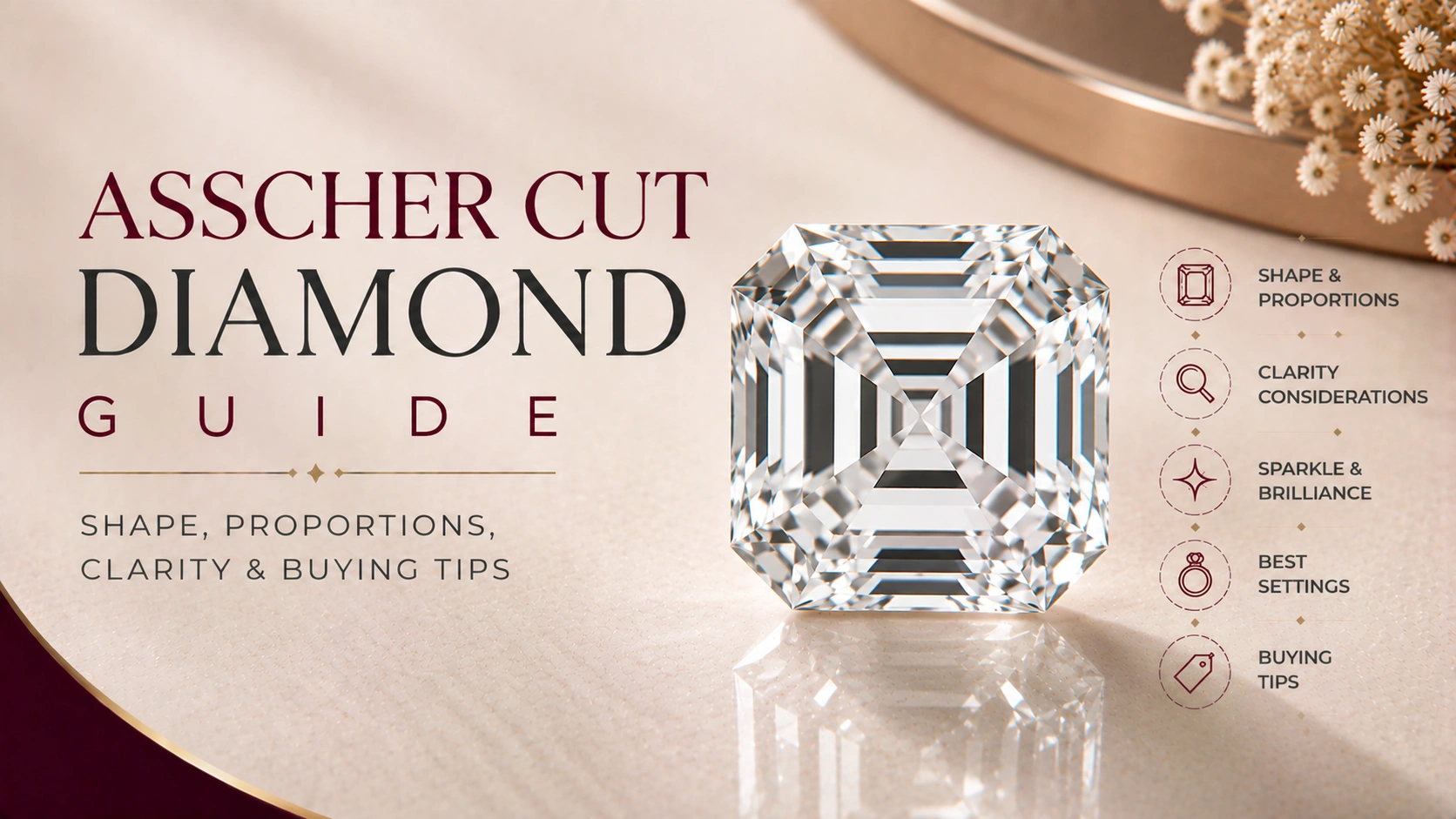
An Asscher cut diamond is one of the most distinctive step-cut diamond shapes. Its square outline, cropped corners, and concentric step facets create a geometric “hall of mirrors” appearance that looks very different from the sparkle of a round brilliant.
The Asscher cut is especially appealing if you like Art Deco design, clean geometry, vintage-inspired jewelry, and flashes of light rather than nonstop sparkle.
But Asscher diamonds require a little more care when shopping. Their large, open facets can make inclusions, body color, windowing, and poor symmetry easier to see than they would be in a brilliant-cut diamond.
This guide explains what makes an Asscher cut unique and what to look for when choosing one for an engagement ring.
What Is an Asscher Cut Diamond?
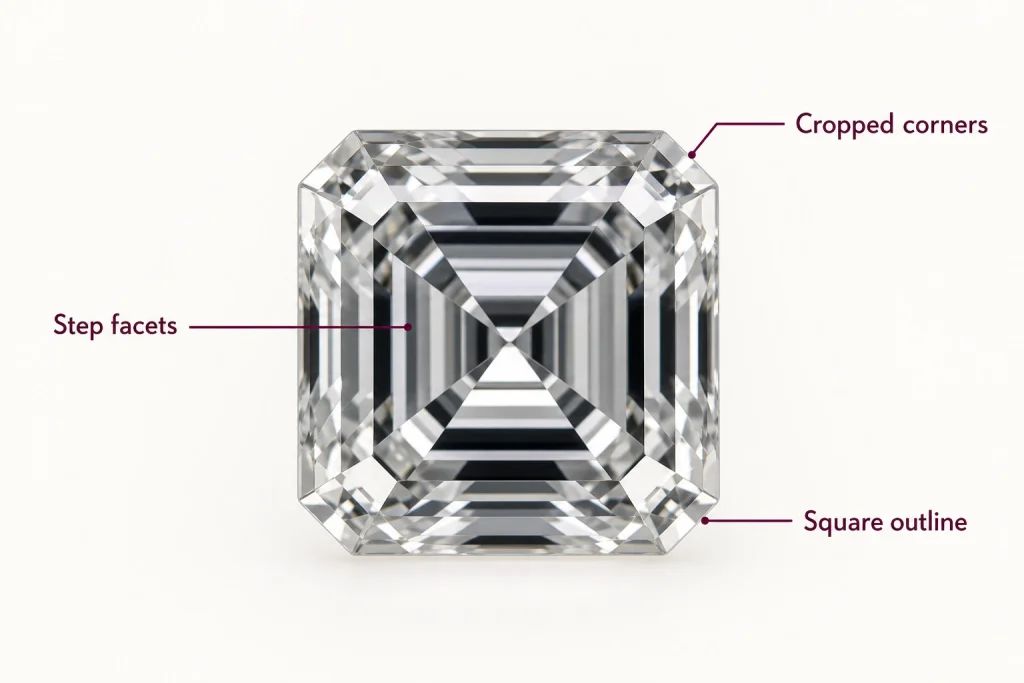
An Asscher cut is a square step-cut diamond with cropped corners. From above, the clipped corners give it an almost octagonal outline, while its broad, parallel facets create layers of reflections that appear to recede toward the center.
The original Asscher design was created by Joseph Asscher in Amsterdam in 1902. It became closely associated with the Art Deco period, particularly during the 1920s and 1930s. The original design used 58 step-cut facets.
Unlike a round brilliant, which uses many facets to create intense sparkle and scintillation, an Asscher relies on larger, more organized step facets. The result is a quieter but highly recognizable appearance.
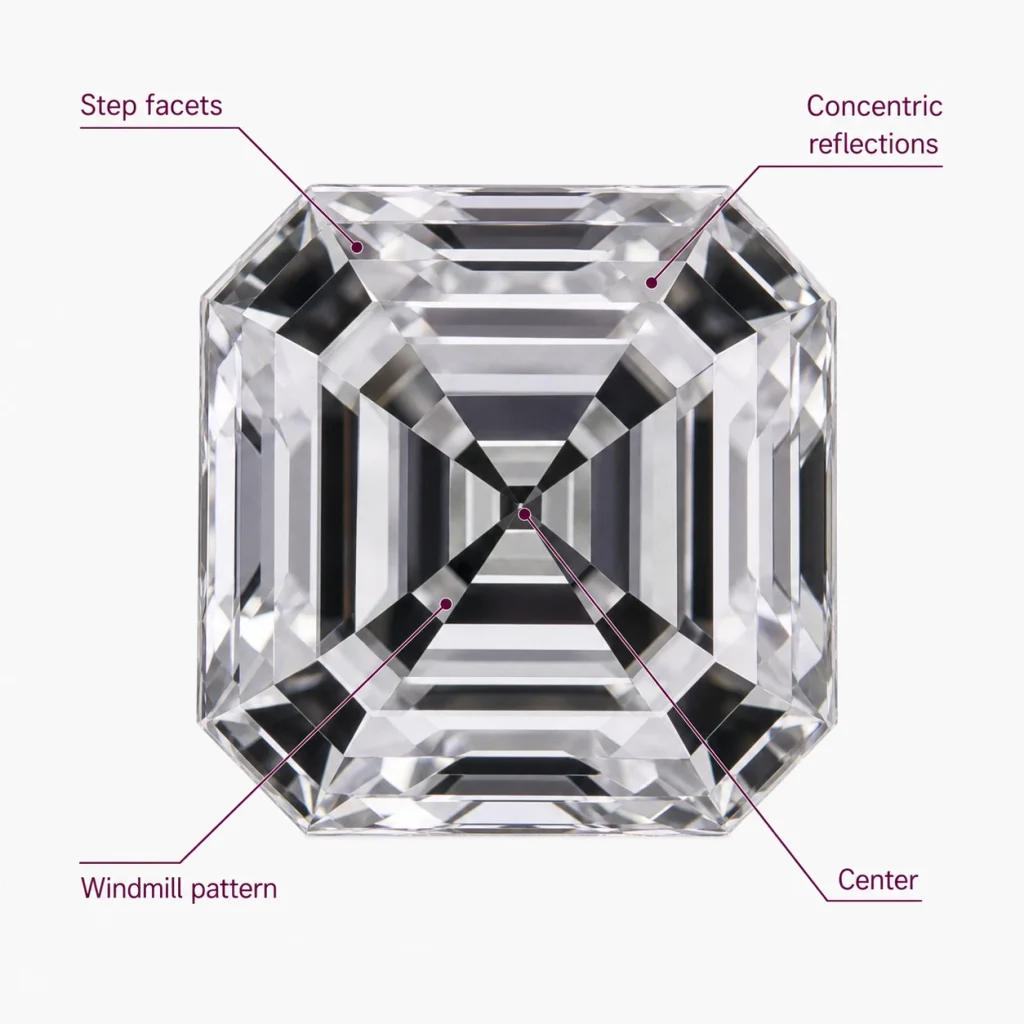
Asscher Cut Diamond at a Glance
| Feature | Asscher Cut |
|---|---|
| Shape | Square with cropped corners |
| Faceting | Step cut |
| Typical outline | Nearly square/octagonal |
| Visual character | Geometric, reflective, architectural |
| Popularity | Strong choice for vintage and Art Deco styles |
| Best known for | Concentric-square or windmill pattern |
| Main buying concern | Clarity, color, proportions, and light performance |
The History of the Asscher Cut
The Asscher cut traces its origins to the Asscher diamond-cutting family in Amsterdam.
Joseph Asscher developed the original Asscher cut in 1902 and patented the design. The shape became particularly popular during the Art Deco era because its straight lines, symmetry, and geometric structure suited the design movement perfectly.
The Asscher family’s diamond-cutting history also includes its involvement with the famous Cullinan Diamond. The 3,106-carat rough diamond was discovered in 1905, and Joseph Asscher was later entrusted with cleaving it in 1908.
The original Asscher design eventually became available to cutters more broadly after its patent expired. A later version, the Royal Asscher Cut, was introduced by the Asscher family in 2001 with 74 facets instead of the original 58.
What Makes an Asscher Cut Diamond Different?
The most important difference is the way the diamond handles light.
An Asscher is built around step-cut faceting. Instead of the smaller triangular and kite-shaped facets used extensively in brilliant cuts, the facets form broad geometric steps.
When the proportions and facet alignment work well together, you can see:
- Concentric square or octagonal reflections
- A central “X” or windmill pattern
- Broad flashes of light
- Strong contrast between light and dark areas
- A deep, mirror-like appearance
This is sometimes described as a “hall of mirrors” effect.
The pattern is one of the main reasons people choose an Asscher. Two diamonds with similar carat weight and certificate grades can look surprisingly different once you compare them face-up.
How Do Asscher Cut Diamonds Look?
An Asscher usually has a more structured and sophisticated appearance than a brilliant-cut diamond.
Instead of appearing to sparkle continuously, the diamond can produce larger flashes as it moves. The eye is drawn toward the center because the step facets create repeated reflections.
A well-performing Asscher should have a coherent, attractive pattern without large areas that look dead or see-through.
The Windmill Pattern
One of the visual characteristics buyers often look for is a recognizable windmill or X-shaped pattern.
This pattern comes from the arrangement of the step facets and their interaction with light. It should appear balanced rather than distorted.
However, don’t choose a diamond solely because a listing describes it as having a “perfect windmill.” Look at the actual diamond from multiple angles and under movement whenever possible.
Windowing
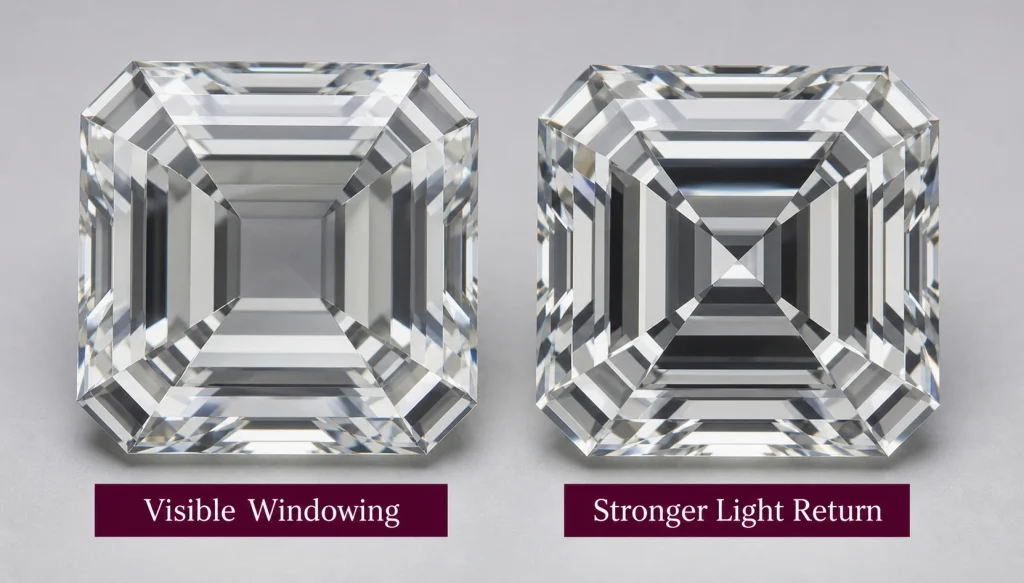
Windowing occurs when you can see through parts of the diamond instead of seeing strong internal reflections.
Because Asschers have broad, open facets, windowing can be particularly noticeable.
A photograph can sometimes hide this problem, which is why high-quality video or 360-degree imagery is valuable when comparing stones.
Asscher Cut vs. Emerald Cut
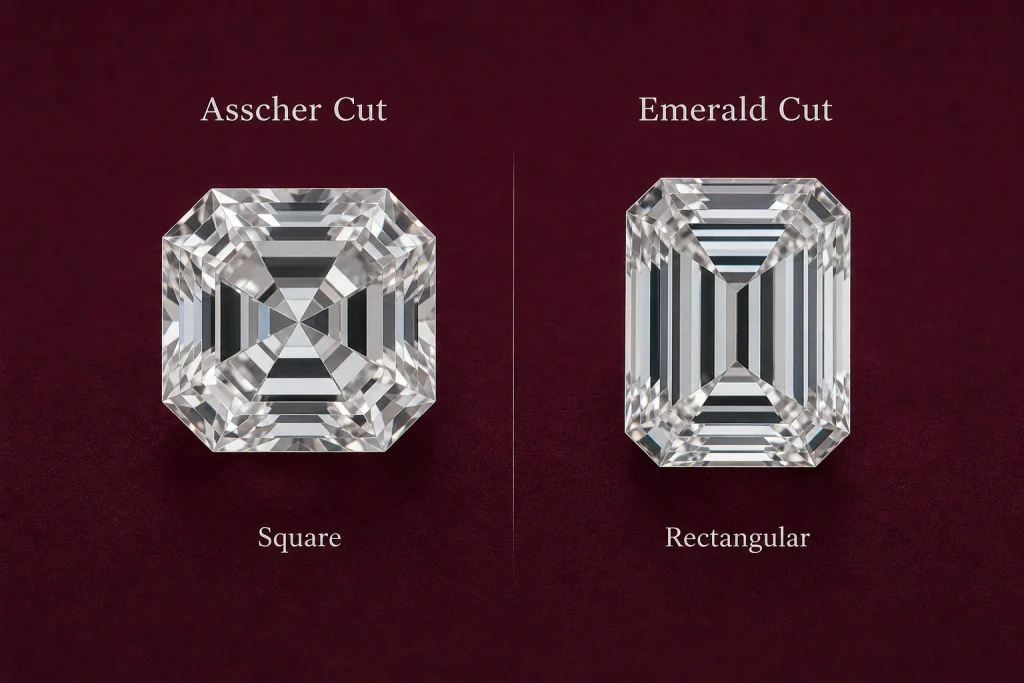
Asscher and emerald cuts are closely related because both use step-cut faceting and cropped corners.
The biggest difference is their overall outline.
An Asscher is intended to look square, while an emerald cut is generally rectangular.
| Feature | Asscher Cut | Emerald Cut |
|---|---|---|
| Shape | Square | Rectangular |
| Faceting | Step cut | Step cut |
| Corners | Cropped | Cropped |
| Appearance | Geometric and compact | Elongated and elegant |
| Typical impression | Art Deco, architectural | Classic, understated |
| Light pattern | Concentric/windmill | Broad hall-of-mirrors effect |
An Asscher also tends to have its own distinctive visual personality because of its square geometry and facet arrangement.
For a broader look at step cuts, compare step-cut and brilliant-cut diamonds.
Asscher Cut vs. Brilliant Cut
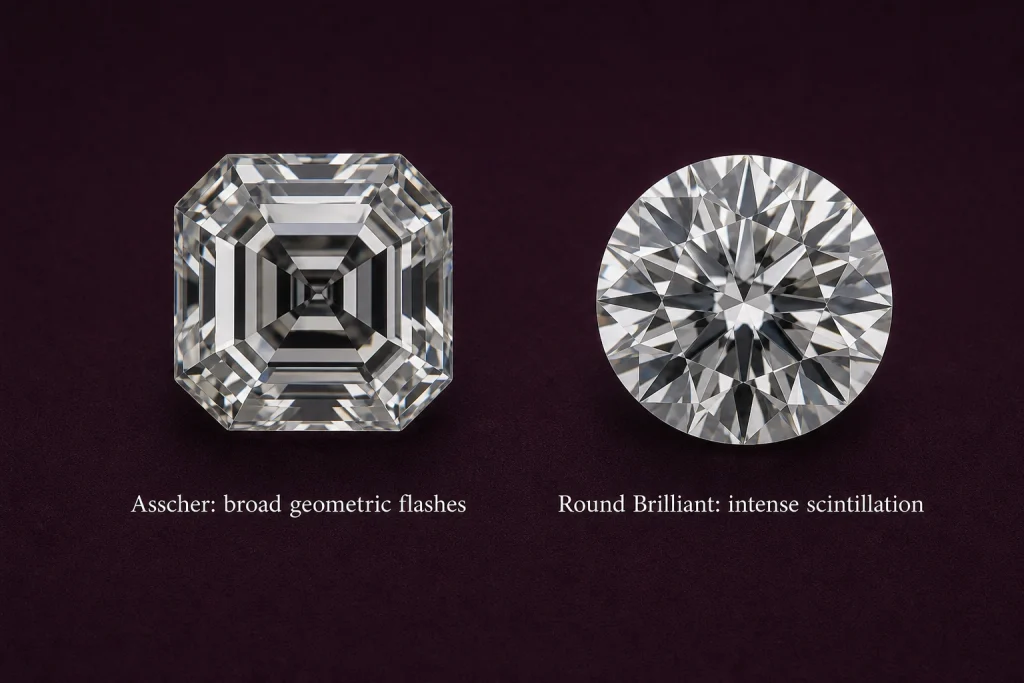
The biggest difference between an Asscher and a brilliant cut is how the facets are designed to interact with light.
Brilliant cuts are designed for strong brightness, scintillation, and sparkle. Asschers use larger step facets to create reflections that look more organized and geometric.
That doesn’t mean an Asscher is dull. A well-cut Asscher can have plenty of life and beautiful flashes, but the effect is different.
If you want maximum sparkle from every angle, a round brilliant may be more suitable. If you prefer symmetry, depth, and a dramatic geometric pattern, an Asscher may be the better match.
You can also review the broader diamond cut guide when comparing different cutting styles.
How to Choose an Asscher Cut Diamond
Choosing an Asscher is less about finding a single “magic” combination of numbers and more about finding a stone where the proportions and optical performance work together.
1. Look for a Square Outline
A traditional Asscher should look square when viewed face-up.
A length-to-width ratio around 1.00 to 1.05 is a useful starting point for shoppers who want the classic square appearance. Ratios farther from 1.00 can begin to make the stone look more rectangular.
Always check the actual measurements rather than relying only on the shape name.
2. Pay Attention to Depth
Asscher diamonds can be relatively deep.
Depth percentage is useful for screening diamonds, but it should not be treated as an automatic pass-or-fail measurement. Different proportions can interact in different ways, and a diamond that looks good on paper can still have weak visual performance.
Many current Asscher buying guides place workable depth ranges roughly in the low-60s through low-70s, although the exact number should be evaluated alongside the rest of the stone.
3. Consider the Table
The table is the large top facet of the diamond.
For Asschers, table size can influence how much of the stone’s internal pattern is visible and how much the diamond behaves like a window.
A commonly cited starting range is roughly 55% to 65%, but table percentage should be considered alongside depth, crown, pavilion, symmetry, and the actual face-up appearance.
4. Check Symmetry Carefully
Symmetry is particularly important for a geometric diamond.
Look at:
- Corner clipping
- Concentric steps
- Centering
- Facet alignment
- Overall outline
Small inconsistencies can be more noticeable on an Asscher because there are fewer distractions from intense brilliant-style sparkle.
5. Judge the Diamond in Motion
This is one of the most important Asscher buying tips.
Don’t rely exclusively on:
- Carat weight
- Color grade
- Clarity grade
- Depth
- Table
- A vendor’s “ideal” label
Use those specifications to narrow your options, then inspect the diamond itself.
A video can reveal whether the windmill pattern is centered, whether the contrast looks attractive, and whether the stone has excessive windowing or persistent dark areas.
Fancy-shaped diamonds do not receive the same overall GIA cut grading system used for round brilliants, making visual evaluation especially important.
What Is the Best Clarity for an Asscher Cut Diamond?
Clarity matters more with an Asscher than with many brilliant-cut diamonds.
The reason is simple: the large, open step facets can make inclusions easier to see.
A round brilliant’s numerous facets can scatter light and make some imperfections less obvious. An Asscher’s broad facets provide a clearer view into the stone.
A practical starting point
VS2 or higher is a sensible place for many shoppers to begin.
VS1 and VVS grades can make sense if you want additional clarity or are comfortable spending more, but higher clarity is not automatically better if the inclusions are already invisible to the naked eye.
SI1 can sometimes offer good value, but it needs to be evaluated carefully because inclusion visibility varies from stone to stone.
The goal is not necessarily to buy the highest clarity grade. The goal is to buy a diamond that looks clean at normal viewing distance.
For more help evaluating grades, see the diamond clarity guide.
What Is the Best Color for an Asscher Diamond?
Asscher diamonds can also show body color more readily than brilliant cuts.
The large step facets and open appearance give you more opportunity to notice warmth in the diamond.
For many buyers, G or H is a useful balance between a near-colorless appearance and value.
If you want a particularly crisp, icy appearance, you may prefer F or higher.
On the other hand, warmer colors can work beautifully when intentionally paired with yellow or rose gold.
The right choice depends on the appearance you want rather than simply choosing the highest available grade.
See the diamond color guide for more information about how color grades work.
Does an Asscher Diamond Look Smaller?
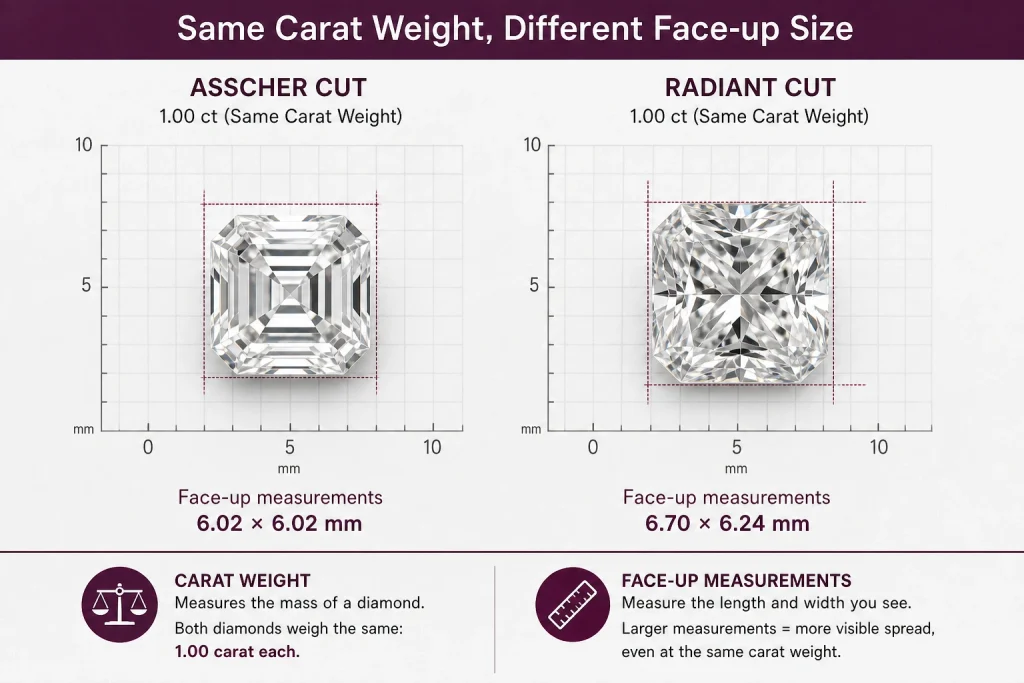
It can.
Asscher diamonds are often deeper than some other diamond shapes, meaning more of the carat weight can be carried below the girdle instead of contributing to the stone’s face-up dimensions.
As a result, an Asscher can look smaller from above than another diamond with the same carat weight.
This is why millimeter measurements matter.
If spread is important to you, compare the actual length and width of the diamonds rather than comparing carat weights alone.
Best Settings for Asscher Cut Engagement Rings
The Asscher’s geometric shape works especially well with settings that complement rather than hide its clean lines.
Solitaire
A solitaire puts the Asscher at the center of attention.
A simple four-prong or similar design can emphasize the square outline and allow the clipped corners to remain visible.
Vintage or Art Deco
This is one of the most natural pairings.
Milgrain details, geometric lines, engraving, and symmetrical side stones can reinforce the Art Deco character of an Asscher.
Halo
A halo can make the center stone appear larger while adding additional sparkle around the step-cut center.
A geometric or square halo can work particularly well with the Asscher’s outline.
Three-Stone
An Asscher can also be paired with side stones for a more substantial look.
The side stones can be chosen to complement the center diamond rather than compete with its distinctive step pattern.
Bezel
A bezel setting provides a clean, modern appearance and protects the diamond’s edges.
The choice ultimately depends on whether you want the finished ring to feel vintage, modern, minimalist, or highly decorative.
Asscher Cut Diamond Pros and Cons
Pros
- Distinctive square shape
- Strong Art Deco and vintage appeal
- Elegant geometric appearance
- Beautiful step-cut reflections
- Cropped corners create a unique silhouette
- Works well in both vintage and modern settings
- Can look sophisticated without relying on intense sparkle
Cons
- Can show inclusions more readily
- Can show body color more easily
- Poor windowing can be noticeable
- Symmetry and facet alignment matter greatly
- Can face up smaller than some shapes of the same carat weight
- Requires more visual evaluation than simply selecting a certificate grade
Classic Asscher vs. Royal Asscher
The terms Asscher Cut and Royal Asscher Cut should not automatically be treated as interchangeable.
The original Asscher design dates to 1902 and traditionally has 58 facets.
The Royal Asscher Cut is a later design introduced in 2001. It uses 74 facets and is a specific branded and trademarked design associated with the Asscher family.
The additional facets are intended to enhance the light interaction while maintaining the square step-cut character.
If a retailer uses the term “Royal Asscher,” check that the stone is actually the branded Royal Asscher design rather than assuming that every Asscher-style diamond qualifies.
Are Asscher Cut Diamonds Good for Engagement Rings?
Yes, especially for someone who values individuality, symmetry, vintage influence, and a sophisticated look.
An Asscher can be an excellent engagement-ring choice if you prefer:
- Step-cut diamonds
- Art Deco design
- Square shapes
- Clean geometric lines
- Broad flashes rather than intense sparkle
- Vintage-inspired jewelry
It may be less suitable if your priority is maximum brilliance and sparkle from every viewing angle.
There is no universally best diamond shape. The right choice depends on the visual style you want and how you prioritize size, sparkle, clarity, color, and budget.
For a direct comparison with other square shapes, see the cushion vs. princess vs. Asscher comparison.
How Much Does an Asscher Cut Diamond Cost?
There isn’t one standard price for an Asscher diamond.
The price depends on factors such as:
- Carat weight
- Color
- Clarity
- Cut quality and proportions
- Symmetry
- Polish
- Natural versus lab-grown origin
- Certification
- Brand or proprietary cutting style
Asscher diamonds can sometimes offer a different value proposition from round brilliants because demand, cutting complexity, and market pricing vary by shape.
Rather than comparing price per carat alone, compare stones with similar visual quality and specifications.
You can also review the 4Cs of diamond quality when evaluating the overall quality of a diamond.
Asscher Cut Diamond Buying Checklist
Before purchasing, check the following:
Shape
- Does the diamond look genuinely square?
- Are the corners evenly cropped?
- Does the outline look symmetrical?
Proportions
- Is the length-to-width ratio close to your preferred square appearance?
- Are the depth and table reasonable?
- Do the measurements make sense when compared with the carat weight?
Light performance
- Is the center pattern attractive?
- Is the windmill or concentric pattern reasonably balanced?
- Does the stone show excessive windowing?
- Are there large, persistent dark areas?
Clarity
- Is the diamond eye-clean?
- Are inclusions visible through the large table?
- Are you paying for a higher clarity grade you cannot actually see?
Color
- Does the diamond look white enough for your preference?
- Does the color work with the chosen metal?
- Have you compared stones side by side?
Certificate
- Is the diamond independently graded?
- Do the certificate measurements match the listing?
- Is the shape designation consistent with what you’re purchasing?
Video
- Have you seen the diamond from multiple angles?
- Does the pattern remain attractive as the stone moves?
Frequently Asked Questions
Is an Asscher cut the same as an emerald cut?
No. Both are step cuts with cropped corners, but an Asscher is designed to have a square outline while an emerald cut is generally rectangular. Their proportions and visual patterns also differ.
Is an Asscher cut diamond sparkly?
Yes, but its sparkle looks different from a brilliant-cut diamond. Asschers produce broad flashes and geometric reflections rather than the rapid scintillation associated with round brilliants.
What clarity should an Asscher diamond be?
VS2 or higher is a useful starting point for many buyers, but the actual stone matters more than the grade alone. Because Asschers have large open facets, inclusions can be easier to see.
What color should an Asscher diamond be?
G or H can provide a good balance between a near-colorless appearance and value. Higher grades can be chosen for a more colorless look, while warmer grades can work intentionally with yellow or rose gold.
What is a good length-to-width ratio for an Asscher?
A ratio around 1.00 to 1.05 is a useful starting point if you want the classic square appearance. The closer the ratio is to 1.00, the more square the diamond will generally look.
Do Asscher diamonds look smaller?
They can. Their deeper proportions can place more carat weight below the girdle, so the diamond may have less face-up spread than another shape with the same carat weight.
Are Asscher diamonds good for vintage engagement rings?
Absolutely. Their geometric shape and step-cut faceting fit naturally with Art Deco and vintage-inspired designs.
What is a Royal Asscher diamond?
The Royal Asscher Cut is a specific later design developed by the Asscher family in 2001. It uses 74 facets compared with the 58 facets of the original Asscher design.
Final Takeaway
An Asscher cut diamond is a strong choice for someone who wants an engagement ring that feels geometric, elegant, distinctive, and timeless.
Its beauty comes from the arrangement of its step facets rather than the intense sparkle of a brilliant cut. That also means shopping for one requires a closer look at clarity, color, symmetry, proportions, and especially the diamond’s actual face-up appearance.
Start with a square outline, use proportions as screening tools, prioritize an eye-clean appearance, and inspect the diamond in motion before buying.
Most importantly, don’t choose an Asscher simply because its certificate has attractive numbers. The best stone is the one whose pattern, contrast, symmetry, and overall appearance appeal to you when you actually look at it.