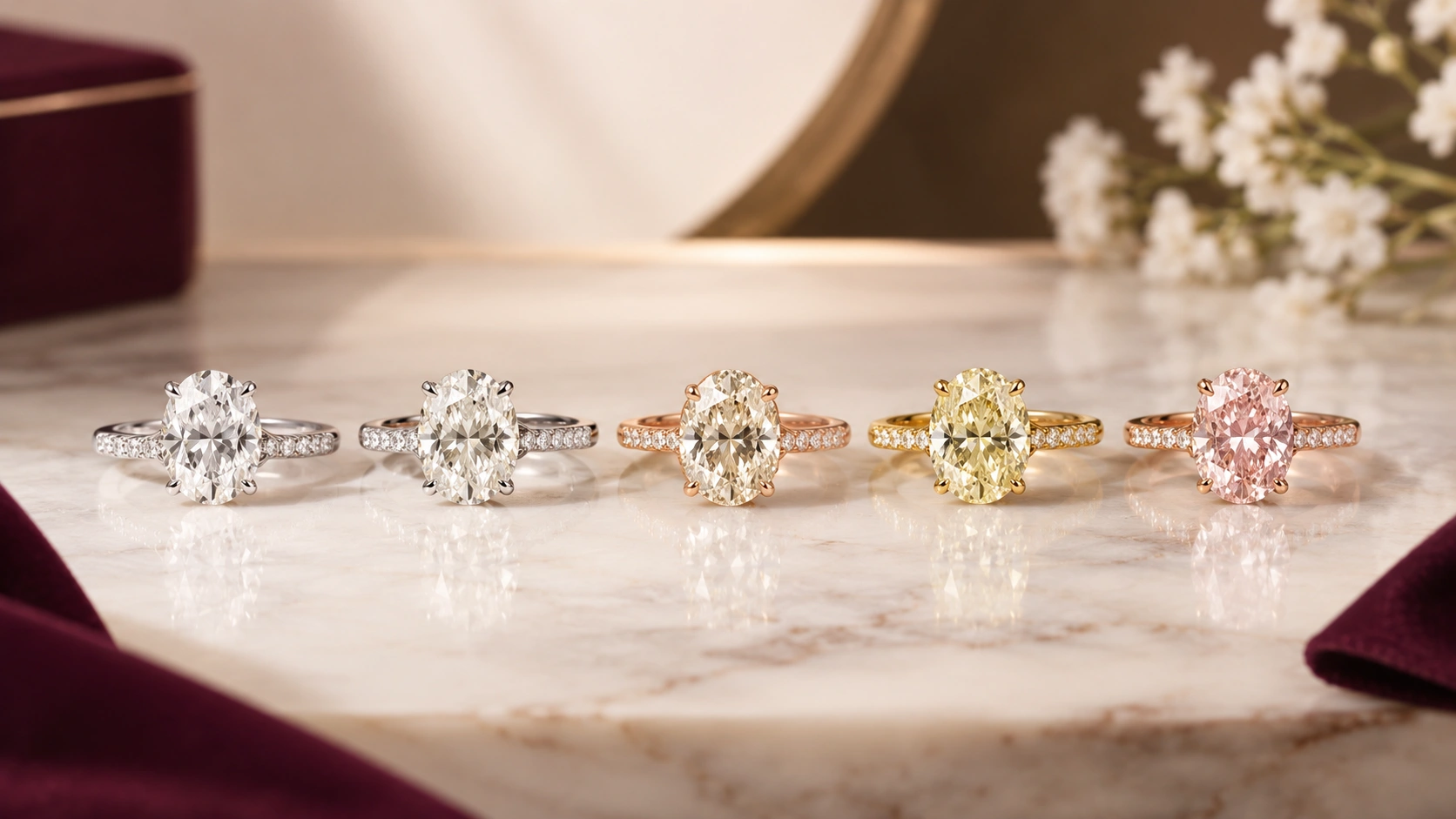
Choosing the best diamond color for an engagement ring can feel surprisingly complicated.
Diamond color is graded on a scale from D to Z, with D representing the highest color grade and increasing warmth as you move toward Z. But here’s the part many shoppers miss: the highest color grade isn’t automatically the best choice for every engagement ring.
For many buyers, a G, H, or even I diamond can provide a beautiful white appearance while leaving more of the budget for carat weight, cut quality, clarity, or the setting.
The right diamond color depends on several things:
- Your engagement ring’s metal
- Diamond shape
- Carat size
- Cut quality
- Your sensitivity to color
- Whether you’re buying a natural or lab-grown diamond
- How much you’re willing to spend
So, what is the best diamond color for an engagement ring?
For many shoppers, G or H offers an excellent balance of whiteness and value.
But if you want the highest possible colorless appearance, D, E, or F may be preferable. And if maximizing size and value is more important than an icy-white appearance, I or even J can be worth considering.
Let’s break it down.
Best Diamond Color for an Engagement Ring at a Glance
| Diamond Color | Category | Appearance | Typical Value | Best For |
|---|---|---|---|---|
| D | Colorless | Exceptionally colorless | Lowest value | Maximum colorlessness |
| E | Colorless | Extremely colorless | Very high | Buyers wanting premium color |
| F | Colorless | Very colorless | Very high | Premium appearance |
| G | Near Colorless | Very white | Excellent | Best balance for many shoppers |
| H | Near Colorless | White | Excellent | Value-conscious buyers |
| I | Near Colorless | Slight warmth possible | Very good | Larger diamond on a budget |
| J | Near Colorless | Noticeably warmer in some stones | Very good | Value and warm settings |
| K–M | Faint | More visible warmth | Lower | Intentional warmer look |
The key point is that D isn’t necessarily the best value, and J isn’t necessarily a bad choice.
The best grade is the one that gives you the appearance you want without spending more than necessary.
What Is Diamond Color?
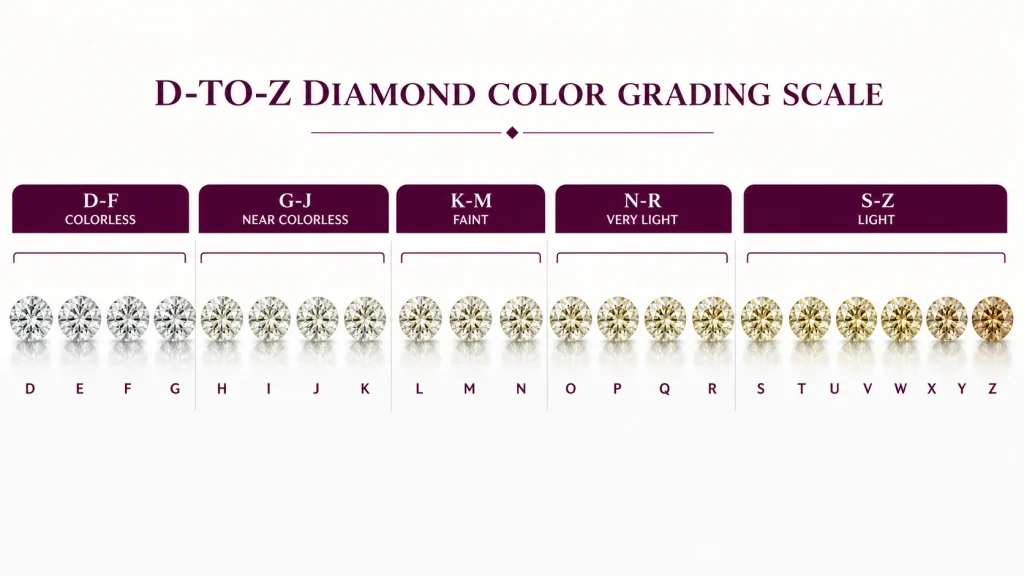
Diamond color refers to the amount of body color visible in a diamond.
For traditional white diamonds, the grading scale generally runs:
D → E → F → G → H → I → J → K → L → M → N → O → P → Q → R → S → Z
As you move down the scale, the diamond generally shows progressively more yellow or brownish warmth.
The scale is divided into broad categories:
D-F: Colorless
These are the highest color grades.
They have extremely little detectable body color when professionally graded.
G-J: Near Colorless
These diamonds can still look very white, especially when viewed face-up.
This is where many shoppers find a particularly attractive balance between appearance and price.
K-M: Faint
Warmth becomes more noticeable.
Some shoppers love this slightly warmer appearance, particularly with yellow or rose gold.
N-R: Very Light
More obvious body color is present.
S-Z: Light
Color is increasingly visible.
For engagement rings intended to look traditionally white, shoppers typically focus on the Colorless and Near Colorless ranges.
For more information, see this diamond color guide.
What Is the Best Diamond Color Grade?
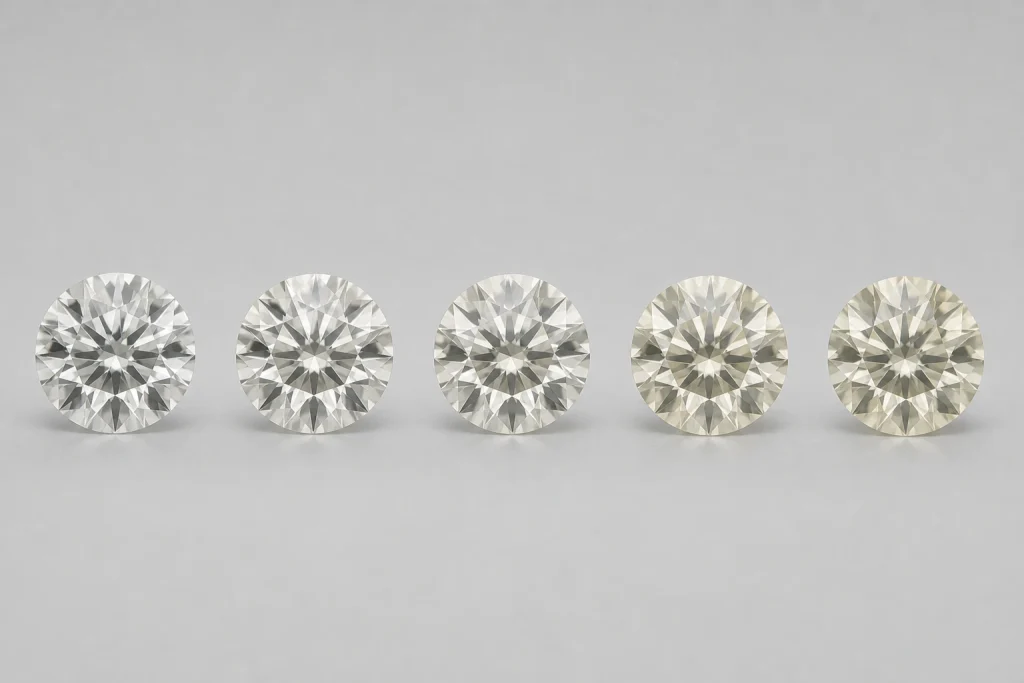
There is no single best color grade for everyone.
However, if you’re looking for a practical starting point:
Best overall balance: G
G is the first grade in the Near Colorless category and can look extremely white in an engagement ring.
Best value: H
H remains Near Colorless while generally costing less than G when other characteristics are comparable.
Best premium color: D
D is the highest color grade and is ideal if maximum colorlessness is your priority.
Best budget-friendly option: I
I can offer a larger diamond or better specifications while still remaining in the Near Colorless category.
Best warm-toned setting option: J or lower
If you’re using yellow or rose gold and like a warmer appearance, going lower on the color scale can make sense.
Is D the Best Diamond Color for an Engagement Ring?
D is the highest color grade.
If your only goal is obtaining the most colorless diamond possible, D is the obvious choice.
A D-color diamond has virtually no detectable body color under controlled grading conditions.
But that doesn’t mean D is automatically the best purchase.
The price premium can be substantial, while the visual difference between D and slightly lower grades may be difficult for the average person to appreciate once the diamond is mounted.
For some buyers, that premium is worthwhile.
For others, spending the same money on a better-cut G or H diamond may produce a more noticeable improvement.
D vs E vs F: Which Colorless Grade Is Best?
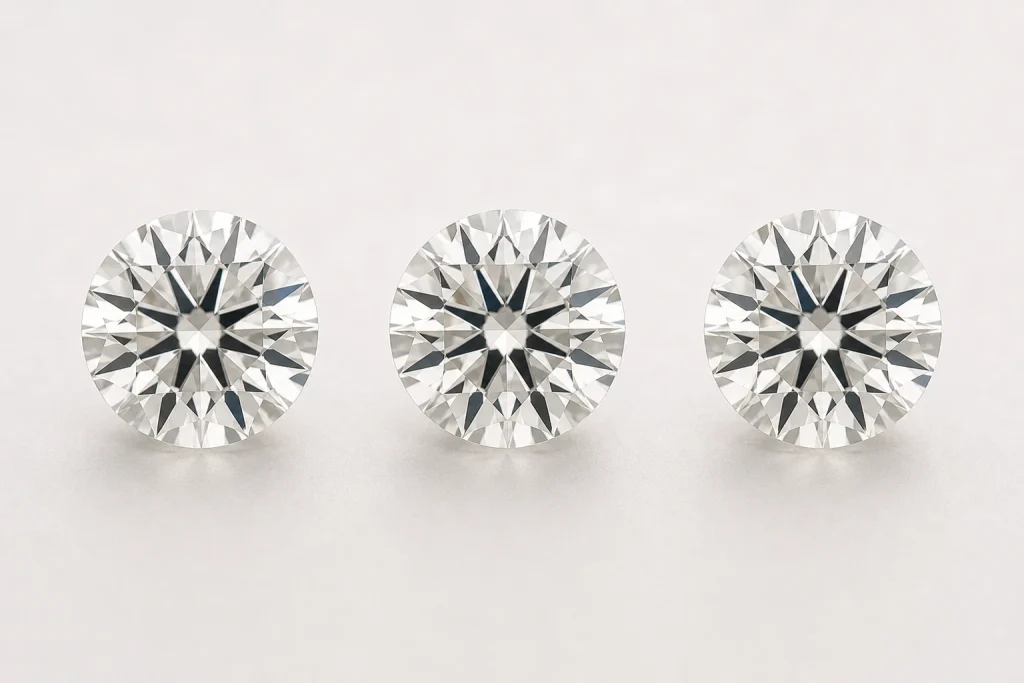
D, E, and F are all classified as Colorless.
The differences between them are extremely subtle.
D
The highest possible color grade.
Best for buyers who want maximum colorlessness.
E
Extremely high color quality with virtually no visible difference from D for most observers.
F
The lowest grade within the Colorless category.
It can offer a slightly better price while maintaining a premium color classification.
If you’re specifically shopping for a Colorless diamond, F can be a particularly interesting place to look.
G: The Best All-Around Diamond Color?
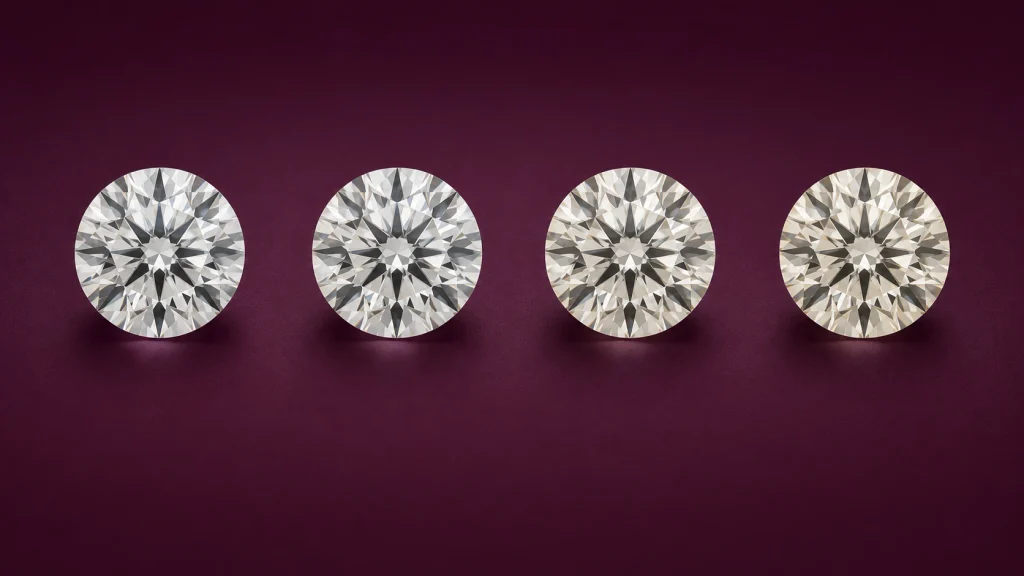
For many engagement-ring shoppers, G is one of the most appealing color grades.
Why?
Because G sits directly below the Colorless category but remains in the Near Colorless range.
A well-cut G diamond can appear very white face-up while avoiding some of the premium associated with D, E, and F.
This makes G attractive for shoppers who want:
- A white appearance
- A premium-looking diamond
- Good value
- Flexibility across different shapes
- A balance between color and other diamond characteristics
You can also compare G with H in this detailed guide to G vs H diamonds.
Is H a Good Color for an Engagement Ring?
Absolutely.
H is one of the most popular value-oriented choices in the Near Colorless range.
An H diamond can look beautifully white, particularly when:
- The cut is strong
- The diamond is viewed face-up
- The setting complements it
- The shape is relatively color-forgiving
The difference between G and H can be subtle.
If you can’t see a meaningful difference between the two diamonds, choosing H may allow you to put your budget toward something else.
For a more detailed comparison, see H vs G diamond color.
Is I Color Good for an Engagement Ring?
I is also classified as Near Colorless.
It contains more detectable body color than G or H, but that doesn’t automatically make it unattractive.
A well-cut I-color diamond can still look very white face-up.
I can be especially interesting when your priorities include:
- Larger carat weight
- Excellent cut
- A particular diamond shape
- A fixed budget
- Yellow or rose gold
If you don’t mind a hint of warmth, I can provide excellent value.
Is J Color Too Yellow for an Engagement Ring?
Not necessarily.
J is the lowest grade in the Near Colorless category.
Depending on the diamond, shape, size, lighting, and setting, you may notice some warmth.
But “warm” isn’t necessarily the same as “bad.”
Some engagement-ring styles actually look beautiful with a slightly warmer diamond.
J can work particularly well with:
- Yellow gold
- Rose gold
- Vintage-inspired designs
- Antique-style settings
- Buyers who prefer warmer diamond appearances
The important thing is to know what aesthetic you’re trying to achieve.
Best Diamond Color for White Gold
If your engagement ring uses white gold, you may want a diamond that looks particularly white against the metal.
A good starting range is:
G–H
For buyers with stronger color sensitivity:
D–F
For buyers focused heavily on value:
I can still be worth considering, depending on the individual diamond.
The higher the color grade, the easier it is to maintain a crisp, icy appearance against a white-metal setting.
However, don’t assume you need D simply because your ring is white gold.
Best Diamond Color for Platinum
Platinum is naturally white, so the same general principle applies.
Premium choice
D–F
Best balance
G–H
Value option
I
Platinum can provide a clean backdrop for the diamond, so color-sensitive buyers may prefer G or higher.
But a well-selected H can still look excellent.
Best Diamond Color for Yellow Gold
Yellow gold changes the equation.
Because the metal itself has a warm color, you may not need to pay a premium for an extremely high diamond color grade.
A range such as:
H–J
can work beautifully.
Some buyers even intentionally choose warmer diamonds to complement the setting.
This can free up budget for:
- A larger center stone
- Better cut
- More detailed setting
- Higher clarity
Best Diamond Color for Rose Gold
Rose gold has a similar effect.
Its pinkish warmth can complement diamonds with slightly warmer body color.
For this reason, H, I, and J can all be attractive choices.
If you prefer an icy-white diamond regardless of the setting, G or higher may still be your preference.
But you don’t necessarily need a D-color diamond simply because you’re buying a premium engagement ring.
Best Diamond Color for Round Engagement Rings
Round brilliant diamonds are generally among the most forgiving shapes when it comes to color.
Their brilliant faceting creates strong light return, which can help a diamond appear bright and lively.
That makes:
G–H
a particularly attractive range for many round engagement rings.
I can also work well if you’re focused on value.
D–F is ideal if you want the highest color grade and don’t mind the premium.
Best Diamond Color for Oval Engagement Rings
Oval diamonds deserve a little more attention.
Their elongated shape can sometimes make body color more noticeable.
This is especially relevant with larger stones.
If you want a distinctly white oval, consider:
G–H
If you’re more color-sensitive:
D–F
If value is more important:
I
But don’t rely on the grade alone.
Look at the individual oval because color appearance can vary from stone to stone.
Best Diamond Color for Emerald-Cut Engagement Rings
Emerald cuts are one of the shapes where color deserves extra consideration.
Their large, open step facets can make body color easier to observe.
For that reason, many buyers prefer:
F–G
or
G–H
for an emerald cut.
If you are particularly sensitive to warmth, staying higher on the color scale can make sense.
You can learn more about the differences between step-cut and brilliant-cut diamonds in this guide to step-cut vs brilliant-cut diamonds.
Best Diamond Color for Cushion Cuts
Cushion diamonds can vary considerably depending on their faceting pattern.
Some cushions have:
- Chunky facets
- Brilliant-style faceting
- Crushed-ice patterns
- Antique-style faceting
Because of this variation, color perception can differ significantly between individual stones.
G and H are strong starting points.
I may also work well if you’re comfortable with some warmth.
For related cushion comparisons, explore cushion vs princess vs Asscher diamonds.
Best Diamond Color for Princess Cuts
Princess cuts have brilliant-style faceting and can appear bright and lively.
G–H can provide an excellent balance.
D–F is ideal if you want maximum colorlessness.
I can be considered if budget is important and the individual stone looks sufficiently white.
Best Diamond Color for Pear-Shaped Diamonds
Pear diamonds can show color differently across their elongated shape.
If you’re looking for a crisp white appearance, G or higher is a reasonable starting point.
H can provide excellent value.
I may work too, but it’s worth examining the diamond carefully from different angles.
You can compare elongated shapes in this guide to marquise vs oval vs pear diamonds.
Best Diamond Color for Marquise Cuts
Marquise diamonds can sometimes show warmth toward their ends.
Because of their elongated shape, many buyers prefer G or H when they want a white appearance.
But the actual stone matters.
A well-cut H can look excellent, while an H with unfavorable characteristics may show more warmth than expected.
Does Carat Size Affect the Best Diamond Color?
Yes.
As diamond size increases, body color can become easier to notice.
This doesn’t mean that every large diamond needs D or E.
Instead, larger stones are a good reason to compare the actual diamond carefully.
For example, you might feel perfectly comfortable with:
1 ct H
but prefer:
3 ct G
because the larger stone makes color more noticeable to your eyes.
The ideal grade is personal.
Best Diamond Color for a 1-Carat Engagement Ring
For a 1-carat diamond, G or H can be an excellent starting point.
Premium
D–F
Balanced
G–H
Value-focused
I
A well-cut H-color 1-carat diamond can look remarkably white.
If the difference between G and H isn’t visible to you, the H may offer better overall value.
Best Diamond Color for a 2-Carat Engagement Ring
At 2 carats, color can become more noticeable depending on the shape.
A practical starting point is:
G–H
If you’re particularly sensitive to warmth:
F–G
If you’re looking for value:
H–I
The shape matters significantly.
A 2-carat emerald cut may benefit from a higher color grade than a 2-carat round brilliant.
Best Diamond Color for a 3-Carat Engagement Ring
At 3 carats, color deserves more attention.
For a traditional white appearance, you may want to focus around:
F–G
or
G–H
depending on the shape and your personal preference.
A large emerald, oval, or pear may make body color more noticeable than a well-cut round.
At this size, viewing the actual stone is especially valuable.
Does Diamond Cut Affect Color?
Yes, indirectly.
Cut determines how a diamond interacts with light.
A well-cut brilliant diamond can appear brighter and may make subtle color less noticeable face-up.
This is why you shouldn’t choose a diamond based solely on color.
For a better understanding of cut, see this diamond cut guide.
Which Is More Important: Color or Cut?
For many engagement-ring shoppers, cut deserves greater attention than moving up one color grade.
Imagine two diamonds:
Diamond A
D color
Poorer cut
Diamond B
H color
Excellent cut
The H may look more lively, bright, and attractive.
That’s why optimizing color while sacrificing cut quality can be a mistake.
The four major diamond quality factors are commonly discussed as the 4Cs: cut, color, clarity, and carat. You can explore them in this 4Cs of diamond quality guide.
Best Diamond Color vs Clarity: What Should You Prioritize?
Don’t pay for clarity that you can’t see.
The same principle applies to color.
If an H diamond looks completely white to you and is eye-clean, moving to G might provide less visible benefit than spending the difference elsewhere.
For many shoppers, a balanced combination such as:
Excellent cut + G/H color + eye-clean clarity
can be more appealing than:
Excellent cut + D color + unnecessarily high clarity
The best combination depends on your eyes and budget.
Best Diamond Color for Natural Diamonds
For natural diamonds, G and H are popular choices because they can offer an attractive balance between color and price.
D–F remain premium choices.
I can provide additional value.
The important thing is to compare complete diamonds rather than color grades in isolation.
Best Diamond Color for Lab-Grown Diamonds
Lab-grown diamonds can also receive D-to-Z color grades.
Because lab-grown diamonds are often available at different price points than natural diamonds, you may have more flexibility in selecting a higher color grade.
For example, if your budget comfortably allows it, you could choose:
- G instead of H
- F instead of G
- A larger stone at the same color grade
- Better clarity
- A more elaborate setting
For a broader comparison, see lab-grown vs natural diamonds.
Should You Choose the Highest Diamond Color You Can Afford?
Not necessarily.
This is one of the biggest misconceptions about diamond shopping.
You don’t necessarily need to spend your entire budget on color.
If you’re unable to distinguish between G and H, paying significantly more for G may not improve your experience.
Instead, you could potentially allocate the money toward:
- Better cut
- Larger carat weight
- Better proportions
- A more beautiful setting
- A design you prefer
The best diamond isn’t the one with the highest specifications.
It’s the one where the specifications work together to create the appearance you want.
What Diamond Color Looks Best?
If you want a traditional white engagement ring, these are useful starting points:
Most premium appearance
D-F
Best overall balance
G-H
Best value while remaining Near Colorless
I
Warmer aesthetic
J and below
But remember that individual diamonds vary.
A G isn’t guaranteed to look better to you than an H.
Best Diamond Color for an Engagement Ring by Metal
| Ring Metal | Suggested Color Range |
|---|---|
| Platinum | D–H |
| White Gold | D–H |
| Yellow Gold | G–J |
| Rose Gold | G–J |
| Mixed Metal | G–H |
These aren’t strict rules.
They’re simply useful starting points.
If you want an icy-white appearance, move higher.
If you like warmth and want better value, move lower.
Best Diamond Color for an Engagement Ring by Shape
| Diamond Shape | Good Starting Range |
|---|---|
| Round Brilliant | G–H |
| Oval | G–H |
| Emerald | F–G / G–H |
| Cushion | G–H |
| Princess | G–H |
| Radiant | G–H |
| Pear | G–H |
| Marquise | G–H |
| Asscher | F–G / G–H |
These are starting points rather than universal requirements.
Shape, cut quality, carat size, and setting all influence how color appears.
How to Choose the Best Diamond Color for Your Engagement Ring
Here’s a simple way to narrow it down.
Step 1: Choose Your Ring Metal
White metals generally make color more noticeable.
Warm metals can complement warmer diamonds.
Step 2: Choose Your Shape
Brilliant cuts are often more forgiving.
Step cuts can reveal body color more readily.
Step 3: Decide How Color-Sensitive You Are
If you immediately notice warmth, stay higher.
If you don’t, consider G, H, or I.
Step 4: Compare Actual Diamonds
Don’t rely exclusively on the letter.
Look at the diamond.
Step 5: Compare G and H
This is often where shoppers find their sweet spot.
Step 6: Check Cut Quality
Don’t sacrifice cut just to move up one color grade.
Step 7: Check Clarity
Make sure the diamond is eye-clean rather than simply choosing the highest clarity grade.
Step 8: Compare Total Prices
See what the extra money for a higher color grade actually buys you.
Step 9: Consider Carat Weight
Would you rather have a smaller D or a larger G/H?
Step 10: Trust Your Eyes
If two diamonds look identical to you, you don’t necessarily need to pay more for the higher color grade.
Common Diamond Color Buying Mistakes
1. Assuming D Is Always Best
D is the highest grade, but not necessarily the best value.
2. Thinking H Is Yellow
H is still Near Colorless.
3. Ignoring Shape
Color visibility varies significantly by shape.
4. Sacrificing Cut for Color
A beautiful cut can have a greater visual impact than a one-grade color improvement.
5. Paying for Color You Can’t See
If G and H look identical to you, the premium may not be worthwhile.
6. Ignoring the Setting
The metal can influence how the diamond appears.
7. Choosing a Color Grade Without Seeing the Diamond
The grading report is important, but visual inspection matters too.
8. Forgetting About Carat Size
Larger stones can make subtle warmth easier to notice.
What Is the Best Diamond Color for the Money?
For many shoppers, G or H is the sweet spot.
Why?
Because both are in the Near Colorless category and can provide a very white appearance without requiring the premium associated with D–F.
If your goal is maximum value, you might even consider I.
If your goal is premium color, D–F may be worth the additional cost.
The important thing is to understand what you’re paying for.
Final Verdict
So, what is the best diamond color for an engagement ring?
There isn’t one answer that works for everyone.
But if you’re looking for a practical recommendation:
Best overall balance: G
G offers a high color grade while remaining below the Colorless category.
Best value: H
H can look beautifully white while giving you more budget flexibility.
Best premium color: D
D is the highest color grade for shoppers who want maximum colorlessness.
Best value for a larger stone: I
I can allow you to prioritize size while remaining in the Near Colorless range.
Best for warmer settings: H-J
These grades can complement yellow and rose gold beautifully.
Ultimately, don’t buy a color grade simply because it is higher.
Buy the diamond that looks beautiful to your eyes.
A well-cut H can be a better engagement-ring choice than a poorly cut D.
A G may be worth the premium if you’re sensitive to color.
And a J can be exactly right if you love a warmer, vintage-inspired appearance.
The best diamond color is the one that gives you the appearance you want while leaving enough budget for the other things that make your engagement ring special.
Frequently Asked Questions
What is the best color grade for an engagement ring?
For many shoppers, G or H offers an excellent combination of whiteness and value. D–F are better suited to buyers prioritizing maximum colorlessness.
What diamond color looks the whitest?
D is technically the highest color grade and represents the most colorless appearance. E and F are also in the Colorless category.
What is the best diamond color for the money?
G and H are strong starting points for value because they remain Near Colorless while generally costing less than D–F.
Does diamond color affect sparkle?
Not directly. Cut quality has a much greater influence on sparkle and light performance.
Should I choose a higher color or bigger carat?
If you can’t see a meaningful difference between the color grades, choosing a larger diamond may provide more noticeable visual impact. But compare the actual stones before deciding.
Does diamond shape affect color?
Yes. Some shapes, particularly step cuts and certain elongated shapes, can make body color easier to observe.
Is G better than H?
G is one grade higher than H, but that doesn’t necessarily make it the better value. H can provide a similar-looking appearance at a lower price.
What is the lowest diamond color you should buy?
There is no universal minimum. G–H is a safe starting point for a traditional white appearance, while I–J can work beautifully when value or warmth is preferred.
Should I prioritize diamond color over clarity?
Not automatically. You should consider cut, color, clarity, and carat together. If an H diamond is eye-clean, paying significantly more for higher color or clarity may not provide a visible benefit.
Is color more important for a large diamond?
It can be. Larger diamonds may make subtle body color easier to notice, so color deserves more attention as carat weight increases.
Can a lower-color diamond look white?
Yes. Near Colorless diamonds such as G, H, I, and J can look quite white face-up, depending on the stone, shape, cut, and setting.