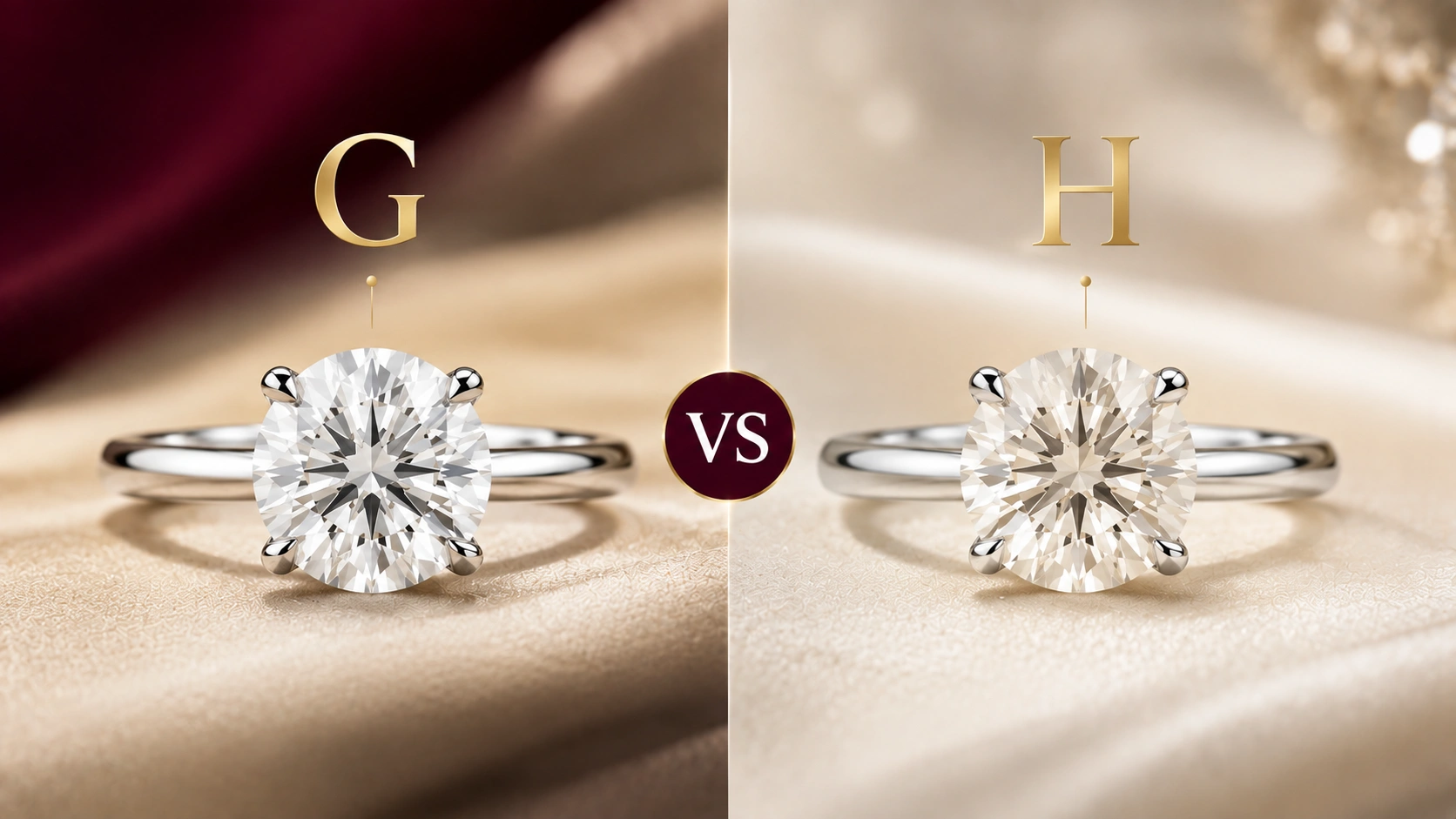
If you’re comparing G vs H diamonds, you’re looking at two of the most popular grades in the near-colorless range.
G and H sit next to each other on the standard D-to-Z diamond color scale. G is the higher color grade, while H is one step lower. Both can look beautifully white in an engagement ring, but the difference can become more noticeable depending on the diamond’s shape, size, cut quality, setting, and viewing conditions.
The interesting part is that moving from G to H doesn’t necessarily mean you’re getting a visibly “yellow” diamond.
In fact, for many shoppers, H can offer an excellent balance between appearance and price, while G may appeal to buyers who want a little more colorlessness without moving into the premium Colorless grades.
So which one should you choose?
G if you want a little more colorless appearance.
H if you want strong visual whiteness with potentially better value.
But there’s more to the decision than the letter on the grading report.
G vs H Diamond at a Glance
| Feature | G Color | H Color |
|---|---|---|
| Color category | Near Colorless | Near Colorless |
| Position on D-to-Z scale | Higher | One grade lower |
| Visible color | Usually very subtle | Usually very subtle |
| Appearance | Bright and white | Bright and white |
| Typical price | Usually higher | Usually lower |
| Best for | Buyers prioritizing color | Buyers prioritizing value |
| White-metal settings | Excellent | Excellent |
| Yellow/rose gold settings | Excellent | Excellent |
| Overall value | Very good | Excellent |
The biggest takeaway is simple:
Both G and H can look very white, and the visual difference between them is usually much smaller than the difference between their grading letters suggests.
What Does G Color Mean?
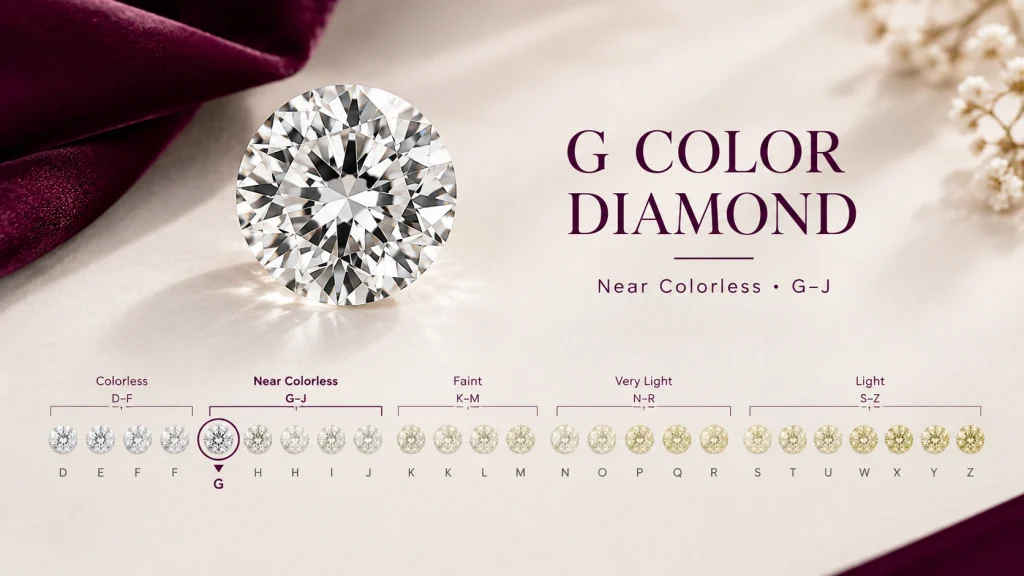
G is the first grade in the Near Colorless category on the GIA D-to-Z color scale.
The standard categories are:
- D–F: Colorless
- G–J: Near Colorless
- K–M: Faint
- N–R: Very Light
- S–Z: Light
G therefore sits directly below the Colorless range.
That makes it an interesting grade for buyers who want a high-quality white appearance without necessarily paying the premium associated with D, E, or F.
A well-cut G-color diamond can appear remarkably white, especially when viewed face-up.
Is G Color Good?
Yes.
G is one of the most popular choices for shoppers who want a balance between color appearance and price.
It gives you a Near Colorless grade while avoiding some of the premium associated with the Colorless range.
For many engagement rings, G can provide an excellent combination of:
- White appearance
- Good value
- Strong market availability
- Flexibility across different shapes
- Attractive appearance in both white and warm-toned settings
What Does H Color Mean?
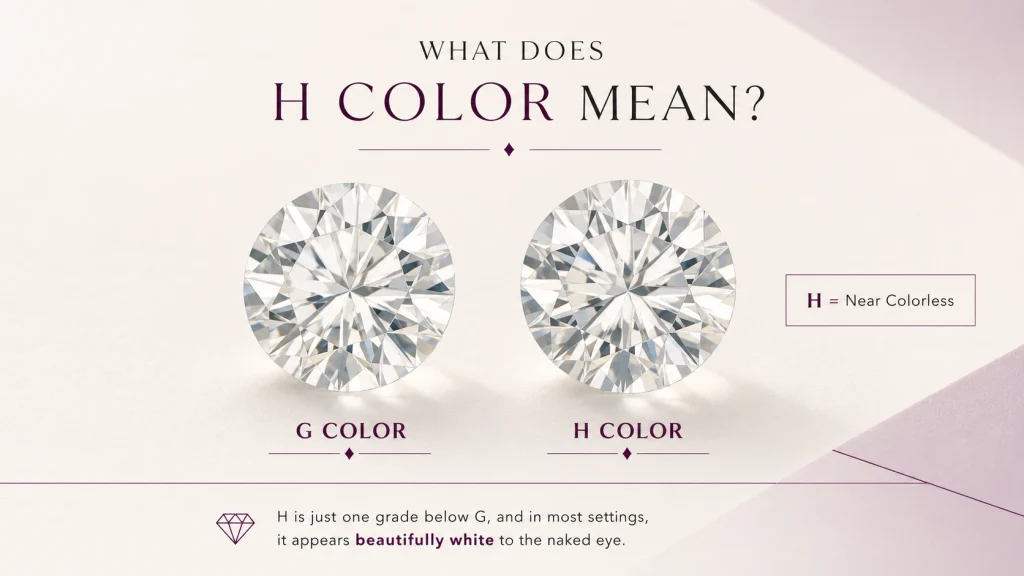
H is the next grade below G.
It is also classified as Near Colorless.
An H-color diamond has slightly more body color than a G-color diamond, but that doesn’t mean it will appear obviously yellow.
Under normal viewing conditions, an H diamond can still look beautifully white, especially when it has strong cut quality.
This is one reason H is often considered a practical choice for shoppers who want to spend more of their budget on characteristics they can see more readily.
For example, instead of paying extra to move from H to G, you could potentially use that money toward:
- A larger carat weight
- Better cut quality
- Higher clarity
- A more elaborate setting
The exact trade-off depends on the individual diamonds and their prices.
What Is the Difference Between G and H Diamonds?
The primary difference is color grade.
G is one grade higher than H.
On the D-to-Z scale:
D → E → F → G → H → I → J
G is closer to the Colorless range.
H has slightly more detectable body color.
However, this doesn’t mean that G looks dramatically whiter than H.
The distinction between adjacent color grades can be subtle, particularly when diamonds are viewed face-up and mounted in an engagement ring.
That’s why comparing the actual stones can be much more useful than simply comparing their certificates.
Can You See the Difference Between G and H?
Sometimes.
But for many people, the difference is subtle.
Professional diamond color grading is performed under controlled conditions because the distinctions between neighboring grades can be very fine.
In everyday life, you’re usually not viewing your diamond:
- Loose
- Against a white background
- Under laboratory lighting
- Next to a comparison stone
Instead, you’re looking at it:
- On your finger
- Under natural light
- In indoor lighting
- In restaurants
- At work
- Outdoors
- Against clothing
- Alongside your engagement ring setting
In those situations, a well-cut H diamond can still appear very white.
A side-by-side comparison of loose G and H diamonds is much more likely to reveal the subtle distinction.
Is G Diamond Better Than H?
Technically, yes.
G is higher on the color scale.
But higher doesn’t automatically mean better value.
If you compare two otherwise identical diamonds, the G will generally command a premium over H because it has a higher color grade.
The important question is whether you can see enough difference to justify that premium.
For some buyers, the answer is yes.
For others, H provides essentially the appearance they want at a lower cost.
That’s why the choice should be based on your priorities rather than simply choosing the higher letter.
Is H Color Too Yellow?
No.
H is still in the Near Colorless category.
It shouldn’t be automatically described as a visibly yellow diamond.
That said, some people are more sensitive to diamond color than others.
Color can also become easier to notice depending on:
- Diamond size
- Shape
- Cut style
- Setting
- Viewing angle
- Lighting
- Whether the diamond is compared with a higher-color stone
An H-color diamond can look noticeably warmer than a D-color diamond in a direct comparison.
But that doesn’t mean it will look yellow when worn.
G vs H Diamond Price: Which Offers Better Value?
This is where H becomes particularly interesting.
Generally, moving upward on the color scale can increase diamond pricing, assuming other characteristics are comparable.
So you may encounter:
G = higher price
H = lower price
But don’t assume the price difference is always large or always small.
Diamond pricing depends on multiple variables, including:
- Carat
- Cut
- Clarity
- Shape
- Certification
- Fluorescence
- Natural or lab-grown origin
- Market conditions
Two G-color diamonds can have completely different prices.
The same applies to H.
So when comparing G vs H, don’t evaluate color in isolation.
Is G Worth More Than H?
It depends.
G may be worth the premium if:
- You’re particularly sensitive to color.
- You’re buying a shape that can reveal color more readily.
- You prefer a whiter appearance.
- You’re choosing a larger diamond.
- You’re using a white-metal setting and want a crisp look.
- The price difference is relatively small.
- You simply prefer G after comparing the stones.
H may be the better choice if:
- You can’t see a meaningful difference between G and H.
- You want to maximize carat weight.
- Cut quality is a higher priority.
- You’re working with a fixed budget.
- You’re using yellow or rose gold.
- You want a Near Colorless diamond without paying extra for G.
There is no universal winner.
G vs H for Round Brilliant Diamonds
Round brilliant diamonds are generally forgiving when it comes to color because their faceting can return a lot of light.
A well-cut round G can look exceptionally white.
A well-cut round H can also look beautifully white.
This makes round brilliant one of the shapes where shoppers can reasonably consider both grades.
If you’re deciding between:
1.00 ct G
and
1.10 ct H
and the H still looks completely white to you, the larger H could be a more appealing choice.
But if you strongly prefer a cooler, whiter appearance, G may be worth the premium.
For a broader explanation of diamond shapes, see this guide to diamond shapes.
G vs H for Oval Diamonds
Oval diamonds require a little more attention.
An oval can sometimes display color differently depending on its proportions and faceting.
Some ovals may show more warmth toward the ends or around the body of the stone.
This doesn’t mean H is automatically a poor choice for an oval.
It simply means you should evaluate the individual diamond rather than assuming every H will look identical.
If color sensitivity is high on your priority list, G can provide additional comfort.
If you’re comfortable with a slight warmth and want better value, H can still be an excellent option.
G vs H for Cushion Diamonds
Cushion diamonds can vary considerably in appearance because they come in different faceting styles.
Some cushions have:
- Chunky facets
- Brilliant-style faceting
- Crushed-ice appearances
- Antique-inspired faceting
The way these facets interact with light can influence how color is perceived.
Because of this, comparing the actual G and H stones is especially useful.
If an H cushion looks white to your eyes, there’s little reason to assume you must upgrade to G.
G vs H for Emerald-Cut Diamonds
This is where the comparison becomes more important.
Emerald cuts use step-cut faceting, with larger, open facets that can make body color easier to observe.
Because of that, some buyers prefer higher color grades for emerald cuts.
If you’re comparing G and H emerald-cut diamonds, G may be worth considering if you want a cleaner, icier appearance.
H can still work beautifully, especially if the setting is warm-toned or you’re comfortable with a subtle hint of warmth.
For more information on step-cut diamonds, compare step-cut and brilliant-cut diamonds.
G vs H for Princess-Cut Diamonds
Princess cuts use brilliant-style faceting and can look very bright.
Both G and H can work well.
If your goal is maximum whiteness, G provides a small advantage.
If your goal is value, H can be very attractive.
Again, cut quality matters.
A well-cut H can easily outperform a poorly cut G from a visual perspective.
G vs H for Pear-Shaped Diamonds
Pear-shaped diamonds can sometimes show body color differently along their elongated shape.
The actual stone matters.
If you’re color-sensitive, G may provide more confidence.
If you’re less concerned about tiny color differences, H may allow you to allocate more of your budget toward size or cut.
You can also compare other elongated shapes in this guide to marquise, oval, and pear diamonds.
G vs H for White Gold and Platinum
White-metal settings are often paired with higher-color diamonds because buyers want a bright, icy appearance.
Both G and H can look excellent in:
- White gold
- Platinum
- Palladium
G gives you a slightly higher position on the color scale.
H gives you potentially better value.
If the H diamond looks sufficiently white to your eyes, there’s no technical reason you must upgrade to G just because the setting is white metal.
G vs H for Yellow Gold
Yellow gold changes the conversation.
The warm color of the setting can make the small difference between G and H less important.
An H-color diamond can look perfectly natural and attractive against yellow gold.
In some cases, shoppers may intentionally choose a slightly lower color grade because the warm setting complements it.
If you’re using yellow gold, don’t automatically assume G is necessary.
G vs H for Rose Gold
The same principle applies to rose gold.
The warm pinkish tone of the metal creates a different visual environment around the diamond.
Both G and H can work beautifully.
If you’re deciding between:
G + smaller diamond
and
H + larger diamond
the H may be worth serious consideration if you don’t notice a significant color difference.
Does Diamond Size Affect G vs H?
Yes.
Size can influence how easily you notice color.
A larger diamond gives you more stone to observe, which can make subtle body-color differences easier to evaluate.
But there is no universal rule saying:
“A diamond over X carats must be G.”
That’s too simplistic.
Two diamonds of the same carat weight can appear different because of:
- Shape
- Proportions
- Cut
- Faceting
- Setting
If you’re buying a larger diamond, compare the actual stones whenever possible.
Does Cut Matter More Than G vs H?
In many situations, cut quality can have a larger effect on appearance than moving one color grade.
This is particularly important for brilliant-cut diamonds.
A well-cut H diamond can return strong light and appear bright and lively.
A poorly cut G diamond may not have the same visual appeal.
That’s why you shouldn’t automatically choose:
G + mediocre cut
over:
H + excellent cut
If you’re evaluating diamonds, make sure you understand what cut quality actually means with this diamond cut guide.
G vs H and Clarity: Which Should You Prioritize?
Color and clarity solve different problems.
Color measures body color.
Clarity measures internal and external characteristics.
You shouldn’t automatically sacrifice one for the other.
For example, suppose your budget gives you two options:
Option A
- G color
- Lower clarity
- Excellent cut
Option B
- H color
- Higher clarity
- Excellent cut
If both are eye-clean, Option B might make more sense.
But if the clarity difference isn’t visible, you might instead choose H and increase carat weight.
The best choice depends on what you can actually see.
You can learn more about clarity in this diamond clarity guide.
G vs H vs F: Is G Still Worth It?
This is an interesting comparison because F is the final grade in the Colorless category.
The progression is:
F → G → H
F is Colorless.
G and H are Near Colorless.
If you’re trying to balance color and price, G often acts as a bridge between these categories.
You get a Near Colorless grade that’s immediately below F.
For many buyers, G provides a very attractive compromise.
H takes the value approach one step further.
G vs H vs I: Should You Consider I?
Yes, depending on your goals.
I is also classified as Near Colorless.
So:
G, H, I, and J = Near Colorless
If you’re highly focused on value, I may be worth considering.
But color differences can become more noticeable as you move farther down the scale.
Whether I works depends heavily on:
- Shape
- Size
- Setting
- Cut
- Personal preference
For someone who wants a distinctly white appearance, G or H may provide more confidence.
For someone prioritizing maximum size, I can sometimes be an interesting option.
Does G vs H Matter for Lab-Grown Diamonds?
The same basic color-grade principles apply to lab-grown diamonds.
Lab-grown diamonds can receive D-to-Z color grades, including G and H.
So if you’re comparing a G lab-grown diamond with an H lab-grown diamond, the color-grade relationship remains the same.
The bigger question is how you want to allocate your budget.
If lab-grown pricing gives you more flexibility, you might consider putting the difference into:
- Larger carat weight
- Better cut
- Higher clarity
- A premium setting
For a broader comparison, see lab-grown vs natural diamonds.
G vs H for Natural Diamonds
For natural diamonds, G and H remain popular Near Colorless grades.
A natural H-color diamond can be an excellent choice if you’re looking for a beautiful white appearance without paying for the higher color grades.
G may appeal more if:
- You want a slightly whiter appearance.
- You’re comparing diamonds side by side.
- You’re buying a shape where color is easier to notice.
- You’re comfortable paying the premium.
The key is to compare complete diamonds rather than color grades alone.
Does Fluorescence Affect G vs H?
Fluorescence is a separate characteristic from color grade.
Some diamonds fluoresce when exposed to ultraviolet light. Blue is the most common fluorescence color.
Its effect can vary depending on the diamond.
In some circumstances, blue fluorescence may make a diamond with more body color appear somewhat whiter.
But you shouldn’t choose or reject a diamond based solely on fluorescence.
Look at the actual diamond and its grading report.
G vs H: Which Is Better for an Engagement Ring?
Both can be excellent.
The right choice depends on what matters most to you.
Choose G if:
- You want a slightly whiter appearance.
- You’re sensitive to color.
- You’re buying a shape where color can be more noticeable.
- You’re purchasing a larger stone.
- You prefer a higher position on the color scale.
- The price premium is comfortable.
Choose H if:
- You want excellent value.
- You still want a Near Colorless diamond.
- You don’t see a significant difference between G and H.
- You’d rather increase carat weight.
- You’d rather spend more on cut quality.
- You’re using yellow or rose gold.
- You’re working with a defined budget.
For many buyers, H is one of the most practical choices in the Near Colorless range.
G vs H Diamond: Common Buying Mistakes
1. Thinking H Means Yellow
H is still Near Colorless.
It isn’t automatically a visibly yellow diamond.
2. Assuming G Is Always Worth the Premium
The visual difference can be subtle.
3. Ignoring Cut
A high color grade can’t compensate for poor light performance.
4. Looking Only at the Certificate
The certificate tells you the grade, but your eyes tell you whether you actually like the diamond.
5. Ignoring Shape
An H round and an H emerald cut may not display color in exactly the same way.
6. Ignoring the Setting
Yellow gold and rose gold can make slightly warmer diamonds look completely natural.
7. Automatically Choosing G Because It’s Higher
Higher isn’t always better value.
How to Choose Between G and H
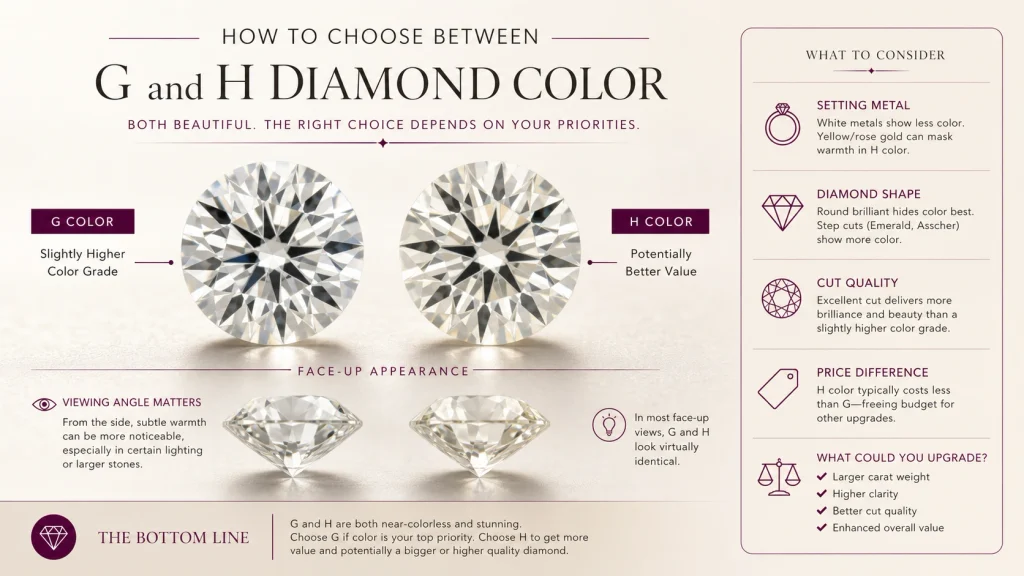
Here’s a simple process.
Step 1: Decide Your Budget
Know how much you’re comfortable spending.
Step 2: Choose the Shape
Shape can affect color visibility.
Step 3: Prioritize Cut
Especially for brilliant-cut diamonds, strong cut quality can have a major impact on appearance.
Step 4: Compare G and H Side by Side
If possible, compare actual stones under similar lighting.
Step 5: Look at Them Face-Up
This is how you’ll generally wear the diamond.
Step 6: Examine the Diamond From Different Angles
Check whether warmth becomes more noticeable from the side.
Step 7: Consider Your Setting
White metal, yellow gold, and rose gold can create different visual effects.
Step 8: Compare the Price Difference
Ask what moving from H to G actually costs.
Step 9: Consider What Else You Could Upgrade
Would the same money give you:
- More carat weight?
- Better cut?
- Higher clarity?
- A better setting?
Step 10: Choose What Looks Best to You
If you can’t distinguish them, there’s little reason to pay purely for the higher grade.
Final Words
G and H are both Near Colorless diamond grades, and both can look beautifully white in an engagement ring.
G is higher on the color scale.
H is one grade lower and can offer excellent value.
If you want a slightly whiter appearance and don’t mind paying the premium, G is an excellent choice.
If you’re more interested in maximizing your overall budget while maintaining a white-looking diamond, H can be a smarter option.
For many shoppers, the decision comes down to this:
G = prioritize color
H = prioritize value
But don’t make the decision based on the letter alone.
A beautifully cut H-color diamond can look more impressive than a poorly cut G.
A well-chosen G can be worth the premium if you are sensitive to color or buying a shape where body color is easier to notice.
And if you can’t tell the difference between the two, H may give you more room to spend your budget elsewhere.
The goal isn’t to buy the highest letter.
The goal is to buy the diamond that looks beautiful to you at a price you’re comfortable with.
For a broader understanding of how color fits into diamond quality, explore this diamond color guide.
Frequently Asked Questions
Is G better than H diamond color?
Yes. G is one grade higher than H on the D-to-Z color scale. However, both G and H are classified as Near Colorless, so the visual difference can be subtle.
Is H diamond color good?
Yes. H is a Near Colorless grade and can look beautifully white, particularly when the diamond has strong cut quality.
Can you see the difference between G and H?
Sometimes, especially in a direct side-by-side comparison. But under normal viewing conditions, the difference can be difficult for many people to notice.
Is G better for platinum?
G can provide a slightly whiter appearance in platinum, but H can also work very well. You don’t automatically need G just because the setting is platinum.
Does G sparkle more than H?
No. Color grade does not determine sparkle. Cut quality, proportions, faceting, symmetry, and light performance have a much greater influence on sparkle.
Is H a good diamond color for a 2-carat diamond?
It can be. At larger sizes, color can become easier to evaluate, so compare the actual diamond. If you are particularly color-sensitive, G may provide additional reassurance.
Should I buy G or H if I want the best value?
H is often the more value-focused choice because it remains Near Colorless while sitting one grade below G. But the best value depends on the complete diamond, not color alone.
Is G vs H more important than cut?
Usually, you shouldn’t sacrifice excellent cut quality simply to move from H to G. A well-cut H can be more visually impressive than a poorly cut G.
Can H diamonds look completely colorless?
Yes. Many H diamonds can appear very white face-up, especially when well cut and viewed under normal conditions.