Choosing between a Radiant Cut vs Emerald Cut diamond isn’t always easy. Both shapes are elegant, timeless, and popular for engagement rings, yet they create completely different visual effects. One is all about sparkle and brilliance, while the other stands out with clean lines and understated sophistication.
If you’ve narrowed your search to these two styles, you’re already comparing two of the most distinctive diamond shapes available. The real question is: Which is better – radiant or emerald cut? The answer depends on what matters most to you. Do you want maximum sparkle? A larger-looking diamond? Better value for your budget? Or a refined, classic look that never goes out of style?
In this detailed comparison, we’ll break down every important difference between a radiant cut vs emerald cut diamond, including sparkle, brilliance, clarity, durability, price, finger coverage, and ideal engagement ring settings. By the end, you’ll know exactly which diamond shape suits your style and budget.
Quick Answer: Choose a Radiant Cut if you love intense sparkle, better durability, and a diamond that hides inclusions well. Choose an Emerald Cut if you prefer crisp geometric lines, a sophisticated “hall of mirrors” effect, and a timeless Art Deco-inspired design.
Radiant Cut vs Emerald Cut: At a Glance
| Feature | Radiant Cut | Emerald Cut |
|---|---|---|
| Facet Style | Brilliant Cut | Step Cut |
| Sparkle | Very High | Moderate |
| Brilliance | Excellent | Elegant flashes of light |
| Fire | High | Moderate |
| Clarity Visibility | Hides inclusions well | Reveals inclusions easily |
| Durability | Excellent | Very Good |
| Appearance | Modern diamond shape | Timeless diamond shape |
| Best For | Maximum sparkle | Sophisticated elegance |
Although they share a similar rectangular diamond outline with cropped corners, the way they interact with light is completely different. That’s why comparing a radiant diamond vs emerald diamond involves much more than appearance alone.
What Is a Radiant Cut Diamond?
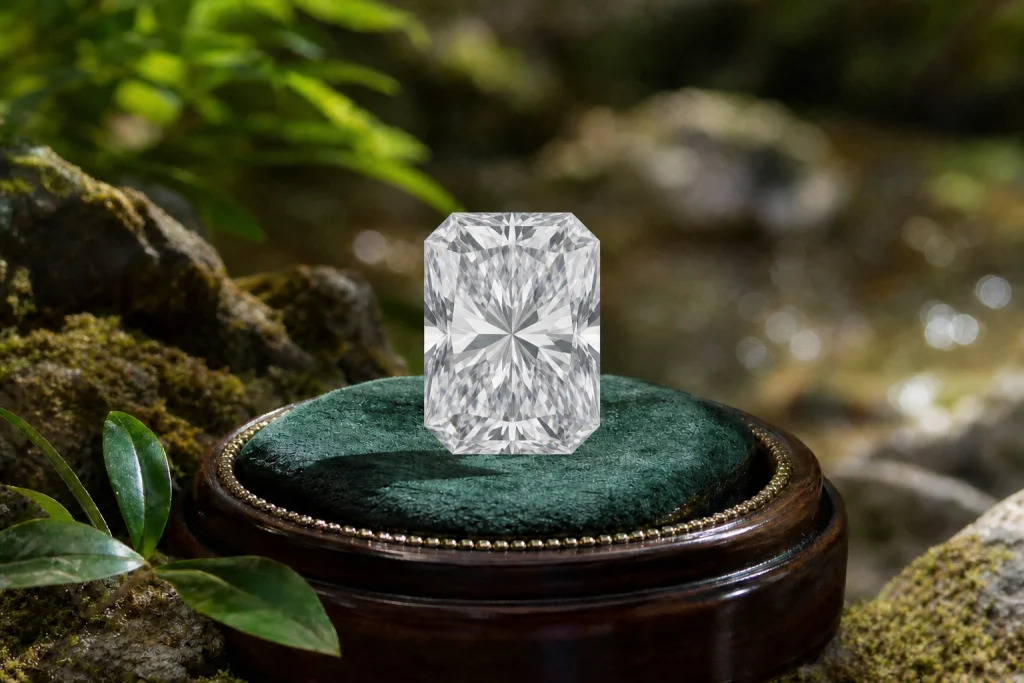
A Radiant Cut combines the clean rectangular shape of an emerald cut with the brilliant facets typically found in a round brilliant diamond. Introduced in 1977 by master diamond cutter Henry Grossbard, this design was created to deliver exceptional light performance while maintaining elegant straight edges.
Instead of long, parallel facets, a radiant cut features a complex facet pattern that maximizes diamond brilliance, diamond fire, and scintillation. Many people describe its appearance as lively because it reflects light from multiple directions.
One of its biggest strengths is versatility. Whether you choose a square or elongated diamond, the radiant cut works beautifully in solitaire, halo, hidden halo, and vintage-inspired engagement rings.
Why Buyers Love Radiant Cut Diamonds
- Outstanding sparkle in most lighting conditions
- Brilliant cut helps hide small diamond inclusions
- Cropped corners reduce the risk of chipping
- Offers excellent finger coverage
- Available in square and elongated proportions
- Complements both modern and classic ring designs
If your goal is a diamond that catches attention from across the room, the Radiant Cut is hard to beat.
What Is an Emerald Cut Diamond?
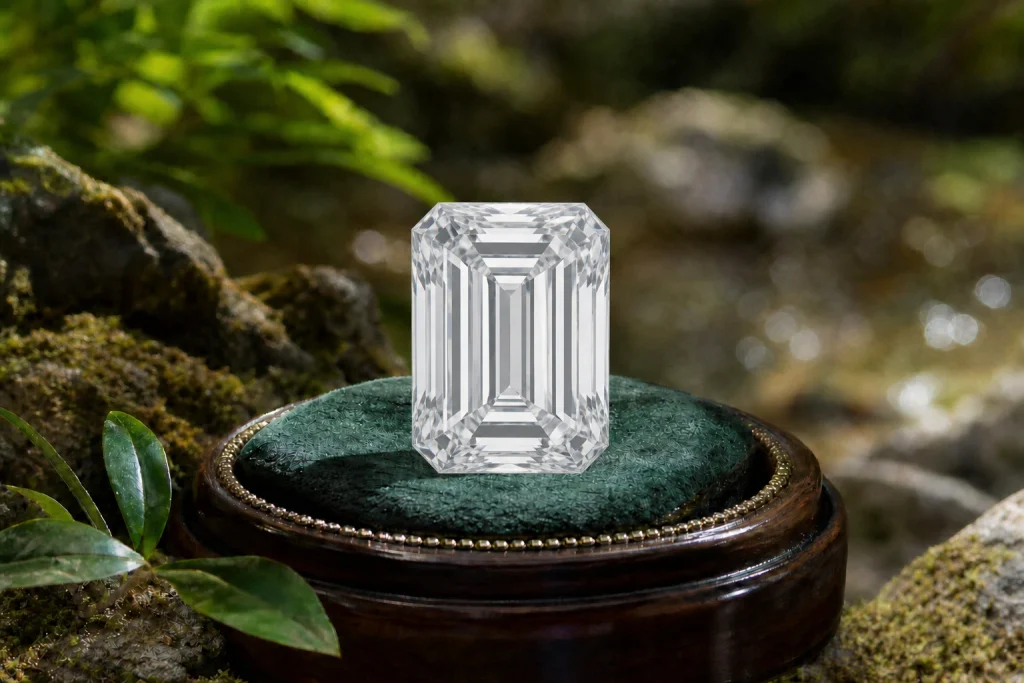
An Emerald Cut is one of the oldest and most recognizable diamond shapes. Unlike a radiant cut, it belongs to the step-cut diamond family, featuring long, parallel facets that create broad flashes of light instead of intense sparkle.
This unique optical effect is often called the hall of mirrors effect. Rather than producing countless tiny flashes, an emerald cut reflects light in large, elegant patterns. The result feels calm, sophisticated, and refined.
Originally developed for emerald gemstones before becoming popular in diamonds, the emerald cut gained widespread recognition during the Art Deco era. Today, it remains a favorite for buyers who appreciate clean geometry and understated luxury.
Why Buyers Love Emerald Cut Diamonds
- Elegant, sophisticated appearance
- Iconic Art Deco diamond styling
- Large open table showcases exceptional clarity
- Appears clean and minimal
- Long shape can create the illusion of slimmer fingers
- Never goes out of style
An emerald cut doesn’t compete with a radiant cut on sparkle. Instead, it wins people over with symmetry, depth, and timeless character.
Fun Fact: Think of these two cuts like two kinds of music. A Radiant Cut is the energetic concert that gets everyone dancing, while an Emerald Cut is a beautifully played piano performance – quieter, but unforgettable.
Difference Between Radiant and Emerald Cut
At first glance, these diamonds may appear similar because both have rectangular outlines and trimmed corners. However, their internal structure creates two completely different personalities.
The biggest difference between radiant cut vs emerald cut lies in their facet arrangement.
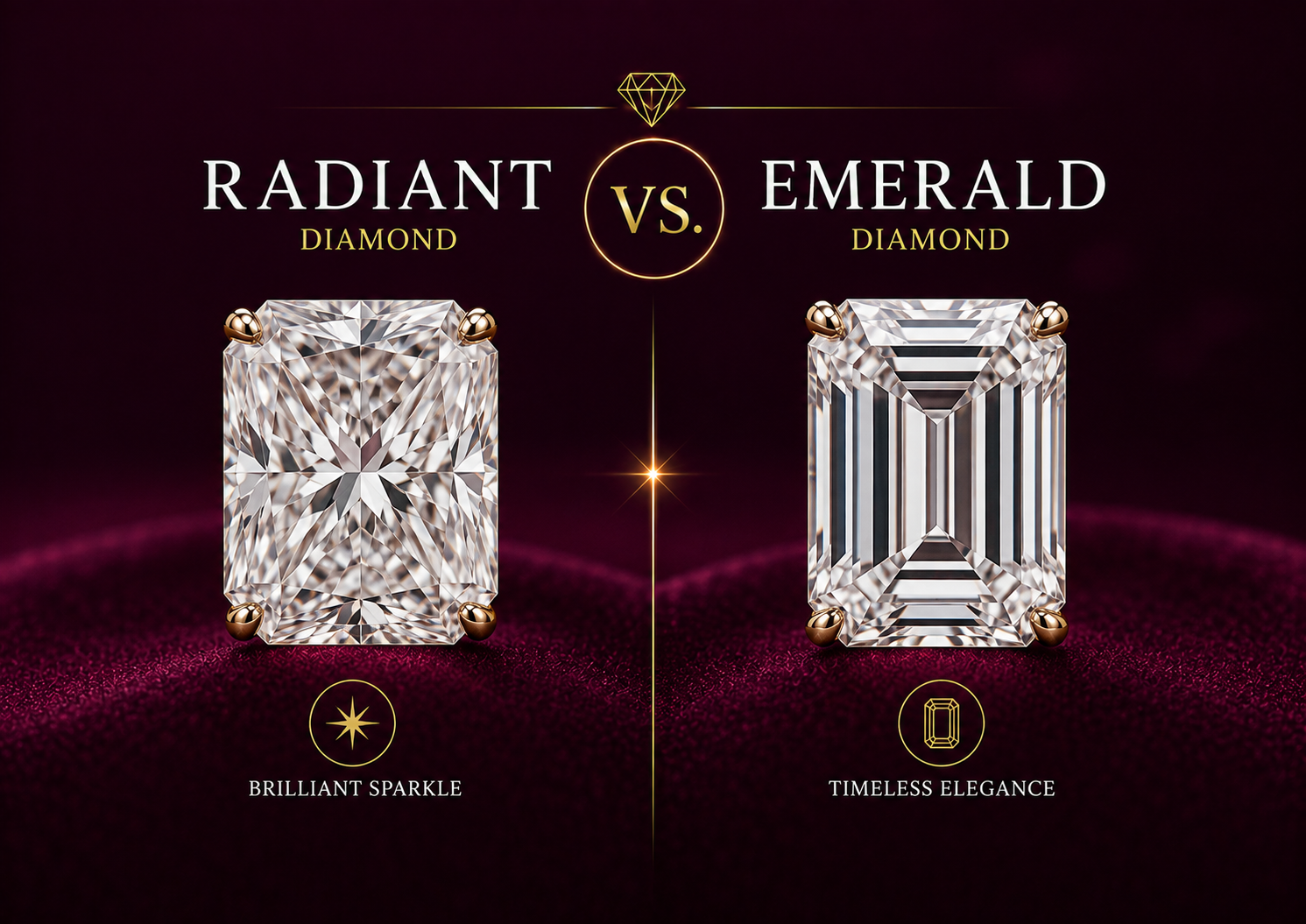
A Radiant Cut uses a brilliant cut facet design. These numerous triangular and kite-shaped facets are engineered to maximize light return, producing intense sparkle, strong brilliance, and colorful flashes known as diamond fire.
An Emerald Cut, by comparison, uses long, parallel step cut facets. Instead of creating continuous sparkle, these facets generate broad flashes of light that emphasize clarity, symmetry, and depth. This elegant visual style has remained popular for decades because it highlights the natural beauty of the diamond rather than masking it with brilliance.
Another important difference involves diamond clarity. Because the emerald cut has a large, open table, even small inclusions can be easier to see. Radiant cuts, with their intricate facet pattern, naturally disguise many minor inclusions, making them a practical choice for buyers who want to maximize value without sacrificing beauty.
Radiant Cut vs Emerald Cut Sparkle
When comparing Radiant Cut vs Emerald Cut, sparkle is often the deciding factor.
A Radiant Cut belongs to the brilliant cut family. Its intricate facet pattern is designed to maximize light performance, producing exceptional diamond brilliance, colorful diamond fire, and lively scintillation. As the diamond moves, it reflects countless flashes of white and colored light.
An Emerald Cut behaves very differently. Because it uses step-cut diamond facets, it reflects light in long, mirror-like flashes instead of thousands of tiny sparkles. This creates the famous hall of mirrors effect, which many buyers associate with sophistication rather than brilliance.
If you compare both diamonds under the same lighting, the radiant cut almost always appears brighter and more energetic. The emerald cut offers a calmer, more refined glow.
Sparkle Winner
🏆 Radiant Cut
Choose a radiant cut if maximum sparkle is your priority. If you appreciate elegance over brilliance, the emerald cut remains an excellent choice.
Radiant Cut vs Emerald Cut Brilliance and Fire
Although sparkle and brilliance often get grouped together, they are not exactly the same.
- Brilliance refers to the white light reflected by a diamond.
- Fire describes the colorful flashes created when light disperses into rainbow colors.
A radiant cut excels in both categories because its brilliant facets are designed to return as much light as possible. Even in softer lighting, a well-cut radiant diamond usually maintains impressive brightness.
An emerald cut produces less fire because its long, parallel facets emphasize clarity and geometry instead of light dispersion. The flashes are larger and slower, creating an elegant visual effect rather than continuous sparkle.
If your goal is dramatic light performance, the radiant cut has the clear advantage.
Radiant Cut vs Emerald Cut Clarity
This is one of the biggest practical differences between these two diamond shapes.
An Emerald Cut has a large open table and fewer facets. While this creates its signature clean appearance, it also makes diamond inclusions easier to spot. Even a small feather or crystal may become noticeable if it sits near the center of the stone.
A Radiant Cut, on the other hand, has many brilliant facets that help disguise minor inclusions. This allows buyers to choose slightly lower clarity grades without obvious visual differences.
According to the Gemological Institute of America (GIA), step-cut diamonds generally require higher clarity because their facet arrangement offers less visual masking than brilliant cuts.
Clarity Recommendation
Radiant Cut
- Eye-clean SI1 or VS2 diamonds often provide excellent value.
- The facet pattern hides many minor inclusions.
Emerald Cut
- VS1, VS2, or higher clarity grades are commonly recommended.
- Higher clarity helps preserve the clean, transparent appearance.
If you’re balancing beauty with budget, the radiant cut vs emerald cut clarity comparison usually favors the radiant cut.
Radiant Cut vs Emerald Cut Color
Color grading matters for every diamond, but it becomes more noticeable in an emerald cut.
The emerald cut’s broad, open facets allow you to see deeper into the stone. As a result, lower color grades may show a warmer tint more easily.
Radiant cuts scatter light in multiple directions, making slight body color less noticeable.
Color Recommendations
| Diamond Shape | Recommended Color Grade |
|---|---|
| Radiant Cut | G–I often looks beautifully white |
| Emerald Cut | D–G is commonly preferred for a crisp appearance |
These are general guidelines rather than strict rules. The ideal color grade also depends on your ring’s metal. Yellow and rose gold settings can make slightly warmer diamonds appear whiter, while platinum and white gold tend to highlight color more clearly.
Radiant Cut vs Emerald Cut Durability
If you plan to wear your engagement ring every day, durability deserves careful attention.
The good news is that both shapes feature cropped corners, making them less vulnerable than pointed diamond shapes like pear or marquise.
However, the radiant cut has a slight edge.
Its brilliant facet structure naturally disguises tiny scratches that can develop over years of wear. Emerald cuts, with their large flat facets, may reveal surface marks more easily if the ring isn’t maintained.
Regardless of the shape, choosing a protective setting and scheduling regular inspections will help keep your diamond secure.
Durability Winner
🏆 Radiant Cut
The difference isn’t dramatic, but the radiant cut offers a little more forgiveness for everyday wear.
Radiant Cut vs Emerald Cut Price
Many shoppers ask, “Is radiant cut more expensive than emerald cut?”
The answer depends on more than the shape alone.
Diamond prices are primarily influenced by the 4Cs – carat weight, cut quality, color, and clarity. Supply and demand also play a role.
Radiant cuts often allow buyers to save on clarity because their facet pattern hides inclusions well. Emerald cuts usually benefit from higher clarity grades, which can increase the total cost.
On the other hand, radiant cuts are highly sought after in today’s engagement ring market, so prices for well-cut stones can also be competitive.
Rather than assuming one shape is always cheaper, compare diamonds with similar grades and certifications.
Money-Saving Tip
If you’re shopping on a budget:
- A radiant cut may let you choose a slightly lower clarity grade while still appearing eye-clean.
- An emerald cut often rewards buyers who prioritize clarity over maximum sparkle.
Radiant Cut vs Emerald Cut Size Comparison
Many buyers want their diamond to look as large as possible without increasing the carat weight.
The visual size of a diamond depends on its face-up dimensions, table size, depth percentage, and length-to-width ratio, not just its carat weight.
Emerald cuts typically have large open tables that make them appear spacious and elegant. Their elongated shape can also create the illusion of a larger stone and provide excellent finger coverage.
Radiant cuts can look slightly smaller from above because more of the diamond’s weight is often distributed in the pavilion to maximize brilliance. However, elongated radiant cuts also offer impressive finger coverage while delivering significantly more sparkle.
Which Diamond Looks Bigger?
For the same carat weight:
- Emerald Cut often appears slightly larger because of its open face-up design.
- Elongated Radiant Cut offers a balanced combination of visual size and exceptional brilliance.
The best choice depends on whether you value a larger appearance or stronger sparkle. In the final part, we’ll compare which cut suits different finger shapes, the best engagement ring settings, lab-grown diamonds, moissanite, the pros and cons of each cut, and help you decide which one is the right fit for you.
Radiant Cut vs Emerald Cut on Finger
The way a diamond looks on your hand depends on more than its carat weight. Its proportions, outline, and length-to-width ratio all influence how it appears once it’s set in a ring.
Both radiant and emerald cuts are excellent choices for elongating the finger, especially when you choose a rectangular shape instead of a square one.
Best for Small Hands
If you have smaller hands, either shape can work beautifully.
- An elongated radiant cut adds sparkle without overwhelming the finger.
- A slender emerald cut creates an elegant, refined look.
Choosing a slightly narrower stone often creates a balanced appearance.
Best for Long Fingers
If you have long fingers, you have more flexibility.
- A square or slightly rectangular Radiant Cut creates a bold, modern look.
- A classic Emerald Cut enhances long fingers with clean, symmetrical lines.
Ultimately, personal style matters more than hand shape. Try different proportions to see what feels right.
Best Engagement Ring Settings
Whether you choose a Radiant Cut vs Emerald Cut engagement ring, the setting can dramatically change the final look.
Best Radiant Cut Settings
- Solitaire setting
- Hidden halo
- Halo setting
- Three-stone ring
- Pavé band
Because radiant cuts deliver exceptional sparkle, simple settings often let the diamond take center stage.
Best Emerald Cut Settings
- Solitaire setting
- Three-stone setting
- Side baguette diamonds
- East-west setting
- Vintage or Art Deco-inspired settings
Emerald cuts pair beautifully with minimalist designs that highlight their geometric beauty.
Which Cut Is Better for Lab-Grown Diamonds?
Both shapes perform exceptionally well as lab-grown diamonds because they have the same physical, chemical, and optical properties as natural diamonds. The difference comes down to appearance rather than origin.
A Lab Grown Radiant Cut Diamond is a great option if you want maximum brilliance and sparkle while staying within your budget.
A Lab Grown Emerald Cut Diamond is ideal if you prefer exceptional clarity, clean lines, and timeless elegance.
Since lab-grown diamonds often cost less than comparable natural diamonds, many buyers choose higher color or clarity grades without increasing their overall budget.
Which Cut Is Better for Moissanite?
Moissanite reflects more light than diamond, giving it even stronger rainbow flashes.
Because of this, a Radiant Cut moissanite can appear extremely bright and fiery. Some buyers love this bold look, while others may find it more intense than a diamond.
An Emerald Cut moissanite offers a calmer appearance. Its step-cut facets reduce the overwhelming sparkle and create a more diamond-like visual effect.
Neither option is better – they simply create different styles.
Radiant Cut vs Emerald Cut Pros and Cons
| Radiant Cut | Emerald Cut |
|---|---|
| ✔ Exceptional sparkle and brilliance | ✔ Elegant, timeless appearance |
| ✔ Hides inclusions well | ✔ Appears larger for its carat weight |
| ✔ Durable cropped corners | ✔ Classic Art Deco styling |
| ✔ Works in many ring styles | ✔ Sophisticated hall of mirrors effect |
| ✘ Doesn’t emphasize clarity as much | ✘ Inclusions are easier to see |
| ✘ Can appear slightly smaller face-up | ✘ Less sparkle than brilliant cuts |
Which Is Better: Radiant or Emerald Cut?
If you’re still deciding between a Radiant Cut vs Emerald Cut, think about what you want your diamond to say.
Choose a Radiant Cut if you:
- Want maximum sparkle and brilliance.
- Prefer a modern diamond shape.
- Want better value by choosing a slightly lower clarity grade.
- Love lively, eye-catching diamonds.
- Plan to wear your engagement ring every day.
Choose an Emerald Cut if you:
- Appreciate understated elegance.
- Prefer clean geometric lines.
- Love vintage or Art Deco-inspired jewelry.
- Value clarity over sparkle.
- Want a timeless design that never feels trendy.
Neither cut is objectively better. The right choice depends on your personal style, budget, and what catches your eye every time you look at your ring.
Frequently Asked Questions
Does a radiant cut sparkle more than an emerald cut?
Yes. A radiant cut uses brilliant-cut facets that maximize light return, producing significantly more sparkle, fire, and scintillation than an emerald cut, which uses step-cut facets for broad flashes of light.
Which diamond looks bigger, radiant or emerald cut?
An emerald cut usually appears larger than a radiant cut of the same carat weight because of its large open table and elongated shape. It offers excellent finger coverage without increasing carat size.
Is a radiant cut more expensive than an emerald cut?
Not necessarily. The price depends on the diamond’s cut quality, carat, color, clarity, and market demand. Emerald cuts often require higher clarity grades, while radiant cuts can hide minor inclusions, making them a better value in many cases.
Which cut hides inclusions better?
A radiant cut hides inclusions better because its brilliant facet pattern masks small imperfections. Emerald cuts have large, open facets that make inclusions easier to notice.
Which diamond is better for an engagement ring?
Both are excellent choices. A radiant cut suits buyers who want brilliance and everyday durability, while an emerald cut is ideal for those who love sophisticated, timeless designs.
Which cut has better durability?
Both cuts have cropped corners that reduce the risk of chipping. However, the radiant cut has a slight advantage because its facet pattern helps conceal minor scratches and wear over time.
What is the main difference between a radiant cut and an emerald cut?
The biggest difference is the facet style. A radiant cut has brilliant-cut facets for maximum sparkle, while an emerald cut has step-cut facets that create elegant flashes of light and emphasize clarity.
Is an emerald cut more elegant than a radiant cut?
Many people consider the emerald cut more elegant because of its clean geometric lines and understated appearance. The radiant cut offers a more modern look with intense sparkle.
Which cut is better for lab-grown diamonds?
Both radiant and emerald cuts perform beautifully as lab-grown diamonds. Choose a radiant cut for brilliance and sparkle, or an emerald cut for clarity and timeless style.
Which diamond shape is easier to keep looking clean?
Radiant cuts tend to hide fingerprints and minor dirt better because of their brilliant facets. Emerald cuts have large flat surfaces that may show smudges more easily and benefit from regular cleaning.
What is the best color and clarity for a radiant or emerald cut?
For a radiant cut, many buyers choose G–I color and VS2–SI1 clarity for excellent value. For an emerald cut, D–G color and VS2 or higher clarity are often recommended because the step-cut facets reveal color and inclusions more easily.
Final Verdict
The debate between Radiant Cut vs Emerald Cut doesn’t have a universal winner because each shape celebrates a different kind of beauty.
If you love brilliance, sparkle, and a diamond that catches the light from every angle, the Radiant Cut is the stronger choice. Its brilliant-cut facets, excellent durability, and ability to hide minor inclusions make it a practical option for everyday wear.
If you prefer refined elegance, crisp geometry, and the unmistakable hall of mirrors effect, the Emerald Cut remains one of the most iconic diamond shapes ever created. Its clean lines and timeless appeal continue to attract buyers who appreciate sophistication over flash.
Whichever shape you choose, focus on cut quality, certification from a respected grading laboratory such as the Gemological Institute of America (GIA) or International Gemological Institute (IGI), and a setting that complements your lifestyle. A well-cut diamond with the right proportions will always outshine one selected on carat weight alone.