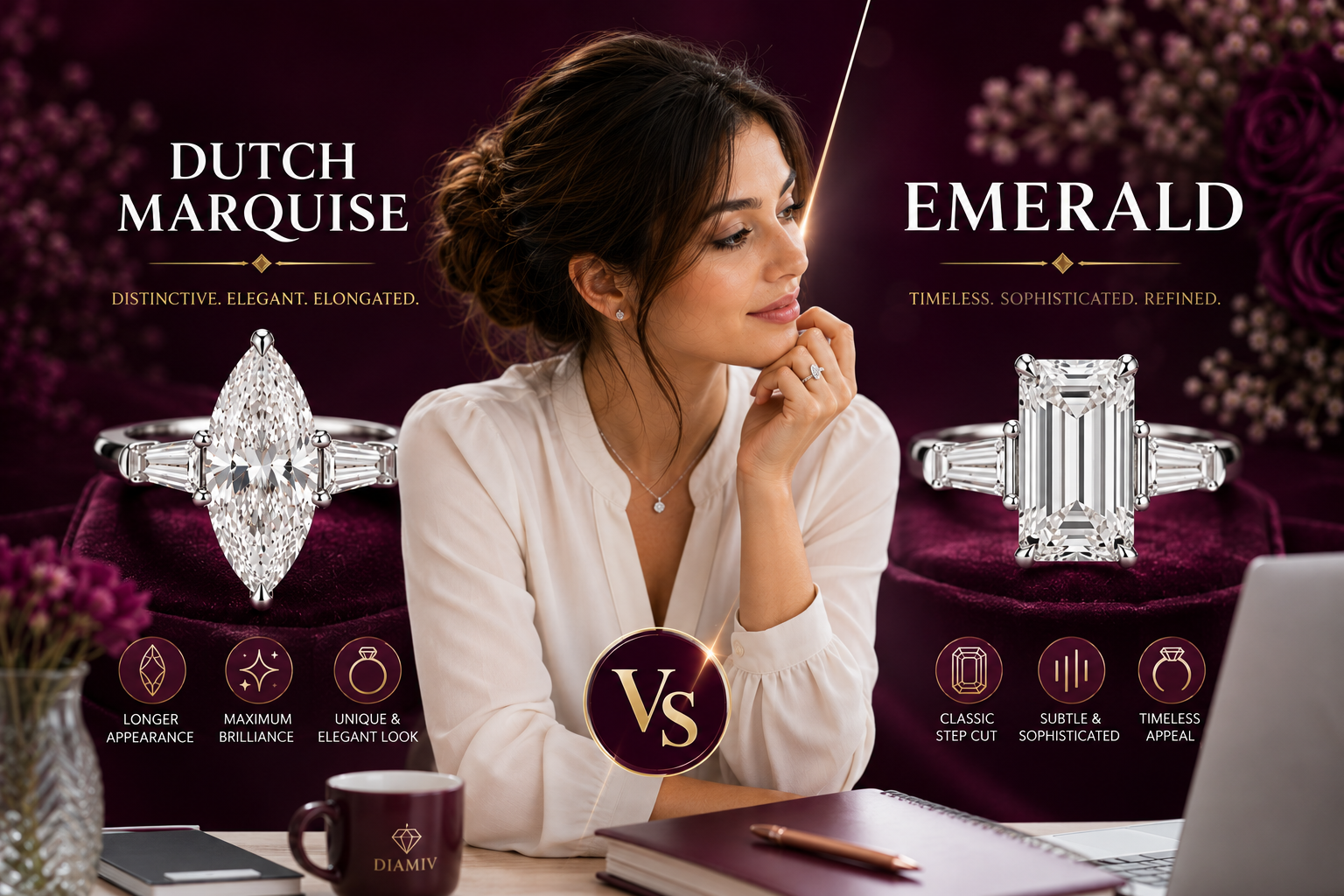
Choosing between two distinctive diamond shapes can be surprisingly difficult. A Dutch Marquise and an Emerald Cut can both create an elongated, elegant look, but they deliver very different experiences once you compare their sparkle, proportions, durability, and overall style.
So, Dutch Marquise vs Emerald Engagement Ring: which one wins?
The short answer is that there is no universal winner. A Dutch Marquise is the stronger choice if you want more sparkle, a distinctive silhouette, and strong visual coverage. An Emerald Cut is better if you prefer quiet sophistication, geometric lines, and broad step-cut flashes.
Here’s how the two compare.
Dutch Marquise vs Emerald Engagement Ring at a Glance
| Feature | Dutch Marquise | Emerald Cut |
|---|---|---|
| Overall shape | Elongated, pointed, geometric | Rectangular with cropped corners |
| Faceting | Varies by stone; often brilliant-style | Step cut |
| Sparkle | Higher | More subtle |
| Light pattern | Lively flashes and scintillation | Broad mirror-like flashes |
| Visual coverage | Excellent | Very good |
| Style | Unique and contemporary | Classic and sophisticated |
| Clarity sensitivity | Generally more forgiving | More demanding |
| Point/corner protection | Pointed ends need protection | Cropped corners offer more protection |
| Best for | Sparkle and individuality | Timeless elegance |
What Is a Dutch Marquise Diamond?
The Dutch Marquise is a distinctive marquise-inspired diamond shape with an elongated profile and pointed ends. The exact appearance can vary because “Dutch Marquise” is a trade term rather than a universally standardized grading shape.
Some current diamond sources describe it as an elongated, geometric form with straighter sides than a traditional marquise. Because terminology can vary between sellers, it’s smart to look at the actual diamond, its proportions, symmetry, and grading report rather than relying on the name alone.
If you’re unfamiliar with the shape, this Dutch Marquise diamond guide can help you understand its proportions and design in more detail.
One of its biggest attractions is its elongated outline. Like other elongated shapes, it can create strong finger coverage and make the finger appear longer.
What Is an Emerald Cut Diamond?
An Emerald Cut has a rectangular outline with cropped corners and long, parallel step-cut facets.
Instead of breaking light into numerous small flashes, its broad facets create larger reflections that are often described as a “hall of mirrors” effect. GIA notes that emerald cuts tend to reveal inclusions and body color more readily because of their large table and open facets.
This gives the Emerald Cut a very different personality from a brilliant-style diamond.
It isn’t trying to produce maximum sparkle. Its appeal comes from clean geometry, clarity, symmetry, and elegant flashes of light.
You can learn more about its characteristics in this Emerald Cut diamond guide.
Dutch Marquise vs Emerald: Sparkle
This is one of the clearest differences.
Dutch Marquise
A Dutch Marquise with brilliant-style faceting can produce lively brilliance, scintillation, and fire. As the stone moves, you are likely to see numerous smaller flashes of light.
If your ideal engagement ring is one that catches attention immediately, this gives the Dutch Marquise an advantage.
Emerald Cut
An Emerald Cut takes a quieter approach.
Its step facets create larger flashes and alternating areas of light and shadow rather than the rapid sparkle associated with brilliant cuts. GIA describes the Emerald Cut as a shape where the open facets can make clarity and color more visible.
Winner for sparkle: Dutch Marquise
If maximum sparkle is your priority, the Dutch Marquise generally wins.
If you prefer large, elegant flashes instead of intense scintillation, Emerald may be more appealing.
Dutch Marquise vs Emerald: Shape and Finger Coverage
Both shapes can elongate the appearance of the hand, but they do it differently.
The Dutch Marquise has pointed ends that pull the eye along the length of the stone. This creates a dramatic, elongated appearance and can provide excellent finger coverage.
The Emerald Cut has a more structured rectangular outline. Its straight edges give the ring a cleaner and more architectural appearance.
GIA notes that elongated diamond shapes can create the illusion of greater size compared with round diamonds of the same carat weight.
If you’re specifically shopping for elongated shapes, you may also want to compare Marquise vs Oval vs Pear.
Winner for dramatic finger coverage: Dutch Marquise
The Dutch Marquise has the stronger visual impact if you want a long, distinctive center stone.
Which Diamond Sparkles More?
In most cases, the Dutch Marquise will appear more sparkly than an Emerald Cut.
The reason is primarily the faceting style.
Brilliant-style faceting is designed to return more light through numerous facets. Step-cut faceting, by contrast, creates broader reflections.
GIA explains that brilliant cuts tend to conceal small inclusions better through their many facets, while step cuts such as Emerald and Asscher make color and clarity more apparent.
So the choice isn’t really about one cut being “better.”
It’s about the type of light performance you prefer.
Choose Dutch Marquise for:
- More visible sparkle
- Faster scintillation
- More lively light performance
- A bolder appearance
Choose Emerald for:
- Broad flashes
- Mirror-like reflections
- A calmer visual effect
- Sophisticated, understated beauty
Dutch Marquise vs Emerald: Clarity
This is an important buying consideration.
Emerald Cuts are relatively unforgiving when it comes to clarity. Their large table and long step facets can make inclusions easier to see.
GIA specifically notes that Emerald Cuts can show inclusions and color more readily than many other diamond shapes.
That doesn’t mean you automatically need the highest clarity grade.
Instead, prioritize an eye-clean diamond and inspect the actual stone carefully.
A Dutch Marquise with brilliant-style faceting can be more forgiving because its sparkle creates more visual movement.
For more help choosing clarity, see this guide to the best diamond clarity for an engagement ring.
Winner for forgiving clarity requirements: Dutch Marquise
Emerald Cut can still be an excellent choice, but you should be more selective about clarity and inspect the stone carefully before buying.
What About Diamond Color?
Color can also be more noticeable in an Emerald Cut.
Its large open table doesn’t scatter light in the same way a brilliant-style stone does, so warm tones can be easier to see.
GIA similarly notes that step cuts tend to show color more readily than brilliant cuts.
With either shape, the setting and metal color also influence how the diamond looks.
If you’re deciding between grades, this diamond color guide can help put the differences into perspective.
Dutch Marquise vs Emerald: Durability
Both shapes can be suitable for an engagement ring, but both require attention to their vulnerable areas.
Dutch Marquise
The pointed ends are the main concern.
GIA explains that pointed diamond shapes are more exposed to damage at their tips and recommends protective settings such as V-shaped prongs for vulnerable points.
For a Dutch Marquise, a secure setting that protects both tips is especially important.
Emerald Cut
Emerald Cuts have cropped corners, which removes the sharpest points found on a traditional marquise.
However, cropped corners aren’t invulnerable. GIA notes that diamond corners can still be vulnerable to chipping, particularly when the girdle is very thin.
Winner for easier everyday protection: Emerald Cut
The Emerald Cut has a slight advantage because its corners are cropped rather than ending in two sharp points.
That said, a well-set Dutch Marquise can absolutely work for everyday wear.
Dutch Marquise vs Emerald: Price
There isn’t a simple rule that one shape will always cost more.
Diamond price depends on factors such as:
- Carat weight
- Color
- Clarity
- Cut quality
- Proportions
- Symmetry
- Natural vs lab-grown origin
- Availability
- Overall craftsmanship
Emerald Cuts can sometimes offer a lower price per carat than round diamonds, but the savings can be reduced when you need to move up in clarity or color to achieve the appearance you want. Current market guides also show considerable variation in Emerald Cut pricing based on quality and specifications.
Dutch Marquise pricing can be harder to generalize because the shape is less standardized and availability varies between sellers.
Winner for price: Tie
Instead of choosing based on shape alone, compare diamonds with similar carat, color, clarity, proportions, and overall visual quality.
Dutch Marquise vs Emerald: Which Looks Bigger?
If visual spread is your priority, both can perform well.
The Dutch Marquise’s elongated silhouette can make it look particularly large across the finger.
Emerald Cuts also benefit from their elongated rectangular shape, but their proportions can create a different visual impression.
The most important point is that carat weight does not tell you exactly how large a diamond will look face-up.
Compare the actual millimeter dimensions and inspect the diamond from above before buying.
Winner for dramatic visual spread: Dutch Marquise
The Dutch Marquise generally has the edge if your main goal is maximum visual presence.
Which One Has the More Timeless Style?
This depends on what you consider timeless.
The Emerald Cut has a long history in jewelry and is strongly associated with clean, sophisticated, Art Deco-inspired design. Its geometric appearance works equally well in minimalist, vintage-inspired, solitaire, and three-stone settings.
The Dutch Marquise feels more distinctive.
It can combine the recognizable elegance of a marquise-inspired silhouette with a more unusual geometric profile.
Winner for classic elegance: Emerald
Winner for individuality: Dutch Marquise
Dutch Marquise Engagement Ring Pros and Cons
Pros
- Distinctive and less conventional appearance
- Strong finger coverage
- Elongated silhouette
- Can deliver lively sparkle
- Excellent choice for someone who wants a unique center stone
Cons
- Pointed ends require protection
- Symmetry is especially important
- Bow-tie effects can occur in elongated brilliant-style stones
- Terminology and cutting style can vary between sellers
GIA recommends paying close attention to symmetry and bow-tie effects when evaluating marquise-shaped diamonds.
Emerald Cut Engagement Ring Pros and Cons
Pros
- Timeless and sophisticated appearance
- Clean geometric silhouette
- Distinctive step-cut reflections
- Cropped corners offer more protection than pointed tips
- Works well with minimalist and vintage-inspired settings
Cons
- Inclusions can be easier to see
- Color can be more noticeable
- Less intense sparkle than brilliant-style cuts
- Individual proportions have a major effect on appearance
Which Is Better for an Engagement Ring?
There isn’t one answer for every buyer.
Choose a Dutch Marquise if you:
- Want more sparkle
- Prefer unusual diamond shapes
- Want strong finger coverage
- Like elongated silhouettes
- Want your engagement ring to feel distinctive
- Don’t mind using a protective setting
Choose an Emerald Cut if you:
- Prefer understated elegance
- Love geometric designs
- Want broad flashes rather than intense sparkle
- Prefer a classic engagement-ring style
- Are comfortable being more selective about clarity and color
- Want cropped corners rather than pointed tips
Dutch Marquise vs Emerald: Which Engagement Ring Wins?
Overall winner for sparkle and individuality: Dutch Marquise.
Overall winner for timeless sophistication: Emerald Cut.
If we had to choose one for a shopper who wants the most distinctive ring with strong visual presence, the Dutch Marquise gets the edge.
Its elongated shape, unusual silhouette, and lively light performance make it a compelling alternative to more familiar engagement-ring shapes.
But if your idea of the perfect engagement ring is elegant rather than flashy, the Emerald Cut may be the better winner for you.
Its clean geometry and broad reflections offer a completely different kind of beauty.
Ultimately, don’t choose based on the name of the shape alone. Compare the actual diamond’s proportions, symmetry, clarity, color, light performance, and setting. A beautiful diamond in the right setting will matter far more than simply choosing the shape that wins a comparison chart.
Frequently Asked Questions
Is Dutch Marquise better than Emerald Cut?
Neither is objectively better. Dutch Marquise is generally better for sparkle, individuality, and dramatic finger coverage, while Emerald Cut is better suited to shoppers who want understated elegance and step-cut reflections.
Does Dutch Marquise sparkle more than Emerald?
Generally, yes, particularly when comparing a Dutch Marquise with brilliant-style faceting to an Emerald Cut. Brilliant-style faceting produces more small flashes, while Emerald’s step facets produce broader reflections.
Which looks bigger, Dutch Marquise or Emerald?
A Dutch Marquise can provide excellent visual spread because of its elongated silhouette. However, actual face-up size depends on the diamond’s millimeter dimensions and proportions, not just carat weight.
Is Emerald Cut more durable than Dutch Marquise?
The Emerald Cut has an advantage because its corners are cropped instead of pointed. A Dutch Marquise can still be suitable for everyday wear when its pointed ends are properly protected.
Does Emerald Cut show inclusions?
Yes. The Emerald Cut’s large table and open step facets can make inclusions easier to see than they would be in many brilliant-cut diamonds.
Is Dutch Marquise a standardized diamond shape?
Not in the same way that established grading terminology such as marquise or emerald is standardized. “Dutch Marquise” is commonly used as a trade name, and the exact geometry or faceting can vary. Check the grading report and the actual stone rather than relying only on the seller’s label.
Which one is better for a modern engagement ring?
The Dutch Marquise generally feels more unconventional and contemporary, while an Emerald Cut can work beautifully in both modern and vintage-inspired designs. The setting can significantly change the overall personality of either shape.