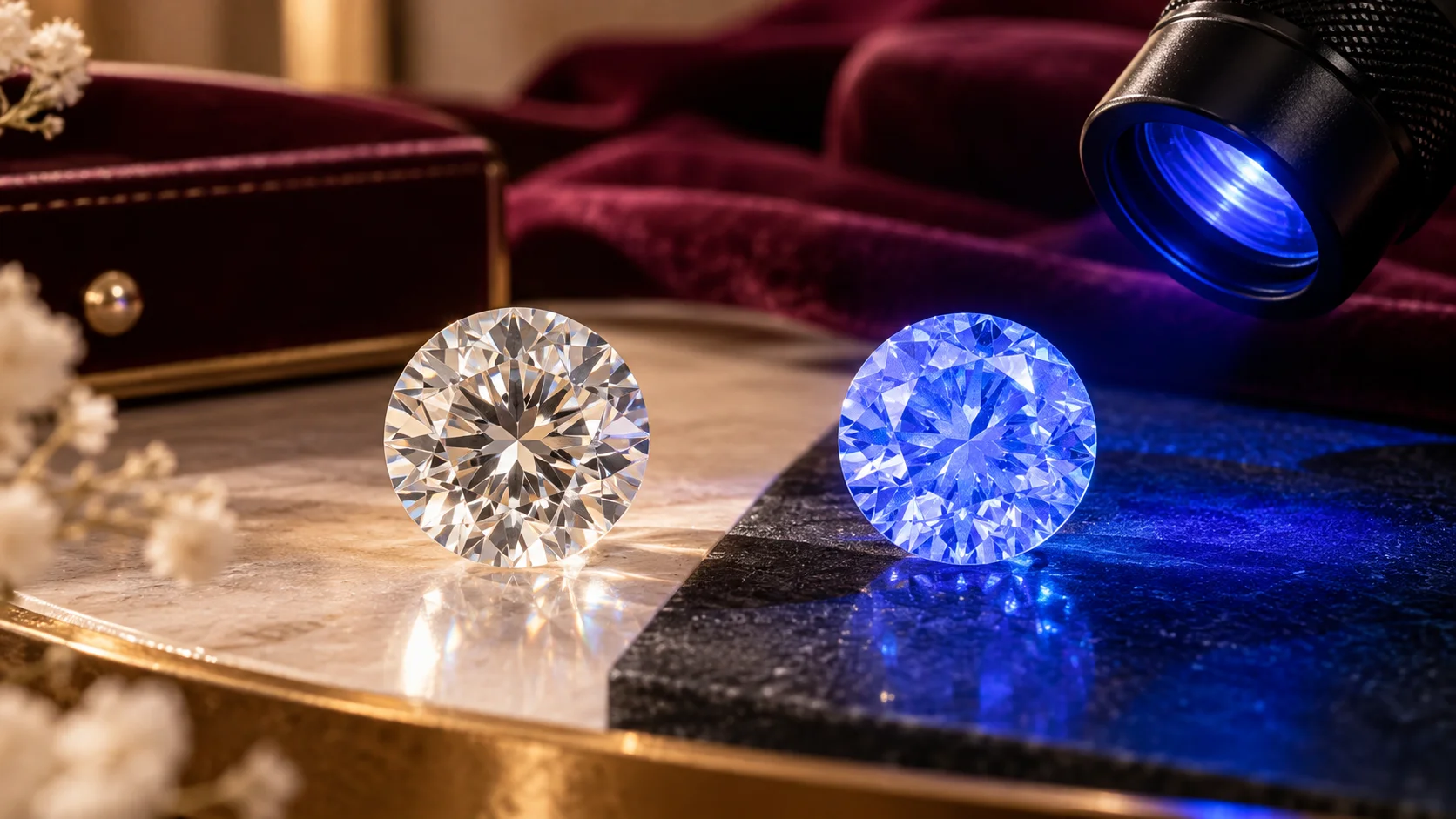
Diamond fluorescence is one of those terms that can look confusing when you’re comparing diamonds or reading a diamond grading report.
In simple terms, diamond fluorescence is the visible light a diamond emits when exposed to ultraviolet (UV) light. Blue is by far the most common fluorescence color, although diamonds can fluoresce in other colors.
For most diamonds, fluorescence has little or no noticeable effect on appearance in everyday lighting. In some cases, however, it can influence how a diamond looks or how much it costs.
So, is diamond fluorescence good or bad? Neither. It is a characteristic of a diamond, and whether it matters depends on the individual stone.
What Is Diamond Fluorescence?
Diamond fluorescence is the glow produced by some diamonds when they are exposed to long-wave ultraviolet light.
You may have seen a similar effect under a black light. Certain materials absorb UV radiation and then emit visible light. A fluorescent diamond behaves in a similar way.
The fluorescence is generally blue, although other colors can occur.
Importantly, fluorescence is not the same thing as a diamond permanently changing color. The visible glow occurs while the diamond is exposed to the appropriate UV light source and disappears when that source is removed.
GIA reports that approximately 25% to 35% of diamonds submitted to its laboratories exhibit some degree of fluorescence. More than 95% of fluorescent diamonds show blue fluorescence.
What Causes Diamond Fluorescence?
Fluorescence is related to the diamond’s internal atomic structure.
Small structural variations and trace elements within a diamond can affect how it responds to ultraviolet radiation. When exposed to UV light, the diamond can absorb energy and emit some of it as visible light.
This creates the characteristic fluorescence that gemologists observe under long-wave UV.
Fluorescence is therefore a natural characteristic, not a coating or treatment that has been added to make the diamond look different.
It also does not mean that a diamond is damaged or structurally weaker. GIA’s research specifically indicates that fluorescence does not compromise a diamond’s structural integrity.
Do All Diamonds Have Fluorescence?
No.
Some diamonds show fluorescence under UV light, while others show little or none.
GIA’s commonly used fluorescence descriptions are:
- None
- Faint
- Medium
- Strong
- Very Strong
These descriptions refer to the intensity of the diamond’s reaction to long-wave UV light, rather than its overall diamond quality.
A diamond with None fluorescence does not visibly react under the grading conditions, while a Very Strong fluorescent diamond produces a much more noticeable reaction.
That does not automatically make Very Strong fluorescence worse. The actual appearance of the individual diamond still matters.
What Color Is Diamond Fluorescence?
Blue is the most common fluorescence color.
More than 95% of fluorescent diamonds submitted to GIA show blue fluorescence. However, diamonds can also fluoresce in colors such as yellow, white, green, orange, or other less common hues.
The color matters because it can influence the visual appearance of a diamond in certain lighting conditions.
For example, blue fluorescence may visually offset some yellow tones in a diamond with a lower color grade when it is exposed to UV-containing light.
That does not change the diamond’s official color grade.
Diamond Fluorescence Levels Explained
The fluorescence strength shown on a grading report tells you how strongly the diamond reacts to long-wave UV light.
None
The diamond shows no noticeable fluorescence under the grading conditions.
Faint
The diamond shows a weak fluorescence reaction.
In normal everyday lighting, faint fluorescence is generally difficult to notice.
Medium
The diamond has a more noticeable reaction to UV light.
Medium fluorescence can sometimes influence how a diamond’s color is perceived in UV-containing lighting, particularly in diamonds with warmer color grades.
Strong
Strong fluorescence produces a clearly visible reaction under UV light.
It is not automatically a problem. Many strongly fluorescent diamonds still look excellent in normal lighting.
Very Strong
Very Strong fluorescence produces the strongest reaction in the standard fluorescence scale.
A small number of diamonds with very strong fluorescence can show a hazy or oily appearance, but this is uncommon. GIA reports that fewer than 0.2% of fluorescent diamonds submitted to its laboratories exhibit this effect.
The key point is that fluorescence strength alone does not tell you whether a diamond looks good.
Is Fluorescence Part of the 4Cs?
No.
The traditional 4Cs of diamond quality are:
- Cut
- Color
- Clarity
- Carat weight
Fluorescence is not a fifth C.
Instead, it is an identifying characteristic that can appear on a diamond grading report.
For example, a GIA report can describe fluorescence as None, Faint, Medium, Strong, or Very Strong. When the fluorescence is Medium, Strong, or Very Strong, the fluorescence color is also noted.
If you’re learning how diamond quality is evaluated, understanding the 4Cs of diamond quality can help put fluorescence into context.
Does Fluorescence Affect Diamond Appearance?
Sometimes, but usually less than shoppers expect.
GIA research found that, for the overwhelming majority of diamonds, fluorescence does not create a widely noticeable difference in appearance. In controlled studies, average observers did not consistently distinguish fluorescent diamonds from comparable diamonds without fluorescence.
There are several reasons why fluorescence should not be evaluated in isolation.
A diamond’s appearance also depends heavily on:
- Cut quality
- Proportions
- Color
- Clarity
- Lighting conditions
- Viewing angle
- Transparency
- Individual visual characteristics
This is why two diamonds with the same fluorescence grade can still look different.
Can Fluorescence Make a Diamond Look Cloudy?
Fluorescence itself does not cause a diamond to become cloudy.
This is an important distinction.
In rare diamonds with pre-existing light-scattering characteristics, strong fluorescence may intensify an already existing hazy or milky appearance. However, fluorescence does not create that underlying defect by itself.
GIA estimates that this type of hazy or oily appearance occurs in fewer than 0.2% of fluorescent diamonds submitted to its laboratories.
So you should not automatically reject every diamond with Strong or Very Strong fluorescence simply because you have heard that fluorescence causes cloudiness.
Instead, evaluate the actual stone.
If you’re specifically wondering about this issue, see our guide to whether diamond fluorescence makes a diamond look cloudy.
Does Fluorescence Affect Diamond Color?
Fluorescence can influence how a diamond’s color is perceived, but it does not change the official color grade assigned by a grading laboratory.
Blue fluorescence can sometimes make a diamond with a warmer color appear slightly more colorless in UV-containing lighting. This effect can be particularly relevant for diamonds toward the lower end of the D-to-Z color scale.
For example, a diamond with a noticeable yellow tint may appear somewhat whiter when blue fluorescence interacts with UV-containing light.
However, you should not think of fluorescence as a way to upgrade a diamond’s color grade.
A diamond graded J remains a J-color diamond whether it has None, Faint, Medium, or Strong fluorescence.
For a deeper look at this relationship, see how fluorescence affects diamond color.
Does Diamond Fluorescence Affect Price?
It can.
Fluorescence does not have one universal effect on diamond pricing because its market impact can depend on factors such as:
- Diamond color grade
- Fluorescence strength
- Fluorescence color
- Cut quality
- Clarity
- Overall appearance
- Buyer preferences
Historically, some diamonds with stronger fluorescence, particularly in higher color grades, have been priced differently from otherwise comparable diamonds without fluorescence.
At the same time, fluorescence can create opportunities for shoppers. A fluorescent diamond may sometimes offer an attractive price if its appearance is excellent and the fluorescence is not visually objectionable.
That makes fluorescence worth evaluating rather than automatically avoiding.
See how diamond fluorescence affects price for a more detailed discussion.
Is Diamond Fluorescence Good or Bad?
Neither.
Fluorescence is not inherently good or bad.
For most diamonds, it has little noticeable impact on appearance. Some buyers may prefer the look of a fluorescent diamond, while others may prefer a diamond without fluorescence.
The important question is:
Does the individual diamond look good to you at the price being offered?
This is more useful than following a blanket rule such as “never buy fluorescence” or “strong fluorescence is always a bargain.”
GIA’s research found no systematic negative effect on face-up appearance for the average observer, and in some situations observers preferred the appearance of fluorescent diamonds.
Should You Buy a Diamond With Fluorescence?
You can absolutely consider one.
If you’re comparing two otherwise similar diamonds, fluorescence can become another factor in your decision.
A practical approach is:
1. Start with the diamond’s overall quality
Do not sacrifice a well-cut, attractive diamond simply to avoid fluorescence.
Cut, proportions, transparency, color, and clarity all contribute to how a diamond looks.
2. Check the fluorescence strength
None and Faint fluorescence are unlikely to be a major visual concern.
Medium, Strong, and Very Strong fluorescence deserve a closer look, particularly if the diamond is being purchased sight unseen.
3. Consider the color grade
Blue fluorescence may be more visually interesting in warmer-color diamonds, while some buyers are more cautious about strong fluorescence in high-color diamonds.
This is not an absolute rule, however.
4. Look at the actual diamond
If possible, view the diamond under several lighting conditions.
Pay attention to:
- Bright daylight
- Indoor lighting
- Diffused lighting
- UV-containing light when available
A grading report tells you the fluorescence strength, but it cannot replace your assessment of the stone’s actual appearance.
5. Compare similar diamonds
If one diamond has Medium or Strong fluorescence and another has None, compare them side by side when possible.
The comparison can tell you much more than the fluorescence description alone.
For a more purchase-focused discussion, read Should You Buy a Diamond With Fluorescence?.
How to Check Fluorescence on a Diamond Report
When reviewing a diamond grading report, look for the section labeled Fluorescence.
You may see a description such as:
Fluorescence: Medium Blue
This tells you two things:
- Medium describes the intensity of the fluorescence.
- Blue describes the color of the fluorescence.
If the report says None, the diamond has no recorded fluorescence under the laboratory’s grading conditions.
Remember that fluorescence is separate from the diamond’s color grade.
A diamond can be graded D color and have fluorescence, just as a J-color diamond can have None fluorescence.
Diamond Fluorescence vs. Phosphorescence
Fluorescence and phosphorescence are related but not identical.
With fluorescence, the diamond emits visible light while it is being exposed to UV light.
Once the UV source is removed, the fluorescence stops.
Phosphorescence involves continued light emission after the excitation source has been removed.
For most diamond shoppers, fluorescence is the characteristic that matters when reading a standard diamond grading report.
Does Diamond Fluorescence Affect Diamond Durability?
No.
Fluorescence does not make a diamond weaker or more likely to break.
A fluorescent diamond has the same fundamental structural integrity as a diamond that does not fluoresce. GIA specifically notes that the presence or absence of fluorescence does not inherently weaken the stone.
If you’re evaluating a diamond for an engagement ring, fluorescence should therefore not be treated as a durability concern.
Common Diamond Fluorescence Myths
Myth 1: Fluorescence means the diamond is lower quality
Not necessarily.
Fluorescence is not one of the 4Cs and does not automatically indicate poor diamond quality.
Myth 2: Strong fluorescence always makes a diamond cloudy
No.
Fluorescence does not itself cause cloudiness. In rare cases, it can make an existing light-scattering issue more noticeable.
Myth 3: Fluorescence changes the diamond’s color grade
No.
The laboratory’s color grade is assigned under controlled conditions designed to produce consistent grading. Fluorescence does not change the official grade.
Myth 4: Only blue fluorescence exists
Blue is the most common, but diamonds can fluoresce in other colors.
Myth 5: You should always avoid fluorescent diamonds
There is no scientific basis for a universal rule like this.
Some fluorescent diamonds can be attractive and can represent good value.
Frequently Asked Questions
What does diamond fluorescence mean?
Diamond fluorescence is the visible light a diamond emits when exposed to long-wave ultraviolet light. Blue is the most common fluorescence color.
Is diamond fluorescence good or bad?
Neither. Fluorescence is a natural characteristic rather than an automatic quality indicator. Its effect depends on the individual diamond.
Is blue fluorescence good in a diamond?
Blue fluorescence is not inherently good or bad. In some warmer-color diamonds, it may make the diamond appear somewhat whiter under UV-containing light. In rare cases, very strong fluorescence can be associated with a hazy appearance.
What is the best fluorescence for a diamond?
There is no single best fluorescence level. None, Faint, Medium, Strong, and Very Strong can all be appropriate depending on the diamond and your preferences.
Does diamond fluorescence make it look blue?
Usually, you will not see a blue color in ordinary lighting simply because a diamond has blue fluorescence. The blue glow is most noticeable when the diamond is exposed to UV light.
For more detail, see Does Fluorescence Make a Diamond Look Blue?.
Is Very Strong fluorescence bad?
Not automatically.
Very Strong fluorescence deserves closer inspection because a small number of diamonds can show a hazy or oily appearance, but GIA research indicates that this effect is extremely uncommon.
Does fluorescence affect diamond clarity?
Fluorescence is separate from the clarity grade. A diamond’s clarity grade describes the presence and visibility of internal and external characteristics, while fluorescence describes its reaction to UV light.
For more information, see fluorescence and diamond clarity.
Can you see diamond fluorescence in sunlight?
Sunlight contains UV radiation, so fluorescent diamonds can react to it. The visible effect varies depending on the diamond’s fluorescence strength and the lighting conditions.
See diamond fluorescence in sunlight for more detail.
Final Takeaway
Diamond fluorescence is the visible glow some diamonds produce when exposed to ultraviolet light.
It is common enough that many diamond shoppers will encounter it on a grading report, but it is often misunderstood.
The most important things to remember are:
- Fluorescence is not one of the 4Cs.
- About 25%–35% of diamonds submitted to GIA show some fluorescence.
- Blue is by far the most common fluorescence color.
- Fluorescence is described by intensity, from None to Very Strong.
- It does not weaken a diamond.
- It does not automatically make a diamond cloudy.
- It does not change the diamond’s official color grade.
- Its effect on appearance is usually small, although rare exceptions exist.
- Fluorescence can influence price and may sometimes create a value opportunity.
- The best way to judge a fluorescent diamond is to consider the individual stone’s appearance, not the fluorescence label by itself.
If you’re shopping for a diamond, treat fluorescence as one characteristic to understand—not a reason to automatically reject or choose a stone.
